Two recent books warn Americans that our society stagnated after the moon landing: The Decadent Society and The Complacent Class. Both imply that the 2000’s are running on fumes and have no equivalent of the Saturn V rocket. We have barely altered our physical world in decades, improvements in cell phones notwithstanding.
This has launched an interesting debate (you could even call it a game) where people look for counterexamples. Here’s the most recent one I’ve seen
This week I saw a reinforcing example of stagnation.
In the 1990’s I used to read the American Girl doll catalogue from cover to cover every year. Everything is terribly expensive but also delightful to look at. I had the Molly doll and I read a few AG books about how she was inconvenienced on the homefront during World War II. She complained about having to eat turnips from a Victory garden, but she was encouraged to be patriotic and support a cause greater than herself. Her father is away with the U.S. Army Medical Corps.
I was a little dismayed when I saw that you can now buy a mini Molly doll for your 80’s doll. My life is now “historical”, so I am officially old. Great.
It’s not lost on me that American Girl is playing on nostalgia to sell more product. Millennials like myself might buy this mini Molly doll so we can re-live memories of childhood vicariously. However, I’m going to use this to illustrate “the great stagnation”.
You can be inwardly focused or outwardly focused. The WWII war effort was a time when America was dynamic and focused on achieving great things.
“Courtney” the 80’s doll is pictured next to a Pac-Man arcade machine. Her goal is to keep herself sufficiently entertained. She can listen to her Walkman if Pac-Man gets boring.
Today, 40 years later, people are still starting at screens just like Courtney the 80’s doll. The reason we are buying a mini 1940’s doll to gift to a 1980’s doll is because so little has happened since 1980.
You can make jokes about an infinite recursion of American Girl dolls. It’s funny because it won’t happen. You can be inwardly focused or outwardly focused. Molly’s America is outwardly focused, and that makes her exciting.
I don’t think anyone is going to give a 2050 doll a mini Courtney 80’s doll. I’m even more certain that no 2050 doll is going to get a mini 2010 doll complete with tiny 2010 iPhone.
Maybe by 2040, there will be something new to ignite the imagination.
Throughout this semester, I have asked some students in my data analytics class to think about how data is relevant to current events. Undergraduate Jack Brittle wrote this article about data and election news.
Sometimes public attention moves on quickly after an election is over. Today, on November 15th, voting and messaging is still being debated. It was a month ago on October 14th that Twitter locked up the digital platform of the New York Post, a right-leaning newspaper.
This was an important development in the debate about whether tech companies have the authority to censor posts written by users.
Twitter initially said that linking to the Post stories violated the social-media company’s policies against posting material that contains personal information and is obtained via hacking. As the story broke, Twitter began preventing users from tweeting the stories. Twitter locked the Post’s account, saying it would be unlocked only after it deleted earlier tweets that linked to the stories.” (Wall Street Journal). Twitter suspended a major American newspaper. This move is viewed by some as a direct threat to the freedom of the press. Twitter and other major tech companies came under fire for their ability to manipulate and control media. After major pressure and backlash, Twitter released the account back to the New York Post. “Twitter on Friday unlocked the New York Post’s Twitter account, ending a stalemate between the social-media company and the newspaper stemming from the latter’s publication of stories it said were based on documents obtained from the laptop of Hunter Biden. “We’re baaaaaaack,” the Post’s Twitter account tweeted on a Friday afternoon, just minutes after Twitter said that it was reversing its policies in a way that would allow the Post to be reinstated.” (Wall Street Journal).
It seems that Twitter backed down in that instance. The fundamental question has not been resolved. Should Big Tech censor material on their platforms?
First, there is a school of thought that believes Twitter has the right to control the flow of information on its platforms. Companies like Twitter are not breaking any laws by doing this. Do they not have the right to support and defend certain social causes? By only allowing users to see certain opinions and facts, Twitter can choose to support different policies. It’s not laws but our expectation of media that leads to controversy. Twitter should allow a free flow of information in order to create an open marketplace of ideas.
However, a new difficulty arises because of “fake news”. Now more than ever, media can be manipulated to create certain storylines by nefarious users. According to studies, “fake news” spreads nearly six times faster across digital platforms that real news stories. This leaves Twitter between a rock and a hard place. Do they control information spreading on their site and risk censoring the wrong material, like some consider to be the case of the New York Post article? Or do they take a hands-off approach, allowing all stories to have a place in the arena?
These giant tech firms have unprecedented power. Not only are they gaining massive amounts of data about people and firms, they also have the unique ability to shape their users’ outlook on a variety of ideas and events. These data giants are struggling with how to manage these capabilities and will no doubt continue to update and reform policy.
A example of evolving policies is the treatment of President Trump since November 3rd. Since election day, Donald Trump, has tweeted challenges to official vote counts. Trump has not only claimed voter fraud but also claimed he has won states where vote counts favor Joe Biden. Twitter has since developed a flagging system that adds a note on any tweet that Twitter deems misleading. Instead of censoring the president by locking the entire account, there are flags warning about disinformation. This system seems to be an improvement over previous ways Twitter has handled misleading information. It allows users to see all information but also be warned about potentially questionable information. I expect these policies to continue to evolve as tech companies grapple with the difficult task of managing the flow of information.
A few months back, I received a call for essays from the AEI Initiative on Faith in Public Life. The question was: In the contemporary United States, what would a truly humane economy look like? and it has been rattling around my head for a couple months. Occasionally I’ll write down some thoughts. In this post, I want to share with readers an excerpt from those thoughts.
“… I will situate a humane economy in the literature on fairness and justice and turn to a well-known philosophical device called the “veil of ignorance”. From behind this veil, there is no knowledge of race, sex, abilities, etc. From behind this veil — unencumbered by bias — a person would choose a humane society. John Rawls believed individuals, not knowing where they would be located in the income distribution, would seek to maximize the lowest income. This is what he called the “difference principle”.
In 1987, three political scientists conducted an experimental test of the veil of ignorance (Frolich et al., 1987). Students were presented with distributions of income that reflected different philosophical convictions like utilitarianism, egalitarianism, the difference principle, and utilitarianism with a floor constraint. Then students were asked to vote on their preferred distribution without knowing their ultimate position in the distribution. Students then deliberated with each other for a minimum of five minutes and unanimous vote was required for the adoption of a distribution otherwise one would be chosen randomly.
Rawls was right that individuals come to unanimous agreement behind the veil, however, the difference principle failed. The authors write, “Under all experimental conditions, all groups reached consensus and no group ever selected maximizing the floor as their preferred principle.” From behind a veil of ignorance, what did most people want? Overwhelmingly groups chose utilitarianism subject to a floor constraint. For a majority of people, prosperity is not dirty and undesirable. The economic pie can be large and some people can do very well. However, there is some willingness to limit the ceiling to raise the floor.
The direction of Rawls’ instincts were correct. People do think about the folks on the bottom rung and this experiment, and others like it, reveal something about human nature. We want the opportunity for great prosperity and we want to care for those less fortunate …”
After this discussion of the veil of ignorance, the essay proceeds with a reminder that if we are attempting to secure some material threshold, the poor in the United States are materially doing well by historical and global standards. But, for the remainder of the essay I focus on a different kind of poverty: unmet needs. Specifically the needs for purpose, security, and opportunity. Then I make the argument that to best meet these needs we need a more robust civil society and federalism.
My dear friend Mark Lutter has had me all riled up about charter cities for a few years now. I link to a new podcast from USFQ’s Aula Magna magazine on the subject that gives a very short introduction to the topic. After recording the podcast I returned to preping a class on genetic algorithms and got all riled up because I saw a connection between the two I hadn’t seen (clearly) before. Charter cities can be real life genetic algorithms for institutional innnovation.
Genetic algorithms are a form of machine learning that searches for solutions to problems by trying out a variety of solutions. As the name implies they are based on the evolutionary algorithm of diversity-selection-amplification to adapt solutions. In a genetic algorithm a population of of possible solutions to an optimization problem is instantiated and solutions with high fitness and reproduce (using cross over, mutation, and other genetic operators) to create new populations of solutions. over enough iterations genetic algorithms are goods ways to search for solutions whe the solution space is complex and poorly defined, which is probably what institutional space looks like.
Now imagine a country that is designed as a genetic algorithm and charter cities within the country as posible institutional solutions. The constitution of the central government is the overall framework of the genetic algorithm and the diversity of institutional arrangments at local government levels (i.e. different charters) are posible solutions.
Viewing charter cities in this light, the interesting question now turns to the rules of the central government and not necesarily to the rules implemented by the charters themselves.
A few of the questions that have begun to bother me follow. What country level rules lead to convergence, or at least continual adaptation to better institutional arrangments at the local level? What should the constriants be imposed on the charters for better, faster convergence and learning? Zoning and housing restrictions would be a clear impediment to convergence as they limit foot voting. If we view charter cities (and fiscal federalism) as an experiment to search for solutions to institutional arrangements for governance, can we use the criteria used by IRB boards as the minimum set of requirements that informa the central government constitution/framework where this experiment takes place?
Continuing on the theme of last week’s minimum wage increase in Florida, there are two interesting papers recently accepted for publication that both cover the 1966 Fair Labor Standards Act. This law extended the federal minimum wage to a number of previously uncovered. Crucially, the newly covered industries employed a large number of African-American workers.
The two papers agree on some points, such as that African Americans saw large wage gains following the increase. But was there a disemployment effect? Here is where the papers differ.
Ellora Derenoncourt and Claire Montialoux’s paper “Minimum Wages and Racial Inequality” is forthcoming in the Quarterly Journal of Economics. Here is what they find: “We can rule out significant disemployment effects for black workers. Using a bunching design, we find no aggregate effect of the reform on employment.”
So who is right? Let me clearly state here that both of these papers are very well done, both in their methods and in their assembling of historical data. But I think there is a key difference in the samples they analyze: Derenoncourt and Montialoux’s paper only includes workers aged 25-55. Bailey and co-authors use a broader age range, 16-64, which importantly includes teenagers (this is discussed in Section D of their online appendix).
Since teenagers and other young workers are the ones we suspect are going to be most impacted by the minimum wage (much of the literature focuses on teenagers), the exclusion of workers under 25 seems like a curious omission, and a reason I tempted to believe the results of Bailey and co-authors. But Derenoncourt and Montialoux do try to justify their choice of age group: 1. workers under 21 were subject to a different minimum wage; and 2. workers under 25 were subject to the draft for the Vietnam War.
So once again, you might ask, who is right? I will admit here that I don’t know. Standard economic theory suggests that disemployment effects will result from a legal minimum wage (I fully acknowledge the emerging literature on monopsony power, but I maintain this is still not the standard analysis), and especially so for teenagers and young workers. So I am skeptical of any analysis which excludes these workers, whatever other merits it may have.
Here’s my take: we probably can’t tell much about how the minimum wage will impact young workers today based on these studies. If Derenoncourt and Montialoux’s reasons for removing young workers are indeed sound, then we aren’t really testing the question most economists are interested in today (so I would caution against their attempt to apply the results to labor markets today). But that doesn’t mean these aren’t interesting papers to read on an important change in the history of minimum wage laws in the US!
Corporations raise money in various ways to invest in their operation. A company may sell common stock to the public; the shareholders are not guaranteed any particular return on their investment, but if the company does well, the share price and the dividends paid by the stock can be expected to go up.
Preferred stock falls in between common stock and bonds. Investors mainly buy preferred stock for its dividends. Typically, the price of the preferred stock doesn’t go up like common stock can, but the company cannot pay any dividends on the common unless all of the promised dividends on the preferred are paid up.
CORPORATE BONDS: INVESTMENT GRADE AND JUNK
Companies can sell bonds to raise money. Bonds are somewhat standardized securities, which are marketed to the broad investing community. The company is legally bound to pay the interest, and eventually the principal, of a bond. Bonds are senior to stocks in case of extracting value from a company that has gone bankrupt. Some bonds are more senior than others, depending on the “covenants” in the fine print of the bond description (debenture). For smaller, less stable companies, the only way they may get someone to buy their bonds is to agree to certain conditions that make it more likely the bond will be repaid. For instance, the company selling the bond might be restricted from issuing more than a certain amount of total debt relative to its earnings, or from taking on additional debt which might be senior to its existing debt.
Bonds are rated by agencies such as Moody’s and Standard and Poor’s. Large, stable companies get high ratings (e.g. AA), and can pay lower interest. You, the public, can buy into investment grade bonds through funds such as iShares iBoxx $ Investment Grade Corporate Bond ETF (LQD). This fund currently pays about 2.6%, but most of the returns in the past several years have been from an increase in the price of the fund shares. (For longer term bonds, the market price of a previously-issued bond increases as market interest falls, which it has in recent years).
The lowest investment grade is BBB. The bonds of shakier companies are rated at BB or lower, and have pay higher interest. This is called high yield debt or junk bonds. You can invest in junk bonds through funds such as JNK and HYG.
CORPORATE BANK LOANS
Companies also obtain loans from banks. Banks scrutinize the operations of the company to decide whether they want to risk their money in making a loan. Banks usually demand restrictions and guarantees to help ensure the loan will paid back. These restrictions are called covenants. Sometimes the payback of the loan is tied to a specified asset. For instance, if the income of a company falls below a certain level (which might imperil paying off the loan), the covenant may require the company to give ownership of some asset, like a building or a set of oil wells, to the bank, so the bank can sell it to pay back the loan immediately, before economic conditions worsen.
This graphic shows some of the conditions a company might have to sign to in order to get a loan from a bank:
Here is a summary of the differences between bonds and loans, courtesy of WallStreetMojo (slightly edited):
The main difference is that a bond is highly tradeable. If you purchase a bond, there is usually a market place where you can trade it. It means you can even sell the bond, rather than waiting for the end of the thirty years. In practice, people purchase bonds when they wish to increase their portfolio in that way. Loans tend to be the agreements between borrowers and the banks. Loans are generally non-tradeable, and the bank will be obliged to see out the entire term of the loan.
In the case of repayments, bonds tend to be only repaid in full at the maturity of the bond – e.g., 10, 20, or 30 years. With bank loans, both principal and interest are paid down during the repayment period at regular intervals (like a home mortgage).
Issuing bonds give the corporations significantly greater freedom to operate as they deem fit because it frees them from the restrictions that are often attached to the loans that are lent by the banks. Consider, for example, that lenders or the creditors often require corporates to agree to a variety of limitations, such as not to issue more debt or not to make corporate acquisitions until their loans are repaid entirely.
The rate of interest that the companies pay the bond investors is often less than the rate of interest that they would be required to pay to obtain the loan from the bank. Sometimes the interest on the loan is not a fixed percent, but “floats” with general short-term interest rates.
A bond that is traded in the market possesses a credit rating, which is issued by the credit rating agencies, which starts from investment grade to speculative grade, where investment-grade bonds are considered to be of low risk and usually have low yields. On the contrary, a loan don’t have any such concept; instead, the creditworthiness is checked by the creditor.
LEVERAGED LOANS
The rough equivalent of a junk bond in the world of corporate loans is called a “leveraged loan”. A leveraged loan is a type of loan that is extended to companies or individuals that already have considerable amounts of debt or poor credit history. Lenders consider leveraged loans to carry a higher risk of default, and so they demand higher interest on the loan. Leveraged loans and junk bonds play a key role in helping smaller or struggling companies achieve their financial goals. Leveraged loans are widely used to fund mergers and acquisitions.
Because the company itself is considered shaky, creditors typically require that the company offers some specific asset for collateral to “secure” the loan. Also, the loan is typically written to be “senior” to other debt, including bonds, in case of bankruptcy. Historically, the recovery rate for such senior secured loans has been about 80%, as compared to a recovery of about 40% for unsecured bonds, if the company goes bankrupt.
Typically, a bank would not want to take all the risk of such a loan upon itself. Therefore, for a leveraged loan, the bank arranges for a syndicate of multiple banks or other financial institutions to own pieces of the loan. You, too, can get a piece of this action by buying shares of the fund Invesco Senior Loan ETF (BKLN), which is currently yielding 3.2%.
S&P Global Market Intelligence offers a primer on leveraged loans, complete with tutorial videos. As shown below, the market for leveraged loans in the U.S. is now over $ 1 trillion:
John Steinbeck’s The Grapes of Wrathdetails the impoverished circumstances of the fictional Joad family during the Great Depression and the Dust Bowl. Initially, the Joads are tenant farmers in Oklahoma, but due to the consolidation and mechanization of agriculture during the 1920s, they are displaced from their farm and without many options. After receiving a leaflet that promises abundant jobs and housing, the family follows in the path of many of their neighbors that have already left for California in search of more opportunity. Yet the hardships continue for the Joads. The grandfather dies on the arduous trip and find that they have been misled about the availability of jobs and the conditions of the squalid camps.
According to Steinbeck, the introduction of the tractor and the power of the bank are responsible for their initial misfortunes. The tractor makes farming easier and more efficient, but leaves families without work including the Joads. In an encounter with a tractor driver, a tenant farmer without work asks, “what you doing this kind of work for—against your own people?” (pg. 25). The tractor driver is seen as treasonous because he improves his own standing while a hundred other people—his people— are left without a means to provide for their own families. But the tractor driver doesn’t revel in his improved circumstances, instead he is blunt about all of their predicaments, “crop land isn’t for little guys like us anymore” (pg.25). This assessment indicates that despite their divergent trajectories, neither the tractor driver nor the tenant farmers have any influence, but they are both pawns of a larger power. Steinbeck insinuates that both individuals—the tenant farmer and the tractor driver– is largely expendable. If the driver leaves another tractor driver would gladly accept the job; if that one left, still another one would come along. The greater enemy is the big-wigs in ‘the East’ who give orders to ‘the bank,’ who are ultimately responsible for displacing the farmers.
The increasing efficiency of agriculture and its effect on the fictional Joad family illustrates what many families have faced due to the increasing efficiency of manufacturing. For the Joads, there is a strong sense of alienation. Their family home is damaged by a tractor, the neighbors are leaving, and there is no work available. Similarly, as factories and plants that were economic drivers have shuttered in rust belt towns, other main street staples such as the barber shop, the diner, and the hardware store can’t afford to stay open. As a result, formerly vibrant communities are emptied. Individuals are faced with the reality that the relatively straight-forward path to the middle class afforded to their parents will not be the same for them as options diminish for blue-collar work. The next steps for people, specifically without a college education, may not seem clear or within reach.
The monsters outlined in the first section of The Grapes of Wrath— the bank and the tractor—could be subbed in for the current monsters in our current political and economic discourse—automation and trade. The novel picks up on some of our current anti-establishment rhetoric as individuals in ‘the East’ that run the bank profit handsomely while families such as the Joads have their lives uprooted. The bank and the people in the East create a new class of winners and losers as well. The winners in this case are the tractor drivers who can now afford to give their kids shoes for the first time; the losers are the tenant farmers who have no income for food. The income inequality between the tractor driver and the tenant farmers is a microcosm of increasing income inequality in the U.S. as a result of rapidly increasing productively for a small sector of the labor force. In Average is Over, Tyler Cowen illustrates how low-skilled laborers face a similar scenario to the tenant farmer of the 1920s: individuals who are a complement to innovative technology are richly rewarded, but unskilled labor that can be replaced by it will struggle to find work in the knowledge economy.
The Grapes of Wrath demonstrates how creative destruction brought about by innovation and technology is an enduring phenomenon. Yet the characterization of this trend in The Grapes of Wrath seems prescient given the sentiments of many Americans that computers, automation, and globalization are richly benefitting a small portion of Americans that can harness these technologies at the drastic expense of many Americans that have been automated or outsourced out of their jobs.
Hannah Florence is a student at Samford University, where she studies economics, political science, and data analytics. She is currently a Young Scholar for the American Enterprise Institute’s Initiative on Faith and Public Life. After graduation, she hopes to continue her public policy research as she begins a career in Washington, D.C.
Why can computers beat humans at chess but not predict election outcomes with great precision? Experts in 2020 mostly forecasted that Biden would win by a large enough margin to avoid the kind of quibbling and recounts we are now seeing. I don’t write this as a criticism of the high-profile clever Nate Silver, or any other forecaster. I’m thinking through it as a data scientist.
First, consider a successful application of modern data mining. How did AlphaZero “learn” to play chess? It generated millions of hypothetical games and decided to use the strategies that looked successful ex-post. AlphaZero has excellent data and lots of it.
If we think about actual election outcomes, there aren’t enough observations to expect accurate forecasts. If each presidential election is one observation, then there have only been about 50 since the founding hundreds of years ago. No data scientist would want to work with 50 data points.
You can’t say “in the years when ‘defund the police!’ was associated with Democrats, the GOP presidential candidate gained among married women”. There has only ever been one presidential election when that occurred. Judging by what I have been observing of the DNC post-mortem on Twitter in the past week, that might not happen again. See this tweet for example:
Rep. James Clyburn on @MeetThePress: “Defund the police” cost Democrats in House and Senate races.
I know very little about political analysis. Only from what I know about data science, I would imagine that computers will get better at predicting the outcomes of races for the House of Representatives.
House representatives serve 2-year terms. There are over 400 House elections every 2 years.
Think about this over one decade of American history. There are actually more than 400 representatives in the house, but let’s imagine a “Shelter” of Reps with 400 members for ease of calculation.
In one decade, there are usually two presidential elections. That means we get 2 observations to learn from. In the same decade, there would be 400×5 “Shelter” elections. That yields 2,000 observations, which is considered respectable for the application of data mining methods.
One application of such a forecasting machine would be to determine which slogans are the most likely to lead to success.
I’m going to teach text mining in the upcoming week. Most of my students have never heard of it. We have spent the semester talking about what do to with structured data, which includes some of the basic concepts from traditional statistics.
I often ask them to think about what computers can do. We talk about why “data analytics” classes are happening in 2020 and did not happen in 1990. Hardware and software innovations have expanded the boundaries of what computers can do for us.
The gritty details of how text mining works can make for a boring lecture, so I’m going to use the following narrative to get intellectually curious students on board. It always helps to start with fighting Nazis. Alan Turing helps defeat the Nazis by using a proto-computer to crack codes. The same brilliant Turing was smart enough to realize that computer could play chess someday (acknowledgement for me knowing that trivia: Average is Over). Turing didn’t live to see computers beat humans in chess but, in a sense, it didn’t take very long. Only about 50 years later, computers beat humans at chess.
Maybe chess is exactly the kind of thing that is hard for humans and easy for computers. When we discuss basic data mining, I tell students to think about how computers can do simple calculations much faster than humans can. It’s their comparative advantage.
Could Turing ever have imagined that a human seeking customer service from a bank could chat with a bot? Maybe text mining is a big advance over chess, but it only took about one decade longer for a computer (developed by IBM) to beat a human in Jeopardy. Winning Jeopardy requires the computer to get meaning from a sentence of words. Computers have already moved way beyond playing a game show to natural language processing.
How computers make sense of words starts with following simple rules, just as computer do to perform data mining on a spreadsheet of numbers. As I explain those rules to my students this week, I’m hoping that starting off the lecture with fighting Nazis will help them persevere through the algorithms.
What is justice? It’s a lofty question, up there in the pantheon of “What is the meaning of life?” and “Who let the dogs out?”. There is no great answer for that, but, essentially justice is about doing the right thing. What is right? That’s a good question.
There are three taste buds to justice: merit, need, and equality. When people make an argument for something being right they will draw on one or more of these taste buds. These criteria become especially important when groups decide to allocate goods through non-market institutions.
Here is a favorite example from Peyton Young’s book Equity: In Theory and Practice. At the end of World War II, the United States was demobilizing soldiers in Europe. Some had to be retained to fight Japan while others could come home. Which soldiers should come home first?
After debate, the U.S. Army decided to survey thousands of soldiers in the United States to identify relevant factors. There were four important factors: length of time in the Army, age, amount of overseas service, and number of dependents. Then troops completed a pairwise-comparison of each criteria like in the picture below.
You can see among the transitive rankings (90 percent of those surveyed satisfied transitivity) the two most important features to those surveyed in the United States was overseas service and number of dependents.
But, it turns out there was an important write-in candidate among the soldiers: exposure to combat. A large swath of soldiers mentioned that this should be an important criteria but the Army hadn’t considered it in their survey.
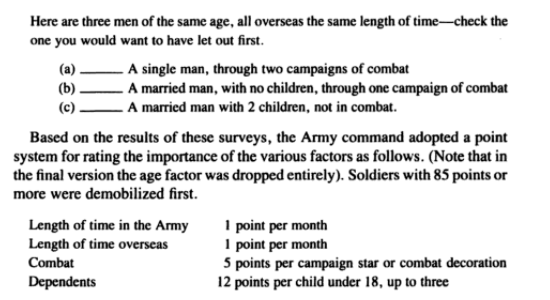
The Army devised another survey that attempted to develop how much different criteria should be weighted. You can see a sample question below and the resulting points system (from a series of questions like the sample question).
What matters most to the troops: exposure to combat and number of dependents. Put another way, what matters most is merit and need. The right thing to do regarding who comes home first involves consideration of whether you merit coming home (exposure to combat elevates you over others) and need (a child needs their parent).
So I do not have a precise definition of justice. But, I have noticed that when people talk about doing the right thing they often rely one one or more of merit, need, and equality.