Government Makes Quasi-Nationalization Deal to Assure Supply of Critical Rare Earths for Defense 

If top government officials were regular readers of this blog, they would have been warned by a headline here more than two years ago, “China To Squeeze West by Restricting Export of Essential Rare Earths “.  For the last few years, the U.S. has been trying to limit Chinese access to the most powerful computing chips, which are largely made by American company Nvidia. But China has some high cards to play in this game. It produces some 90% of refined rare earths and rare earth products like magnets.  These super-powerful neodymium-containing magnets are utterly critical components in all kinds of high-tech products, including wind turbine generators and electric motors for electric vehicles and drones, and miscellaneous military hardware.

It has been painfully obvious at least since 2010, when China put the squeeze on Japan by unofficially slowing rare earth exports to Japan over a territorial dispute, that it was only a matter of time before China played that card again. But the West slumbered on. There is a reasonable amount of rare earth ores that are mined outside China, but nobody wanted to build and operate the expensive and environmentally messy processes to refine the rare earth minerals (carbonates, oxides, phosphates) into the pure metals. Unlike the esoteric and hard-to-imitate processing for cutting edge computing chips, anyone can gear up and start refining rare earth ores. It mainly just takes money, lots and lots of it, to build and operate all the processing equipment for the multiple steps involved*. There was little free market incentive for a Western company to invest in expensive processing, since China could readily bankrupt them by cutting prices as soon as they started up their shiny new process line. Reportedly, the Chinese used this tactic twice before (in 2002 and 2012) to kill nascent refining of the rare earth ores at Mountain Pass mine in California.

As of April of this year, in response to ongoing U.S. export restrictions on chips, China threw its latest rare earth card down on the table, requiring export licenses and imposing other restrictions that throttled rare earth exports. Western manufacturers were soon howling in pain. As of early June:

Global automakers are sounding the alarm on an impending shortage of rare earth magnets as China’s restrictions on the material vital for the automotive, defence and clean energy industries threaten production delays around the world.

German automakers became the latest to warn that China’s export restrictions threaten to shut down production and rattle their local economies, following a similar complaint from an Indian EV maker last week. U.S., Japanese and South Korean automakers warned President Donald Trump on May 9 car factories could close.

The Trump administration quickly caved on chips and in July permitted boatloads of high-end H20 Nvidia chips to ship to China, in return for resumption of rare earth exports from China. Score one for the CCP. As of mid-August, rare earth shipments had climbed back to around half of their pre-May levels, but China ominously warned Western companies against trying to stockpile any reserves of rare earths, or they would “face shortages” in the future.

After this ignominious face-slapping, the administration finally did something that should have been done years ago: they gave an American company a solid financial incentive to buckle down and do the dirty work of refining rare earth ores at large scale. The Defense Department inked a deal with MP Materials Corp, the current operator of the Mountain Pass mine and the modest refining operation there to quickly ramp up production:

The Department of Defense is investing capital in MP across several fronts. This includes a $400 million convertible preferred equity, struck at a fixed conversion price of $30.03. The government gets 10-year MP stock warrants also set for a $30.03 price. As planned, this would get the Department of Defense to about a 15% ownership position in MP Materials. In addition, the Department of Defense will lend MP Materials $150 million at a highly competitive interest rate to help the company expand its heavy rare earth element separation capabilities.

It’s not just a financing deal, however. This arrangement also provides a striking level of influence over pricing and profitability for MP Materials going forward.

For one thing, the Department of Defense will provide a price floor of $110 per kilogram for NdPr. NdPr is a product that is a combination of neodymium and praseodymium. This is a generous floor price…

The Department of Defense’s involvement now gives MP Materials the runway necessary to build what’s being dubbed the 10X magnet manufacturing expansion plant. The Department of Defense is committed to buying the output of this plant with a controlled cost-plus pricing structure. And there will be a profit split with the DoD getting a significant chunk of the upside above certain EBITDA thresholds.

This is being billed as a private-public partnership, but it is akin to nationalization. The government will be heavily involved in planning output and setting pricing here, as well as sharing in profits.  Fans of laissez-faire free markets may be understandably queasy over this arrangement, but national security considerations seem to make this necessary.

I predict that further “private-public” deals will be struck to subsidize Western production of vital materials. Let’s be clear: massive subsidies or similar incentives, in one form or another, will be needed. And this means that Americans will have to devote more resources to grinding out industrial materials, and less to consumer goods; hence, we will likely live in smaller houses, perhaps (gasp) lacking granite countertops and recessed lighting. Economics is all about trade-offs.

Due to its vast, lower-paid, hard-working and highly-capable workforce, the whole Chinese supply chain and production costs run far, far cheaper than anything in the West. We don’t have to produce 100% of what we use, even say 40% might be enough to keep from being helplessly squeezed by another nation. How to do this without descending into unproductive rent-seeking rip-offs will be a challenge.

Some other materials candidates:  China has as of December 2024 completely shut off exports to the U.S. of three key non-rare earth technical elements, gallium, germanium and antimony, so those might be a good place to start. China mines or refines between half and 90% of global supply of those minerals. Also, China has instituted export regulations of for more key metals (tungsten, tellurium, bismuth, indium and molybdenum-related products), so these may be further subjects for squeeze plays. Finally, “China is the world’s top graphite producer and exporter, and also refines more than 90% of the world’s graphite into a material that is used in virtually all EV batteries,” so that is yet another vital material where the West must decide how much it is worth to break its dependence on an unreliable trading partner.
Moderation as responsibility

I’ve been thinking a lot about the loneliness of moderates/centrists/whatever you want to call them, in no small part because that’s the camp in which I place myself. While it’s (perhaps undeservably) flattering to think of yourself as “practical” and “reasonable”, it’s not a fun identity. There’s no good art to fall back on when you need to fill in the missing parts of your personality. You are constantly disappointing the more vocal members of the chattering classes while simultaneously sharing their frustration with the fire-dog-meme “This is fine” folks who don’t seem constitutionally capable of noticing when the room is in fact actively on fire. It’s a tough political identity to pin down because it is, at least ostensibly, an identity defined by it’s relation to two polar extremes. Anarchists, socialists, liberals, conservatives, they have an easier time because they can start from first principles and work upwards. As society progresses, so does the middle. To define yourself as wherever the middle stands is to be plastic, externally shaped, even inauthentic. Such a positional identity may be safe, but it’s not especially useful.

I would like to suggestion a more useful lodestone for moderates: responsibility

You have social responsibility. As a moderate I am uncomfortable with the libertarian fetishism of individualism without an obligation to others. With all due deference to “Naked and Afraid”, we are primates, and as such we are just shambling hunks of nutrition for other species if left on our own. Individuals, wholly independent of others, are completely useless. You are useless on your own. All human achievement is predicated on coordination with others. Through families, communities, and states. Through exchange, markets, and firms. You need other people, whether you like them or not. Admitting you need others is not weakness.

You have personal responsibility. As a moderate I am often uncomfortable with the type of socialism that promises relief from the obligations of toil. That your comfort and care can be assured regardless of the efforts and investments you make for yourself. There is no life without toil. There is no life without risk. The only institutions that can wholly shelter you from toil and risk demand the enslavement of others. Sure, you can be a party elite, but you’re only going to be fed and sheltered because of those toiling in the gulag. Admitting that others have an obligation to action and self-care is not cruelty.

Which is all to say that moderates should be up in arms, protesting and raging alongside progressives, liberals, democrats, and (yes) classic conservatives. Not because the current administration has strayed too far down an abstract one-dimensional range of political positions. But because their destruction, grifting, and hate are in direct opposition to everything we hold dear. They accept no responsibility for their actions while acknowledging no responsibility for the welfare of others. They are the antithesis of responsible adults.

I’m not much of a political philosopher, but maybe if I get stuck in an airport long enough I’ll hammer out my own “Theory of Responsibility”. I mean, that’s how Rawls got his magnum opus done, right?

Students still need to learn principles

Sometimes I get weeks in the summer that are more research focused. This past week is very much a teaching and service focused week at my university. I haven’t had any time to ponder topics related to research or current events. So, I will share what I’ve been telling my fellow college educators. This will sound backward to some and like common sense to others. Feel free to comment with your thoughts.

College professors who teach 200-level or “principles” classes should not change all that much in response to AI. Students still need to know something. There need to be a few concepts and vocabulary words in their heads. For example, a person cannot use a calculator effectively if they do not know what a square root is at all.

I see highly trained mid-career professionals bragging about how they get ChatGPT to do their work. Can a 20-year-old do that if they don’t know what words to use in a prompt? How does vibe coding go for people who never learned to write out a single line of code? (not a question I have an expert answer to right now)

We should largely be sticking to the “old ways” and at least to some extent still require memorization. Having an exam on paper is a good way to ensure that the students can form coherent thoughts of their own, when possible.

Indeed, students might become AI jockeys when they get to the workplace. A 400-level class would be a good place for them to start heavily integrating AI tools to accomplish tasks and do projects. For anyone unfamiliar with American college categories, that would mean that an undergraduate might heavily use AI tools in their 4th and final year of study.

AI makes a great tutor for learning and enforcing principles, but it should not serve as a replacement test-taker. A human who cannot read and write will not be able to take full advantage of an intelligent machine in the next decade. Voice recognition is getting very good and the models are getting more agentic, so this might all change if we can keep the data centers on long enough. In the future, you might argue that having students write an exam answer by hand is as superfluous as teaching them to play the violin.

As of 2025, what you might see is some teachers who feel pressured to claim they are integrating AI more than they actually want to. A relative I talked to his summer in a corporate job told me that she feels intense pressure at work to be able to claim that she’s using AI. Anyone doesn’t have the appearance of embracing AI looks behind or expendable!

We Don’t Have Mass Starvations Like We Used To

Two ideas coalesced to contribute to this post. First, for years in my Principles of Macroeconomics course I’ve taught that we no longer have mass starvation events due to A) Flexible prices & B) Access to international trade. Second, my thinking and taxonomy here has been refined by the work of Michael Munger on capitalism as a distinct concept from other pre-requisite social institutions.

Munger distinguishes between trade, markets, and capitalism. Trade could be barter or include other narrow sets of familiar trading partners, such as neighbors and bloodlines.  Markets additionally include impersonal trade. That is, a set of norms and even legal institutions emerge concerning commercial transactions that permit dependably buying and selling with strangers. Finally, capitalism includes both of these prerequisites in addition to the ability to raise funds by selling partial stakes in firms – or shares.

This last feature’s importance is due to the fact that debt or bond financing can’t fund very large and innovative endeavors because the upside to lenders is too small. That is, bonds are best for capital intensive projects that have a dependable rates of return that, hopefully, exceed the cost of borrowing. Selling shares of ownership in a company lets a diverse set of smaller stakeholders enjoy the upside of a speculative project. Importantly, speculative projects are innovative. They’re not always successful, but they are innovative in a way that bond and debt financing can’t satisfy. Selling equity shares open untapped capital markets.

With this refined taxonomy, I can better specify that it’s not access to international trade that is necessary to consistently prevent mass starvation. It’s access to international markets. For clarity, below is a 2×2 matrix that identifies which features characterize the presence of either flexible prices or access to international markets.

Continue reading

The Little Book of Active Investing

Wiley publishes a series of short books on investing called “Little Books, Big Profits“.

I previously reviewed Vanguard founder John Bogle’s entry in this series, the Little Book of Common Sense Investing:

I can sum it up at much less than book length: the best investment advice for almost everyone is to buy and hold a diversified, low-fee fund that tracks an index like the S&P 500.

You could call Bogle’s book the Little Book of Passive Investing; but most of the rest of the series could be the Little Books of Active Investing. That is certainly the case for Joel Greenblatt’s entry, The Little Book that Beats the Market (or its 2010 update, The Little Book that Still Beats the Market).

Greenblatt offers his own twist on value investing that emphasizes just two value metrics- earnings yield (basically P/E) and return on capital (return on assets). The idea is to blend them, finding the cheapest of the high-quality companies. The specific formula is to pick stocks with a return on assets of at least 25%, then select the ~30 stocks with the lowest P/E ratio among those (excluding utilities, financials, and foreign stocks), then hold them for a year before repeating the process. He shows that this idea performed very well from 1988 to 2010.

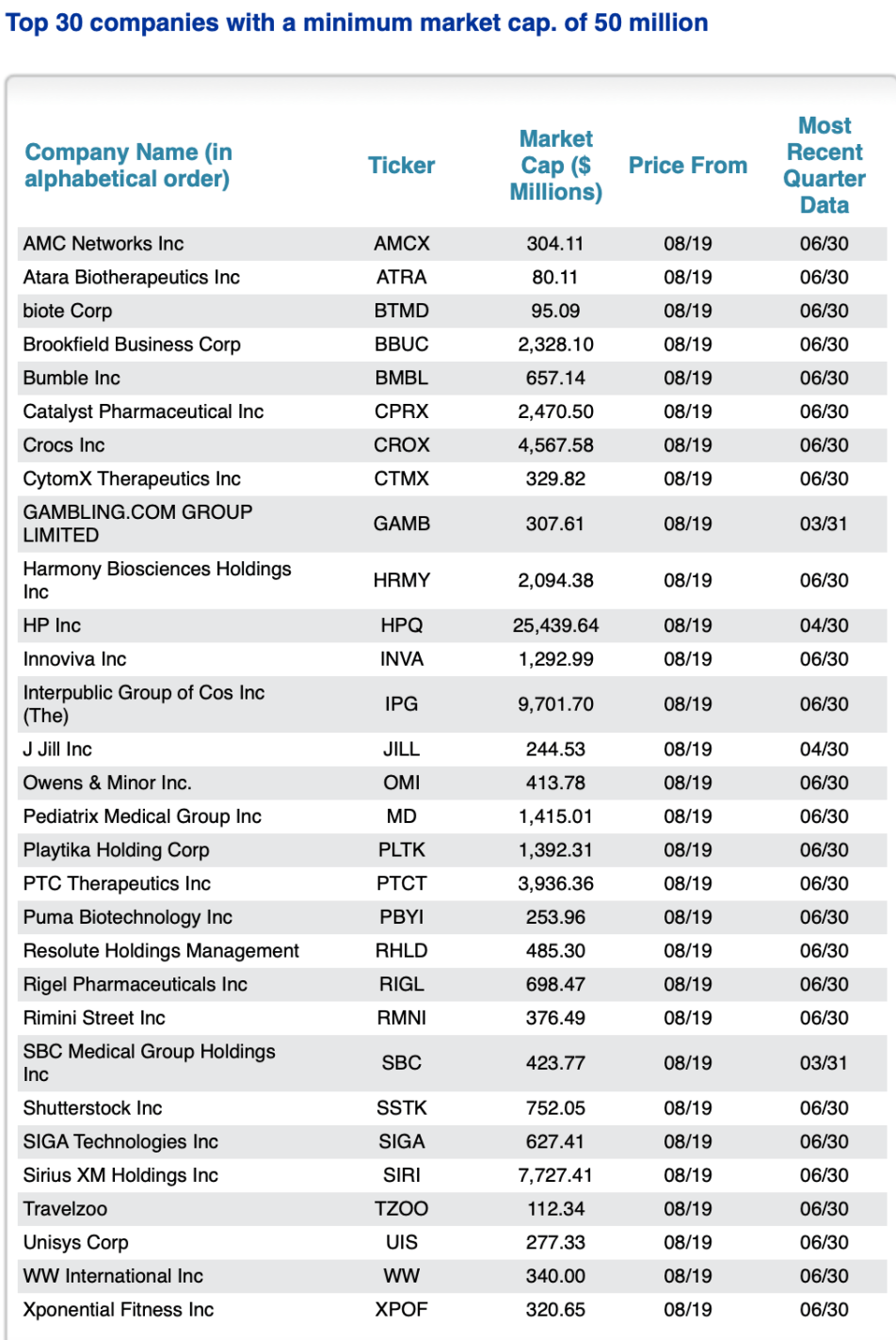
How has it done since? He still maintains the website, https://www.magicformulainvesting.com, that gives updated stock screens to implement his formula, which is nice. But the site doesn’t offer updated performance data, and his company (Gotham Capital) offers no ETF to implement the book’s strategy for you despite offering 3 other ETFs, which suggests that Greenblatt has lost confidence in the strategy. Here are the top current top stocks according to his site (using the default minimum market cap):

Perhaps this is worthwhile as an initial screen, but I wouldn’t simply buy these stocks even if you trust Greenblatt’s book. When I started looking them up, I found the very first two stocks I checked had negative GAAP earnings over the past year, meaning Greenblatt’s formula wouldn’t be picking them if it used correct data. The site does at least have a good disclaimer:

“Magic Formula” is a term used to describe the investment strategy explained in The Little Book That Beats the Market. There is nothing “magical” about the formula, and the use of the formula does not guarantee performance or investment success.

Greenblatt’s Little Book is a quick and easy way to learn a bit about value investing, but I think Bogle’s Little Book has the better advice.

What is $300,000 from “The Gilded Age” Worth Today?

SPOILER ALERT FOR THE THIRD SEASON OF THE GILDED AGE

In Season 3 of the drama series “The Gilded Age,” one of the servants (Jack, a footman) earns a sum of $300,000 by selling a patent for a clock he invented (the total sum was $600,000, split with his partner, the son of the even wealthier neighbor to the house Jack works in). In the series, both the servants and Jack’s wealthy employers are shocked by this amount. Really shocked. They almost can’t believe it.

How can we put that $300,000 from 1883 in New York City in context so we can understand it today?

A recent WSJ article attempts to do that. They did a good job, but I think more context could help. For example, they say “Jack could buy a small regional bank outside of New York or bankroll a new newspaper.” Probably so, but I don’t think that quite conveys the shock and awe from the other characters in the show (a regional bank? Ho-hum).

First, the WSJ states that the “figure nowadays would be between $9 and $10 million.” That’s just doing a simple inflation adjustment, probably using a calculator such as Measuring Worth (it’s a good tool, and they mention it later in the story). But as the WSJ goes on to note, that probably isn’t the best way to think about that figure.

Here’s my best attempt to contextualize the $300,000 figure: as a footman, Jack probably made $7 to $10 per week. Or let’s call it $1 per day. That means Jack’s fellow servants would have had to work 300,000 days to earn that same amount of income — in other words, assuming 6 days of work per week, they would have had to work for almost 1,000 years to earn that much income. Jack appears, to his co-workers, to have earned that income almost in one fell swoop (though in reality, he spent months of his free time toiling away at the clock).

Continue reading

A Modern-Day Pirate Seeks to Recover Up to Ten Billion Dollars of Gold from Republic Shipwreck Off Nantucket

Arrrr, me hearties! What think ye of a venture to raise a gigantic hoard of sunken treasure?

The story begins with the last voyage of RMS Republic. This was a luxurious passenger steamship of the White Star Line, which sailed between Europe and America.

Wikipedia

Republic was a large vessel (15,000 tons displacement) for her day, and was known as the “Millionaires’ Ship” for the number of wealthy Americans who sailed back and forth on her. A number of such magnates were aboard on her last voyage. In January, 1909 Republic left New York City with  passengers and crew, bound for Gibraltar and Mediterranean ports. In thick fog off the island of Nantucket, Republic was rammed amidships by the Italian liner Florida. Florida’s bow was crumpled back, but she stayed afloat. The damage to Republic was fatal. The engine rooms flooded, the ship began to list, and it was clear that the passengers needed to be evacuated.

Using the new-fangled Marconi “wireless” apparatus, a CQD distress signal was broadcast by radio operator Jack Binns. This was the first wireless transmission that resulted in a major life-saving marine rescue. (Binns had to scramble and improvise to get this done, since his apparatus had been damaged and the ship’s power was lost as a result of the collision, so he was a technology nerd turned hero, duly lauded by a ticker-tape parade). It was hard for other ships to locate Republic in the fog, but eventually nearly all the passengers and crew from Republic and from the damaged Florida were safely transferred to other ships.

As was the custom of the time, she did not carry enough lifeboats to hold all the passengers, but only enough to ferry them to some other ship; it was assumed that on the busy Atlantic route there would always be other large ships around.  (That scheme played out well with the Republic, but when sister White Star liner Titanic sank four years later, the dearth of lifeboats helped doom some 1,500 people to a watery grave.) Despite efforts to save her, Republic went down stern-first on January 24. She was the largest ship ever to sink at the time.  There were reports at the time that she was carrying some $3 million (1909 dollars) of gold, which went down with the ship. That would translate to hundreds of millions of dollars today for that gold.

But wait, there’s more, maybe much more. Enter a modern-day pirate, Martin Bayerle:

Vineyard Gazette

Bayerle looks like a pirate, sporting a genuine eyepatch covering an eye lost in an explosives accident. He killed a man who was fooling around with his wife, which seems like a piratical thing to do, and he is after a ship’s gold.   His salvage enterprise is even formally described in legal court papers as “modern day pirates”. 

His company, Martha’s Vineyard Scuba Headquarters, Inc. (“MVSHQ”), acquired salvage rights to the wreck of the Republic. In 2013 he published a book, The Tsar’s Treasure, detailing his thesis that Republic carried far more gold than was publicly acknowledged. He notes that there was no formal inquiry regarding the sinking of Republic, which was highly unusual and is suggestive of a cover-up. Cover-up of what?

Well, Europe at the time was a tinder box of potential conflict, which did in fact erupt five years later in World War I.  Czarist Russia was a key part of the European military equation. Britain was counting on Russia to help contain the emerging militaristic Germany. Russia had incurred huge debts in its disastrous war with Japan in 1905. Russia was about to issue a new round of bonds in 1909, to roll over its debt from 1905. It was critical that that bond issuance would go forward.


Bayerle believes that a large amount of gold was stashed in the hold of the Republic, destined for European banks, to support the Russian bonds of 1909. The revelation that that gold was lost would have jeopardized this crucial financial transaction, perhaps leading to Russia’s collapse, which is something Britain could not afford. Hence, the cover-up. Bayerle estimates that the value of this trove is up to $10 billion in today’s money. Shiver me timbers!

This geopolitical speculation, together with stories of failed previous salvage attempts on Republic, all make for a rollicking yarn. Is it for real? Nobody knows, but Bayerle is offering investors a chance at a slice of the booty. If you are inclined to “Dare to dream the impossible” (per the website), you have the opportunity to invest in his Lords of Treasure enterprise as they make a dive on the site this summer.


I don’t happen to have that much risk appetite, but it should be an interesting story to follow.

UPDATE

According to the June 2025 Lords of Fortune Newletter, salvage operations originally slated for 2025 are being put off till 2026, as funding is still being developed. We note the technical challenge of picking through hundreds of tons of steel plate and girders, deep underwater, in search of a smallish volume of gold. On the other hand, Capt. Bayerle’s recent researches suggest the gold trove may be even larger than earlier estimated, up to some $30 billion. So high risk meets high reward here. It seems ironic that VC’s will throw say $300 million into dubious tech unicorns or the latest crap-coin, but eschew a pretty sure bet of at least breaking even here (if only the lowest estimates of the Republic gold pan out) with a good shot at 10X-ing their investment. We will stay tuned.

Walking around DC

I’m here to discuss women in the criminal justice system as part of the ongoing BRIDGE series organized by Arnold Ventures. DC remains one of my very favorite cities, one I lived in and around for decades. I arrived with some trepidation, of course, now that the federal government is attempting to “occupy” it while deploying National guard troops (“some armed”) while ICE agents execute their own specific combination of random assault sprinkled in with some light kidnapping. I wasn’t quite sure whether I should expect military vehicles on every other street or just the odd rented van with masked men claiming to be ICE agents pouring out.

What I’ve seen so far is mostly…nothing. I don’t me DC seems normal, not in the slightest. I mean the streets feel emptier. There’s far too few tourists for mid-August. There were families on the steps of the museums, but normally they’d be swarmed. I’m sure to some degree I’m layering my own sensitivies on the scene, but I really do think it is far quieter than it normally is. Than it should be.

Tonight I’m going to head to U street to visit an old friend, have a drink, catch up. I’ve done this a million times, in this exact neighborhood, for going on 20 years. That this time, with a cheap tinny authoritarian claiming to clean up crime while DC is experiencing the lowest rate of violent crime of my lifetime, that this is the only time I’ve really had any sense of insecurity, that something bad could happen around me, is some of a grossest irony I’ve ever experienced first hand.

Anyway, it’s always nice to come home, no matter how hard some are trying to take feeling away.

Podcast to understand modern coupling challenges

As marriage rates decline nationally, Esther Perel’s “Where Should We Begin?” offers more than dating advice. These episodes are recordings of real couples or single people today who explain why they are struggling to find relationship success. It provides an anthropological study of why coupling is challenging in the 21st century.

Each couple’s struggle with intimacy and commitment reflects broader questions about what it means to build a life together in an age of individualism. “Where Should We Begin?” doesn’t offer easy solutions to the coupling crisis, but it does helps us understand the deeper currents shaping modern love. Especially now that she has branched out to non-romantic friendship topics this year, almost anyone can find an episode here that might help them navigate one of their own personal problems as if they had the world’s leading relationship therapist on hand.

One of Perel’s points is that modern couples are drowning under expectations that previous generations never faced. Partners are expected to be best friends, passionate lovers, co-parents, financial partners, emotional support systems, and personal growth catalysts all at once. Perel points out that they’re asking their relationship to fulfill needs that used to be met by entire communities.

One episode I listened to is “I Can’t Love You the Way You Want Me To” Description: Their relationship is on the edge. They’re grappling with communication issues and the emotional scars from their past. And they’re trapped. Trapped in an endless cycle of blame, defensiveness, and attack.

As someone who grew up on the periphery of Philadelphia, I was interested in their specific fight. The man said that Philly sports fans are trash. The woman defended the honor of Philly with specific examples, and now they hate each other. Honestly sounds like my high school.

The 2018 Tariffs in Many Graphs

Did president Trump’s first term tariffs, enacted in 2018, increase manufacturing employment or even just manufacturing output? Let’s set the stage.

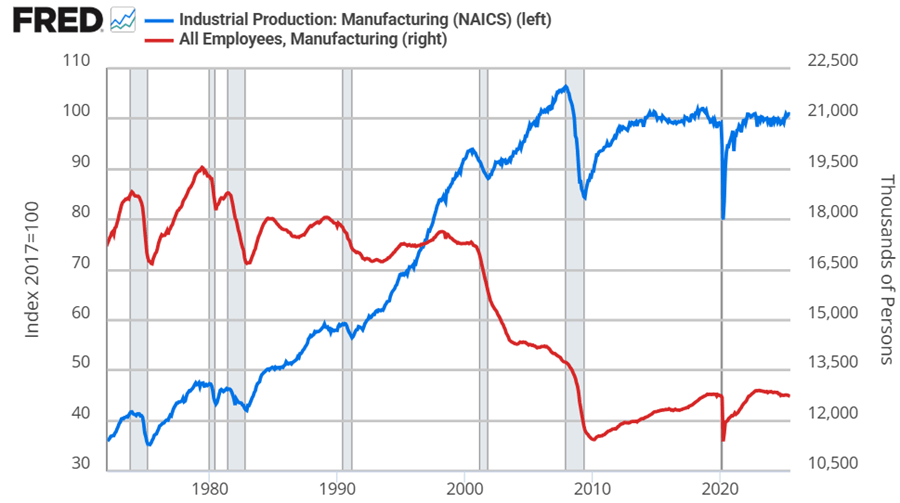
Manufacturing employment was at its peak in 1979 at 19.6 million. That number declined to 18m by the 1980s, 17.3m in the 1990s. By 2010, the statistics bottom out at 11.4m. Since then, there has been a rise and plateau to about 12.8m if we omit the pandemic.

Historically, economists weren’t too worried about the transition to services for a while. After all, despite falling employment in manufacturing, output continued to rise through 2007. But, after the financial crisis, output has been flat since 2014, again, if we omit the pandemic. Since manufacturing employment has since risen by 5% through 2025, that reflects falling productivity per worker. That’s not comforting to either economists or to people who want more things “Made in the USA”.

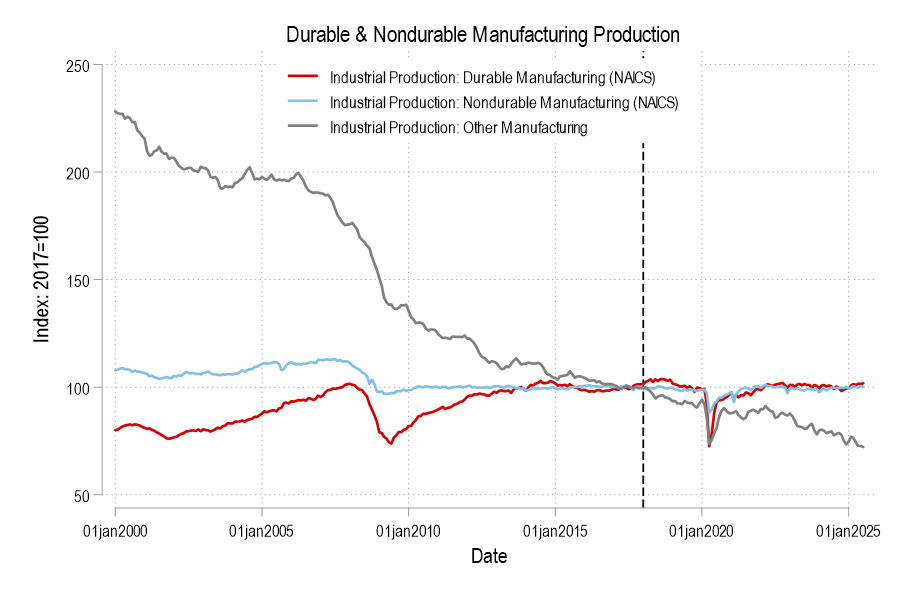
Looking at the graphs, there’s no long term bump from the 2018 tariffs in either employment or output. If you squint, then maybe you can argue that there was a year-long bump in both – but that’s really charitable. But let’s not commit the fallacy of composition. What about the categories of manufacturing? After all, the 2018 tariffs were targeted at solar panels, washing machines, and steel. Smaller or less exciting tariffs followed.

Breaking it down into the major manufacturing categories of durables, nondurables, and ‘other’ (which includes printed material and minimally processed wood products),  only durable manufacturing output briefly got a bump in 2018. But we can break it down further.

Continue reading