Rising Chinese Zombie Firms

Have you ever looked up and wondered where the time went? One moment you’re living your life, and the next moment you realize that you’ve just lost time that you’ll never get back? That’s what happened to Japan’s economy at the turn of the century in an episode that’s known as ‘the lost decades’. It was a period of slow or null economic growth. Economists differ with their explanations. One cause was the prevalence of ‘zombie firms’.

Japan’s Economy

Japan had a current account surplus from 1980-2020, which means that they had more savings than they effectively utilized domestically. Metaphorically, they were so full of savings that they exhausted productive domestic investment opportunities and their savings spilled out into other counties in the form of foreign investments. This was driven by high household savings and slow growth in domestic investment demand. The result was the Japanese firms had easy access to credit. Maybe a little too easy…

Private corporate debt ballooned throughout the 1980s. That’s not intrinsically a problem. In the 1990s, households began saving somewhat less, and most firms began to drastically deleverage… But not all firms. The net effect of the mass deleveraging was that interest rates fell.  The firms that remained in debt were the ones that risked insolvency. Less productive firms had slim profits and their Earnings Before Interest, Taxes, Depreciation, and amortization (EBITDA) was slim. So slim, that they couldn’t pay their debts. Faced with the prospect of insolvency, firms did what was sensible. They refinanced at the lower interest rates. Firms went to their banks and to bond markets and rolled over their debt, which they couldn’t afford, and replaced it with debt that had a lower interest rate. This occurred across industries, but especially in non-tradable goods and services that were insulated from international competition. Crisis averted.

Except this process of refinancing, while avoiding acute defaults and a potential financial crises, ensured that the less productive firms would survive. Not exactly failing and not exactly thriving, they could sort of just hold on to something that looks like life. Well, high debt and low profits aren’t much of a life for a firm. It’s more like being undead – like a zombie. Between 1991 and 1996, the share of non-finance firm assets held by zombie firms ballooned from 3% to 16%. The run-up differed by industry: Manufacturing zombie assets rose from 2% to 12%, from 5% to 33% in real estate, and from 11% to 39% in services.  These zombie firms linger on, tying up valuable resources with low-productivity activities and drag on the economy.

China’s Economy

I’m not prone to China hysteria generally. However, I do have uncertainty about the plans and actions of the Chinese government because I don’t know that domestic economic welfare is its priority. That makes forecasting more political and less economic and outside my expertise. Regardless, the Chinese economy is a constraint on the government, whether they like it or not.  And there are some echoes of the Japanese economy’s lost decades.

Continue reading

Government Makes Quasi-Nationalization Deal to Assure Supply of Critical Rare Earths for Defense 

If top government officials were regular readers of this blog, they would have been warned by a headline here more than two years ago, “China To Squeeze West by Restricting Export of Essential Rare Earths “.  For the last few years, the U.S. has been trying to limit Chinese access to the most powerful computing chips, which are largely made by American company Nvidia. But China has some high cards to play in this game. It produces some 90% of refined rare earths and rare earth products like magnets.  These super-powerful neodymium-containing magnets are utterly critical components in all kinds of high-tech products, including wind turbine generators and electric motors for electric vehicles and drones, and miscellaneous military hardware.

It has been painfully obvious at least since 2010, when China put the squeeze on Japan by unofficially slowing rare earth exports to Japan over a territorial dispute, that it was only a matter of time before China played that card again. But the West slumbered on. There is a reasonable amount of rare earth ores that are mined outside China, but nobody wanted to build and operate the expensive and environmentally messy processes to refine the rare earth minerals (carbonates, oxides, phosphates) into the pure metals. Unlike the esoteric and hard-to-imitate processing for cutting edge computing chips, anyone can gear up and start refining rare earth ores. It mainly just takes money, lots and lots of it, to build and operate all the processing equipment for the multiple steps involved*. There was little free market incentive for a Western company to invest in expensive processing, since China could readily bankrupt them by cutting prices as soon as they started up their shiny new process line. Reportedly, the Chinese used this tactic twice before (in 2002 and 2012) to kill nascent refining of the rare earth ores at Mountain Pass mine in California.

As of April of this year, in response to ongoing U.S. export restrictions on chips, China threw its latest rare earth card down on the table, requiring export licenses and imposing other restrictions that throttled rare earth exports. Western manufacturers were soon howling in pain. As of early June:

Global automakers are sounding the alarm on an impending shortage of rare earth magnets as China’s restrictions on the material vital for the automotive, defence and clean energy industries threaten production delays around the world.

German automakers became the latest to warn that China’s export restrictions threaten to shut down production and rattle their local economies, following a similar complaint from an Indian EV maker last week. U.S., Japanese and South Korean automakers warned President Donald Trump on May 9 car factories could close.

The Trump administration quickly caved on chips and in July permitted boatloads of high-end H20 Nvidia chips to ship to China, in return for resumption of rare earth exports from China. Score one for the CCP. As of mid-August, rare earth shipments had climbed back to around half of their pre-May levels, but China ominously warned Western companies against trying to stockpile any reserves of rare earths, or they would “face shortages” in the future.

After this ignominious face-slapping, the administration finally did something that should have been done years ago: they gave an American company a solid financial incentive to buckle down and do the dirty work of refining rare earth ores at large scale. The Defense Department inked a deal with MP Materials Corp, the current operator of the Mountain Pass mine and the modest refining operation there to quickly ramp up production:

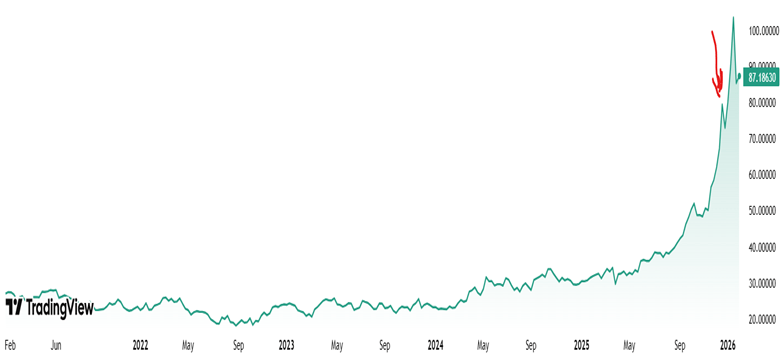
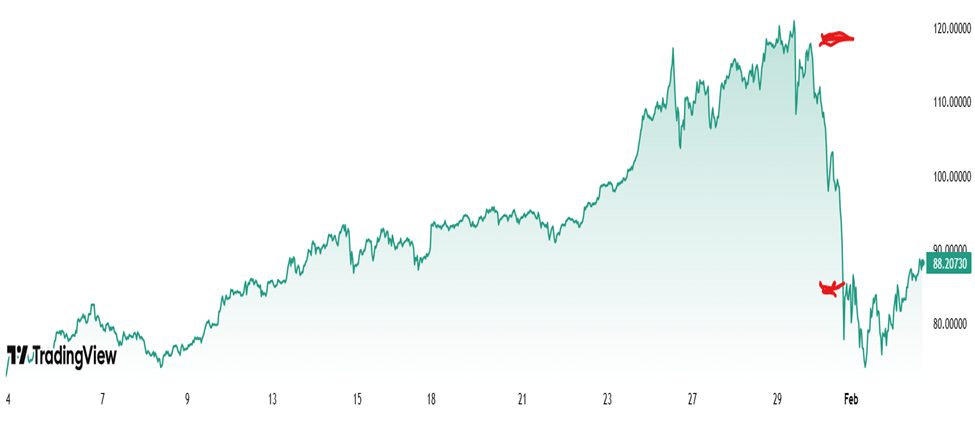
The Department of Defense is investing capital in MP across several fronts. This includes a $400 million convertible preferred equity, struck at a fixed conversion price of $30.03. The government gets 10-year MP stock warrants also set for a $30.03 price. As planned, this would get the Department of Defense to about a 15% ownership position in MP Materials. In addition, the Department of Defense will lend MP Materials $150 million at a highly competitive interest rate to help the company expand its heavy rare earth element separation capabilities.

It’s not just a financing deal, however. This arrangement also provides a striking level of influence over pricing and profitability for MP Materials going forward.

For one thing, the Department of Defense will provide a price floor of $110 per kilogram for NdPr. NdPr is a product that is a combination of neodymium and praseodymium. This is a generous floor price…

The Department of Defense’s involvement now gives MP Materials the runway necessary to build what’s being dubbed the 10X magnet manufacturing expansion plant. The Department of Defense is committed to buying the output of this plant with a controlled cost-plus pricing structure. And there will be a profit split with the DoD getting a significant chunk of the upside above certain EBITDA thresholds.

This is being billed as a private-public partnership, but it is akin to nationalization. The government will be heavily involved in planning output and setting pricing here, as well as sharing in profits.  Fans of laissez-faire free markets may be understandably queasy over this arrangement, but national security considerations seem to make this necessary.

I predict that further “private-public” deals will be struck to subsidize Western production of vital materials. Let’s be clear: massive subsidies or similar incentives, in one form or another, will be needed. And this means that Americans will have to devote more resources to grinding out industrial materials, and less to consumer goods; hence, we will likely live in smaller houses, perhaps (gasp) lacking granite countertops and recessed lighting. Economics is all about trade-offs.

Due to its vast, lower-paid, hard-working and highly-capable workforce, the whole Chinese supply chain and production costs run far, far cheaper than anything in the West. We don’t have to produce 100% of what we use, even say 40% might be enough to keep from being helplessly squeezed by another nation. How to do this without descending into unproductive rent-seeking rip-offs will be a challenge.

Some other materials candidates:  China has as of December 2024 completely shut off exports to the U.S. of three key non-rare earth technical elements, gallium, germanium and antimony, so those might be a good place to start. China mines or refines between half and 90% of global supply of those minerals. Also, China has instituted export regulations of for more key metals (tungsten, tellurium, bismuth, indium and molybdenum-related products), so these may be further subjects for squeeze plays. Finally, “China is the world’s top graphite producer and exporter, and also refines more than 90% of the world’s graphite into a material that is used in virtually all EV batteries,” so that is yet another vital material where the West must decide how much it is worth to break its dependence on an unreliable trading partner.

WSJ: Nothing Important Happened in China, India, or AI This Year

I normally like the Wall Street Journal; it is the only news page I check directly on a regular basis, rather than just following links from social media. But their “Biggest News Stories of 2024” roundup makes me wonder if they are overly parochial. When I try to zoom out and think of the very biggest stories of the past five to ten years, three of the absolute top would be the rapid rise of China and India, together with the astonishing growth in artificial intelligence capabilities.

All three of those major stories continued to play out this year, along with all sorts of other things happening in the two most populous countries in the world, and all the ways existing AI capabilities are beginning to be integrated into our businesses, research, and lives. But the Wall Street Journal thinks that none of this is important enough to be mentioned in their 100+ “Biggest Stories”.

To be fair, China and AI do show up indirectly. AI is driving the 4 (!) stories on NVIDIA’s soaring stock price, and China shows up in stories about spying on the US, hacking the US, and the US potentially forcing a sale of TikTok. But there are zero stories regarding anything that happened within the borders of China, and zero that let you know that AI is good for anything besides NVIDIA’s stock price.

Plus of course, zero stories that let you know that India- now the world’s most populous country, where over one out of every six people alive resides- even exists.

AI’s take on India’s Prime Minister using AI

This isn’t just an America-centric bias on WSJ’s part, since there is lots of foreign coverage in their roundup; indeed the Middle East probably gets more than its fair share thanks to “if it bleeds, it leads”. For some reason they just missed the biggest countries. They also seem to have a blind spot for science and technology; they don’t mention a single scientific discovery, and only had two technology stories, on SpaceX catching a rocket and doing the first private spacewalk.

The SpaceX stories at least are genuinely important- the sort of thing that might show up in a history book in 50+ years, along with some of the stories on U.S. politics and the Russia-Ukraine war, but unlike most of the trivialities reported.

I welcome your pointers to better takes on what was important in 2024, or on what you consider to be the best news source today.

China To Squeeze West by Restricting Export of Essential Rare Earths

Rare earths are a set of 17 metals with properties which make them essential to a swathe of high-tech products. These products include lasers, LEDs, catalysts, batteries, medical devices, sensors, and above all, magnets. Rare earth magnets are used in electric motors and generators and vibrators, making them essential to electric cars, wind turbine generators, cell phones/tablets/computers, airplanes, phones, and all sorts of military devices. 

China happens to have large amounts of rare earth oxide ores for mining, relatively lax environmental standards, and a large, compliant workforce. The Chinese government has harnessed these resources to make the nation by far the largest producer of rare earths. Their massive, relatively low-cost production has suppressed production in other countries. This has been a conscious policy, to achieve global control over a vital raw material.

The first time China used this effective monopoly as a political weapon was in a maritime dispute with Japan in 2010. China cut off exports of rare earth metals to Japan for two years, crimping the Japanese electronics industry.  Other nations took note of this threat, and since then have been a number of half-hearted (in my opinion) efforts in various Western nations to develop some domestic capacity and to redesign motors to reduce dependence on rare earth materials.

 China’s share of rare earth ore mined is down to 60%, but they totally dominate processing the ore to metals, and subsequent fabrication of magnets from the metal.  Nearly all of the ore mined in the U.S. is shipped over to China for processing, mainly because of environmental regulations here.  

According to the Asia Times,

The PRC still dominates the entire vertical industry and can flood global markets with cheap material, as it has done before with steel and with solar panels. In 2022, it mined 58% of all rare earths elements, refined 89% of all raw ore, and manufactured 92% of rare earths-based components worldwide.

There is no other global industry so concentrated in the hands of the Chinese Communist Party, nor with such asymmetric downstream impact, as rare earths.

It seems the only way for the West to blunt the Chinese monopoly in rare earths is with large, long-term subsidies (since the Chinese can always undersell the rest of the world on a free market basis) and probably some pushing past environmental objections.

Alarmed by the rapid buildup of Chinese military forces (towards a possible invasion of Taiwan), the U.S. and its allies have begun restricting exports of the highest-power silicon chips to China. In retaliation, China has reportedly made plans to restrict exports of rare earths, starting in 2023. If they follow through, that move would crush fabrication of magnets and of magnet-dependent devices like motors and generators in other countries; the rest of the world would have to come crawling to China for all these items.

This move would in turn cause the rest of the world to accelerate its plans to produce rare earths outside China, but there would be several years of great disruption, and Chinese-made final devices like motors and generators would always have a huge price advantage, due to their cheaper raw material inputs.

I suspect there may be a high-stakes game of brinksmanship going on behind the scenes. The Chinese leadership presumably knows that they can only play this rare earth export ban card once, and the West does not really want to plow a lot of resources into producing large amounts of rare earths much more expensively than they can be bought from China. So maybe we will see some relaxation in chip export controls for China in exchange for them not pulling the final trigger on a rare earth export ban.

We live in interesting times.

“Let whoever needs to die, die”:  China’s Abrupt COVID Reopening To Achieve Rapid Herd Immunity and Resumption of Industrial Production, at the Cost of a Million Deaths

I noted a month ago that President Xi and the CCP have taken credit for relatively low (reported) deaths from COVID, due to strict lockdown protocols. By “strict” we mean locking down whole cities and blockading residents in their apartment buildings for months at a stretch. However, public protests rose to an unprecedented level, and so the Chinese government has done a surprising full 180 policy change, towards almost no restrictions.

According to Dr. Ezekiel Emanuel in the Wall Street Journal, the way this policy is being carried out has the makings of a mass human tragedy:

Zero Covid was always untenable and had to be ended. But it could have been done responsibly.

Among other things, that would involve buying Pfizer and Moderna bivalent vaccines and administering them to the elderly and other high-risk people, and purchasing Paxlovid and molnupiravir to treat those who test positive. Supplies of these products are ample. Authorities could continue mask mandates to reduce transmission. And China could institute a rigorous wastewater testing program to identify potential SARS-CoV-2 variants as soon as possible – and commit to sharing the data with the world.

Due to nationalistic pride, China has spurned the purchase of effective mRNA vaccines from Pfizer and Moderna, pushing instead the less-effective in-house vaccine.

Readers may recall in the early days of COVID spread in the West, masking and social distancing were promoted, not because they would prevent everyone from ultimately becoming infected, but because these measures would “flatten the curve” (i.e. reduce the peak load on hospitals at any one time, but instead spread it out over time). China is headed into a very un-flattened infection curve; some 800 million people (10% of the world’s population) may get COVID in the next 3 months, overwhelming hospitals and leading to over a million deaths. Besides the near-term human costs, this concentration of active COVID cases is likely to lead to a slew of new, even more virulent variants which will affect the rest of the world, along with China. What should help mitigate the situation is that the newer, most virulent variants of COVID may be somewhat less fatal than the original strain.

Why is the Chinese government doing it this way? Well, the sooner the country gets through mass exposure to the virus, the sooner everyone can get back to their factories and start producing stuff again. If in the process a bunch of (mainly older) people die, well, that’s just the price of progress. Let ‘er rip…

From MSN:

[U.S.] Epidemiologist and health economist Dr Eric Feigl-Ding estimate that 60 per cent of China’s population is likely to be infected over the next 90 days. “Deaths likely in the millions—plural,” he added.

According to Eric, bodies were seen piled up in hospitals in Northeast China. “Let whoever needs to be infected infected, let whoever needs to die die. Early infections, early deaths, early peak, early resumption of production,” the epidemiologist said terming it to be summary of Chinese Communist Party’s (CCP) current goal.

But don’t expect any acknowledgement of mass death from the official Chinese media. Just as the initial COVID outbreak was denied and censored by the Chinese propaganda machine, so the current surge is being minimized. From Barrons:

On Friday, a party-run newspaper cited an official estimate of half a million daily new cases in the eastern city of Qingdao. By Saturday, the story had been amended to remove the figure, an AFP review of the article showed….

Several posts on the popular Weibo platform purporting to describe Covid-related deaths appeared to have been censored by Friday afternoon, according to a review by AFP journalists.

They included several blanked-out photos ostensibly taken at crematoriums, and a post from an account claiming to belong to the mother of a two-year-old girl who died after contracting the virus.

Posts about medicine shortages and instances of price gouging were also taken down, according to censorship monitor GreatFire.org.

And social media users have posted angry or sardonic comments in response to the perceived taboo around Covid deaths.

Many rounded on a state-linked local news outlet after it reported Wu Guanying — designer of the mascots for the 2008 Beijing Olympics — had died of a “severe cold” at the age of 67.

Perhaps we should not be surprised that the Chinese Center for Disease Control and Prevention just reported zero COVID deaths for December 25 and 26.

Protests Erupt Across China Over COVID Policy But Lockdowns Continue: Why?

Headlines in today’s financial news include items like “Clashes in Shanghai as COVID protests flare across China“ from Yahoo Finance. There have been widespread protests this week, which are normally a rarity under the authoritarian regime, and are being suppressed by any means necessary. Apple stock is down about 4% in the past two trading days on fears that iPhone shortages will get worse due to worker unrest in the giant Foxconn factory in Zhengzhou. Wall Street keeps hoping the China will loosen up, since the lockdowns on the world’s second-largest economy are a drag on global markets.

China has pursued a “zero-COVID” policy, of strict mass lockdowns to halt any spread of the virus. Residents have been confined to their apartments for over 3 months in some cases. Whole cities with tens of millions of people have been locked down for months at a time whenever a number of cases are spotted. China’s economic growth has stagnated, and unemployment among young people has risen to 20%, which has helped fuel unrest.  Chinese people are aware that the rest of the world has moved on from mass lockdowns, and may be realizing the futility of thinking that lockdowns can stave off the virus indefinitely.

Given its discomfort with widespread discontent and protests, why does the Chinese government persist in this policy? An article in the Atlantic by Michael Shuman answers that question: “Zero COVID Has Outlived Its Usefulness. Here’s Why China Is Still Enforcing It. “  Back in 2020 when COVID first swept through the world, the strict lockdowns (readily enforced in an authoritarian regime) seemed like a big win for the Chinese leadership:

When the outbreak began in Wuhan in early 2020, the virus was unknown, vaccines were unavailable, and China’s poorly equipped health system could have quickly become overwhelmed by a sweeping pandemic. Yet the policy had a political element from the very beginning as well. The Communist Party is adept at sniffing out threats to its rule, and it quickly identified COVID as one of them. A major public-health crisis, with millions dying, would have raised serious doubts about the regime’s competence, which is, in effect, its sole claim to legitimacy.

Worse, the party could have faced a populace that directly blamed it for the outbreak—with good reason. The Chinese authorities at both the national and local levels botched their initial response to the novel coronavirus, suppressing information about its discovery by a Wuhan doctor and acting far too slowly to contain the initial spread. Sensing its potential vulnerability, the party shifted into anti-COVID overdrive, shutting down large swaths of the country, with the result that it did succeed in snuffing out an epidemic in a matter of weeks, even as it spread to the rest of the world.

That success allowed the Communist Party to transform a potential tragedy into a public-relations triumph. Within weeks of the Wuhan outbreak, China’s propaganda machine was touting the wonders of its virus-busting methods. And as the U.S. and other Western countries struggled to contain the disease, Beijing’s big win became even more valuable as evidence that its authoritarian system was more capable and caring than any democratic one. Beijing and its advocates pointed to rising case and death counts in the U.S. as proof of China’s superiority and American decline.

A number of other countries including Australia and New Zealand also implemented strict (stricter than in the U.S.) lockdown measures in 2020, and, like China, experienced far less impact from the virus in that timeframe than seen in the U.S. However, most of these measures were lifted in 2021. The widespread application of mRNA vaccines like those from Pfizer and Moderna in the West has served to mitigate the severity of the viral infection. Also, some measure of herd immunity has been achieved by the widespread exposure to COVID in the population; antibodies persist for at least eight months after contracting the disease. So, what’s up with China?

China has resisted using Western vaccines, relying instead on homegrown vaccines which are less effective, though they do give some measure of protection.  Also, “The additional layers of high-tech surveillance adopted in the name of pandemic prevention can be used to enhance the tracking and monitoring of the populace more generally,” which is another win for the government. However, the major factor is that the Party, and especially President Xi, cannot afford to loosen up now and risk an embarrassing explosion of cases that would overburden the healthcare system and probably lead to millions of deaths:

The victory of zero COVID was claimed not just as the party’s but as Xi Jinping’s in particular. The State Council, China’s highest governing body, declared in a 2020 white paper that Xi had “taken personal command, planned the response, overseen the general situation and acted decisively, pointing the way forward in the fight against the epidemic.”

This narrative became entrenched. If Beijing loosened up and allowed COVID to run amok, the Chinese system would appear no better than those of loser democracies, and Xi would seem like another failing politician, a mere mortal, not the virus-fighting superhero he was painted as. Zero COVID’s failure would be a disaster for the Communist Party’s veneer of infallibility.

So the leadership insists on zero COVID and damn the consequences.

China Cracks Down on Cryptocurrencies

The Chinese Communist Party (CCP) is all about control. In the well-known words of Chairman Mao:

Every Communist must grasp the truth, “Political power grows out of the barrel of a gun.” Our principle is that the Party commands the gun, and the gun must never be allowed to command the Party.

These days political power is linked to economic power and control of information, as well as raw military firepower. Cryptocurrencies have assumed financial importance and they entail information processing and tracking.

On the other hand, a key driver for cryptocurrencies is precisely to escape from the domination of big central authorities, such as the CCP. Proponents of crypto revel in the fact that anyone with a PC can get in on “mining” and that the crypto universe does indeed operate on the web as a largely democratized enterprise. Anybody can transact large sums with anybody, with a moderate degree of anonymity.

These two different visions of life collided on Sept. 28 when the Chinese government banned nearly all crypto-related transactions:

China’s central bank said on Friday that all cryptocurrency-related transactions are illegal in the country and they must be banned, citing concerns around national security and “safety of people’s assets.” The world’s most populated nation also said that foreign exchanges are banned from providing services to users in the country.

In a joint statement, 10 Chinese government agencies vowed to work closely to maintain a “high pressure” crackdown on trading of cryptocurrencies in the nation. The People’s Bank of China separately ordered internet, financial and payment companies from facilitating cryptocurrency trading on their platforms.

The central bank said cryptocurrencies, including Bitcoin and Tether, cannot be circulated in the market as they are not fiat currency. The surge in usage of cryptocurrencies has disrupted “economic and financial order,” and prompted a proliferation of “money laundering, illegal fund-raising, fraud, pyramid schemes and other illegal and criminal activities,” it said.

Offenders, the central bank warned, will be “investigated for criminal liability in accordance with the law.”

The Chinese government will “resolutely clamp down on virtual currency speculation, and related financial activities and misbehaviour in order to safeguard people’s properties and maintain economic, financial and social order,” the People’s Bank of China said in a statement.

Well, those are the bare facts. It’s good to know the CCP is so diligently safeguarding people’s assets and public order. And as noted, Mao’s successors would not naturally favor systems that allow people to just do what they want to do, free from guidance from the Party. But inquiring minds want to know or at least speculate further regarding the reasons for this move and its consequences.

Brian Liu and Raquel Leslie highlighted two other motivations for this crackdown. One motivation  concerns China’s desire to launch its own state-controlled digital currency. This will give the government heightened ability to track every single transaction by every single user. It would also provide China with a new means of exerting influence over other nations and corporations:

The ban comes as the People’s Bank of China (PBOC), China’s central bank, is piloting its own digital currency, the eCNY or “digital yuan.” Unlike private cryptocurrencies, the eCNY is issued directly by the central government and is being designed to provide the PBOC with near-real-time financial data on user transactions. Some observers fear that the eCNY will be used as a tool to strengthen the Chinese Communist Party’s domestic surveillance. Others worry that the eCNY will be used to retaliate against international companies that speak out on human rights issues. Fan Yifei, a deputy governor of the PBOC, announced last week that the eCNY has entered a “sprint stage” ahead of the February 2022 Winter Olympics in Beijing.

Another motivation may be to help prevent wealthy Chinese from taking their money abroad:

The crypto ban may also be intended to deter capital flight. Despite past crypto crackdowns and strict capital controls, wealthy Chinese have used cryptocurrencies to funnel more than $50 billion overseas in 2020. As China is in the middle of an economic slowdown that has been exacerbated by other regulatory crackdowns on the tech and education sectors, China may be redoubling its efforts to ward off skittish entrepreneurs from exporting their money overseas.

Will this crackdown fully succeed? Many observers doubt it. They think that people will find ways to do what they want to do, using platforms that are hosted outside China.

As for the digital yuan, well, it kind of goes against most of the reasons people have gravitated to crypto. It represents a move back to government control and surveillance. It is not really a “crypto” currency at all, but simply another form of regular money.  It could get traction, however, in international trade among countries who have reasons to try to escape from the current U.S. dollar dominance. Also, China could hand out its digital currency like candy to impoverished nations, to get them on board. Millions, maybe billions of people live without regular banking access, and so a medium of exchange and store of value that requires only a cell phone to move funds around town or around the world could be attractive. At any rate, count on China to make the digital yuan a big “thing” for international visitors due at the February 2022 Olympics.

The price of Bitcoin took this news in stride. It continues to bounce around in the same $40,000-$50,000 range that it has been in for the past three months. And being banned by China is not a death-knell for a financial entity.  Indeed, it could be a contrarian indicator. Consider that China has also banned Youtube, Facebook, Google, Instagram, Pinterest, and even (because of his uncanny resemblance to President Xi) Winnie the Pooh.

Government Elimination of Perceived Vices

My post yesterday was about video games, prompted by the CCP legal restriction on video games for children. To enforce this rule, the government is making a list. Any adult playing these online video games will have to register with their real name. Is this a regulation of an addictive substance for minors, like we have for cigarettes, or is it progress toward managing the leisure time of males?

Before the Communists came to power (and before video games existed), previous Chinese government administrations had tried to ban another addictive form of recreation: smoking opium. The British famously did not help with this endeavor, but the British imports of opium ended years before the CCP crackdown. Where others had failed, the CCP practically eliminated opium from China in about 3 years. For my information, I’m drawing partly from a honors thesis on this topic.

The CCP started the relentless march toward eliminating opium in a clever way. They gathered information before announcing how ambitious the program would be. It started with making a list.

There had been previous attempts to send soldiers to destroy poppy fields (hello, 21st century?) but never in a coordinated enough way to stamp out supply. Police had raided opium dens in the cities, but nothing ever worked. Addicts were going to buy the stuff as long as it was being produced, and producers were going to grow the stuff as long as it was profitable. The CCP pulled off a coordinated attack on both producers and consumers in the entire country at the same time.

After a period of record-keeping, the CCP started forcefully addressing opium both in the rural areas where it was both produced and in the cities. There were different strategies for all the unique regions of China.

Those who did not cooperate knew that prison or immediate execution could result. The CCP, along with civilian volunteers, provided rehabilitation for some addicts who were willing to register themselves as offenders. It was acknowledged that kicking an opium addiction is hard. When possible, the government manipulated taxes and subsidies in such as way that farmers would choose to switch away from cultivating opium. The use of force was a reason for the success of the campaign, but people who were willing to cooperate often could find a way to transition away from their old habits.

The Communists did not just write laws and send soldiers. They held rallies that sound to me a lot like religious revival meetings. They galvanized millions of people to not just distain addictive drugs but to become volunteers for the cause. I would assume that many Chinese parents didn’t like opium in 1949 but were not yet so fervent as to become police informants. That changed in 1950. Everyone wants to have a moral cause. For some people today, it’s global warming. For millions in 1950’s China, it was eliminating opium distribution and addiction.

In one of my posts on Afghanistan I speculated that it is self-defeating for Americans to purchase illicit opium as consumers and also task our military with stamping out its production by force. This week when I read about the opium campaign, I found that a related message was used in 1950. The CCP presented opium abstinence as a way to defeat America in the Korean War.

I will be curious to watch developments concerning screen time and China. There is much to be determined. As Vice reported this week, ‘It’s unclear how the government will define “sissy pants”…’

Dan Wang’s 2020 letter on China

Dan Wang is a writer who currently lives in Beijing. He’s released another long letter about what is going on in China. I’ll share the part that caught my attention.

Waiting politely in line is a pretty strong norm in America. I had heard from several sources that Chinese norms for waiting in an orderly line were weak. Here’s an update on that:

And for years, Xi has emphasized following clear rules of written procedure, under the rubric of “law-based governance.”  Since then, the state has improved regulatory systems, for example in setting clear standards for license approvals and in securities and antitrust regulation. The state has removed some of the arbitrary aspects of governance, thus bringing serious enforcement actions following the passage of relatively clear regulations. That has improved facts on the ground. Companies and lawyers tell me that a decade-long effort by the State Council to ease doing business has yielded real results. Obtaining business licenses no longer requires a relentless pace of wining and dining, and has instead become close to a matter of routine. I haven’t been able to verify this fact for myself, but one of my friends told me that the office of the National Development and Reform Commission used to be ringed by some of the fanciest restaurants in Beijing, offering mostly private rooms; many of these restaurants have now closed, following the professionalization of business approvals.

The lived experience of being in Beijing has improved in parallel. I remember what a nightmare it was to buy a high-speed rail ticket for the first time years ago, which involved lots of yelling and multiple people cutting in line. Today, I purchase one on my phone, with no need to obtain a paper ticket, and the lines to board are more or less orderly.

China is changing.

Incidentally, I tried to start a company when I was about 19 in New Jersey. Applying for a tax ID number for my sole proprietorship was quick and easy. All I had to do was fill out a form and pay a small fixed fee to some government office.