70,000: that’s the number of adults (age 25 and older) in the US that earned the federal minimum wage of $7.25 per hour in 2021.
Another 538,000 adults reported earning below the minimum wage, but these are likely to be workers that earn tips, which aren’t reported in their hourly wages. Legally, they must make at least $7.25 including their tips, though many of them earn more. The data comes from a 2022 report by BLS using CPS data (hopefully the 2023 report is coming out soon).
If we include all workers 16 and older, there are about 1.1 million people earning the federal minimum wage or less. That’s just 1.4% of hourly wage earners, and only 0.8% of all workers (including salaried workers). Crucially, this number has declined dramatically over time from a high of 15.1% of hourly wage earners (8.9% of all workers) in 1981. It has even declined significantly since 2010, the first full year that the $7.25 federal minimum was in effect, when 6% of hourly wage earners (3.5% of all workers) earned $7.25 or lower.
Perhaps, though, a big part of this decline is because most states (and even some cities and counties) now have minimum wages that are above the federal level, in some cases significantly above. Today, only 20 states use the federal minimum wage. No doubt this is important!
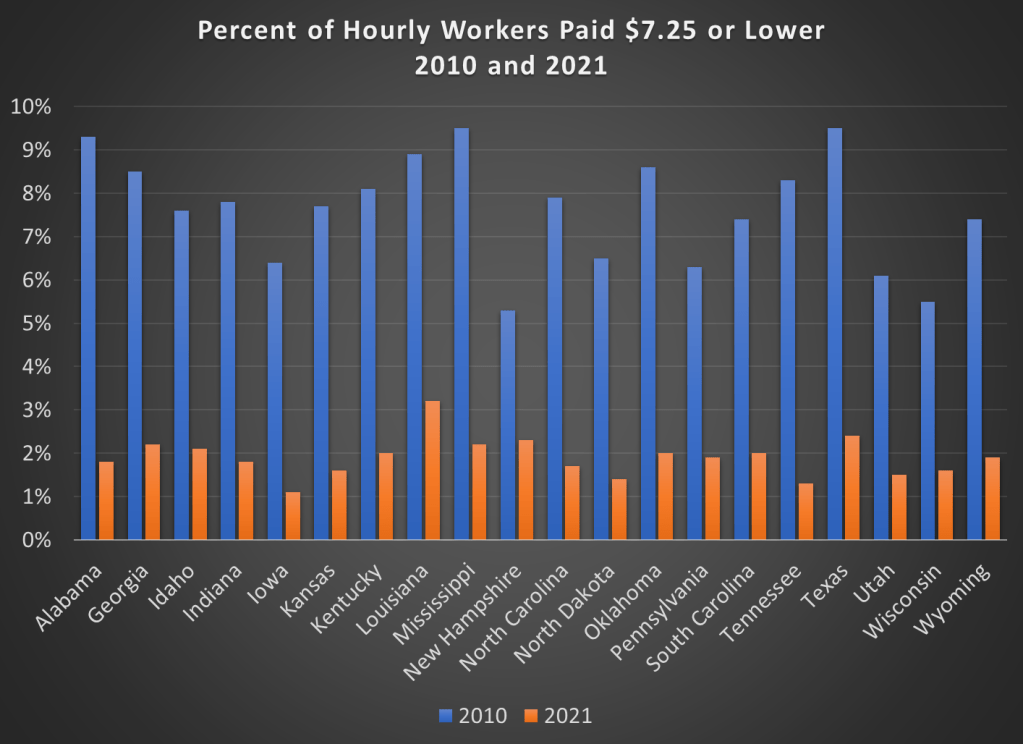
However, even if we focus just on those 20 states that use $7.25 per hour as the minimum, there were also large declines in the percent of hourly wage earners that earned $7.25 or less. Some states declined by 7 percentage points or more from 2010 to 2021, though all declined by at least 3 percentage points.
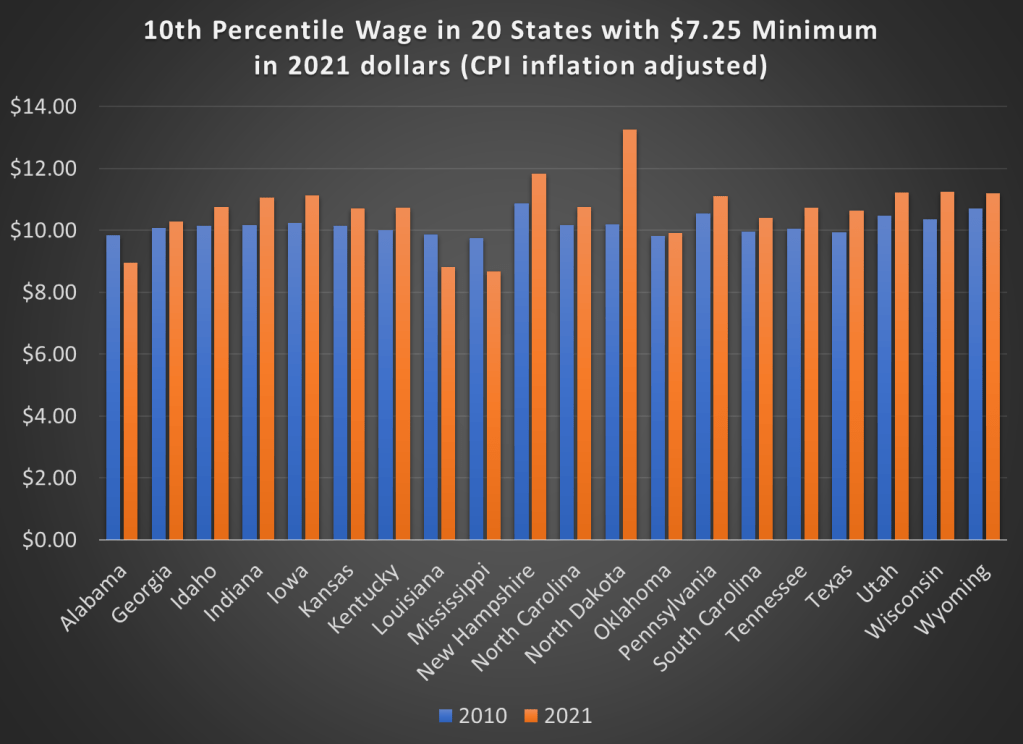
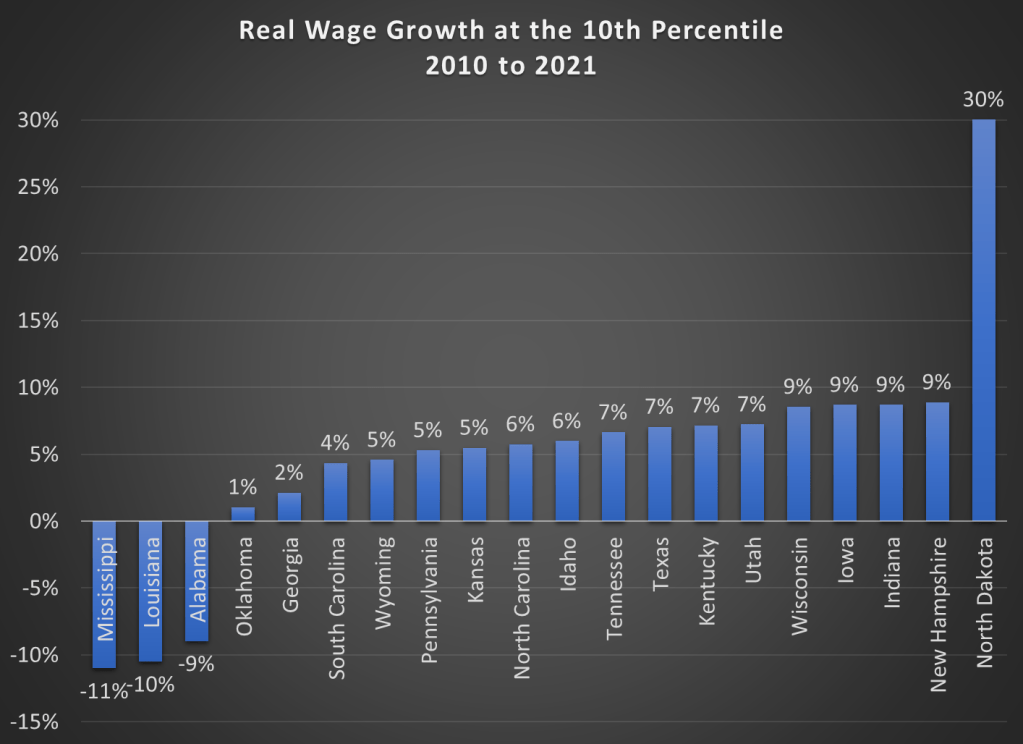
But maybe what’s going on is that employers are just providing wage increases that keep up with price inflation. So while fewer workers are earning the federal minimum wage, maybe they are no better off. We can address that possibility using BLS’s occupational wage data, which allows us to look at wages at the 10th percentile (these aren’t exactly minimum wage earners, but they are close). Real wage declines did happen in a few states (Alabama, Louisiana, and Mississippi), but most of these states experienced clear real wage growth from 2010 to 2021 at the 10th percentile of earners.
Here are the changes in percentage terms (once again, adjusted for CPI inflation).
Some might look at this growing irrelevance of the minimum wage as a reason to increase the federal minimum wage. But as the data from most states suggests, there are clear increases in wages happening already, suggesting that these are competitive labor markets. The case for raising the legal minimum wage in a competitive labor market is weak (it is stronger in a monopsony labor market).
In August 2022, I wrote a post showing that among G7 nations, the US had the highest inflation during the pandemic, but also the highest rate of real economic growth. But since the economic situation is evolving rapidly, I wanted to update that data from mid-2022 (I also use core inflation, but I’ll use total inflation in this post).
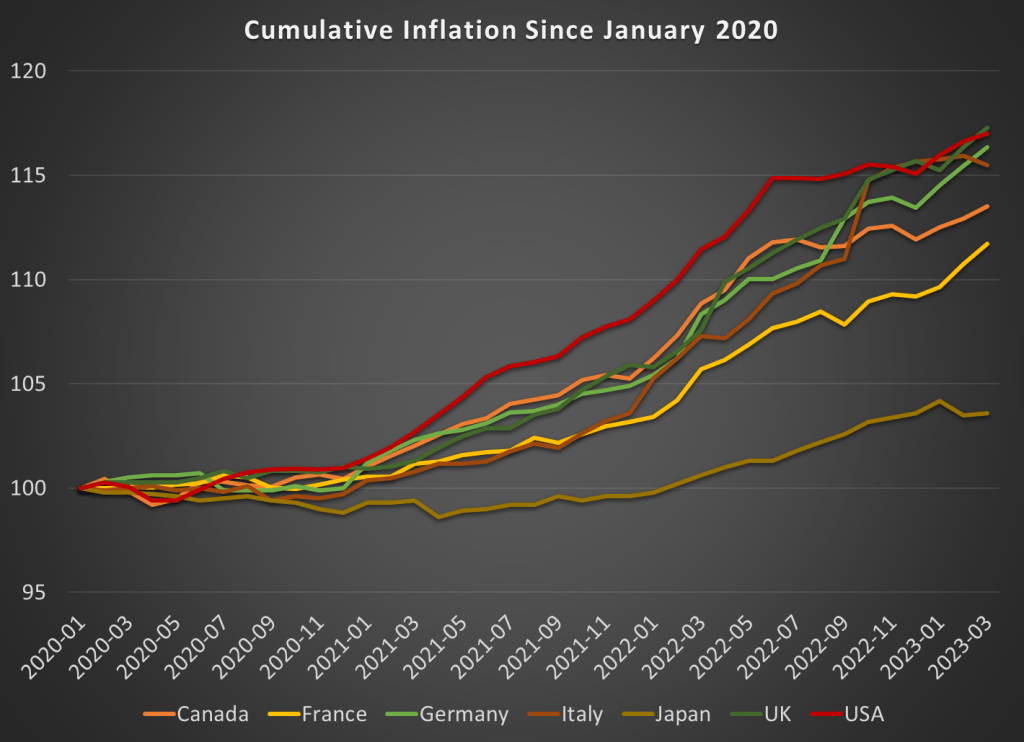
Here’s how inflation has looked during the pandemic:
While the US had the most cumulative inflation for much of the pandemic, the cooling of inflation in the US and the acceleration in Europe has changed things a bit. By late 2022, the UK and Italy had caught up to the US, and Germany is closing in too. These countries have cumulative inflation of between 15 and 17 percent since January 2020.
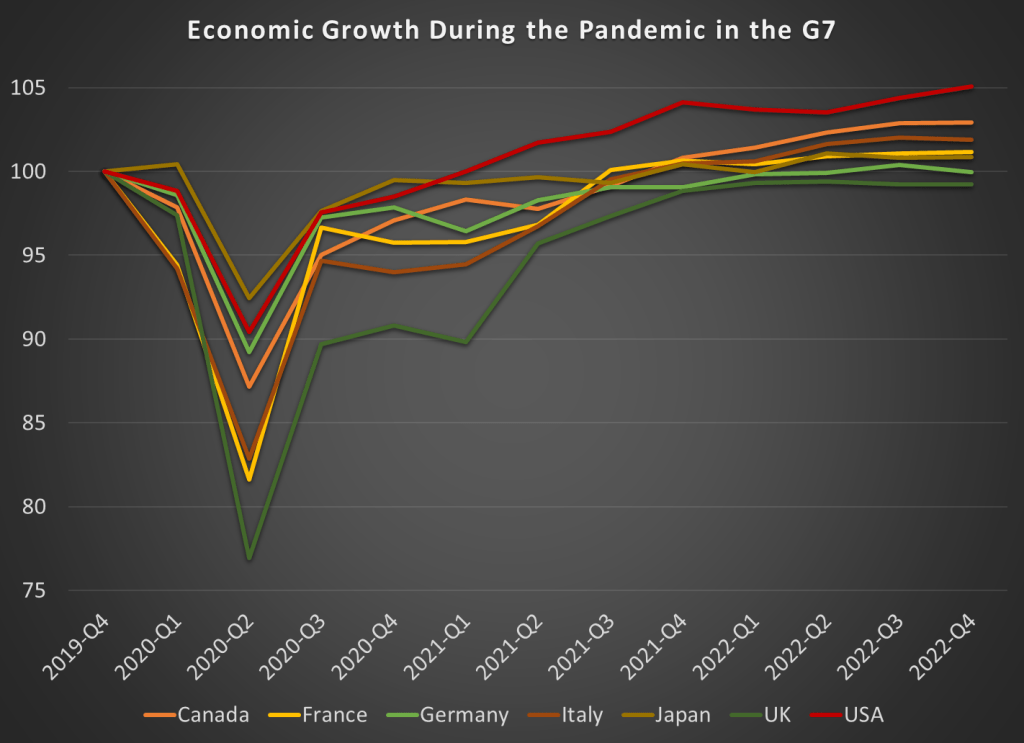
Japan looks to be the winner here. But wait, we don’t only care about low and stable inflation. We also want economic growth. Here’s the data through the 4th quarter of 2022 (we’ll start to get 2023q1 data from countries next week):
By this measure, the US comes out as the clear winner, with real GDP being about 5 percent higher than the end of 2019. That might not sound impressive for 3 years of growth, until you realize that 5 of the 7 nations had growth below 2 percent, with Germany and the UK actually still smaller than the end of 2019! And this doesn’t take account of the cumulative losses. Notice that the US had the second smallest dip in 2020q2 as well.
It’s hard to know exactly what the right non-COVID counterfactual would be, since these countries all had different rates of growth before the pandemic. But adding up the GDP scaled to 100 before the pandemic, the US is the only G7 country where these 12 quarters of data add up to more than 1,200. The other countries haven’t even had enough growth since the 2020 recession to make up for the losses during the recession, to say nothing of what their potential growth would have been. Japan comes the closest to making up the losses, while the UK stands out as the worst.
Here’s the figures for all the G7 countries, with 100% meaning they have had enough growth to offset the losses from the 2020 recession:
Are resources becoming scarcer as world population increases and per capita consumption increases? Are basic goods becoming more expensive relative to wages in the face of potential resource shortages? These are some of the main questions that are addressed in the just released book Superabundanceby Marian Tupy and Gale Pooley. The authors were kind enough to provide me with an advance copy, which is why I’m already able to review this book on its release date (I’m not really that fast of a reader).
The author take a very optimistic view of the issues surrounding those opening questions. Properly measured (one of the key tasks of their work), resources are becoming more abundant, not more scarce. And properly measured, almost all consumer goods are becoming cheaper relative to wages.
The authors use the approach of “time prices” throughout the book. They are not the first to use this approach. Julian Simon (their inspiration for this project) used it in various places in his work. William Nordhaus famously used it is in paper on the history of the price of lighting. And Michael Cox and Richard Alm have used the time-price approach in many of their writings, from the 1997 Dallas Fed annual report, to a full-length book a few years later, as well as updates to the original 1997 report. And if you follow me on Twitter, I like to use this approach too.
In short, “time prices” tell us how many hours of work it takes to purchase a given good or service at different points in time. How many hours would you have to work to buy a pound of ground beef? A square foot of housing? An hour of college tuition? It’s the superior method when you are looking at the price of a particular good or service over time, compared with a naïve inflation adjustment, which only tells you if the price of that good/service rose faster or slower than goods or services in general, not if it’s become more affordable. Inflation adjustments are really only useful when you are trying to compare income or wages to all prices, to see if and how much incomes have increased over time. Of course, which wage series you choose is important (and you need to have a consistent series over time, or at least the end points), but as the authors point out (which they learned from me!), if you looking at wages after 1973, the wage series you use doesn’t matter much. Median wages, average wages, wages of the “unskilled” — these all give you the same trend since 1973. We don’t have all of these back earlier (especially median wages), but there’s not much reason to believe they’ve diverged that much. And the authors also present their data using multiple wage series in many of the charts and tables.
Last month Eric Basmajian published “Why Demographics Matter More Than Anything (For The Long Term)” on the financial site Seeking Alpha. He predicts that that the developed world plus China face a future of low economic growth (regardless of policy machinations) due simply to demographics. His key points:
Demographics are the most important factor for long-term analysis.
The young and old age cohorts negatively impact economic growth.
The prime-age population (25-64) drives the bulk of economic activity.
The world’s major economies are suffering from lower population growth and an older population.
Over the long run, the world’s major economies will have worse economic growth, which will negatively impact pro-cyclical asset prices (like stocks).
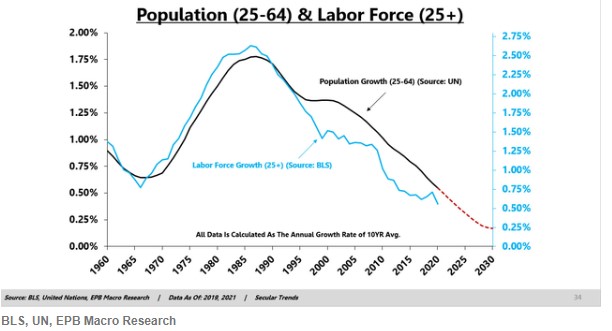
I will paste in some of his supporting charts. First, the labor force is more or less proportional to the 25-64 age cohort (U.S. data shown) :
…and GDP growth trends with labor force growth:
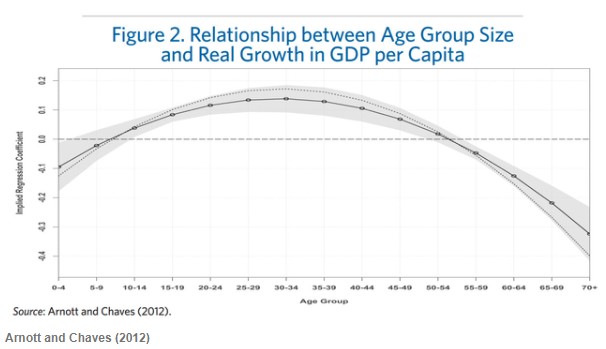
Also, on the consumption side, that is highest with the 25-54 age group:
And so,
Younger people are a drag on economic growth and older people are a drag on economic growth… The prime-age population is the segment that drives economic activity, so if the share of population that is 25-54 is shrinking, which it is, then you’re going to have more people that are a negative force than a positive force:
Once the working-age population growth flips negative, an economy is doomed…. Working age population growth in Japan flipped negative in the 1990s, and they moved to negative interest rates, QE, and they have never been able to stop. The economy is too weak.
After 2009, the working-age population in Europe flipped negative, and they moved to negative rates and QE, and they haven’t been able to stop. Even now, as the US is raising rates, Europe is struggling to catch up and has already abandoned most of its tightening plans.
In 2015, China’s working-age population flipped negative, and they’ve had problems ever since. They devalued their currency in 2015 and tried one more time to inflate a property bubble, but it didn’t work, and now they’re having to manage the deflation of an asset bubble that the population cannot support.
The US is in better shape than everyone else, but we’re not looking at robust growth levels in this prime-age population.
In conclusion, “ The real growth rate in most developed nations is collapsing because of those two factors, worsening demographics, and increased debt burdens. In the US, as a result of the demographic trends I just outlined plus a rising debt burden, real GDP per capita can barely sustain 1% increases over the long run compared to 2.5% in the 60s, 70s, and 80s.”
That is pretty much where Basmajian leaves it. No actionable advice (besides subscribing to his financial newsletter). What isn’t addressed is whether productivity (production per worker) can somehow be accelerated. Also, one of his charts (which I did not copy here) showed a big trend down in 25-64 age fraction in the US population in the 1950’s-1960’s (as hangover from the Depression?), and yet these were decades of strong GDP growth. So these demographic trends are not the whole story, but his analysis is sobering.
This semester I am participating in a reading group with undergraduate students that focuses on the history and prospects for capitalism and socialism. Lately we have been reading Joseph Stiglitz, who has long argued that China’s transition to a market economy has gone much better than the former Soviet Union. Gradual transition is superior to “shock therapy,” according to Stiglitz.
There’s an extent to which this is true. If we just look at economic growth rates since, say, 1995, China has clearly outpaced Russia.
It’s hard to know exactly what year to start, since GDP figures for former planned economies immediately after transition aren’t reliable, but the start date is mostly irrelevant for everything I’ll say here (please play around with the start year in the charts to see if I’m cherry-picking years). 1995 seems a reasonable enough year to start for reliable post-transition starting point.
As we see above, while Russia has had a rough doubling of GDP per capita since 1995 (respectable, and yes, it’s all adjusted for inflation!), China has soared almost 600%. Wow! But this is something of a cheat. Despite all that growth, average income in China is still lower than Russia: only about 60% of Russia in 2020. China started from a much lower level, meaning that faster growth, while not guaranteed, is at least easier to achieve. In fact, if we go back to 1978, when China’s first reforms began, GDP per capita in the Former USSR was about 6 times as high as China (that’s according to the latest Maddison Project estimates, which will always be speculative for non-market economies, but are the best we have).
Furthermore, Russia hasn’t really transitioned to a democracy either. China clearly hasn’t, but no one doubts that. But despite having the outward symbols of democracy (elections, a legislature, etc.), Russia still scores low on most indexes of democracy and civil liberties. For example, Freedom House scores them at 19/100, a little better than China (9/100), but nothing like Western Europe.
So, did the quick transition to market economies fail? Not so fast. While it did fail in Russia, in most of Eastern Europe and the eastern part of the former USSR seems to have been a major success. Take a look at this chart, which shows the former Soviet Republics in and near Europe (I exclude Central Asian FSRs).
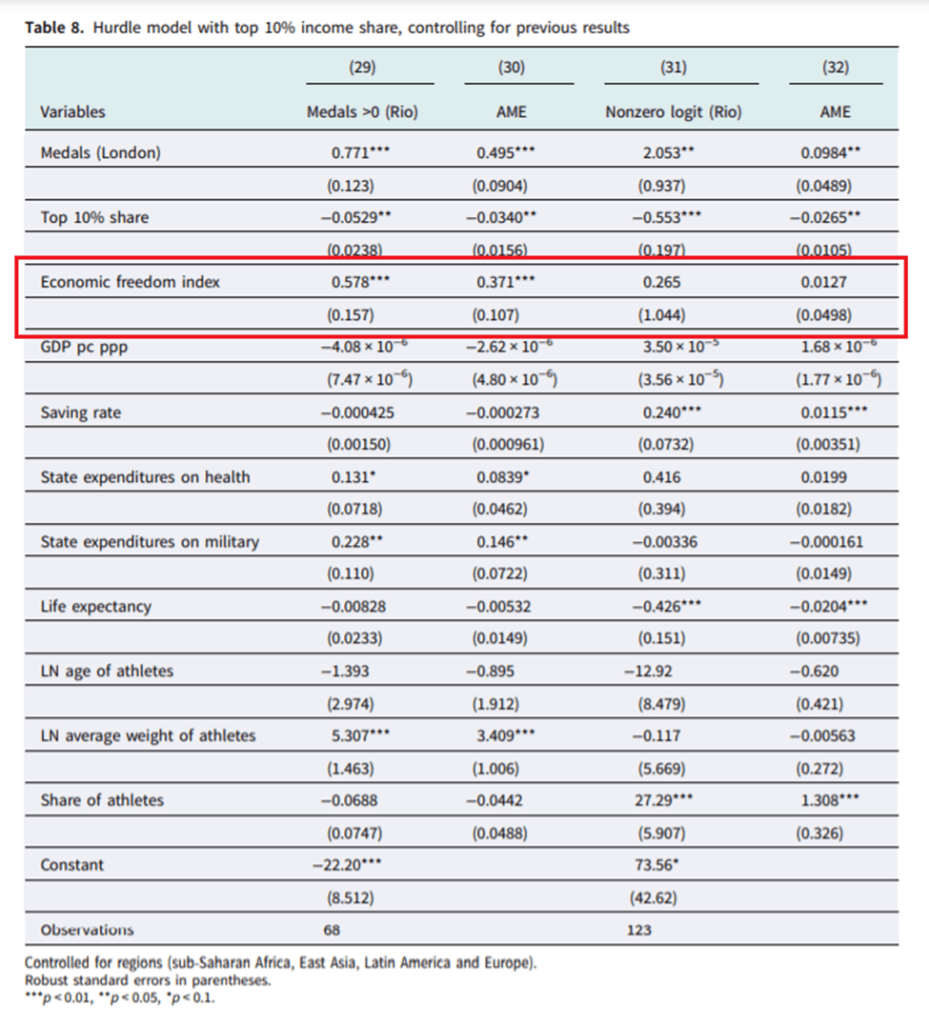
The Olympics have begun. Is there anything economists can say about what determines a country’s medal count? You might not think so, but the answer is a clear yes! In fact, I am going to say that both the average economist and the average political economist (in the sense of studying political economy) have something of value to say.
Why could they not? After all, investing efforts and resources in winning medals is a production decision just like using labor and capital to produce cars, computers or baby diapers. Indeed, many sports cost thousand of dollars in equipment alone each year – a cost to which we must add the training time, foregone wages, and coaching. Athletes also gain something from these efforts – higher incomes in after-career, prestige, monetary rewards per medal offered by the government. As such, we can set up a production function of a Cobb-Douglas shape
Where N is population, Y is total income (i.e., GDP), A is institutional quality and T is the number of medals being won. The subscript i and t depict the medals won at any country at any Olympic-event. This specification above is a twist (because I change the term A’s meaning as we will see below) on a paper in the Review of Economics and Statistics published in 2004 by Andrew Bernard and Meghan Busse.
The intuition is simple. First, we can assume that Olympic-level performance abilities requires a certain innate skill (e.g. height, leg length). The level required is an absolute level. To see this, think of a normal distribution for these innate skills and draw a line near the far-right tail of the distribution. Now, a country’s size is directly related to that right-tail. Indeed, a small country like Norway is unlikely to have many people who are above this absolute threshold. In contrast, a large country like Germany or the United States is more likely to have a great number of people competing. That is the logic for N being included.
What about Y? That’s because innate skill is not all that determines Olympic performance. Indeed, innate skills have to be developed. In fact, if you think about it, athletes are less artists who spend years perfecting their art. The only difference is that this art is immensely physical. The problem is that many of the costs of training for many activities (not all) are pretty even across all income levels. Indeed, many of the goods used to train (e.g., skis, hockey sticks and pucks, golfing equipment) are traded internationally so that their prices converge across countries. This tends to give an edge to countries with higher income levels as they can more easily afford to spend resources to training. This is why Norway, in spite of being quite small, is able to be so competitive – its quite-high level of income per capita make it easier to invest in developing sporting abilities and innate talent.
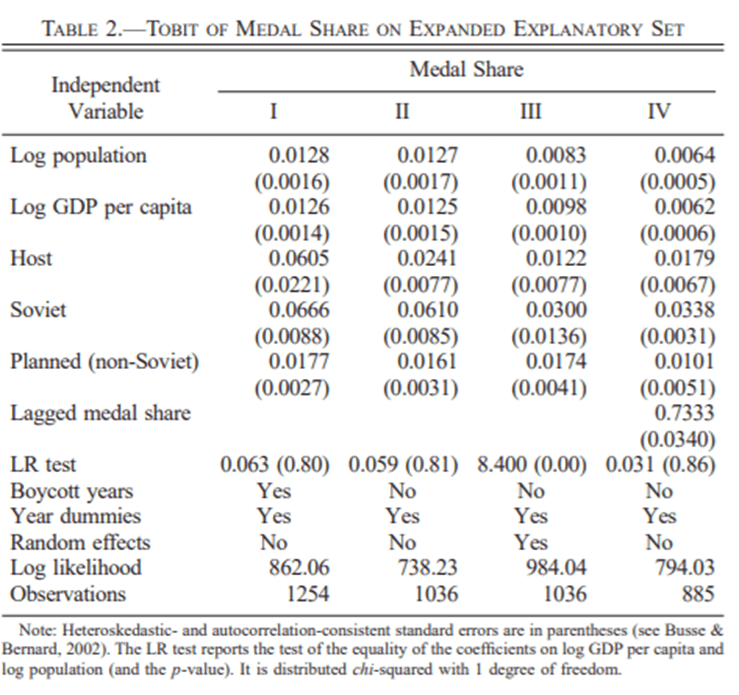
Bernard and Busse confirm this intuition and show that, yes, population and development levels are strong determinants of medal counts. The table below, taken from their article, shows this.
What about A? Normally, A is a scalar we use in a Cobb-Douglas function to illustrate the effect of technological progress. However, it is also frequently used in the economic growth literature as the stand-in for the quality of institutions. And if you look at Bernard and Musse’s article, you can see institutions. Do you notice the row for Soviet? Why would being a soviet country matter? The answer is that we know that the USSR and other communist countries invested considerable resources in winning medals as a propaganda tool for the regimes. The variable Soviet represents the role of institution.
And this is where the political economist has lots to say. Consider the decision to invest in developing your skills. It is an investment with a long maturity period. Athletes train for at least 5-10 years in order to even enter the Olympics. Some athletes have been training since they were young teenagers. Not only is it an investment with a long maturity period, but it pays little if you do not win a medal. I know a few former Olympic athletes from Canada who occupy positions whose prestige-level and income-level that are not statistically different from those of the average Canadian. It is only the athletes who won medals who get the advertising contracts, the sponsorships, the talking gigs, the conference tours, and the free gift bags (people tend to dismiss them, but they are often worth thousands of dollars). This long-maturity and high-variance in returns is a deterrent from investing in Olympics.