When Commitment Backfires: The Economics Behind Gang Tattoos and Changing Incentives

In economics, commitment devices are often seen as clever solutions to self-control problems—ways people can tie their future hands to avoid giving in to temptation. A smoker throws away their cigarettes, a dieter pays in advance for healthy meals, a student announces a deadline publicly so they can’t back out. The idea is that by limiting future choices, a person can force themselves to stick with a preferred long-term strategy. But commitment devices also show up in places far removed from personal productivity—and in some cases, they carry bad unintended consequences when the strategic landscape shifts.

Consider the case of gang tattoos, especially those associated with MS-13. For years, highly visible tattoos served as a powerful way to demonstrate loyalty to the group. These tattoos—sometimes covering the face, neck, or arms—weren’t just aesthetic. They signaled that the individual was fully committed to the gang. In economic terms, they functioned as a high-cost, hard-to-fake commitment device. By making oneself easily identifiable as a gang member, a person burned bridges to legitimate employment or life outside the gang. That might seem irrational at first glance, but it was often a rational decision in context. Within certain neighborhoods or prisons, that signal provided protection, status, and trust among peers. The visible commitment reduced the gang’s uncertainty about who was loyal and who might defect.

But the rules of the game changed. In March 2022, El Salvador launched an aggressive crackdown on gangs following a sharp spike in homicides. Under a sweeping “state of exception,” authorities suspended constitutional rights, arrested tens of thousands of people, and expanded prison capacity dramatically. Tattoos quickly became one of the easiest ways for police to identify and detain suspected gang members. News reports describe men being pulled from buses or homes not for current criminal activity, but simply because of the ink on their skin. In many cases, the tattoos were from years earlier—when the wearer had been young and immersed in a world where signaling loyalty felt necessary for survival. Now, those same signals serve as evidence in court or grounds for indefinite detention.

Continue reading

MSNE Echoes PSNE

Let’s talk game theory. I’ve written in the past about Pure Strategy Nash Equilibria (PSNE). They identify possible equilibrium strategies, even if players are unlikely to adopt those strategies in real life. Students don’t like the implausibility of many PSNE strategies, and they sometimes struggle to limit their conclusions to the premises that yield PSNE. Students have a similar dissonance to Mixed Strategy Nash Equilibria (MSNE).

What is MSNE? A set of MSNE strategies allow a player to choose some strategies probabilistically – with probabilities that are less than 100%. That’s the feature of MSNE that distinguishes it from PSNE. In PSNE, a strategy is chosen with 0% or 100% probability.

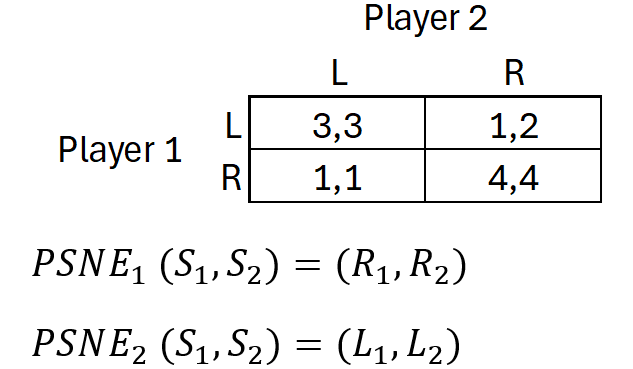
Here’s an example to illustrate. Imagine that you are shopping at the grocery store with your shopping cart. You’re at one end of the aisle and another shopper is at the other end and your heading straight toward one another at a snail’s pace. Ideally, you’d not hit each other or awkwardly arrive in each other’s path. For simplicity, let’s say that each of you can walk on the right or the left side of the aisle only.* Below is a simultaneous normal form game with arbitrary payoffs.

There are two PSNE in the above game: each person walks on their right or their left side of the aisle. If you and the other person are both walking on your respective rights or lefts, then neither of you has an incentive to deviate. The alternative is that you are heading straight for one another and one of you must veer from their path or play an awkwardly low stakes game of chicken.

Continue reading

Update on Game Theory Teaching

I wrote at the end of the summer about some changes that I would make to my Game Theory course. You can go back and read the post. Here, I’m going to evaluate the effectiveness of the changes.

First, some history.

I’ve taught GT a total of 5 time. Below are my average student course evaluations for “I would recommend this class to others” and “I would consider this instructor excellent”. Although the general trend has been improvement, improving ratings and the course along the way, some more context would be helpful. In 2019, my expectations for math were too high. Shame on me. It was also my first time teaching GT, so I had a shaky start. In 2020, I smoothed out a lot of the wrinkles, but I hadn’t yet made it a great class. 

In 2021, I had a stellar crop of students. There was not a single student who failed to learn. The class dynamic was perfect and I administered the course even more smoothly. They were comfortable with one another, and we applied the ideas openly. In 2022, things went south. There were too many students enrolled in the section, too many students who weren’t prepared for the course, and too many students who skated by without learning the content. Finally, in 2023, the year of my changes, I had a small class with a nice symmetrical set of student abilities.  

Historically, I would often advertise this class, but after the disappointing 2022 performance, and given that I knew that I would be making changes, I didn’t advertise for the 2023 section. That part worked out perfectly. Clearly, there is a lot of random stuff that happens that I can’t control. But, my job is to get students to learn, help the capable students to excel, and to not make students *too* miserable in the process – no matter who is sitting in front of me.

Continue reading

The Vicinity of Celebrity Obscenity

I don’t like when celebrities are ‘caught’ saying deplorable things in a heated moment. Sometimes they say really awful things, specifically about observables such as race, weight, sex, nationality, odor, etc. Plenty of people have done it. I won’t mention the names or link to any particulars here.

My problem isn’t that I wish celebrities had better behavior – although I do. My problem is with the entire fallout of how we’re all supposed to take the celebrity seriously when they were enraged. When people get angry they say things that are designed to hurt others.   People will say things that they don’t mean or wouldn’t normally say. And it’s not like they are betraying some unspoken belief that they’ve hidden. Angry people often say wicked things for the sole purpose of hurting someone else’s feelings. In the moment, the offender tries hard to communicate disrespect – not due to a lack of respect – but due to how it will make the other person feel.

I find the entire circumstance weird. If someone is boiling over and saying patently ridiculous things to me and calling me names, then I have a very hard time taking them seriously. All the same, context matters and words can hurt. It’s weird that we know that people can say untrue things in order to hurt us, and then it actually hurts us. Strange.

Continue reading

[Not] Choosing Rationally

I’ve written previously on game theory, about the generality of Pure Strategy Nash Equilibria (PSNE), and the drawbacks of Sub-Game Perfect Nash Equilibria (SGPE). In this post I have another limitation for SGPE.


First, some definitions:
PSNE: “No player can change one of their strategies and improve their payoff, given the strategies of all other players.”
Subgame: “A subset of any extensive-form game that includes an initial node (which doesn’t share an information set with other nodes) and all its successor nodes.”
Subgame Equilibrium (SGE): “The PSNE of the Subgame”
SGPE: “The set of PSNE that are also SGE”


Clearly, there is nothing inconsistent about the above definitions. The reason that SGPE emerged was because some PSNE assert that a player would be willing to choose strategies that do not maximize conditional payoffs in subgames that are off of the equilibrium path. So, people often characterize the SGPE as a player ‘being rational each step of the way in each subgame’.

But, there is a problem. “Each step of the way” and “in each subgame” are not the same thing. Each step of the way implies that a player is rational at each decision – ie, at each information set. But, not every information set is a subgame! So, a SGPE can include rationality at each SGE while also permitting some irrationality at individual information sets. Since economists like to identify the bounds of their claims, let me emphasize the word can. In order to be correct, I need only identify one case in which the claim is true.


Here is that case:

Continue reading

5 Game Theory Course Changes

I want to share some changes that I’ll make to my game theory course, just for the record. It’s an intense course for students. They complete homeworks, midterm exams, they present scholarly articles to the class, and they write and present a term paper that includes many parts. Students have the potential to learn a huge amount, including those more intangible communication skills for which firms pine.

There is a great deal of freedom in the course. Students model circumstances that they choose for the homeworks, and they write the paper on a topic that they choose. The 2nd half of the course is mathematically intensive. When I’ve got a great batch of students, they achieve amazing things. They build models, they ask questions, they work together. BUT, when the students are academically below average, the course much less fun (for them and me). We spend way more time on math and way less time on the theory and why the math works or on the applicable circumstances. All of that time spent and they still can’t perform on the mathematical assignments. To boot, their analytical production suffers because of all that low marginal product time invested in math. It’s a frustrating experience for them, for me, and for the students who are capable of more.

This year, I’m making a few changes that I want to share.

  1. Minimal Understanding Quizzes: All students must complete a weekly quiz for no credit and earn beyond a threshold score in order to proceed to the homework and exams. I’m hoping to stop the coasters from getting ‘too far’ in the course without getting the basics down well enough. The quizzes must strike the balance of being hard enough that students must know the content, and easy enough that they don’t resent the requirement.
Continue reading

New Textbook for Game Theory and Behavioral Economics

Game Theory and Behavior is extremely readable. Carpenter and Robbett have a great set of examples (e.g. the poison drink dilemma from The Princess Bride). I think the book has been developed from teaching a course that resonates with undergraduates today. The authors are both experimental economists, so there is natural integration with lab results from experiments with games.

Topics covered include:

Game Theory and standard definitions

Solving Games

Sequential Games

Bargaining

Markets

Social Dilemmas

Voting

Behavioral Extensions of Standard Theory

In their words:

This book provides a clear and accessible formal introduction to standard game theory, while at the same time addressing how people actually behave in these games and demonstrating how the standard theory can be expanded or updated to better predict the behavior of real people. Our objective is to simultaneously provide students with both the theoretical tools to analyze situations through the logic of game theory and the intuition and behavioral insights to apply these tools to real world situations. The book was written to serve as the primary textbook in a first course in game theory at the undergraduate level and does not assume students have any previous exposure to game theory or economics. 

Not every book on game theory would be described as extremely readable. The authors do present mathematical concepts and solutions and practice problems. I want to be clear that I’m not implying that their book is not rigorous. They present game theory as primarily an intuitive and important framework for decisions instead of as primarily a mathematical object, which should go over well with most undergraduate students.

The following are questions that occurred to me as I was writing this post, with ChatGTP replies.

The Imperfection of Subgame Perfection

I’ve written previously about Pure Strategy Nash Equilibria (PSNE). They are the set of strategies that players can adopt in equilibrium – with no incentive to change their strategy. Students have an intuition that PSNE aren’t great because some outcomes that they identify depend on players making silly decisions in the past. In jargon, we can say that some PSNE depend on players choosing irrationally in a subgame while still reaching a PSNE.

See the extensive form game (below right). There are two players, each with two strategies per information set, and player two has two information sets. All PSNE will include a strategy for each information set. We can present the same game in normal form in order to make it easier to identify the PSNE (below left).

Player 1 (P1) can choose the row (B or C) and Player 2 (P2) can choose the column. Importantly, whether P1 might want to change his mind depends on P2’s strategy at the decision node in the alternative information set. Therefore, P2 must have two strategies, one per information set.

The four PSNE strategies and payoffs are underlined in the above table and they are noted in red on the below extensive form games. Again, the logic of PSNE states that no player can improve their payoff by changing only their own strategy, given the opposing player’s strategy. After all, a player can control their own strategy, but not that of their opponent. For example, note PSNE II. In the left subgame, P2 chooses M. His payoff would be unchanged if he changed his strategy, given the strategy of P1.

Continue reading

Has the Economic Theory Job Market Returned to Equilibrium?

When I was on the job market in 2014, everyone thought that it was terrible to be a theorist. The profession has moved dramatically toward empirical work, so all the hiring was there. But lots of new PhDs were still doing theory, so the supply of theorists exceeded demand and they had a hard time finding jobs.

My school is hiring in Game Theory / Industrial Organization this year, and based on my previous experience I expected a flood of applications from theorists- but it never arrived. We got substantially fewer applications than when we hired in Applied Micro a couple years ago, and even in the applications we did get, lots were out-of-field or doing empirical IO. I think we will still be able to hire well, I’m certainly happy with the three candidates we are flying out, but there is a lot less depth than I expected. It seems that PhD students have got the message that the demand for theorists is low, and so not many choose theory anymore.

I haven’t been able to find great data to either confirm or rebut my impressions; the closest is the data from this 2019 report with a low response rate. There is no “theory” field in it but I think the closest proxies are “Math & Quantitative Methods” and “Microeconomics”, which collectively made up 20% of demand but only 14% of supply.

I’d be interested to hear what everyone else has seen recently- is doing economic theory once again a sane career move?

PSNE: No More, No Less

Today marks the 27th anniversary of John Nash winning The Sveriges Riksbank Prize in Economic Sciences in Memory of Alfred Nobel for his contributions to game theory.

Opinions on game theory differ. To most of the public, it’s probably behind a shroud of mystery. To another set of the specialists, it is a natural offshoot of economics. And, finally a 3rd non-exclusive set find it silly and largely useless for real-world applications.

Regardless of the camp to which you claim membership, the Pure Strategy Nash Equilibrium (PSNE) is often misunderstood by students. In short, the PSNE is the set of all player strategy combinations that would cause no player to want to engage in a different strategy. In lay terms, it’s the list of possible choices people can make and find no benefit to changing their mind.

In class, I emphasize to my students that a Nash Equilibrium assumes that a player can control only their own actions and not those of the other players. It takes the opposing player strategies as ‘given’.

This seems simple enough. But students often implicitly suppose that a PSNE does more legwork than it can do. Below is an example of an extensive form game that illustrates a common point of student confusion. There are 2 players who play sequentially. The meaning of the letters is unimportant. If it helps, imagine that you’re playing Mortal Kombat and that Player 1 can jump or crouch. Depending on which he chooses, Player 2 will choose uppercut, block, approach, or distance. Each of the numbers that are listed at the bottom reflect the payoffs for each player that occur with each strategy combination.

Again, a PSNE is any combination of player strategies from which no player wants to deviate, given the strategies of the other players.

Students will often proceed with the following logic:

  1. Player 2 would choose B over U because 3>2.
  2. Player 2 would choose A over D because 4>1.
  3. Player 1 is faced with earning 4 if he chooses J and 3 if he chooses C. So, the PSNE is that player 1 would choose J.
  4. Therefore, the PSNE set of strategies is (J,B).

While students are entirely reasonable in their thinking, what they are doing is not finding a PSNE. First of all, (J,B) doesn’t include all of the possible strategies – it omits the entire right side of the game. How can Player 1 know whether he should change his mind if he doesn’t know what Player 2 is doing? Bottom line: A PSNE requires that *all* strategy combinations are listed.

The mistaken student says ‘Fine’ and writes that the PSNE strategies are (J, BA) and that the payoff is (4,3)*.  And it is true that they have found a PSNE. When asked why, they’ll often reiterate their logic that I enumerate above. But, their answer is woefully incomplete. In the logic above, they only identify what Player 2 would choose on the right side of the tree when Player 1 chose C. They entirely neglected whether Player 2 would be willing to choose A or D when Player 1 chooses J. Yes, it is true that neither Player 1 nor Player 2 wants to deviate from (J, BA). But it is also true that neither player wants to deviate from (J, BD). In either case the payoff is (4, 3).

This is where students get upset. “Why would Player 2 be willing to choose D?! That’s irrational. They’d never do that!” But the student is mistaken. Player 2 is willing to choose D – just not when Player 1 chooses C. In other words, Player 2 is indifferent to A or D so long as Player 1 chooses J. In order for each player to decide whether they’d want to deviate strategies given what the other player is doing, we need to identify what the other player is doing! The bottom line: A PSNE requires that neither player wants to deviate given what the other player is doing –  Not what the other player would do if one did choose to deviate.

What about when Player 1 chooses C? Then, Player 2 would choose A because 4 is a better payoff than 1. Player 2 doesn’t care whether he chooses U or B because (C, UA) and (C, BA) both provide him the same payoff of 4. We might be tempted to believe that both are PSNE. But they’re not! It’s correct that Player 2 wouldn’t deviate from (C, BA) to become better off. But we must also consider Player 1. Given (C, UA), Player 1 won’t switch to J because his payoff would be 1 rather than 3.  Given (C, BA), Player 1 would absolutely deviate from C to J in order to earn 4 rather than 3. So, (C, UA) is a PSNE and (C, BA) is not. The bottom line: Both players must have no incentive to deviate strategies in a PSNE.

There are reasons that game theory as a discipline developed beyond the idea of Nash Equilibria and Pure Strategy Nash Equilibria. Simple PSNE identify possible equilibria, but don’t narrow it down from there. PSNE are strong in that they identify the possible equilibria and firmly exclude several other possible strategy combinations and outcomes. But PSNE are weak insofar as they identify equilibria that may not be particularly likely or believable. With PSNE alone, we are left with an uneasy feeling that we are identifying too many possible strategies that we don’t quite think are relevant to real life.

These features motivated the later development of Subgame Perfect Nash Equilibria (SGPNE). Students have a good intuition that something feels not quite right about PSNE. Students anticipate SGPNE as a concept that they think is better at predicting reality. But, in so doing, they try to mistakenly attribute too much to PSNE. They want it to tell them which strategies the players would choose. They’re frustrated that it only tells them when players won’t change their mind.

Regardless of whether you get frustrated by game theory, be sure to have a drink and make toast to John Nash.

*Below is the normal form for anyone who is interested.