Which Economies Grow with Shrinking Populations?

If you didn’t know, China has had negative population growth for the past 4 years. Japan has had negative population growth for the past 15 years. The public and economists both have some decent intuition that a falling population makes falling total output more likely. Economists, however, maintain that income per capita is not so certain to fall. After all, both the numerator and denominator of GDP per capita can fall such that the net effect on the entire ratio is a wash or even increase. In fact, aggregate real output can still continue to grow *if* labor productivity rises faster than the rate of employment decline.

But this is a big if. After all, some of the thrust of endogenous growth theory emphasizes that population growth corresponds to more human brains, which results in more innovation when those brains engage with economic problems. Therefore, in the long run, smaller populations innovate more slowly than larger populations. Furthermore, given that information can cross borders relatively easily no one on the globe is insulated from the effects of lower global population. Because information crosses borders relatively well, the brains-to-riches model doesn’t tell us who will innovate more or experience greater productivity growth.

What follows is not the only answer. There are certainly multiple. For example, recent Nobel Prize winner Joel Mokyr says that both basic science *and* knowledge about applications must grow together. That’s not the route that I’ll elaborate.

Continue reading

Rising Chinese Zombie Firms

Have you ever looked up and wondered where the time went? One moment you’re living your life, and the next moment you realize that you’ve just lost time that you’ll never get back? That’s what happened to Japan’s economy at the turn of the century in an episode that’s known as ‘the lost decades’. It was a period of slow or null economic growth. Economists differ with their explanations. One cause was the prevalence of ‘zombie firms’.

Japan’s Economy

Japan had a current account surplus from 1980-2020, which means that they had more savings than they effectively utilized domestically. Metaphorically, they were so full of savings that they exhausted productive domestic investment opportunities and their savings spilled out into other counties in the form of foreign investments. This was driven by high household savings and slow growth in domestic investment demand. The result was the Japanese firms had easy access to credit. Maybe a little too easy…

Private corporate debt ballooned throughout the 1980s. That’s not intrinsically a problem. In the 1990s, households began saving somewhat less, and most firms began to drastically deleverage… But not all firms. The net effect of the mass deleveraging was that interest rates fell.  The firms that remained in debt were the ones that risked insolvency. Less productive firms had slim profits and their Earnings Before Interest, Taxes, Depreciation, and amortization (EBITDA) was slim. So slim, that they couldn’t pay their debts. Faced with the prospect of insolvency, firms did what was sensible. They refinanced at the lower interest rates. Firms went to their banks and to bond markets and rolled over their debt, which they couldn’t afford, and replaced it with debt that had a lower interest rate. This occurred across industries, but especially in non-tradable goods and services that were insulated from international competition. Crisis averted.

Except this process of refinancing, while avoiding acute defaults and a potential financial crises, ensured that the less productive firms would survive. Not exactly failing and not exactly thriving, they could sort of just hold on to something that looks like life. Well, high debt and low profits aren’t much of a life for a firm. It’s more like being undead – like a zombie. Between 1991 and 1996, the share of non-finance firm assets held by zombie firms ballooned from 3% to 16%. The run-up differed by industry: Manufacturing zombie assets rose from 2% to 12%, from 5% to 33% in real estate, and from 11% to 39% in services.  These zombie firms linger on, tying up valuable resources with low-productivity activities and drag on the economy.

China’s Economy

I’m not prone to China hysteria generally. However, I do have uncertainty about the plans and actions of the Chinese government because I don’t know that domestic economic welfare is its priority. That makes forecasting more political and less economic and outside my expertise. Regardless, the Chinese economy is a constraint on the government, whether they like it or not.  And there are some echoes of the Japanese economy’s lost decades.

Continue reading

Old Fashioned Function Keys

Your Function Keys Are Cooler Than You Think
by someone who used to press F1 by mistake

Ever notice the F keys on your keyboard? F1 through F12. Sitting at the top like unused shelf space. If you’re at a computer now, take a glance. I used to think they did nothing, or at least nothing for me. Maybe experts used them. Experts who know what BIOS and DOS are.  But for me, just little space fillers with no purpose. I frequently pressed F1 by accident rather than escape. A help window would pop up, wasting half a second of my life until I closed it.

But the Fn keys (function keys) are sneaky useful. They can save you serious time. No clicking. No dragging. No fumbling with touchpad mis-clicks.

When using a web browser, F5 refreshes the web page. Windows has added the same functionality for folders too, updating recently edited files. Fast and easy. F11 changes your web browser view to full screen. Great for long reads or historical documents. F12 shows the guts of a webpage. That’s perfect if you web scrape or need to know what things are called behind the scenes. Ctrl + F4 closes a tab. Alt + F4 shuts the whole application instance down. That last one works for almost all applications.

Excel? F4 saves so much of your life. It toggles absolute cell, row, and column references. Have you ever watched someone try to click on the right spot with their touchpad and manually press the ‘$’ sign… twice? I can feel myself slowly creeping toward death as my life wastes away. Whereas pressing F4 lets you get on with your life. F12 in most Microsoft applications is ‘Save As’. No need to find the floppy disk image on that small laptop screen. PowerPoint has its own tricks—F5 begins the presentation. Shift + F5 starts it from the current slide. Not bad. And don’t forget F7! That’s the spellcheck hotkey. But now it’s been expanded to include grammar, clarity, concision, and inclusivity.

Continue reading

Human Capital is Technologically Contingent

The seminal paper in the theory of human capital by Paul Romer. In it, he recognizes different types of human capital such as physical skills, educational skills, work experience, etc. Subsequent macro papers in the literature often just clumped together some measures of human capital as if it was a single substance. There were a lot of cross-country RGDP per capita comparison papers that included determinants like ‘years of schooling’, ‘IQ’, and the like.

But more recent papers have been more detailed. For example, the average biological difference between men and women concerning brawn has been shown to be a determinant of occupational choice. If we believe that comparative advantage is true, then occupational sorting by human capital is the theoretical outcome. That’s exactly what we see in the data.

Similarly, my own forthcoming paper on the 19th century US deaf population illustrates that people who had less sensitive or absent ability to hear engaged in fewer management and commercial occupations, or were less commonly in industries that required strong verbal skills (on average).

Clearly, there are different types of human capital and they matter differently for different jobs. Technology also changes what skills are necessary to boot. This post shares some thoughts about how to think about human capital and technology. The easiest way to illustrate the points is with a simplified example.

Continue reading

Charles Hugh Smith: Six Reasons the Global Economy Is Toast

If you are feeling OK about the world after a nice Labor Day weekend, I can fix that. How about six reasons why global economic growth will slow to a crawl, courtesy of perma-bear Charles Hugh Smith?

Smith is recognized as an earnest, good-willed alternative economic thinker. His OfTwoMinds blog and other publications bring out many valid facts and factors. He has been extrapolating from those factors to global financial collapse for well over fifteen years now, growing out of the imminent peak oil movement of circa 2007 vintage and the scary 2008-2009 financial crisis. Obviously, he has continually underestimated the resilience of the national and global systems, especially the ability of our finance and banking folks at keeping the debt plates spinning, and our ability to harness practical technology (e.g. fracking for oil production). Smith recommends preparing to become more self-reliant: we should learn more practical skills, and prepare to barter with local folks if the money system freezes up.

For now, I will let him speak for himself, and leave it to the readers here to ponder countervailing factors. From August 11, 2024, we have his article titled, These Six Drivers Are Gone, and That’s Why the Global Economy Is Toast:

The six one-offs that drove growth and pulled the global economy out of bubble-bust recessions for the past 30 years have all reversed or dissipated. Absent these one-off drivers, the global economy is stumbling off the cliff into a deep recession without any replacement drivers. Colloquially speaking, the global economy is toast.

Here are the six one-offs that won’t be coming back:

1) China’s industrialization.

2) Growth-positive demographics.

3) Low interest rates.

4) Low debt levels.

5) Low inflation.

6) Tech productivity boom.

( 1 ) Cutting to the chase, China bailed the world out of the last three recessions triggered by credit-asset bubbles popping: the Asian Contagion of 1997-98, the dot-com bubble and pop of 2000-02, and the Global Financial Crisis of 2008-09. In each case, China’s high growth and massive issuance of stimulus and credit (a.k.a. China’s Credit Impulse) acted as catalysts to restart global expansion.

The boost phase of picking low-hanging fruit via rapid industrialization boosting mercantilist exports and building tens of millions of housing units is over. Even in 2000 when I first visited China, there were signs of overproduction / demand saturation: TV production in China in 2000 had overwhelmed global and domestic demand: everyone in China already had a TV, so what to do with the millions of TVs still being churned out?

China’s model of economic development that worked so brilliantly in the boost phase, when all the low-hanging fruit could be so easily picked, no longer works at the top of the S-Curve. Having reached the saturation-decline phase of the S-Curve, these policies have led to an extreme concentration of household wealth in real estate. Those who favored investing in China’s stock market have suffered major losses.

( 2 ) Demographics

Where China’s workforce was growing during the boost phase, now the demographic picture has darkened: China’s workforce is shrinking, the population of elderly retirees is soaring, and so the cost burdens of supporting a burgeoning cohort of retirees will have to be funded by a shrinking workforce who will have less to spend / invest as a result.

This is a global phenomenon, and there are no quick and easy solutions. Skilled labor will become increasingly scarce and able to demand higher wages regardless of any other factors, and that will be a long-term source of inflation. Governments will have to borrow more–and probably raise taxes as well–to fund soaring pension and healthcare costs for retirees. This will bleed off other social spending and investment.

( 3 ) The era of zero-interest rates and unlimited government borrowing has ended. As Japan has shown, even at ludicrously low rates of 1%, interest payments on skyrocketing government debt eventually consume virtually all tax revenues. Higher rates will accelerate this dynamic, pushing government finances to the wall as interest on sovereign debt crowds out all other spending. As taxes rise, households are left with less disposable income to spend on consumption, leading to stagnation.

( 4 ) At the start of the cycle, global debt levels (government and private-sector) were low. Now they are high. The boost phase of debt expansion and debt-funded spending is over, and we’re in the stagnation-decline phase where adding debt generates diminishing returns.

( 5 ) The era of low inflation has also ended for multiple reasons. Exporting nations’ wages have risen sharply, pushing their costs higher, and as noted, skilled labor in developed economies can demand higher wages as this labor cannot be automated or offshored. Offshoring is reversing to onshoring, raising production costs and diverting investment from asset bubbles to the real world.

Higher costs of resource extraction, transport and refining will push inflation higher. So will rampant money-printing to “boost consumption.”

( 6 ) The tech productivity boom was also a one-off. Economists were puzzled in the early 1990s by the stagnation of productivity despite the tremendous investments made in personal and corporate computers, a boom launched in the mid-1980s with Apple’s Macintosh and desktop publishing, and Microsoft’s Mac-clone Windows operating system.

By the mid-1990s, productivity was finally rising and the emergence of the Internet as “the vital 4%” triggered the adoption of the 20% which then led to 80% getting online combined with distributed computing to generate a true revolution in sharing, connectivity and economic potential.

The buzz around AI holds that an equivalent boom is now starting that will generate a glorious “Roaring 20s” of trillions booked in new profits and skyrocketing productivity as white-collar work and jobs are automated into oblivion.

There are two problems with this story:

1) The projections are based more on wishful thinking than real-world dynamics.

2) If the projections come true and tens of millions of white-collar jobs disappear forever, there is no replacement sector to employ the tens of millions of unemployed workers.

In the previous cycles of industrialization and post-industrialization, agricultural workers shifted to factory work, and then factory workers shifted to services and office work. There is no equivalent place to shift tens of millions of unemployed office workers,as AI is a dragon that eats its own tail: AI can perform many programming tasks so it won’t need millions of human coders.

As for profits, as I explained in There’s Just One Problem: AI Isn’t Intelligent, and That’s a Systemic Risk, everyone will have the same AI tools and so whatever those tools generate will be overproduced and therefore of little value: there is no pricing power when the world is awash in AI-generated content, bots, etc., other than the pricing power offered by monopoly, addiction and fraud–all extreme negatives for humanity and the global economy.

Either way it goes–AI is a money-pit of grandiose expectations that will generate marginal returns, or it wipes out much of the middle class while generating little profit–AI will not be the miraculous source of millions of new high-paying jobs and astounding profits.

(End of Smith excerpt; emphases mainly his)

~ ~ ~ ~ ~ ~ ~ ~ ~ ~ ~ ~ ~ ~ ~ ~ ~

Have a nice day…

Future Consumption Has Never Been Cheaper

Economics as a discipline really likes to boil things down to their essentials. There are plenty of examples. How many goods can one consume? Just two, bread and not bread. How can you spend your time? You can labor or leisure. How do you spend your money? Consume or save. It’s this last one that I want to emphasize here.

First, all income ultimately ends up being spent on consumption. Saving today is just the decision to consume in the future. And if not by you, then by your heirs. One determinant of inter-temporal consumption decisions is the real rate of return. That is, how many apples can you eat in the future by forgoing an apple eaten today? The bigger that number is, the more attractive the decision to save.

Further, since most saving is not in the form of cash and is instead invested in productive assets, we can also characterize the intertemporal consumption problem as the current budget allocation decision to consume or invest. The more attractive capital becomes, the more one is willing to invest rather than consume. The relative attractiveness between consumption and investment informs the consumption decision.

How attractive is investment? I’ll illustrate in two graphs. First, if the price of investment goods falls relative to consumption goods, then individuals will invest more. The graph below charts the price ratio of investment goods to consumption goods. Relative to consumption, the price of investment has fallen since 1980. Saving for the future has never been cheaper!

Of course, as in a price taker story, I am assuming that individuals don’t affect this price ratio. Truly, prices are endogenous to consumption/investment decisions. For all we know, it may be that the prices of investment goods are falling because demand for investment goods has fallen. But that doesn’t appear to be the case.

Continue reading

Basic Immigration Logic

Economists overwhelmingly favor looser immigration controls. Allowing people to immigrate would improve the allocation of scarce labor and capital and it is a far cheaper way to aid poorer families than sending direct payments or trying to develop an entire country. Let’s cover some static analysis basics for migrating workers and their dependents.

Workers, Labor Markets, & Output Markets

There are two markets to consider: The new home country and the old home country. If workers leave the old country in search of the higher wages in the new country, then world employment remains unchanged. Employment obviously rises in the new country and falls in the old country. With identical laborers (a terrible assumption that’s the least charitable to immigration), wages in the new country fall and wages in the old country rise. This logic illustrates the cheap aid of which economists are fond.

Continue reading

Using Economics to Save Presents from the Economists

Economists like to hate on gift giving. Many of them consider purchasing a gift for another person as a futile attempt at imagining the preferences of another person. Given that you can’t perfectly know another person’s preferences, your gift selection will be sub-optimal. The argument goes that your friend or spouse or whomever would have been better off if you had given them money instead. Then they could have made the gift decision fully equipped with the information that is necessary to make them happiest.

There are some obvious things that are glossed over. Purchasing a good gift – or even writing a card – carries a big load of signaling value. People like to be liked and receiving a good gift signals that the giver cared enough to research appropriate gifts. Also, receiving money as a gift puts the onus of research and transaction costs on the receiver. If the recipient’s value of time is adequately high, then cash payments are even more resource destructive than giving a non-pecuniary gift. Especially if there is an expectation that the giver will later enquire about how the funds were used. At that point, the giver is saddling the recipient with all of the anxieties and costs of choosing a gift that makes another person happy.

But I want to talk about a non-obvious benefit of gift giving.

First, I want to talk about student loans (I promise, it’s relevant). Plenty of people argue that college students don’t understand debt and that they therefore don’t understand the future cost that they will bear by borrowing. When the lender is the department of education, there is no defaulting with the hope of bankruptcy. The debt will get repaid…. So far anyway.

If it’s true that students don’t understand debt, then we can appropriately construe future student loan payments as lump-sum costs. Of course there is deferment and forbearance – but put those to the side. The bottom line is that, almost regardless of a debtor’s activities, they must repay their debt. It doesn’t matter how the debtor earns or consumes, the debt must be paid. This fits the description of a lump-sum cost. Usually, things like lump-sum taxes are hypothetical and unpopular among the laity. But, if we accept that the decision-making-student has incomplete information in regard to the debt’s future payment implications, then the debt payments are exogenous and unavoidable from the future debtor’s perspective.

This is a good thing for the productivity of our economy. Because people are making tradeoffs between the two goods of leisure and consumption, a lump-sum tax causes individuals to work more than they would have worked otherwise. Lump-sum taxes don’t reduce the marginal benefit of working. Essentially, a debtor’s first several hours of work pay-off his debt first and then he gets to work for his own consumption.

Importantly, this ignores any human capital effects of the education. It doesn’t matter whether education actually makes people more productive. The seemingly exogenous debt payments cause debtors to work more and produce more for others. The RGDP per capita of our economy rises and we know that most of the benefits of work do not accrue to producers. Student debt, with the accompanying assumptions laid out above, therefore increases our incomes because it acts as a lump-sum tax.

Now it’s time to save presents from the economists.

As families get older and siblings drift apart, gift-giving begins to become less exciting. I’m tempted to say there is a natural process in which the first couple of adult-sibling Christmases include decent gifts. Then, the gifts become not-so-great as siblings become less familiar with each others’ preferences. Knowing this and still wanting to give a suitable gift, siblings may turn to gift cards. The less that a sibling knows the preferences of another, the more general the gift card.

If you’ve grown more distant from your brothers/sisters and you know that you’ll receive a gift, then it’ll probably be an Amazon, or Walmart, or some other gift card that permits spending on a broad variety of gifts. There comes a point when you’re spending $X on gift cards each year where $X = $x(n). That is, you’re spending some amount on each sibling for a total of $X each year. And for the sake of social cohesion and norms, all of your siblings are doing the same thing and spending the same amounts.

Importantly, you don’t control the social norms, nor your number of siblings. It might seem like you’re all just trading dollar bills at a unitary exchange rate, leaving no-one better or worse-off. But, trading cash is gauche. So, distant siblings trade broadly attractive gift cards in order to achieve that gift-like aura.

Social norms also say that gift giving is not a trade. If you don’t receive a gift, then you’re supposed to be ‘ok’ with that. So, each year you will spend $X on gift cards for your distant siblings and there is some probability that you get nothing in return. If you can’t control the number of siblings that you have and you can’t control whether you receive a gift card in return, then giving cash or cash-like gift cards to your siblings each year is a lot like a lump-sum cost. Socially – or maybe morally – you shouldn’t just ignore your siblings and it is incumbent upon you to give a gift.

Having to give away a lump-sum of money or money-like things no matter what else you do is a lump-sum cost. If people bear lump-sum costs, then they will work a little bit more and produce a little bit more for society. If gifts suboptimal but at least considered a ‘good’, then we’re better off: we work more to make others somewhat better off with resources that wouldn’t exist if we hadn’t chosen to give to others.

There are some caveats, of course. Economists are often not so popular at parties for a variety of reasons. One reason is that they flout social conventions. An economist might scoff at the social constraints as unbinding. Others would disagree. Another point of contention may be that an individual can choose to work no more, but to invest less instead. But this really just pushes the problem off until the individual has less income in the future and works more to compensate for it at a later time. A 3rd caveat is that we can choose the amount that we spend in others. But that just implies that at least part of the gift giving ritual isn’t a lump-sum cost. It does not imply that none of gifting giving is a lump sum cost.

Regardless, the social convention of giving gifts can provide for a Schelling point that makes us a more productive as a society. We spend on others, to a great degree beyond our individual control, in order to avoid severe social stigma. And, if we can’t control all of who counts as a worthy recipient of gifts, then we have a lump-sum cost to some degree. Giving gifts makes sense as a productive convention because it makes us a richer as part of a general equilibrium – if not a partial equilibrium. Merry Christmas.

Has Economic Growth Really Slowed Since 1970?

In the post-WW2 era, by many different measures the US economy performed better before about 1970 than after. You can apparently see this in many different statistics. For example, the productivity slowdown is a well-known and well-studied phenomenon. And even given the productivity slowdown, median wages don’t seem to have kept pace with productivity growth.

I think there are good reasons to doubt these particular statistics. For example, on wages and productivity see this working paper by Stansbury and Summers.

But even considering all these criticisms of the statistics, we do observe that overall GDP growth has been slower since about 1970. Why might this be?

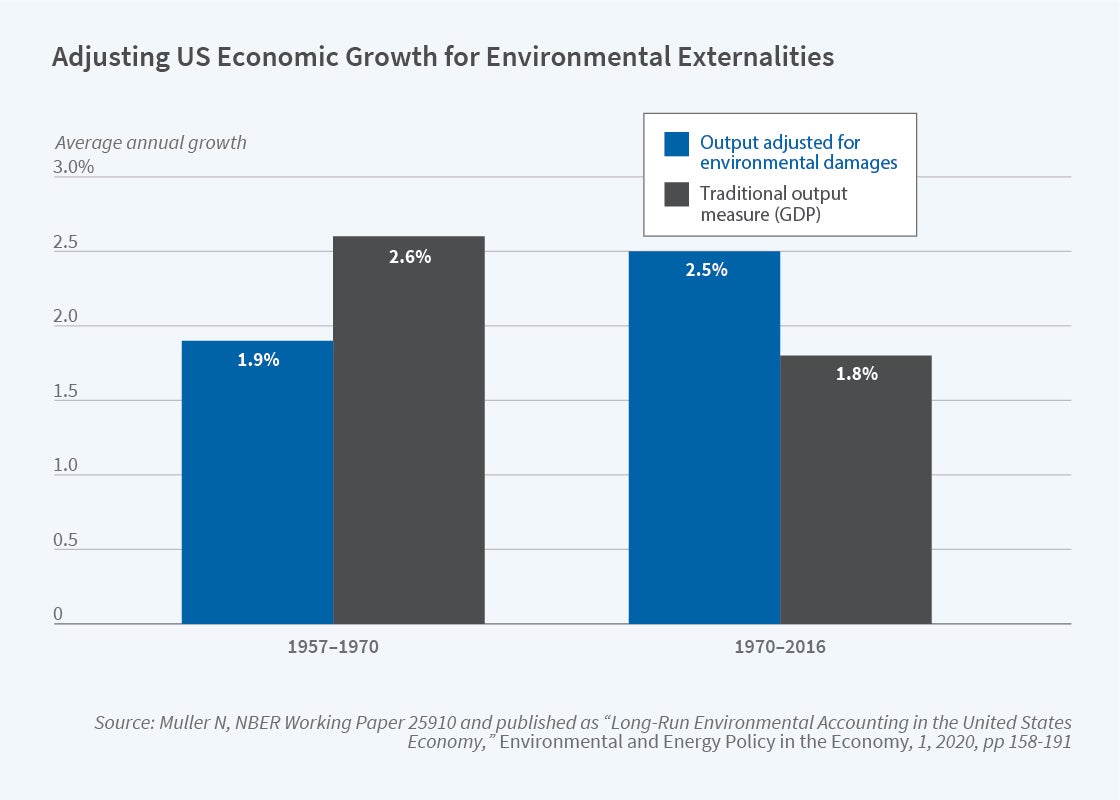
In an NBER summary of his research, Nicholas Muller argues that a big part of the GDP growth slowdown is because we aren’t including environmental damage in the calculation. This is not a new argument (Muller is an important contributor to this literature), and the exclusion of environmental damage is a well-known flaw of GDP, but Muller’s paper does a great job of quantifying how much we are mismeasuring GDP. The following figure is a nice summary of what GDP growth looks like when we consider environmental damage.

2021number3_muller1.jpg

If we use the standard measure of GDP, growth indeed slowed down after 1970. If instead we augment GDP for environmental damages, the period after 1970 was actually faster! The adjustment both slows down growth from 1957-1970, and speeds up growth after 1970.

There are lots of things we can draw from this, but if the results are close to accurate, there is a clear implication: environmental regulations (such as the Clean Air Act) do reduce GDP growth, as traditionally measured. So the skeptics of regulation are partially right: regulation reduces growth!

However, this seems to be a clear case where standard critiques of GDP (as you can find in just about any Econ 101 textbook — yes, really!) need to be incorporated into the complete cost-benefit analysis of the impacts of environmental regulation.

You Shouldn’t Be Writing (All the Time)

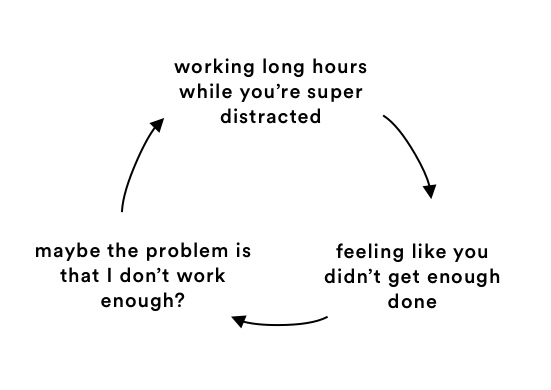
Many people get the idea that they should be working all the time. Certainly many academics do, which for us means a continuous internal reminder that “you should be writing”.

I thought this way in grad school but I don’t anymore. I now almost never work on nights & weekends, and often not on afternoons. Yet I get just as much work done, maybe more, and I’m much happier about it. How can this be?

This post from Ava provides a great explanation. Its very short and you should read it, but I think it illustrates best through its literal illustrations:

Today is a good example. I’m writing this at noon, having just finished the revisions requested by a journal after 3 hours of solid work. Now, rather than start revising the next article & doing a bad job of it, I’ll take the rest of the day off. Real original thought is hard- I know I can do it for about 3 hours on a typical day, I have no one to impress by pretending to work longer, and one way or another the output will speak for itself. As remote work grows, this ability to do the real work and then stop rather than fill time “working” should be available to more people outside of academics.