Top EWED Posts of 2025

These are notable posts from 2025, roughly presented in descending order, starting with the post that got the most views.

  1. Is there a competitive threat to the NBA?  Mike Makowsky wrote, “… let’s put it this way. Why *wouldn’t* the Saudi Arabian PIF invest $5 billion in creating a rival basketball league?”

2. Perspective: This Stock Correction Fear, Too, Will Pass  In March, Scott Buchanan presented “an optimistic take on the current stock market pullback.”   Indeed, the market came back, despite the tariff doomerism of 2025 Spring.

3. The Middle/Working Class Has Not Been “Hollowed Out” Jeremy Horpedahl, corrector of common myths, corrects a common myth.

4. Montana’s New Property Tax System  Jeremy explains “interesting changes to residential property taxes in Montana.”

5. How Scott Bessent Outfoxed Peter Navarro to Get the 90 Day Tariff Pause from Scott: “As Treasury Secretary, Scott Bessent would be particularly sensitized to the interest rate issue…”

6. Spending on Necessities Has Declined Dramatically in the United States Jeremy reminding us that Americans are richer today.

7. Was the US at Our Richest in the 1890s? If you don’t believe Jeremy, consider one of the American Girl Doll historical books I was just reading to my kid. In our book, a little girl sends a letter to Samantha (the 1904 doll) reporting that both of her parents just died from the flu.

8. The Wild Market of July 8th, 2025 James Bailey on the topic that we are all trying to keep up with this year: “Yesterday the S&P 500 shot up 9% on the news that most of Trump’s new tariffs were paused.”

Special mention to Joey Politano who has been trying to follow the news all year and might go insane according to his Twitter/X.

9. No Tech Workers or No Tech Jobs? I (Joy) wish I had more time to write about the market for tech jobs this year. There is some indication that hiring is slowing. Some people still call it a correction from the Covid tech over-hiring spree. Other people take this as a sign that AI reduces the need for human programmers and otherwise “high-skill” humans, while some refute that claim.

10. Other “I, Pencils”  It was fun for several dozen of us economists when everyone else in the world suddenly re-discovered the value of international exchange.

11. The Best Investments of the 1970s James considers “what were the best investments of the 1970’s?”  Interesting to consider the performance of gold in retrospect considering stagflation.

12. Women Have Always Worked More Than Men: Hours of Work Since 1900 I feel seen.

13. Shocked 2025 is shocking, as Mike pointed out in February.

14. Trump’s Economic Policy Uncertainty Along those lines, Zachary Bartsch examines how people are shocked and confused.

15. Salty SALT in the OBBB Zachary explains. “Economically, the SALT makes it cheaper for individuals to live in high-tax jurisdictions. That’s distortionary.” 

16. Illusions of Illusions of Reasoning I wrote, “evaluating AI reasoning is difficult…”

Reflections: We’ve been doing this for 5 years now, as of August 2025. From the analytics I can see, our posts have been the answer to a stranger’s Google query hundreds of thousands of times. Having been the beneficiary of so many other posts from strangers online, I’m happy about that.

Reminder: You can subscribe to our WordPress site to get posts sent to your email. The widget for putting your email in should be on the right side of your screen on a computer, or you can find it by scrolling to the bottom of the home page on a mobile device. WordPress will let you customize your preferences so that you get emails batched once a week if you prefer that to Every Day.

Based on my crude analytics from WordPress, “traffic” to our site from LLMs is low but increasing. It appears that readers occasionally click over from chatgpt.com or perplexity.ai  What we can’t see is if and when our writing is re-molded as part of an LLM answer without attribution. In one sense, writing online is more important than ever, to feed the beast and help get good quality answers to LLM users. On the other hand, old systems in place like upvotes and view counts that used to motivate people to write for free might crumble in the new world.

From me in 2024: “AI companies have money. Could we be headed toward a world where OpenAI has some paid writers on staff? Replenishing the commons is relatively cheap if done strategically, in relation to the money being raised for AI companies.” 

If anyone knows Mark Zuckerberg, please tell him that I’ll write for a fraction of what he’s paying these new engineers. What if he gave out a writing fellowship on the understanding the person never publishes (else the other bots would scrape it) and just exclusively lets Llama train off of original work?

In our case, anyway, we enjoy writing and learn from the process, so we are looking forward to being here every day.

To find prior year “top post” lists, start with: Updated List of Top Posts for 2024
EconTalk Extra on Daisy Christodoulou

I wrote an Extra for the How Better Feedback Can Revolutionize Education (with Daisy Christodoulou) episode.

Can Students Get Better Feedback? is the title of my Extra.

Read the whole thing at the link (ungated), but here are two quotes:

For now, the question is still what kind of feedback teachers can give that really benefits students. Daisy Christodoulou, the guest on this episode, offers a sobering critique of how educators tend to give feedback in education. One of her points is that much of the written feedback teachers give is vague and doesn’t actually help students improve. She shares an example from Dylan William: a middle school student was told he needed to “make their scientific inquiries more systematic.” When asked what he would do differently next time, the student replied, “I don’t know. If I’d known how to be more systematic, I would have been so the first time.” 

Christodoulou also turns to the question many of us are now grappling with: can AI help scale meaningful feedback?

Parkinson’s Law Before Class

Parkinson’s Law, the principle that “work expands to fill the time available for its completion,” was originally intended as a satirical observation on bureaucratic inefficiencies. However, it has broader applications, especially in academic life. When preparing to teach an intermediate microeconomics class, for example, I often find that Parkinson’s Law applies: no matter how much time I dedicate, there’s always more content, illustrative examples, and analysis that could be included. The time invested in preparation creates a tradeoff between covering the broad spectrum of microeconomic theories versus delving deeply into a few core concepts. Either approach can be effective, but Parkinson’s Law reminds me that more preparation doesn’t always imply improvement.

Teaching intermediate microeconomics presents a natural tradeoff between breadth and depth. The course covers foundational concepts like consumer and producer theory, market structures, and welfare economics, and each of these areas is rich with intricate details, special cases, and real-world applications. A broader approach would expose students to more topics, providing a more comprehensive view of microeconomics. Exploring fewer topics fosters more critical thinking and analytical skills. Too much preparation on one topic can detract from time that could be spent introducing other essential concepts… Or other classes for that matter.

Let’s say I have a few hours to prepare for a Monday lecture on consumer theory. I might fall into a spiral of over-preparation: digging into endless variations of consumer surplus or finding additional applications that illustrate price elasticity. This is precisely what Parkinson’s Law warns against; if I pour time into my preparation, then the lecture becomes denser beyond the ideal for my students’ comprehension.

The extra hours may result in a more detailed presentation, but this doesn’t necessarily mean better learning outcomes. A concise, well-planned lecture is often just as effective—if not more so—than one crammed with detail. Overwhelming students with information that won’t stick is bad pedagogy.

Continue reading

Corporate Landlords Make Rent… Lower?

Let’s keep it brief. Stick with me.

You know how perfect diversification means that one bears no idiosyncratic risk? That means that one is willing to pay more for some given return, driving up the price of assets included in such a diversified portfolio. That means that, without an informational advantage, index funds should place upward pressure on the price of assets that compose them. Anyone who invests in individual stocks, again without an informational advantage, would be priced out of the market because they bear idiosyncratic risk and would need to enjoy a risk premium that lowers the maximum price that they are willing to pay.

What about real estate?

Continue reading

Social Cost Irregularities

If you want an economist to support a government intervention, then there are two major sets of logic that they generally find attractive.

The first concerns rate of return and attracts narrower support. If the government can invest in a project in a way that the private sector couldn’t/wouldn’t and the payoff is bigger than the investment by enough, then the project should be built. 

The second set of logic is more accepted more broadly. If there is an externality, and the administration costs are small relative to the change in the externality, then the project should be pursued in order to increase total welfare.

I’m going to criticize and refine the second argument.  I was inspired by a student who wrote about education creating positive externalities for “all”. They kept using the word “all”. And I notated each time “not *all*”. While we might refer to something called ‘social’ cost and value, the existence of externalities does not imply that everyone is affected by the them identically. That’s a representative agent fallacy. The externalized costs and benefits are often irregularly distributed among 3rd parties. This is important because government intervention can impose its own externalities depending on how the administrative costs funded.

I’ll elaborate with two examples that illustrate when an irregular distribution of externalities is a problem and when it isn’t a problem.

Electric Plant Pollution

The first example illustrates how resolving an irregular distribution of externalities can be resolved without issue. Consider a coal-powered electric plant that serves a metropolitan area and creates pollution. That pollution drifts east and passively harms residents in the form of asthma exacerbation and long-term ill health. The residents to the west are unaffected by the pollution, thanks to favorable weather patterns. Obviously, one would rather live on the west side, all else constant (importantly, all else it not always constant and there is a case to be made that there is no externality here).

To resolve the externality, the government imposes a tax per particle on the power plant at a low administrative cost. That’s nice and efficient – we won’t waste our time with means-oriented regulations. In turn, the cost of electricity increases for all metropolitan residents, both those in the east and in the west. Why is this appropriate? Prior to the intervention, the electricity users in the west were enjoying electricity at a low price, failing to pay for the harm done by their consumption. For that matter, the residents to the east are also paying the higher rates, but now they enjoy better health.

In the end, the externality is resolved by imposing a cost on all consumers of the good – which happens to be everyone. This circumstance is not pareto efficient, but it is Kaldor-Hicks efficient. Everyone now considers the costs that they were previously able to impose on others and ignore.

That’s the best case scenario.

Continue reading

The Self-Correcting Property

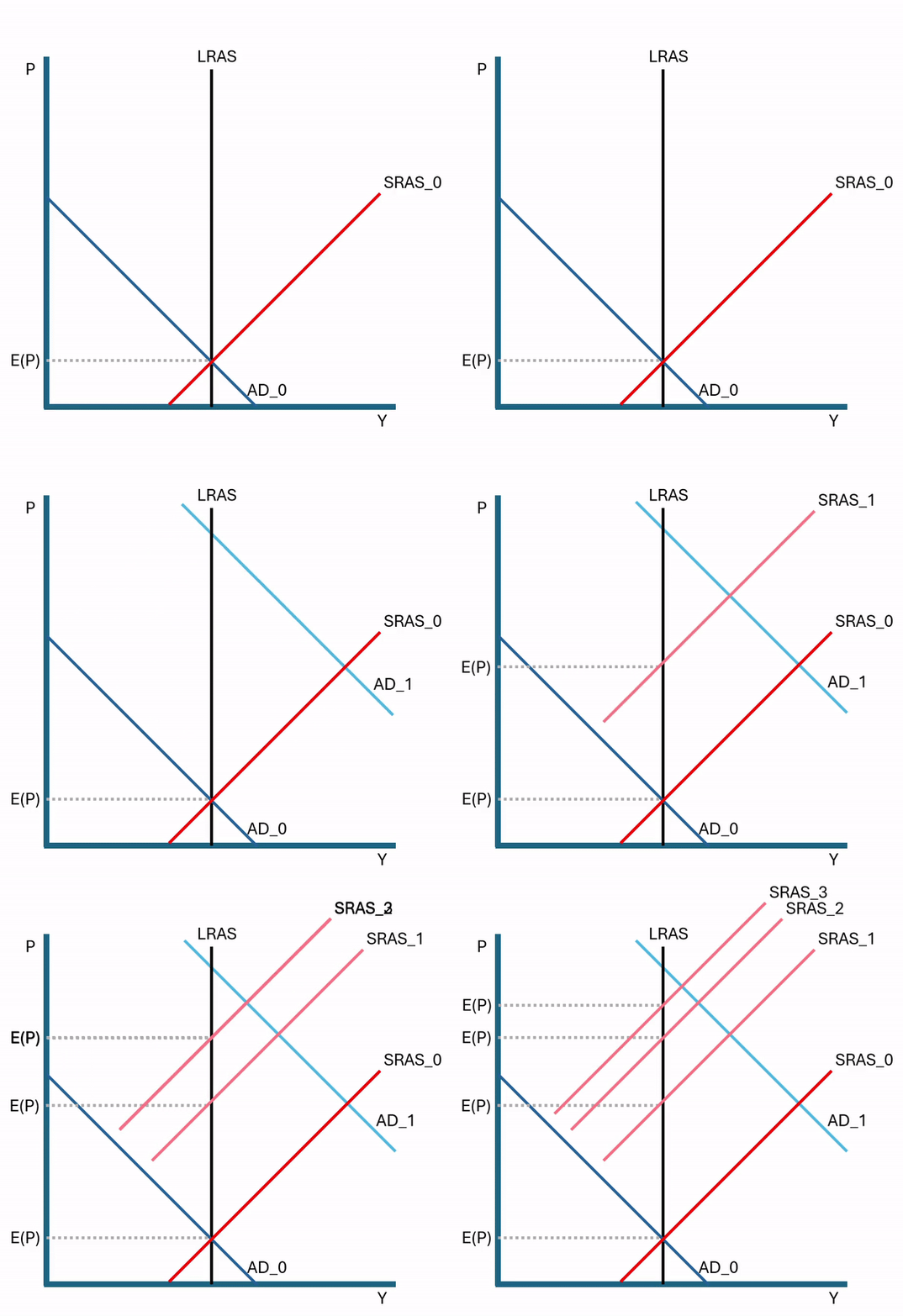
Say that the Federal Reserve Prints a boatload of money. We can use the AS-AD model (aggregate supply & aggregate demand) to evaluate the effect on prices and output.

Printing money results in more total spending in the economy. How much of that initial greater total spending is composed of higher prices versus higher output depends on business marginal costs and whether firms know or expected the greater demand to be due to a broad inflationary event (rather than just greater demand for their particular products).

If there is broad inflation, then the price level that is observed in the economy, including inputs, will deviate from what firms expected. Naturally, firms update their expectations. In so doing, they increase the price that they would require in order to produce every quantity of output. The vertically rising SRAS reflects both of these. The rising itself reflects the higher required prices, and the intersection with the LRAS reflects the expected price level. Notice that updating the expectations places upward pressure on prices, resulting in still higher than anticipated prices. This occurs repeatedly and each time that expectations are updated, the difference between the actual and the expected inflation gets smaller. 

This is what macroeconomists call the “self-correcting property’. The economy will adjust to an AD shock ‘automatically’. Of course, automatic isn’t quite the right word. It’s automatic from the perspective of a policy maker. But the self-correction is the result of an economy’s worth of people bidding for scarce goods and changing their price expectations. It’s automatic in the sense that people don’t need to be told to make the effort. The same results won’t occur if buyers and sellers do nothing, which sounds less automatic.

Since the fundamental productivity of the economy hasn’t changed, we eventually return to the original level of output. If monetary policy doesn’t change in the meantime, then prices will simply rise until the long-run price change composes 100% of the change in total spending. Indeed, given the AS-AD model above, half of the price difference between the current price and the long run price is eliminated each period. Similarly, half of the output gap is eliminated each period. This is why monetary and fiscal stimulus that just focuses on total spending only has short-run output and employment effects. The self-correcting property asserts itself and prices rise in the long run.


*In the figures above, I’ve illustrated an initial sharp price change, though sticky prices and very surprising inflationary stimulus can cause a delay in the initial price adjustment.

**Of course, all of this can be expressed in percent change rather than levels.

Coffee’s Supply & Demand Dance during Prohibition

I’ve written about coffee consumption during US alcohol prohibition in the past. I’ve also written about visualizing supply and demand. Many. Times. Today, I want to illustrate how to use supply and demand to reveal clues about the cause of a market’s volume and price changes. I’ll illustrate with an example of coffee consumption during prohibition.

The hypothesis is that alcohol prohibition would have caused consumers to substitute toward more easily accessible goods that were somewhat similar, such as coffee. To help analyze the problem, we have the competitive market model in our theoretical toolkit, which is often used for commodities. Together, the hypothesis and theory tell a story.

Substitution toward coffee would be modeled as greater demand, placing upward pressure on both US coffee imports and coffee prices. However, we know that the price in the long-run competitive market is driven back down to the minimum average cost by firm entry and exit. So, we should observe any changes in demand to be followed by a return to the baseline price. In the current case, increased demand and subsequent expansions of supply should also result in increasing trade volumes rather than decreasing.

Now that we have our hypothesis, theory, and model predictions sorted, we can look at the graph below which compares the price and volume data to the 1918 values. While prohibition’s enforcement by the Volstead act didn’t begin until 1920, “wartime prohibition” and eager congressmen effectively banned most alcohol in 1919. Consequently, the increase in both price and quantity reflects the increased demand for coffee. Suppliers responded by expanding production and bringing more supplies to market such that there were greater volumes by 1921 and the price was almost back down to its 1918 level. Demand again leaps in 1924-1926, increasing the price, until additional supplies put downward pressure on the price and further expanded the quantity transacted.

We see exactly what the hypothesis and theory predicted. There are punctuated jumps in demand, followed by supply-side adjustments that lower the price. Any volume declines are minor, and the overall trend is toward greater output. The supply & demand framework allows us to image the superimposed supply and demand curves that intersect and move along the observed price & quantity data. Increases toward the upper-right reflect demand increases. Changes plotted to the lower-right reflect supply increases. Of course, inflation and deflation account for some of the observed changes, but similar demand patterns aren’t present in the other commodity markets, such as for sugar or wheat. Therefore, we have good reason to believe that the coffee market dynamics were unique in the time period illustrated above.


*BTW, if you’re thinking that the interpretation is thrown off by WWI, then think again. Unlike most industries, US regulation of coffee transport and consumption was relatively light during the war, and US-Brazilian trade routes remained largely intact.

3 Economic Lessons in 1 Classroom Activity

I teach one hour-forty minute classes on Tuesdays and Thursdays. And I allot only sixty minutes for exams. While student enjoy having the unexpected spare time after an exam, that’s a lot of learning time to miss. Therefore, after my midterms, we do an in-class activity that is a low-stakes, competitive game (and, entirely voluntary).

I call this game “The Extent of the Market” and it has three lessons. Here’s how the game works:

I have a paper handout, a big bag of variety candy, and a URL.  The handout is pictured below-left and lists the types of candy. Each student rates their preference with zero being the least preferred candy. Whether they keep their preferences a secret is up to them. Next, I distribute two pieces of candy to each of them. Importantly, their candy endowment is random and they don’t get to choose or trade (yet). Finally, the URL takes them to a Google sheet pictured below-right where they can choose an id and enter there ‘value score’ under Round 0 by summing the candy ratings of their endowment.

Round 1 is where they get to make choices. I tell students that their goal is to maximize their score and that there is a prize at the end. They are now permitted to trade with anyone at their table or in their row. It doesn’t take long since their candy preferences compose of only the short list, their endowments are small, and the group of potential trade partners is small. When trading is finished, they enter there new scores under round 1.

Lesson #1: Voluntary trade makes people better off.

For each transaction that occurred, someone’s score increased. And in most cases two people’s scores increased. Not everyone will have traded and not everyone will have a higher score. But no one will have a lower score, given the rules and objective of the game. Importantly, the total amount and variety of candy in the little classroom economy hasn’t changed. But the sum of the values in Round 1 increased from Round 0. Trade helps allocate resources where they provide the most value, even if the total amount of physical stuff remains fixed. If it’s a microeconomics class, then this is where you mention Pareto improvements.

Round 2 follows the same process, but this time they may trade with anyone in their quadrant or section of the room. After trading concludes, they enter their scores at the URL under round 2.

Lesson #2: More potential trade partners increases the potential gains from trade.

Again, the variety and total amount of candy in the room remains constant. The only thing that increased was the size of the group of people with whom students could trade. And, they again earn higher scores or, at least, scores that are no lower. People have diverse resources and diverse preferences, and the more of them that you can trade with, the more opportunities to find complementary gains. Clearly, this means that increasing the size of the pool of trading partners is beneficial. One among the many reasons that the USA has had great economic success is that we are a large country geographically with diverse resources and a population of diverse preferences. This means that we have a large common market with many opportunities for mutually beneficial trade. The bigger that we make that common market, the better. Clearly, the implications run afoul of buy-local and protectionist inclinations.

Round 3 proceeds identically with students able to trade with anyone in the room and they enter their scores. At this time the game is finished. It’s important to identify the cumulative class scores across time and to reemphasize lessons #1 & #2. Often, the cumulative value-score will have doubled from Round 0, despite the fixed recourses, making no one worse off. If trading with a row, and then a section, and then the whole class results in gains, then there is an analogy to be drawn to a state, country, and the globe.

Lesson #3: Trade changes the distribution of resources.

Despite an initial distribution of resources, voluntary trade changed that distribution. While no one is worse off and plenty of students are better off, measured inequality may have been affected. Regardless, once a voluntary trade occurs, the distribution of candy and of scores changes. This has implications for redistributive policies. If income or wealth is redistributed in order to achieve some ideal distribution, then the ability to freely trade alters that distribution. The only way to achieve it again would be for another intervention to change the candy distribution by force or threat thereof.  Consider that sports superstar Lebron James became rich by playing basketball for people who like to watch him. If we redistribute his income, and then permit him the freedom to voluntarily play basketball again, then the income distribution will change as he again trades and increases his income.  Similarly, giving money to a low marginal product worker can provide some short-term relief. But, if the worker resumes their prior behavior and productivity, then the same determinants and resulting income persist.

It’s a fund game and students enjoy it. There are some important limitations. #1: There is no production in this game nor incentives for production. This is a feature for the fixed resources aspect of the game. But this is a bug insofar as students think about US jobs vs international jobs. I can assert that the supply side works similarly to the demand side, but students see it less clearly (it helps to draw these parallels throughout the semester). #2: While there is a maximum possible score in the game, the value created in reality is unbounded. There is no highest possible score IRL. #3: There are no feedback dynamics. Taxes associated with income redistribution cause workers to require higher pay, worsening pre-tax inequality. People respond to incentives, and the tax/subsidy component that determined the initial distribution of candy is absent.

It’s a fun game. If you try it, then please let me know how it goes or leave suggestions in the comments.


*By default, Google Sheets anonymizes users. You could have them sign in or use an institutional cloud drive to remove problems that might be associated anonymity.

**If your student can’t handle choosing their own id, then you can just list your students.

***Ideally, each increased trade-group is a superset of the prior round’s potential trading partners.

****You can do more than 3 rounds, but the principle doesn’t change

*****More trade will occur with more students, a greater variety of possible candies, and with more candies endowed per person. You can alter these as needed depending on the classroom limitations.

Arbitrary Framing & Economic Reality

Subjectivism is popular at many universities. I am not talking about the economics kind in which people have a diversity of preferences. I’m talking about the subjectivism that permits different and conflicting assertions of truth to be simultaneously correct. This is where the ‘my truth’ language enters. Having a diversity of feelings is one thing – and unavoidable. Having different practical claims about the material world is another. Many universities have embraced Descartes’s unreliability of the senses writ large. The result is that people of seeming plentiful intellectual capacity dogmatize themselves into speaking such that nothing is considered a default. Nothing “is normal”, there is only “normal for someone”.

It’s a perfectly defensible model of the world. And, as we know, models are applicable only insofar as they’re useful. The subjectivist model is great at describing the diversity of preferences and priorities. The model is bad for math and achieving material ends. Further, it can serve to hinder our understanding of worldly or social phenomena.

Here’s an example.

Consider people who don’t speak the same language. They may or may not have some other compensatory skill. For Mandarin speakers, we can rightfully say that they can’t speak or communicate as effectively with the English-speaking majority of people in the US. We can also say the converse: The English-speaking majority can’t speak Mandarin or communicate as effectively with the Mandarin-speaking minority. There’s a certain symmetrical beauty to being able to interpret reality both ways. It exercises our cerebral cortex.

However, modeling the descriptive statements as intrinsically equivalent harms our ability to sensibly understand and analyze the circumstances. Specifically, we need to talk about opportunity costs.

Consider an urban storeowner in America who speaks only Mandarin. Consider also an only-English-speaking customer who has a question about an item for sale. We can perform the same symmetrical analysis as above saying that they both speak different languages. Importantly, however, they face substantially different opportunity costs in two ways.

First, the English-speaking customer has low-cost alternatives. The language barrier need not be insurmountable. If the transaction cost of more difficult communication is adequate, then the English-speaking customer can go elsewhere relatively easily and purchase from the English-speaking storeowner down the block. They have plenty of low-cost opportunities for gains from trade. Clearly, there is nothing intrinsically advantageous about speaking English. What’s advantageous is speaking the more popular language.

By having access to the larger market, the English speaker has access to greater specialization and to more buyers and sellers. If the language difference is the only difference between two people, then the one who speaks the majority language has an economic advantage. I mean ‘economic’ in both the pecuniary and non-pecuniary sense. Speaking the majority language has the consequence of greater income. But that comes from the very real differences in costs and benefits associated with trade. If the exact same person spoke only a minority language, then their income would be lower along with their lesser access to trading partners. Therefore, while it is symmetrically true that the English speaker can’t speak Mandarin and that the Mandarin speaker can’t speak English, it is not true that they face the same opportunity costs.

Second, and probably more trivially, it may be that most English speakers never have occasion to interact with any Mandarin-only speakers. Whereas Mandarin speakers in the US have constant potential interactions with English speakers. It would therefore belie the costs and benefits to simply say that they symmetrically can’t speak the same language. Indeed, many English-speakers have no motivation nor awareness of potential Mandarin-speaking trade partners. At the same time, in the US, Mandarin speakers would very much have an awareness and occasion to interact with English speakers. While it is true that they don’t speak the same language, they differ by their access to potential trade partners who speak a different language. It wouldn’t reflect the incentives to say that the English speaker is less able to communicate with Mandarin speakers when they largely lack even the awareness of the minority language.

Conclusion

An analysis of English and Mandarin speakers in the US is not a symmetrical analysis. It doesn’t matter whether we frame English speakers has having a lower opportunity cost to trading with Mandarin speakers, or whether we frame Mandarin-speakers as having a higher opportunity cost to trading with English speakers. The economic truth is that the opportunity costs differ, no matter how we might try to equivocate about what normal is. Obviously, the above analysis isn’t specific to Mandarin and English, nor to language necessarily. While framing a circumstance with a default is an arbitrary modelling decision, asserting that two alternatives means or practices have the same opportunity cost or the same productive capacity is indefensible and often doesn’t reflect the underlying economic reality.

Supply & Demand, With gifs

I’ve discussed the ways to teach supply and demand in the past. Regardless, almost all principles of economics classes require a book. But even digital books are often just intangible versions of the hard copy. Supply and demand are illustrated as static pictures, using arrows and labels to do the leg-work of introducing exogenous changes. There’s often a text block with further explanation, but it lacks the kind of multi-sensory explanation that one gets while in a class.

In a class, the instructor can gesticulate and vary their speech explain the model, all while drawing a graph. That’s fundamentally different from reading a book. Studying a book requires the student to repeatedly glance between the words and the graph and to identify the appropriate part of the graph that is relevant to the explanation. For new or confused students, connected the words to one of many parts of a graph is the point of failure.

This is part of why the Marginal Revolution University videos do well. They’re well produced, with context and audio-overlaid video of graphs. It’s pretty close to the in-person experience sans the ability to ask questions, but includes the additional ability to rewind, repeat, adjust the speed, display captions, and share.

Continue reading