About two weeks ago, after my wife and I boarded our plane and settled into our seats, she (seated to my left) noticed that my wedding ring was missing. “Huh,” I said, “That’s weird. I never take it off.” Where could it be? I remembered that just before we left, I had vigorously shaken the water out of a washed, paintbrush, using a whiplike motion of my arm. And that could have worked my ring off my finger, without me noticing. Maybe. If that’s what happened, my ring was lost somewhere in a 10 ft x 20 ft strip of dense grass. Some kind family members spent time on their hands and knees looking there on my behalf, without results.
A replacement genuine 14 karat gold ring might run close to $1000. Cheaper imitation gold rings are available, of course. But, being a techie, I wondered if I could find my ring using a cheap metal detector.
There is a fraternity of serious coin/jewelry hunters, who you see swinging detectors along at the beach. They also enjoy finding artifacts at historical sites, etc. They use more expensive metal detector gear, that really does perform better, especially at distinguishing signals from gold/silver/copper, versus iron/steel trash items. This is essential if you are trying to search large areas efficiently for gold/silver/copper-based coins and jewelry. But since I wasn’t sure my ring was actually lost in that grass, I wanted to minimize my investment. AI helpfully zeroed in on the Bounty Hunter Tracker IV as the cheapest regular metal detector that would perform reasonably well. I got it on Amazon for $71.
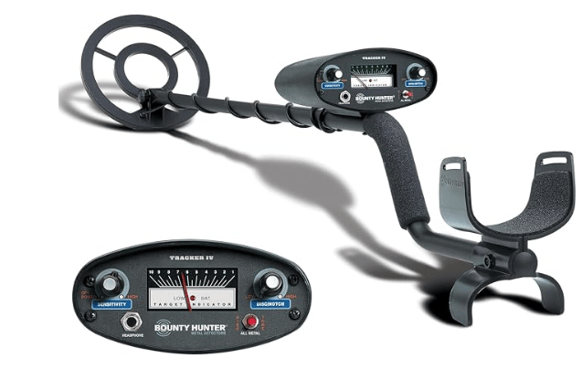
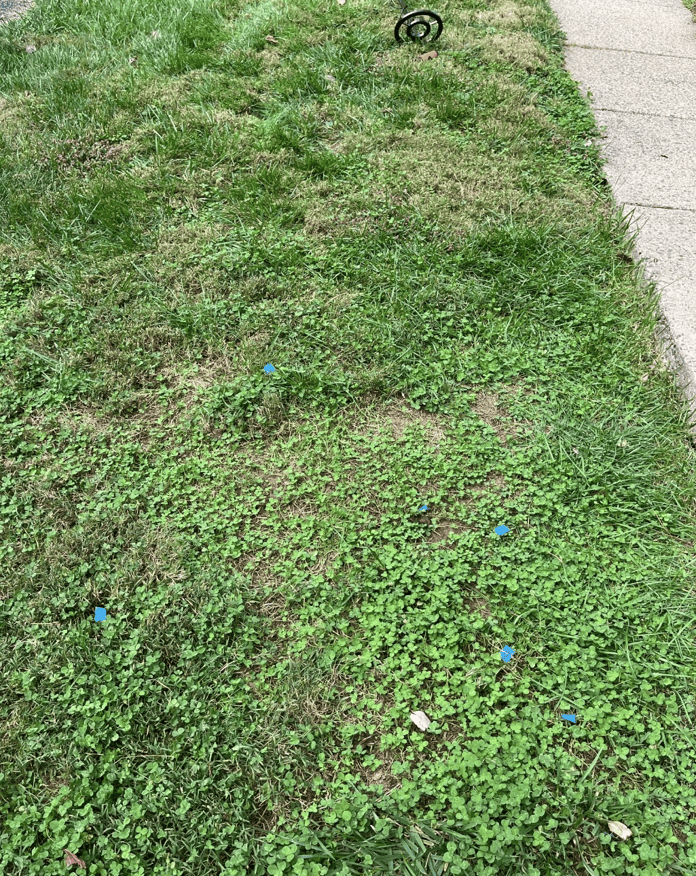
I refer the reader to more extended reviews, such as are here and here and here, for technical details on this device. I will just note here that it did exactly what I needed to do. In its “tone” mode, it is relatively insensitive to small steel objects, and puts out a distinctive low tone for gold (vs. a high beep for copper/silver). As with all such metal detectors, you have to swing it back-and-forth to generate a signal. I swept my 10 x 20‘ area, and got about a dozen hits (beeps). I marked these locations with tabs of blue painter’s tape, some of which are visible in this photo (click to enlarge):
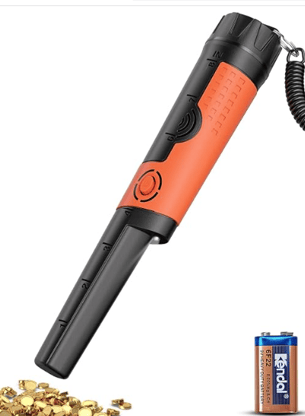
This type of metal detector, with a flat coil that you swing over the ground, is good for detecting the approximate location of metal at or near the surface. But AI recommended also getting a “pinpointer” type detector for zeroing in to the nearest centimeter/ inch. Supposedly the cheapest such pinpointer that gives reasonable performance is the SUNPOW OTMD12, available for $20 on Amazon. It doesn’t discriminate among different metals, it just beeps and vibrates when the tip gets close to metal. See comments on Amazon, and reviews here and here:
I poked around with the pinpointer on the first ten or eleven locations found by the bounty hunter. There was no metal on the surface, but it still beeped on about half of the locations, suggesting there were fairly large pieces of metal buried at some depths.
Then, at the far edge of my 10’ x 20‘ search area, I heard a special low-pitched tone from the Bounty Hunter, indicative of gold or nickel. I poked around with the pinpointer, zeroed in with its beeps, and pulled aside the grass, and…there was my ring, bought by my sweetheart nearly fifty years ago:
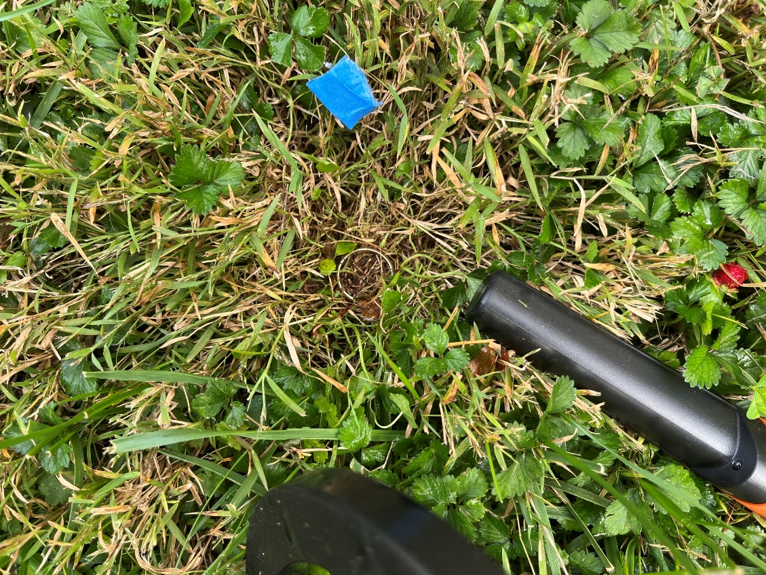
A very welcome sight indeed, which was invisible until the grass over it was pulled aside. Besides my ring, I now have a couple safe, intriguing devices for my grandkids. A way to keep kids occupied is to throw a handful of pennies or other coins out on the lawn and turn the kids loose with the metal detectors.

