Ten Years Gone: Temple University’s Economics PhD

Last weekend brought me back to Temple University, ten years after graduating, for a conference of econ PhD alums. I had so many reactions:

  1. Mixing a research conference with what is effectively a reunion or homecoming is a great idea for a PhD program, and more schools should do it. It brought together alumni from all different years, but it especially felt like a reunion to me since it’s been ten years since I graduated (not that I really know about reunions; I’ve never been to a high school or college one).
  2. Philadelphia in general and Temple University in particular have gotten much nicer (though still gritty). Some of this I expected; the country is getting steadily richer, and it seems like every college is always on a building spree. But as with New Orleans, it is a city still well below its peak population that I first got to know in the aftermath of the great recession. Unemployment in Philly is now well under half what it was the whole time I lived there, and it shows.
  3. Life is short. I was saddened, but not shocked, to hear that one of my professors had died. I was saddened and shocked to hear that one of my fellow students had.
  4. As a kid, whenever I went back to one of my old schools, I usually felt nostalgia mixed with the feeling that everything seemed small. Then I thought this smallness was only about me having grown taller, but now I wonder. At Temple the economics department has changed buildings, but when I went back to the old building everything seemed small, despite me being the same size I was in grad school. But at the time the building loomed so large in my mind; I was so focused on the things that happened there, the classes and tests, the study sessions and writing in the computer lab, what the professors thought, and everything that it all represented. All that apparently made the rooms seem physically larger in a way they now don’t once I have graduated and the professors moved.
  5. Temple PhDs are much more successful than I would have guessed at the time. It was hard for students attending what was then a bottom-ranked program during the Great Recession to be optimistic about our job prospects, especially when we worried we might fail out of the program (a valid concern when, afaik, only 4 of the 11 students in my year finished their PhDs). But things turned out great; just in the past 10 years from a small program there are many people who are tenured or tenure track at decent schools, who have research or important supervisory positions at the Fed, or who are making a name for themselves in the private sector (like Adam Ozimek).
  6. Why have we so exceeded our low expectations? The improving economy helped. Economics PhDs from anywhere turned out to be a valuable degree. Perhaps our training was stronger than we gave it credit for at the time. I see two main tracks for success coming out of a lower-ranked program, where the school’s name alone might not open doors:
    • publish a lot (my strategy), or
    • find some way to get your foot in the door of a major institution like the Fed system or a major bank, then work your way up. The initial way in could be something less competitive, like an internship or a job you don’t necessarily need a PhD for. But once you are in you will be judged mostly on your performance within the institution, not your credentials. In a panel on non-academic jobs, several alums emphasized that conditional on having enough technical skills to get hired, at the margin people/communication skills are much more important to advancement than further technical skills.
  7. Temple’s economics PhD program paused admissions back in 2020, but is aiming to restart with a redesigned program in 2025.

Wages Have Increased Faster Than Prices Since 2019 (Unless You are Rich)

While there are many factors to consider, ultimately whether living standards are rising is a race between prices and income. What does that race look like if we start the clock in December 2019, just before the pandemic?

Whether we use median weekly earnings (the purple line) or average hourly earnings for non-management workers (the blue line), they have clearly won the race with two commonly used price indexes (the CPI-U and the PCEPI). That’s good news, and probably not something you hear very often in the discourse about the economy (unless you spend a lot of time reading this blog).

Continue reading

Rate Cuts Looking Dubious for 2024

Fellow blogger James Bailey and I have noted earlier this year that with inflation having  plateaued well above the target 2% level, and with the ongoing strength in the U.S. economy, the three (initially six) rate cuts that pundits predicted for 2024 may not materialize. In fact, we may get no rate cuts at all. This has implications for many things, including housing markets and investing. Also, high interest on the federal debt, layered on top of insane peacetime budget deficits (neither party is willing to tell we the people that we cannot have big spending and low taxes), means the debt will balloon. Sorry about that, grandkids.

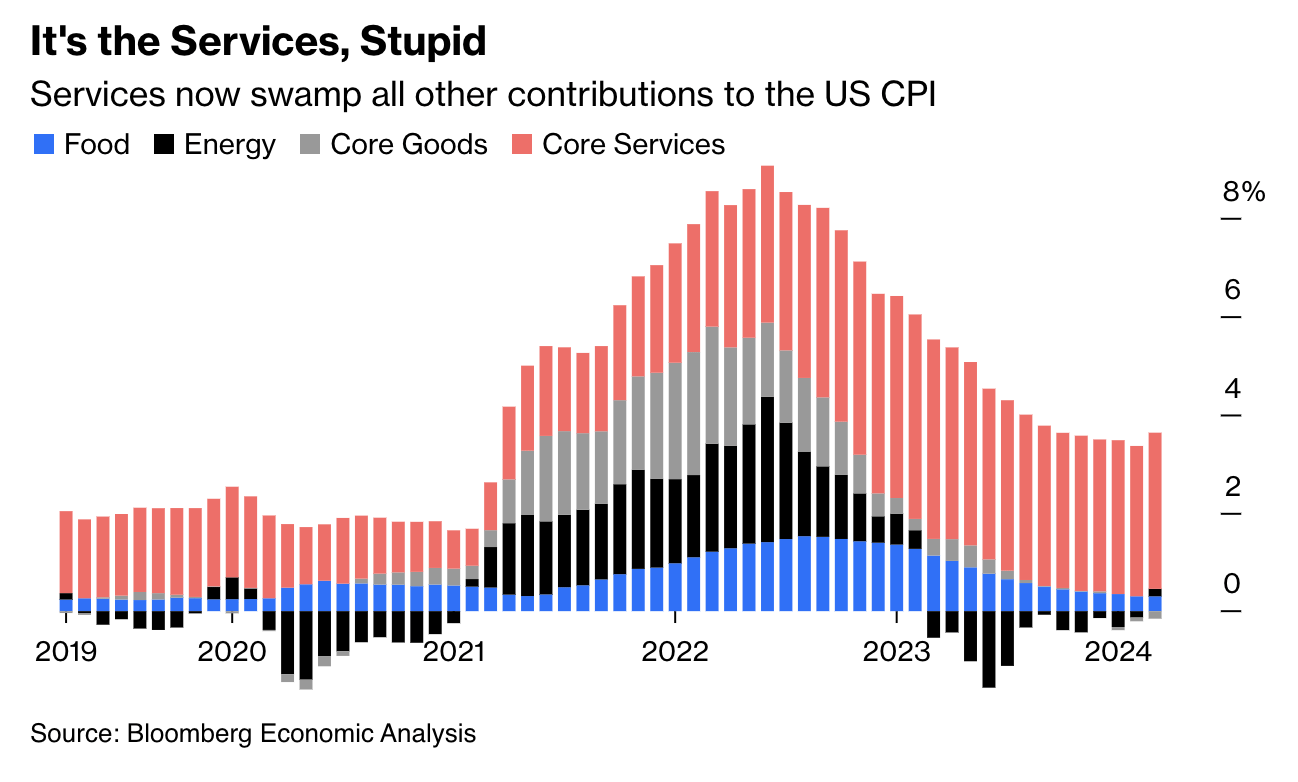
Here is a graphic which illustrates the course of inflation as measured by the Consumer Price Index:

It seems that inflationary expectations are now firmly embedded into wage growth (which is the driver for the increase in Service costs). This mindset way be tough to break. Such is the fruit of the Fed’s head in the sand, inactive approach to raging inflation back in 2021. Instead of nipping it in the bud, they blandly assured us, “It’s just a transitory response to supply shocks”.

One very recent (yesterday) data point is the Census Bureau’s Advance Report on Monthly Sales for Retail & Food Services. This report provides initial data on consumer spending at U.S. retail establishments for March 2024; this is a valuable, timely indicator of current economic activity. According to the Census, Retail Sales expanded by +0.72%, surprising to the upside by +0.32%. This economy just isn’t slowing down.

Slow Landing versus No Landing

The dominant expectation among economists as 2023 drew to a close was that the economy would slow down significantly, gradually enough to justify Fed rate cuts, but it would not crater so fast as to bring on a recession. Now there is more and more talk of a “No Landing” scenario, where GDP keeps chugging along and rates stay high, as the new normal.

Yahoo Finance summarized the recent thinking of Wells Fargo:

The Wells Fargo Investment Institute piled on to that narrative in a note Monday upgrading its outlook for the U.S. economy. While the bank didn’t specifically predict a “no landing” outcome, researchers lifted their gross domestic product growth forecast from just 1.3% for 2024 to 2.5%—the same as last year’s rate of 2.5%.

Wells also said the U.S. unemployment rate will sit at 4.1% instead of 4.7% by the end of 2024. The tradeoff will be slightly higher inflation. The bank now sees U.S. CPI inflation of 3%, instead of its previous 2.8% estimate.

Several factors have been named to account for the unexpected strength of the U.S. economy over the past few years, including record fiscal spending, particularly on infrastructure and semiconductors; the housing market’s resilience to higher rates owing to post–Global Financial Crisis policy changes and supply issues; and even “greedflation.”

But Wells Fargo said the economy has outperformed expectations because financial conditions—a measure of the availability and cost of borrowing, as well as risk and leverage in financial markets—are actually accommodative, despite the Fed’s rate-hiking campaign.

To that point, the Chicago Federal Reserve’s National Financial Conditions Index has been in accommodative territory throughout the Fed’s hiking cycle, and decreased to –0.53 in the week ended April 5—its lowest level since February 2022.

Unless there is a sudden change, it looks unlikely to me that the Fed can cut in May or June or July. If they do not cut by August, the thinking goes, it becomes likely that they will not cut at all this year, because of the optics around the fall election.

Trader Vic’s Mai Tai

The mai tai is a lesson in how a good thing can become a bad thing without the name changing. Followers of politics should take notice. Good rule of thumb: if a mait tai is red it is bad. The simple solution is to always order a Trader Vic’s Mai Tai. If the bartender doesn’t know what that is, just order a Dark and Stormy and live to fight another day.

Trader Vic’s Mai Tai

3/4 ounce fresh lime juice
1/2 ounce orange curaçao
1/4 ounce orgeat
1/4 ounce simple syrup
2 ounces aged rum

If you are looking to abstain from alcohol I suspect you could make a phenomenal limeade by mixing in orgeat and some pineapple juice and then garnishing it with dusted red chili or habanero pepper.

Hanging the curtains back up

There were not a lot of successful female writers and academics in the 1970’s. Maybe I underestimate how many there were, but obviously they would have been in the minority. I’m reading a chapter on the anthropologist Mary Douglas who somehow combined raising three children with remaining active in academia. I read a few pages while helping at the Cub Scout camping trip.

In one of her books, Douglas added an apology for professional duties eclipsing domestic ones: ‘All our things have fallen into neglect while I have been writing, floors unpolished, curtains falling off hooks. I am grateful to my family for their patience.’

page 130 of The Slain God by Timothy Larsen

It is irksome to hear this woman apologizing for working
what is essentially two jobs and performing so well at each one. (I wouldn’t want
to put anyone off reading Larsen, who admires her very much.)

I had planned to do this a year ago, but then I ended up
writing papers on artificial intelligence and doing a bunch of related speaking
engagements. (I love it – anyone who wants a speaker on ChatGPT should invite
me out.) Anyway, I’m going to try to do the equivalent of fixing the
“curtains falling off hooks.” The curtains really do fall down. You
could have a well-functioning household and drawers full of clothes that fit
your children… and then if someone is not engaged in constant warfare… it
will all fall apart in about 6 months.


The Self-Correcting Property

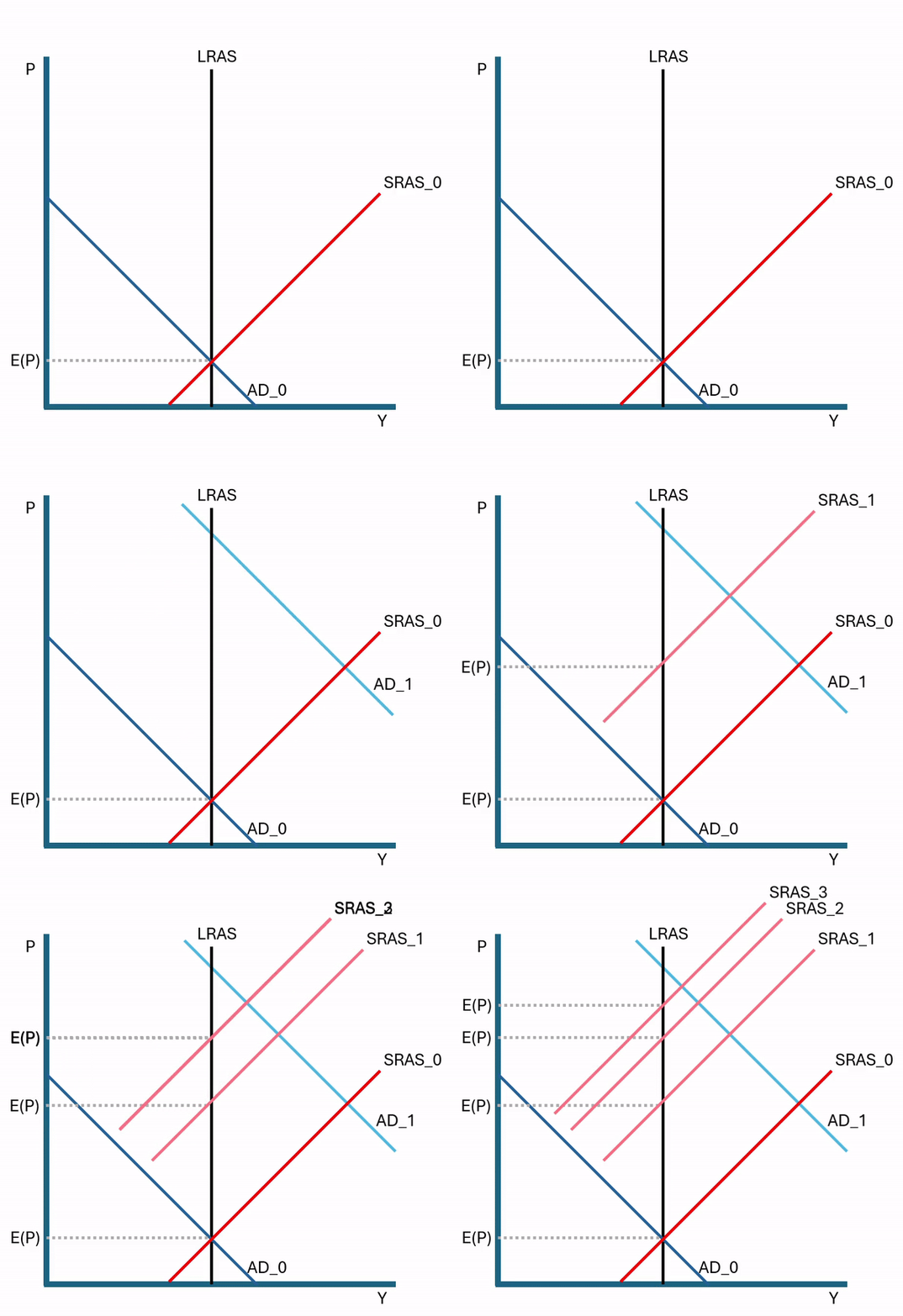
Say that the Federal Reserve Prints a boatload of money. We can use the AS-AD model (aggregate supply & aggregate demand) to evaluate the effect on prices and output.

Printing money results in more total spending in the economy. How much of that initial greater total spending is composed of higher prices versus higher output depends on business marginal costs and whether firms know or expected the greater demand to be due to a broad inflationary event (rather than just greater demand for their particular products).

If there is broad inflation, then the price level that is observed in the economy, including inputs, will deviate from what firms expected. Naturally, firms update their expectations. In so doing, they increase the price that they would require in order to produce every quantity of output. The vertically rising SRAS reflects both of these. The rising itself reflects the higher required prices, and the intersection with the LRAS reflects the expected price level. Notice that updating the expectations places upward pressure on prices, resulting in still higher than anticipated prices. This occurs repeatedly and each time that expectations are updated, the difference between the actual and the expected inflation gets smaller. 

This is what macroeconomists call the “self-correcting property’. The economy will adjust to an AD shock ‘automatically’. Of course, automatic isn’t quite the right word. It’s automatic from the perspective of a policy maker. But the self-correction is the result of an economy’s worth of people bidding for scarce goods and changing their price expectations. It’s automatic in the sense that people don’t need to be told to make the effort. The same results won’t occur if buyers and sellers do nothing, which sounds less automatic.

Since the fundamental productivity of the economy hasn’t changed, we eventually return to the original level of output. If monetary policy doesn’t change in the meantime, then prices will simply rise until the long-run price change composes 100% of the change in total spending. Indeed, given the AS-AD model above, half of the price difference between the current price and the long run price is eliminated each period. Similarly, half of the output gap is eliminated each period. This is why monetary and fiscal stimulus that just focuses on total spending only has short-run output and employment effects. The self-correcting property asserts itself and prices rise in the long run.


*In the figures above, I’ve illustrated an initial sharp price change, though sticky prices and very surprising inflationary stimulus can cause a delay in the initial price adjustment.

**Of course, all of this can be expressed in percent change rather than levels.

New Data on Labor, Income, Finances, and Expectations

The Federal Reserve Bank of Philadelphia just released the first report on a new survey they are conducting quarterly. Some highlights:

Respondents in January 2024 were more positive about their income prospects than respondents a year earlier; one-third believed their income will increase, compared with 29 percent in January 2023

Younger, more affluent, male, or non-White respondents report a more positive outlook, compared with one year prior. Those who are older than 55 or earn less than $40,000 report notably negative changes in their personal outlook, compared with respondents in the same demographic segments surveyed a year ago

When asked about their ability to pay all of their bills in full this month, 23.5 percent of respondents in January 2024 indicated that they could not pay some or any of their bills; this was 1.5 percentage points higher than in January 2023 (22.0 percent) and the highest rate in the last five quarters

Overall, I’d say it shows an economy with mixed performance, but leaning more positive than negative.

Source: My graph of LIFE Survey data

It will be interesting to see if this ends up taking a place in the set of Fed surveys that are always driving economic discussions, like the Survey of Consumer Finances and the Survey of Professional Forecasters. If they keep it up and start putting out some graphics to summarize it, I think it will. My quick impression (not yet having spoken to Fed people about it) is that it will be the “quick hit” version of the Survey of Consumer Finances. It asks a smaller set of questions on somewhat similar topics, but is released quickly after each quarter instead of slowly after each year. If they stick with the survey it will get more useful over time, as there is more of a baseline to compare to.

Grocery Inflation is Under Control, Fast Food Prices Aren’t

Thankfully for US consumers, grocery prices have leveled off. They haven’t fallen, of course, which will still lead to viral complaints about egg prices, etc. But over the past 4 years, wages have almost caught up with grocery prices.

Not so with fast food prices (“limited service meals”), which have definitely outpaced wages over the past 4 years, and continue to grow at an annual rate of about 5 percent (also more than wages).

Furthermore, if we go back to 2014, we see it’s not just a post-pandemic effect on fast food. Prices since 2014 are up 54 percent for fast food according to the BLS, more than the 31 percent overall CPI-U increase and more than average wages (46 percent).

An article from FinanceBuzz puts together some more specific data on a dozen fast-food chains in the US. Consumer favorites for a quick, cheap bite to eat like Taco Bell and McDonald’s have seen menu prices increase by 80 or even 100 percent!

Check out the article for even more specific food item data at each of these restaurants. For example, the most famous of fast-food sandwiches is the Big Mac, which is up from $3.99 in 2014 to $5.99 in 2024, a 50 percent increase. A Whopper meal at Burger King is up 79 percent. All the more reason to seek out deals in the apps, or just good-old in-store discounts, like the “buy one get one for $1” promo at most McDonald’s. This deal would get you two Big Macs for $7, or $3.50 each… less than in 2014! Or since today is Wednesday, you might want to head to Burger King, where Whoppers are $3 at most locations (regular price: around $6).

Price discrimination is alive and well at the drive-thru window, and if you are just ordering from the menu without any discounts, you are really going to feel the pain of inflation.

Recovering My Frozen Assets at BlockFi 2. Scams and More Scams

As I noted last month, the crypto lending firm BlockFi has started to send back to its customers some of their funds which had been frozen for over a year, since the demise of Sam Bankman-Fried’s FTX exchange led to BlockFi likewise vanishing into the mists of Chapter 11.  As BlockFi emerges from bankruptcy, they are reimbursing customers in two tiers. Those who had crypto sitting in their “wallet” on the platform (not lent out and not earning interest), got back 100%. In my case, nearly all my assets on BlockFi were on the lending platform, earning juicy interest. For that class of assets, only a partial recovery is expected. Also, BlockFi will only send to you the crypto (e.g. Bitcoin or USDC) you owned as the crypto coin itself, not as the liquidated dollar value.

Therefore, you must establish an outside crypto wallet, and give them the external wallet address, so they can transfer the coin over a blockchain. This prospect of a connection between BlockFi (or its bankruptcy agent, Kroll) and your crypto wallet has brought out the scammers in force: if they can trick you into connecting them to your wallet, they can suck it dry in a flash.

The first thing I noticed back in early March was the proliferation of web sites that looked legit, but weren’t. When I browsed for “BlockFi withdrawal” or “BlockFi recovery,” up came a number of sites that had “BlockFi” or “Kroll” somewhere in their names, as clickbait. I don’t see any of these sites now, a month later. I assume that either those sites have been taken down as the thieves move onto the next heist, or the search engines have blotted them out.

Bogus phishing emails have also been sent out. Most insidious was an expertly-crafted email that I and other BlockFi customers received. Here is a screen shot of the now-infamous message:

As folks have pointed out, this looks pretty good. It has got the official company logo, and no misspellings. The return address on the email was BlockFi Holdings at www.everbridge.com. Unless you were vigilant, this address did not immediately raise suspicions like a random Gmail address or .ru address might.

Plus, this email was targeted to BlockFi customers, and came right when we were expecting further emails to tell us what steps to take to recovery our funds. How did the thieves have our email addresses? One speculation centers around the “Mother of All Breaches” (MOAB) when the Mailer Lite database was hacked in January. But we know that Kroll’s database was breached last year, where the lost data includes BlockFi customers’ names, email addresses, and amounts held at BlockFi, so that seems a more direct source.

Anyway, lots of BlockFi customers clicked on the link in this email. The thieves were pretty clever. First, they had you scrawl your signature on the screen. So now they have that archived, in order to do further ID theft mischief. And then, they had you connect their app to your wallet, as a trusted dApp. Over on Reddit (here and here), you can read the howls of pain from folks who got their wallets cleaned out. They are not alone – -as of late March, this scam had netted something like $5 million in digital assets.

An eerie thing about crypto is that the holdings at any address on the blockchain are public knowledge, even though you don’t know who the owner of that address is. So crypto sleuth Plumferno was able to display at least one of the BlockFi scammer’s wallets in the process of accumulating stolen assets:

This wallet (0x6C0e83422cD73fFD3A5EC4506638F6A0A8e22b38) currently holds well over $1million in Eth + various tokens combined, and as you can see, this scam is still very active – new victims are showing up in the transaction list quite regularly. Current holdings on Debank:

I am embarrassed to admit that I got taken in by this email. I tried clicking on the links, but fortunately my wallet was empty and my anti-malware resisted having me connect to the phishing site, so I did not lose any coin.  Some takeaways are:

( 1 ) Always be suspicious of emails; especially scrutinize the return address, to make sure it really is from a source you trust. Watch for almost-legit email addresses.

( 2 ) If at all possible, avoid clicking on links in emails; try to go to the actual company website and click links from there.

( 3 ) See ( 1 )

See here for the bittersweet ending to this saga (I did get some money back, but only 27% of my original funds at BlockFi).

Costly introspection

In terms of unexpected introspection, I was careened into by an emotionally wreckless Winnebago :

The answer is obviously job, right? I mean, I’ve dedicated huge swaths of my life to economics. I love economics. Sacrifices have been made, time and emotional toil committed. I would love to be a 20% better economist. That would mean my labor in the profession would be at least 20% more valuable, likely more. The opportunity cost of my time would skyrocket. I would be in more demand as a consultant, would receive more outside offers that would bring me to new heights of salary, likely other parts of the country, other parts of the world even. My work would receive greater attention and scrutiny. I would be fueled by the pressure to keep up with my past self and past contributions. There would be more speculation as to whether I’ve passed my peak, remain worthy of continuing investment. There would be disserations to be written, careers to be made identifying the errors I’ve committed, both subtly important and catastrophically innocent. I’d feel a greater sense of obligation to my, perhaps unearned, talent. To make good on it through service to the world. Sleep, travel, leisure would all feel that much more costly, that much more selfish. Strangers would feel that much more compelled, that much more rewarded, for publicly impugning my abilities and intentions. I would, ironically, probably receive 1000% more public censure as a result of 20% greater capacity. Would my 20% spike in competence come bundled with a thicker skin, independence of thought, and clarity of identity? Would I still be me? What exactly does come out the other side of the teleporter Mr. Scott?

Yeah, so I told the djinn I’d rather be 100% better at golf.