The Growth of Black Wealth and Income in the United States

African Americans have seen much adversity throughout US history, but also significant economic progress. One way to measure economic progress is by looking at wealth. There is a fantastic paper by Derenoncourt and co-authors recently published titled “Wealth of Two Nations: The U.S. Racial Wealth Gap, 1860–2020” which puts together the best historical data on Black and White wealth in the US.

The paper primarily focuses on wealth inequality, and here it paints a pessimistic picture since 1950: while the racial wealth gap was closing up until 1950, it stalled after that, and possibly got worse after the 1980s. But using that same data, we can focus on the growth of Black wealth, and here the results are quite optimistic: inflation-adjusted Black wealth per capita was about 7 times larger in 2019 than it was in 1950. Black wealth per capita has roughly doubled since from about 1992 to 2019 (inflation adjusted).

Here’s the long-run data in a chart, which shows that in 2019 Black wealth per capita was 86 times greater than in 1870 (inflation adjusted). That’s some real economic progress!

For income data, there is no long-run historical series similar to the wealth series that I am aware of, but there are estimates for particular years. For example, Robert Margo estimates that Black income per capita was about $1,500 in 1870 (inflation adjusted to 2022 dollars) and $2,400 in 1900 (once again, inflation adjusted to 2022). Margo says that these data should be comparable to the Census CPS Historical Income tables, and the 2022 estimate from this series is $31,180 for Blacks. This data suggests that Black per capita income is 21 times was it was in 1870, and about 3 times what it was in 1967 (first year in the Census CPS series).

Using the same census data for families, rather than individuals, we can also look at the growth of Black family income since 1967. This data suggests that both median and mean family income for Blacks roughly doubled in inflation-adjusted terms from 1967 to 2022, which isn’t as impressive as the tripling of per capita income, but keep in mind that families are smaller today than in 1967. When we look at the distribution of those incomes, the progress becomes very clear:

In 1967, half of Black families had incomes under $35,000 (in 2022 inflation-adjusted dollars), which is close to the official definition of poverty (depending on family size). By 2022, this had been cut in half: just 25 percent of Black families were under $35,000.

The number of “rich” Black families (incomes of at least $100,000) in 1967 was miniscule: only about 200,000 families, just 5 percent of the total. In 2022, there were an additional 3 million rich Black families, now comprising almost one-third of the total, and outnumbering poor Black families. The number of rich Black families has grown by about 1 million in just the past decade — no stagnation there! The Black “middle class” (incomes between $35,000 and $100,000) now has 4.5 million families — the same number as the total count of Black families in 1967.

Of course, there is still much work to be done on economic progress in the US. But the astonishing economic progress of Blacks since emancipation and since the Civil Rights era is worth celebrating, even if racial gaps haven’t closed much recently.
How To Drive a Turbocharged Car, Such as a Honda CR-V

My old Honda Civic was a fairly small sedan. It had a 1.8 liter engine, that generated about 140 horsepower. It would not win any drag races, but had functional acceleration.

I recently got a Honda CR-V, a much larger, heavier vehicle. I was nonplussed to learn that it only had a 1.5 liter engine. Would I have to get out and push it up steep hills? As it turns out, this small engine can crank out some 190 horsepower. Given the size of this crossover SUV, this still does not make for a peppy drive, but at least I can actually pass another car as needed.

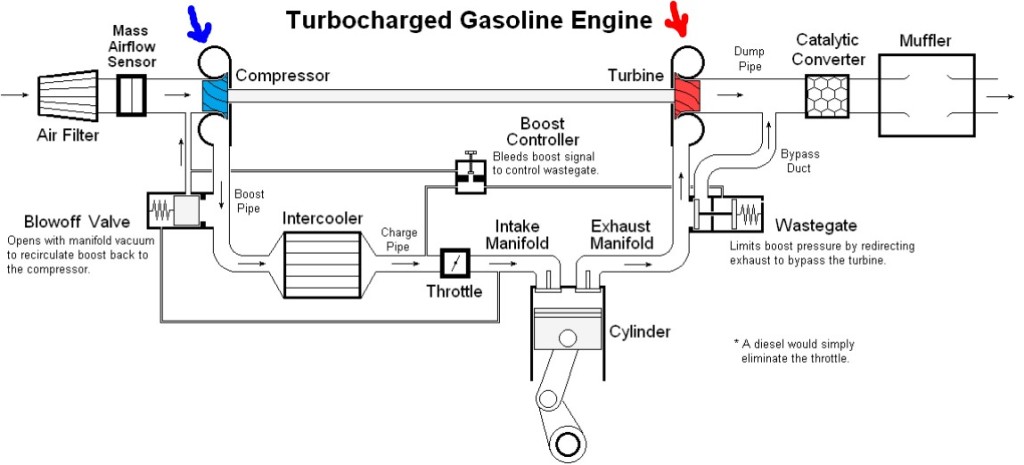
This high power with small engine displacement is made possible by the magic of turbocharging. As the (hot, expanded) exhaust gas leaves the engine, it goes through a turbine and makes it spin. A connected power shaft then spins a compressor, which takes outside air and jams it into the engine at higher pressure, i.e., higher density. With extra air stuffed into the engine cylinders, the engine can inject extra gasoline (keeping the air/fuel ratio roughly constant) – -and voila, high power output.

A schematic of this setup is shown below. I drew in a red arrow to mark the exhaust turbine, and a blue arrow for the intake air compressor. The rest should be fairly self-explanatory.

Source: Wikipedia

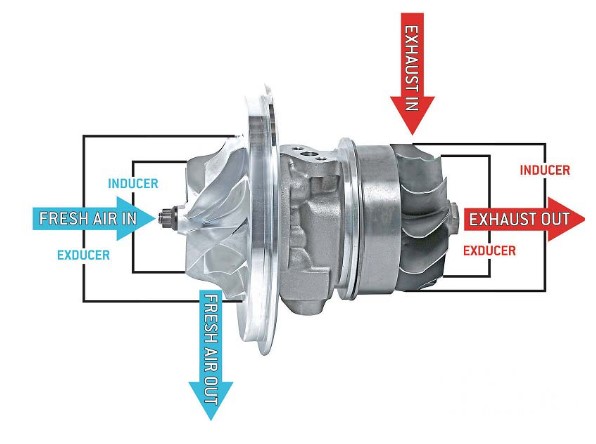
Also, here is a diagram of what the actual turbo hardware might look like:

Source: TurbochargersPlus

When the engine is turning at low-moderate speeds (say below 2000-3000 RPM), the turbine is doing relatively little, and so you are essentially driving around with a small (1.5 L) engine. This is good for gas mileage. When you floor it, the engine spins up and the turbo boost kicks in, giving considerably more power. [1]

What’s not to like? Apart from the potential maintenance headache of a rapidly spinning, complex chunk of precision machinery, there are a couple of issues with driving turbocharged engines that drivers should be aware of. There are articles  and videos (see good comments there) that address these and other issues in some detail.

( A ) Time Lag Before Turbo Boost Kicks In

With a normal non-turbo engine, you can feel the power kick in nearly immediately when you depress the pedal. The pedal opens the throttle, and instantly the engine is gulping more air (and fuel).

With a turbo, there can be a detectible time lag. The engine must rev up until the turbo effect starts to kick in, and then it spins faster, and there is more air shoved into the engine. As long as you know this, you can drive accordingly. This might be a life and death matter if as you are in the middle of passing a car on a two-lane highway, and suddenly an oncoming car appears in your passing lane. If you are not up to full power by that point, such that you can complete the passing quickly, you could become a statistic. I have only faced that situation maybe once every ten years in my driving, but it should be figured in.

The actual time lag varies from one model to another. I’d suggest just testing this out on your car. In some safe driving scenario, floor it and assess how much of a lag there is.

( B ) Don’t turn the engine off immediately if it has been running fast.

The thought here is to let the engine slow down to idle, and maybe even cool down a hair, before turning it off. The reason is that if the engine is revving at say 2000 rpm, and you suddenly turn the engine off, the oil pumping action stops, but the turbo is still spinning away in there. Having the turbine spinning away with no oil circulation can wreck the bushings.

There are articles  and videos (see good comments there) that address these and other issues in some detail.

Comment on Driving Honda CR-V Turbo Engine

Various engines have been used in CR-Vs. The 1.5 L turbo has been common in North America since 2017. It was designed to not have a very noticeable lag, in the sense that nothing happens for two seconds, and then the vehicle lurches forward. The turbo effect reportedly starts to kick in at 2000 rpm. However, this effect is progressive, so the power at 2000-3000 rpm is still modest. So, if you just push halfway down on the accelerator, the response is modest. If you floor it, the engine will within a second or two scream up to like 5000 rpm, and then start to really accelerate. That said, I have a visceral aversion to revving my engines that close to the red-line danger zone on the tachometer (my previous non-turbo cars I never took above about 3500 rpm, never needed to). Even with all that revving, the net acceleration is still modest.

Another factor with driving a CR-V is the “Econ” fuel-saving engine setting. When that is on, it seems to prevent the engine from revving over about 3500 rpm. So, if I plan to pass another car, or if I need power for some other reason, I need to remember to punch the leafy green Econ button to turn off this mode.

The bottom line is that I will think twice, maybe thrice, before passing another vehicle on a two-lane road in my CR-V.

ENDNOTE

[1] That is the theory anyway: great gas mileage most of the time, and bursts of power available for those rare times when you need it. The reality seems to be a little different. There may be reason to believe that turbocharged small engines give good idealized EPA test gas mileage numbers, but that in ordinary driving, the results are not so great. The turbo is never actually turned off, it just contributes more or less at various RPMs. The turbocharging forces the manufacturer to adjust the air/fuel mixture to be less efficient, in order to avoid knock. So, the manufacturer may be essentially manipulating things to look good on the EPA tests.  A larger engine, where some of the cylinders are shut off when not under load, may be more efficient. See video.

What is the optimal amount of time off?

I don’t have an answer, research to reference, or really even ideas regarding the optimal amount of time off. All I know is that I took 5 days off – actually off, with no work to speak of other unless you count reading short stories on a couch as work – and I feel much better. Not that I felt bad before, it wouldn’t even be that noticeable save that working is easier now. Focusing is easier, following through is easier. Enjoying the work is the easier. I never stopped caring, but I had become easier to distract.

Five days isn’t a lot. I didn’t go off the grid for a month. I didn’t try on a new identity in a foreign country. I ate granola with my wife at top of a beautiful mountain, so maybe that counts as eating, praying, and loving. I liked my job before and I still like it now, but sometimes you can end up too deep and caring a little too much, particularly about the bureaucratic details and status-oriented outcomes.

I am firmly team vacation, but with the caveat that your vacation actually be a vacation. Something stimulating and relaxing at the same time. The kind of thing where you are excited to get out of bed to do stuff but also free to do nothing for long languid periods of time, preferably with the hot or cold beverage of your choice.

As for the question presented at the outset, I still don’t know what the optimal length of time is. My closest approximation is a period of time long enough that don’t remember what you were working on the day that you left but not so long that the discontinuity becomes a source of stress and anxiety.

Or maybe its a schedule – 3 days every 2 months, 1 week every year, 1 month every 3 years, 3 months every decade. I’d love to say there is no rule, that you’ll know what you need when you need it, but I didn’t. I might schedule rereading this post every 6 months though.

Trusting ChatGPT at JBEE

You can find my paper with Will Hickman “Do people trust humans more than ChatGPT?” at the Journal of Behavioral and Experimental Economics (JBEE) online, and you can download it free before July 30, 2024 (temporarily ungated*).

*Find a previous ungated draft at SSRN.

Did we find that people trust humans more than the bots? It’s complicated. Or, as we say in the paper, it’s context-dependent.

When participants saw labels informing them (e.g. “The following paragraph was written by a human.”) about authorship, readers were more likely to purchase a fact-check (the orange bar).

Informed subjects were not more trusting of human authors versus ChatGPT (so we couldn’t reject the null hypothesis about trusting humans, in that sense). However, Informed subjects were significantly less likely to trust their own judgement of the factual accuracy of the paragraph in the experiment, relative to readers who saw no authorship labels.

Some regulations would make the internet more like our Informed treatment. The EU may mandate that ChatGPT comply with the obligation of: “Disclosing that the content was generated by AI.” Our results indicate that this policy would affect behavior because people read differently when they are forced to think up front about how the text was generated.

Inspiration for this article on trust began with observing the serious errors that can be produced by LLMS (e.g. make up fake citations). Our hypothesis was that readers are more trusting of human authors, because of these known mistakes by ChatGPT. This graph shows that participants trust (left blue bar = “High Trust”) statements *believed* to have been written by a human (so, in that sense, our main hypothesis has some confirmation).

Conversely, in the Informed treatment, readers are equally uncertain about text written either by humans or bots. Informed readers are suspicious, so they buy a fact-check. “High Trust” (the blue bar) is the option that maximizes expected value if the reader thinks the author has not made factual errors.

So, in conclusion, we find that human readers can be made more suspicious by framing. In this case, we are thinking of being cautious and doing a fact-check as a good thing. The reason is that, increasingly, the new texts of society are being written by LLMs. Evidence of this fact has been presented by Andrew Gray in a 2023 working paper: “ChatGPT “contamination”: estimating the prevalence of LLMs in the scholarly literature” Note that is the scholarly literature, not just the sports blogs or the Harry Potter – Taylor Swift- crossover fanfics.

What about the medical doctors? What is the authority on whether you are getting surgery or not? See: “Delving into PubMed Records: Some Terms in Medical Writing Have Drastically Changed after the Arrival of ChatGPT”

Continue reading

Future Consumption Has Never Been Cheaper

Economics as a discipline really likes to boil things down to their essentials. There are plenty of examples. How many goods can one consume? Just two, bread and not bread. How can you spend your time? You can labor or leisure. How do you spend your money? Consume or save. It’s this last one that I want to emphasize here.

First, all income ultimately ends up being spent on consumption. Saving today is just the decision to consume in the future. And if not by you, then by your heirs. One determinant of inter-temporal consumption decisions is the real rate of return. That is, how many apples can you eat in the future by forgoing an apple eaten today? The bigger that number is, the more attractive the decision to save.

Further, since most saving is not in the form of cash and is instead invested in productive assets, we can also characterize the intertemporal consumption problem as the current budget allocation decision to consume or invest. The more attractive capital becomes, the more one is willing to invest rather than consume. The relative attractiveness between consumption and investment informs the consumption decision.

How attractive is investment? I’ll illustrate in two graphs. First, if the price of investment goods falls relative to consumption goods, then individuals will invest more. The graph below charts the price ratio of investment goods to consumption goods. Relative to consumption, the price of investment has fallen since 1980. Saving for the future has never been cheaper!

Of course, as in a price taker story, I am assuming that individuals don’t affect this price ratio. Truly, prices are endogenous to consumption/investment decisions. For all we know, it may be that the prices of investment goods are falling because demand for investment goods has fallen. But that doesn’t appear to be the case.

Continue reading

Woodstock for Nerds: Highlights from Manifest

I’m back from Manifest, a conference on prediction markets, forecasting, and the future. It was an incredible chance to hear from many of my favorite writers on the internet, along with the CEOs of most major prediction markets; in Steve Hsu’s words, Woodstock for Nerds. Some highlights:

Robin Hanson took over my session on academic research on prediction markets (in a good way; once he was there everyone just wanted to ask him questions). He thinks the biggest current question for the field is to figure out why is the demand for prediction markets so low. What are the different types of demand, and which is most likely to scale? In a different talk, Robin says that we need to either turn the ship of world culture, or get off in lifeboats, before falling fertility in a global monoculture wrecks it.

Play-money prediction markets were surprisingly effective relative to real-money ones in the 2022 midterms. Stephen Grugett, co-founder of Manifold (the play-money prediction market that put on the conference), admitted that success in one election could simply be a coincidence. He himself was surprised by how well they did in the 2022 midterms, and said he lost a bunch of mana on bets assuming that Polymarket was more accurate.

Substack CEO Chris Best: No one wants to pay money for internet writing in the abstract, but everyone wants to pay their favorite writer. For me, that was Scott Alexander. We are trying to copy Twitter a bit. Wants to move into improving scientific publishing. I asked about the prospects of ending the feud with Elon; Best says Substack links aren’t treated much worse than any other links on X anymore.

Razib Khan explained the strings he had to pull for his son to be the first to get a whole genome sequence in utero back in 2014- ask the hospital to do a regular genetic test, ask them for the sample, get a journalist to tweet at them when they say no, get his PI’s lab to run the sample. He thinks crispr companies could be at the nadir of the hype cycle (good time to invest?).

Kalshi cofounder Luana Lopes Lara says they are considering paying interest on long term markets, and offering margin. There is enough money in it now that their top 10 or so traders are full time (earning enough that they don’t need a job). The CFTC has approved everything we send them except for once (elections). We don’t think their current rule banning contest markets will go through, but if it does we would have to take down Oscar and Grammy markets. When we get tired of the CFTC, we joke that we should self certify shallot futures markets (toeing the line of the forbidden onion futures). Planning to expand to Europe via brokerages. Added bounty program to find rules problems. Launching 30-50 markets per week now (seems like a good opportunity, these can’t all be efficient right?).

There was lots else of interest, but to keep things short I’ll just say it was way more fun and informative doing yet another academic conference, where I’ve hit diminishing returns. More highlights from Theo Jaffee here; I also loved economist Scott Sumner’s take on a similar conference at the same venue in Berkeley:

If you spend a fair bit of time surrounded by people in this sector, you begin to think that San Francisco is the only city that matters; everywhere else is just a backwater. There’s a sense that the world we live in today will soon come to an end, replaced by either a better world or human extinction. It’s the Bay Area’s world, we just live in it.

Was 2022 The “Deadliest Year on Record” For Children in Arkansas?

In my Inbox I read the following sentence, summarizing an article on child health in Arkansas: “The latest Annie E. Casey Foundation KIDS COUNT Data Book shows 2022 was the deadliest year on record for child deaths in Arkansas.”

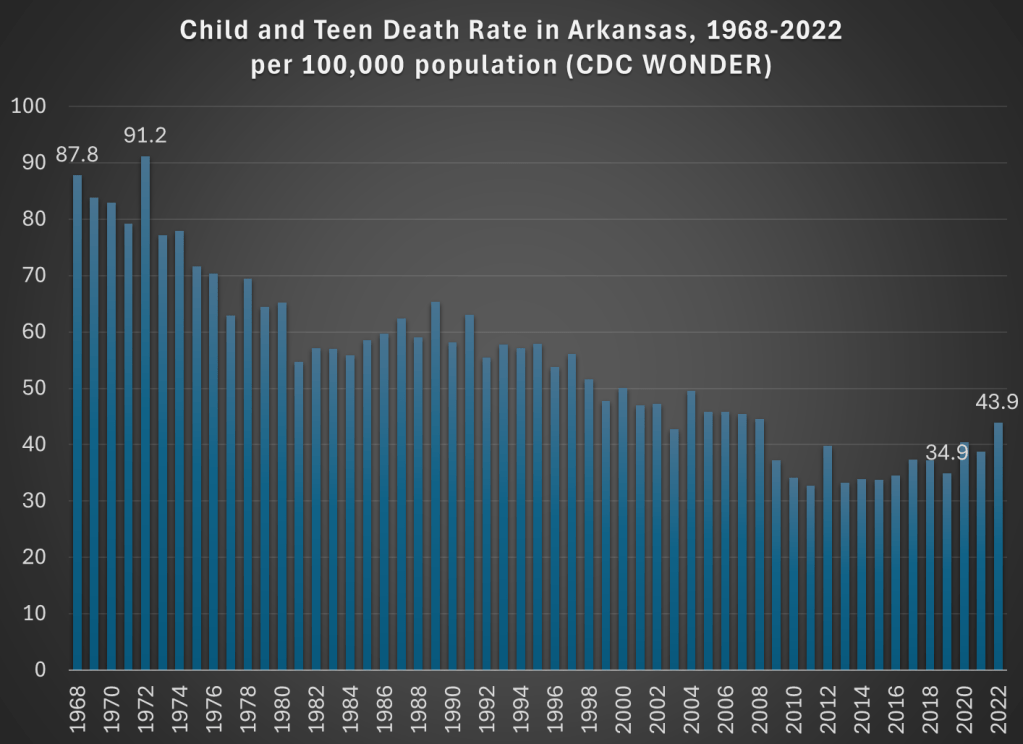
Deadliest on record! That certainly grabbed my attention. I clicked the link and read the article. Indeed, they emphasize three times that 2022 was the “deadliest year” for kids in Arkansas, including with a chart! And the chart does seem to support the claim: in 2022 there were 44 child and teen deaths per 100,000 in Arkansas, higher than any year on the chart.

But wait a minute, this chart only goes back to 2010. Surely the record goes back further than that? Indeed it does. It took me three minutes (yes, I timed myself, and you have to use 4 different databases) to complete the necessary queries from CDC WONDER to extract the data to replicate their 2010-2022 chart, and to extend the data back a lot further: all the way to 1968 (though in 30 seconds I could have extended it back to 1999).

And what do we find in 1968? The death rate for children and teens in Arkansas was twice as high as it was in 2022. Not just a little higher, but double. With some more digging, I might be able to go back further than 1968, but from the easily accessible CDC data, that’s as far back as “the record” goes. Of course, I knew where to look, but I would hope that a group producing a data book on child health also knows where to look. And you don’t need to extend this very far past the arbitrary 2010 cutoff in the article quoted: 2008 and every year before it was more deadly than 2022 for children in Arkansas. Here’s a chart showing the good long-run trend:

Now there is a notable flattening of the long-run trend in the past 15 years or so, and a big reversal since 2019. What could be causing this? The article I read doesn’t get specific, but here’s what they say: “The state data isn’t broken out into cause of death, but firearm-related deaths have become the leading cause of death among U.S. teens in recent years. Deaths from accidents such as car crashes account for most child deaths.”

But using CDC WONDER, we can easily check on what is causing the increase since 2019. “Firearm-related deaths” is an interesting phrase, since it lumps together three very different kinds of deaths: homicides, suicides, and accidents. And while it is true that “deaths from accidents” are the leading category of deaths for children, this also lumps together many different kinds of deaths: not only car crashes, but also poisonings, drownings, or accidental firearm deaths.

For Arkansas in 2022, here are the leading categories of deaths for children and teens (ages 1-19) if we break down the categories a bit:

  • Homicides: 66
  • Non-transport accidents: 58 (largest subcategories: poisonings/ODs and drowning)
  • Transport accidents: 52 (almost all car crashes)
  • Suicides: 24
  • Birth defects: 16
  • Cancers: 14
  • Cardiovascular diseases: 13

And no other categories are reported, because CDC WONDER won’t show you anything smaller than 10 deaths.

We might also ask what caused the increase since 2019, especially since this a report on child health and possible solutions. The death rate increased by 9 deaths per 100,000, and over 80% of the increase is accounted for by just two categories: homicides and non-transport accidents. Car crashes actually fell slightly (though the rate increased a bit, since the denominator was also smaller). Deaths from suicides, cancer, and heart diseases also declined from 2019 to 2022 among children in Arkansas, and these are the three on the list above that we would probably consider the “health” categories. Things actually got better!

But the really big increase, and very bad social trend, is the category of homicides. Among children and teens in Arkansas, it rose from 35 deaths in 2019 to 66 deaths in 2022. It almost doubled. That’s bad! But homicides are not mentioned anywhere in the article on this topic that I read (“firearm-related deaths” is the closest they get). And while car accidents are definitely a major problem, they didn’t really increase from 2019 to 2022 (among kids in Arkansas).

One more thing we can do with CDC WONDER is break down the homicides by age. The numbers so far are looking at a very broad range of children and teens, from ages 1-19. As I’ve written about before, the is a huge difference between homicide rates for older teens versus all of the kids. Indeed for Arkansas we see the same pattern, such as when I run a CDC WONDER query for single-years of age: only the ages 17, 18, and 19 show up (remember, anything less than 10 deaths won’t register in the query).

Breaking it down by five-year age groups, we see that 53 of the 66 homicides (in Arkansas among kids and teens) were for ages 15-19, that is 80% of the total. And further if we run the query by race, we see that 40 of the 66 homicides were for African Americans age 15-19. This is clearly a social problem, but it’s an extremely concentrated social problem. And the increase for older teen Blacks has been large too: it was just 17 deaths in 2019, more than doubling to 40 homicides in 2022.

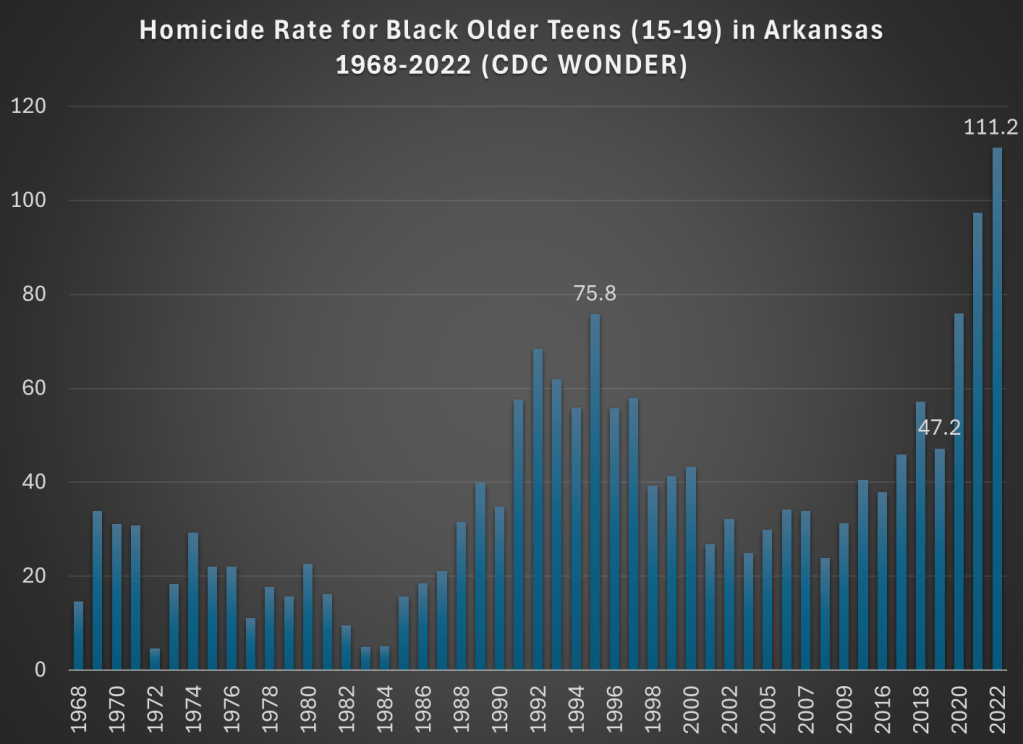
Now, small numbers can jump around a bit, so just looking at 2019 and 2022 might be deceptive. What if we had a longer annual series to look at? Again, CDC WONDER allows us to do this. Here is the chart for homicides among older Black teens in Arkansas:

This is a dramatic chart. The steady rise in homicides among this demographic since 2019 is staggering. Not only the dramatic increase, but notice that 2021 and 2022 are much worse than the crime wave of the early 1990s, which also jump out in this chart. The homicide rate for older Black teens in 2022 was almost 50 percent higher than 1995, the prior worst year on record.

So is there a problem with child and teen deaths in Arkansas? Yes! But with just a few minutes of searching on CDC WONDER, I think we can get a much better picture of what is causing it than the article I read summarizing the report. Indeed, if we read the full national report, the word “homicide” is only mentioned once in a laundry list of many causes of death.

The most important part of addressing a social problem, such as “deadliest year on record for child deaths in Arkansas” is to know some basic details about what is causing a bad social indicator to worsen. Hopefully after reading this blog post you know a little bit more. If you want to read my summary of the research on how to reduce deaths from firearms, see this June 2022 post.

Is the Monster Jobs Report Just a Head-Fake?

Financial markets have sustained themselves for nearly two years now on the hope that within 1-2 quarters, the Fed will finally relent and start lowering interest rates. This hope gets dashed again and again by data showing stubbornly persistent high employment, high GDP growth, and high inflation, but the hope refuses to die.

Long-term interest rates had been falling nicely for the last month, based on expectations of rate cuts in the fall. Then came Friday’s jobs report, and, blam, up went 10-year rates again.  The Bureau of Labor Statistics (BLS) published its “Establishment” survey of data gleaned from employers. Non-farm payrolls rose by US 272k.  This was appreciably higher than the 180k consensus expectation.

The plot below indicates that this number fits into a trend of essentially steady, fairly high employment gains (suggesting ongoing inflationary pressures):

There are fundamental reasons to take the BLS Establishment figures with a grain of salt. They have a history of significant revisions some months after first publication. Also, BLS uses a  “birth/death” model for small businesses, which can account for some 50% (!) of the job gains they report.  [1]

Another factor is that all of the net “jobs” created in recent quarters are reported to be part-time. According to Bret Jensen at Seeking Alpha, “Part-time jobs rose 286,000 during the quarter, while full-time jobs fell by just over 600,000. This is a continuation of a concerning trend where over the past year, roughly 1.5 million part-time positions were created while approximately one million full-time jobs were lost. This difference is that the BLS survey does not account for people working two or three jobs, which are now at a record as many Americans have struggled to maintain their standard of living during the inflationary environment of the past couple of years.”

It seems, then, that this week’s huge “jobs added” figure is not to be taken as indicating that the economy is overheated. However, it is still warm enough that rate cuts will be postponed yet again. A different BLS survey (“Household”) showed unemployment creeping up from 4.0% to 4.1%, which again suggests a more or less steady and fairly robust employment picture.

As far as drivers of inflation, I would look especially at wage growth. That is fitfully slowing, but not nearly enough to get us to the Fed’s 2% annual inflation target. My sense is that ongoing enormous federal deficit spending will keep pumping money into the economy fast enough to keep inflation high. High inflation will prevent significant interest rate cuts, assuming the Fed remains responsible. The interest payments on the federal debt will balloon due to the high rates, leading to even more deficit spending.  If we actually get an economic downturn, leading to job insecurity and a willingness of workers to accept slower wage growth in the private sector, the federal spending floodgates will open even wider.

This makes hard assets like gold look attractive, to hedge against inflating U.S. dollars. This is one reason China has been quietly selling off its dollar hoard, and buying gold instead.

[1] For more in-depth treatments of employment statistics, see posts by fellow blogger Jeremy Horpedahl, e.g. here.

Latest from Leopold on AGI

When I give talks about AI, I often present my own research on ChatGPT muffing academic references. By the end I make sure that I present some evidence of how good ChatGPT can be, to make sure the audience walks away with the correct overall impression of where technology is heading. On the topic of rapid advances in LLMs, interesting new claims from a person on the inside can by found from Leopold Aschenbrenner in his new article (book?) called “Situational Awareness.”
https://situational-awareness.ai/
PDF: https://situational-awareness.ai/wp-content/uploads/2024/06/situationalawareness.pdf

He argues that AGI is near and LLMs will surpass the smartest humans soon.

AI progress won’t stop at human-level. Hundreds of millions of AGIs could automate AI research, compressing a decade of algorithmic progress (5+ OOMs) into ≤1 year. We would rapidly go from human-level to vastly superhuman AI systems. The power—and the peril—of superintelligence would be dramatic.

Based on this assumption that AIs will surpass humans soon, he draws conclusions for national security and how we should conduct AI research. (No, I have not read all if it.)

I dropped in that question and I’m not sure if anyone has, per se, an answer.

You can also get the talking version of Leopold’s paper in his podcast with Dwarkesh.

I’m also not sure if anyone is going to answer this one:

I might offer to contract out my services in the future based on my human instincts shaped by growing up on internet culture (i.e. I know when they are joking) and having an acute sense of irony. How is Artificial General Irony coming along?