The median voter can save us all…if the system allows for it

Macron calls for a snap election, the gears of political bargaining begin turning after Marine le Pen wins the first round and the threat of a nationalist government becomes very real, a center-left coalition emerges, and et voila a surprisingly strategic median voter snatches victory from the jaws of xenophobic cruelty.

Can such things happen in the US system? Yes and no. The US is neither a parliamentary system nor do we have a two-stage majority-rule electoral rule, but the same bargaining occurs beyond closed doors, yielding new and sometimes surprising coalitions. The political bargaining behind candidates, however, is beholden to the primary system, so it’s not always clear when bargaining plays out and what actually transpires. For example, as the prospects of President Biden winning re-election over former President Trump, there is increasing speculative expectation of an alternative Democratic candidate despite the party already nominating the President.

The process happening as we speak is a messy process, absent explicit institutional rules and, in the case of the Democratic candidate, a player with veto power, both effectively and literally. The gravity of the median voter is far weaker when the rules, or in this case the absence of specific rules, lead to large transaction costs and, in turn, enormous uncertainty. Whether the US median voter will hold in November’s election is unclear. All we can do for the moment is doff our caps to French voters, their (in my opinion superior) voting rules, and the political operators who bargained the country out of a potentially disastrous new administration.

Meme Generator for Econ Papers

I’m exploring whether the meme generator by Glif could be a way to introduce an econ paper. What if you identify a main character in your research project for GLIF to drag? (BTW, I have learned that the Wojack Meme Generator will re-write the name of the person you put in if your phrase is too long but that does not mean that the phrase is not used for content. So, you can put a longer phrase into the meme generator.)

I’m going to re-print here the prompt I actually used to get the Glif meme. As a warning, this approach is obviously not appropriate for more professional audiences. But sometimes you have a chance to quickly show your paper to a more informal audience either in a presentation or online. Having a way to wake up the audience in that situation could be helpful.

I’m not sharing all of these because I like them. I’m trying to give readers a chance to decide if they’d want to try it themselves. I think some of these prompts don’t work well and the cartoons either aren’t funny or are not true to life. However, I do find them interesting if the assignment is to scrape the internet for the maximally negative sentiment about a certain thing.

The prompt I used: “Pay Transparency Advocate” / “Effort Transparency and Fairness,” with Elif Demiral and Umit Saglam (under review)

Prompt: “Person Who Trusts ChatGPT” / “Do People Trust Humans More Than ChatGPT?” (2024) with William Hickman. Journal of Behavioral and Experimental Economics, 112: 102239. 

Prompt: “Undergraduate Computer Science Major” / “Willingness to be Paid: Who Trains for Tech Jobs?” (2022) Labour Economics, Vol 79, 102267. 

Continue reading

GLIF Social Media Memes

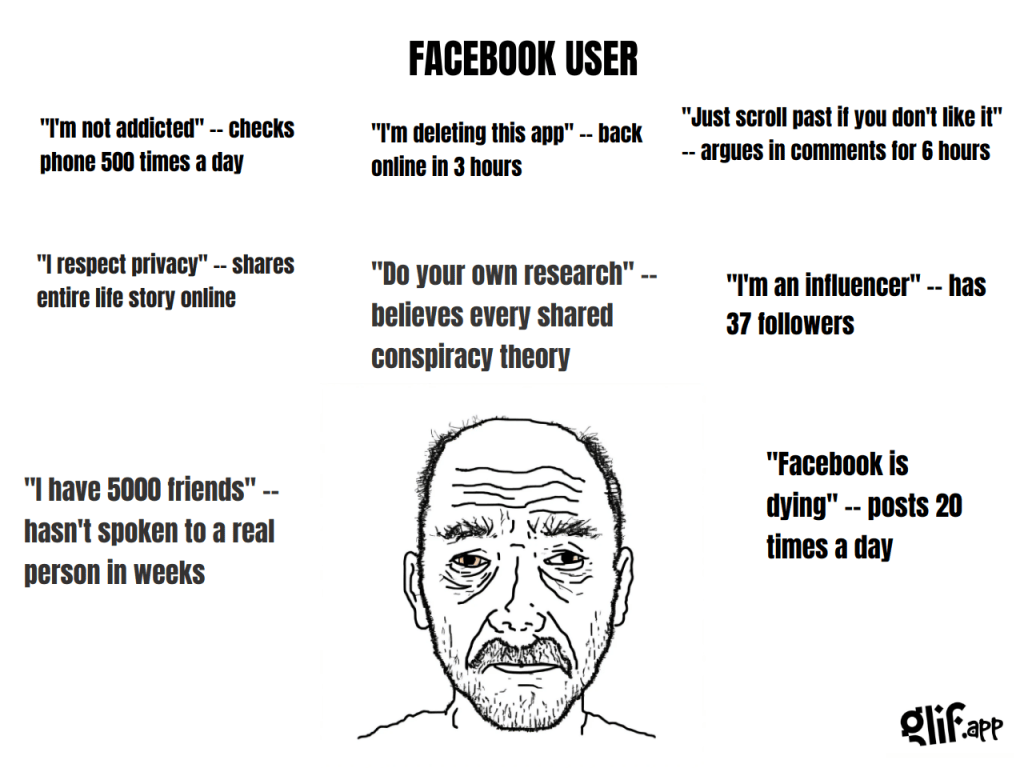
Wojak Meme Generator from Glif will build you a funny meme from a short phrase or single word prompt. Note that it is built to be derogatory, cruel for sport, and may hallucinate up falsehoods. (see tweet announcement)

I am fascinated by this from the angle of modern anthropology. The AI has learned all of this by studying what we write online. Someone can build an AI to make jokes and call out hypocrisy.

Here are GLIFs of the different social media user stereotypes as of 2024. Most of our current readers probably don’t need any captions to these memes, but I’ll provide a bit of sincere explanation to help everyone understand the jokes.

Twitter user: Person who posts short messages and follows others on the microblogging platform.

Facebook user: Individual with a profile on the social network for connecting with friends and sharing content.

Bluesky user: Early adopter of a decentralized social media platform focused on user control.

Continue reading

Market Preserving Federalism in the USA

One of my favorite economic journal articles is by Barry Weingast and has the short title “Market Preserving Federalism” (MPF). In this paper, Weingast lays out the conditions necessary for two tenuous equilibria: A) Federalism  & B) Federalism that preserves a market economy.  Given that we just celebrated Independence Day in the USA, it seems to me like a good opportunity to share some brief thoughts on this paper. I’ll speak in terms of the US for ease.

Weingast enumerates 5 features for MPF, starting with two that characterize a stable federalism:

F1) A hierarchy of governments, that is, at least “two levels of governments rule the same land and people,” each with a delineated scope of authority so that each level of government is autonomous in its own, well-defined sphere of political authority

F2) The autonomy of each government is institutionalized in a manner that makes federalism’s restrictions self-enforcing

Continue reading

Goodbye, Chevron

Last Friday the Supreme Court overturned the doctrine of Chevron deference as part of its ruling in Loper Bright Enterprises v Raimondo. This might not have even been their most discussed ruling of the past week, but in my (non-lawyerly) opinion, there is a good chance it will be their most economically impactful ruling of the past decade. SCOTUSblog explains the basics:

the Supreme Court on Friday cut back sharply on the power of federal agencies to interpret the laws they administer and ruled that courts should rely on their own interpretation of ambiguous laws. The decision will likely have far-reaching effects across the country, from environmental regulation to healthcare costs.

By a vote of 6-3, the justices overruled their landmark 1984 decision in Chevron v. Natural Resources Defense Council, which gave rise to the doctrine known as the Chevron doctrine. Under that doctrine, if Congress has not directly addressed the question at the center of a dispute, a court was required to uphold the agency’s interpretation of the statute as long as it was reasonable. But in a 35-page ruling by Chief Justice John Roberts, the justices rejected that doctrine, calling it “fundamentally misguided.”

Justice Elena Kagan dissented, in an opinion joined by Justices Sonia Sotomayor and Ketanji Brown Jackson. Kagan predicted that Friday’s ruling “will cause a massive shock to the legal system.”

When the Supreme Court first issued its decision in the Chevron case more than 40 years ago, the decision was not necessarily regarded as a particularly consequential one. But in the years since then, it became one of the most important rulings on federal administrative law, cited by federal courts more than 18,000 times.

The most common reaction I’ve seen is that people expect this to reduce the power of executive branch agencies, both in general and relative to courts and businesses, likely resulting in deregulation. Thus those on the economic left have been mostly decrying the decisions, while freemarketers and businesspeople have mostly been celebrating:

Continue reading

Who Will Be the Democratic Presidential Candidate? Follow the Money (Betting Markets)

Back in January I encouraged you to follow the money in the Presidential race, by which I meant follow the betting markets. I suggested this was a good way to cut through the sometimes inaccuracy of polls, and the uncertainty of listening to any one expert or group of experts. Bettors in prediction markets can take all of these into account.

Lately of course the big question in the Presidential race is whether Biden will actually be the Democratic nominee. There is much uncertainty right now, and you will all kinds of predictions from experts, media quoting “inside sources,” and other such rumors. How are you, as a relatively uninformed outsider, supposed to know who to trust?

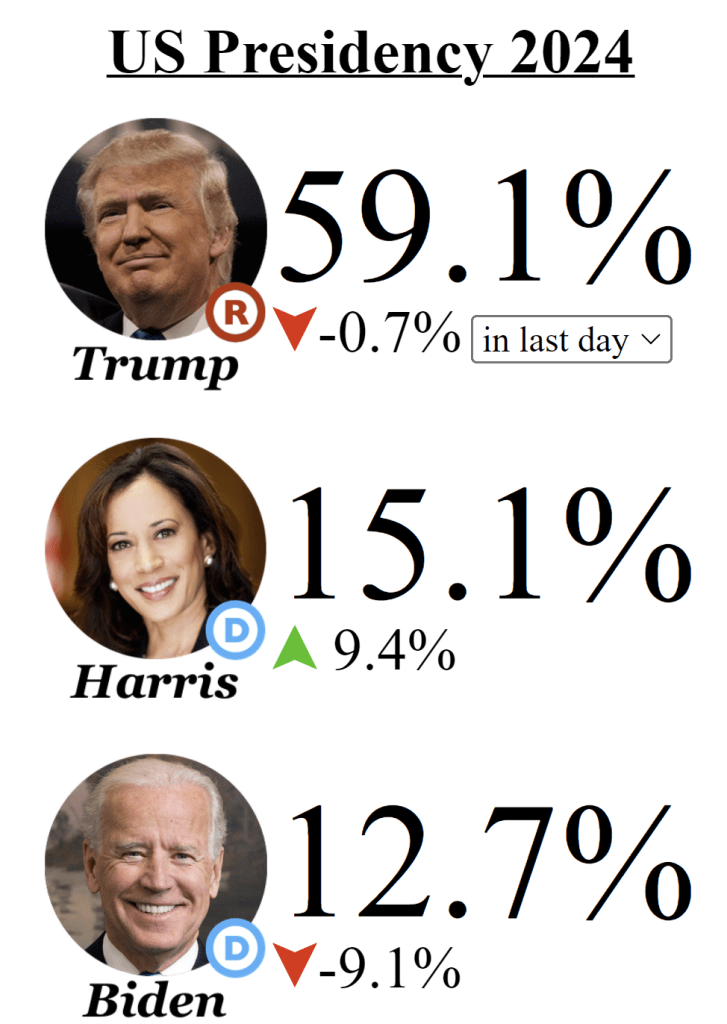
The answer again I will suggest is: watch the betting markets. And if you check the betting markets today (aggregated across multiple markets by EletionBettingOdds.com), you will see that Biden and Kamala Harris have roughly equal chances of becoming the next President (and Trump is about a 60% favorite):

Continue reading

How Repurposing Graphic Processing Chips Made Nvidia the Most Valuable Company on Earth

Folks who follow the stock market know that the average company in the S&P 500 has gone essentially nowhere in the last couple of years. What has pulled the averages higher and higher has been the outstanding performance of a handful of big tech stocks. Foremost among these is Nvidia. Its share price has tripled in the past year, after nearly tripling in the previously twelve months. Its market value climbed to $3.3 trillion last week, briefly surpassing tech behemoths Microsoft and Apple as the most valuable company in the world.

What just happened here?

It all began in 1993 when Taiwanese-American electrical engineer Jensen Huang and two other Silicon Valley techies met in a Denny’s in East San Jose and decided to start their own company. Their focus was making graphics acceleration boards for video games. Computing devices such as computers, game stations, and smart phones have at their core a central processing unit, CPU. A strength of CPUs is their versatility. They can do a lot of different tasks, but sequentially and thus at a limited speed.  To oversimplify, a CPU fetches an instruction (command), and then loads maybe two chunks of data, then performs the instructed calculations on those data, and then stores the result somewhere else, and then turns around and fetches the next instruction. With clever programming, some tasks can be broken up into multiple pieces that can be processed in parallel on several CPU cores at once, but that only goes so far.

Processing large amounts of graphics data, such as rendering a high-resolution active video game, requires an enormous amount of computing. However, these calculations are largely all the same type, so a versatile processing chip like a CPU is not required. Graphics processing units (GPUs), originally termed graphics accelerators, are designed to do enormous number of these simple calculations simultaneously. To offload the burden on the CPU, computers and game stations for decades have included on auxiliary GPU (“graphics card”) alongside the CPU.

This was the original target for Nvidia. Video gaming was expanding rapidly, and they saw a niche for innovative graphics processors. Unfortunately, they the processing architecture they choose to work on fell out of favor, and they skated right up to the edge of going bankrupt. In 1993 Nvidia was down to 30 days before closing their doors, but at the last moment they got a $5 million loan to keep them afloat. Nvidia clawed its way back from the brink and managed to make and sell a series of popular graphics processors.

However, management had a vision that the massively parallel processing power of their chips could be applied to more exulted uses than rendering blood spatters in Call of Duty.  The types of matrix calculations done in GPUs can be used in a wide variety of physical simulations such as seismology and molecular dynamics. In 2007, and video released its CUDA platform for using GPUs for accelerated general purpose processing. Since then, Nvidia has promoting the use of its GPUs as general hardware for scientific computing, in addition to the classic graphics applications.

This line of business exploded starting around 2019, with the bitcoin craze. Crypto currencies require enormous amount of computing power, and these types of calculations are amenable to being performed in massively parallel GPUs. Serious bitcoin mining companies set up racks of processors, built on NVIDIA GPUs. GPUs did have serious competition from other types of processors for the crypto mining applications, so they did not have the field to themselves. With people stuck at home in 2020-2021, demand for GPUs rose even further: more folks sitting on couches playing video games, and more cloud computing for remote work.

Nvidia Dominates AI Computing

Now the whole world cannot get enough of machine learning and generative AI. And Nvidia chips totally dominate that market. Nvidia supplies not only the hardware (chips) but also a software platform to allow programmers to make use of the chips. With so many programmers and applications standardized now on the Nvidia platform, its dominance and profitability should persist for many years.

Nearly all their chips are manufactured in Taiwan, so that provides a geopolitical risk, not only for Nvidia but for all enterprises that depend on high end AI processing.

The President as Authoritarian

As maybe the least libertarian economist on this blog roll, its interesting that the timing of today’s Supreme Court Decision falls on my watch. The best thing to read is probably Sotamayor’s dissent which lays it out plainly: the President is, by today’s ruling, clear to use their power with almost complete immunity from criminal prosecution. It feels like hyperbole, but this is really dark stuff. The kind of thing I didn’t think I would ever see in my lifetime. I know many are framing this in terms of Trump and his current slate of legal cases, but those costs are comparatively trivial relative to the costs going forward.

How did we get here? It’s tempting to trace back a conspiratorial timeline, but I think the answer is far more banal. It only takes the appointment of a few incompetent careerists to undermine the collective wisdom of a nine person voting body and here we are:

I’m not sure what else to write that isn’t already plainly stated by far more qualified legal observers. This isn’t great.