Scott Bessent used to be a serious financial player. When he was with George Soros’s fund, he helped them make a billion dollars in 1992 by betting against the British pound, and $1.3 billion in 2013 with a bet against the Japanese yen. He also ran his own hedge fund, with as much as $5 billion under management. In 2023-2024 he hitched his wagon to the fortunes of Donald Trump, becoming a large campaign contributor and fundraiser. He was rewarded by being made Treasury Secretary. On January 27, 2025, the U.S. Senate voted to confirm Bessent’s nomination. (The same day, a man with multiple Molotov cocktails and a knife who intended to murder Bessent was arrested at the United States Capitol, an event seemingly lost in the noise of all the attempted assassination attempts against this administration).
The current administration has continued the policy of the previous administration of profligate peacetime federal deficit spending, some 6% of GDP annually, well above the 50-year average of about 3.8%. The only way to finance this spend is to sell more and more Treasury debt. But the more of that debt is out there, the more interest needs to be paid on it. By the mid-2030’s, interest payments will balloon to the point that they, plus mandatory transfer payments like Medicare/Medicaid/Social Security, will consume 100% of tax revenues, with nothing left for discretionary spending (including defense). Being the cabinet officer responsible for financing this mess now is sort of like being CFO of Lehman Brothers in 2008.
Which brings us to the ignominious market response to Bessent’s attempt at bond market intervention last week. As it has become more and more clear to the rest of the world that the U.S. has no intention of reining in its deficit, but instead hopes to deal with it by inflating away the value of the dollar, the market has started to demand greater compensation for holding long-term U.S. debt. If you are wondering why you now have to pay 6.65 % for a 30-year mortgage, wonder no longer. These high interest rates are making it all the more painful for Treasury to fund the deficit.
Secretary Bessent made a surprise announcement last Wednesday that his department would double its maximum purchase of older, less-liquid long-term bonds, from $2 billion per week to $4 billion. The stated purpose of this long-running buyback program is to retire hard-to-trade bonds and replace them with newer, more-liquid bonds. That’s fine, but this snap announcement shortly after its quarterly refunding plan broke with Treasury’s long-held strategy of making ‘regular and predictable’ announcements, and (together with statements by Bessant threatening further intervention) was widely seen as an attempt to talk down the long-term rates.
It worked for about one day. Long term yields initially dipped Wednesday morning by about 0.1%, but by Thursday they were about back to where they were before the announcement. Not only did traders realize the size of the intervention was far too small to move the enormous T-bond market (and would not net decrease T-bonds outstanding), but Treasury’s move became interpreted as a sign of desperation over funding the U.S. deficit. That vibe will not help bring down Treasury bond rates going forward. The value of the dollar dipped on world exchanges, while the price of alternatives such as gold and Bitcoin soared:
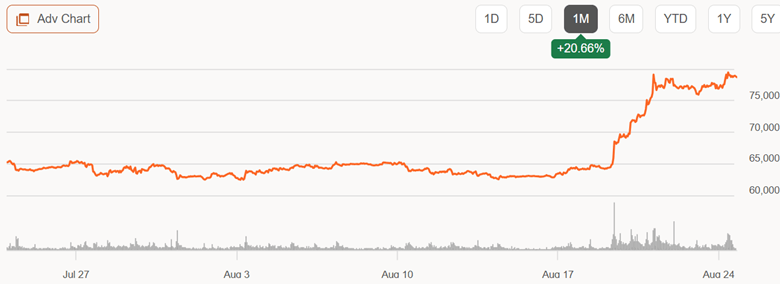
That is a chart of Bitcoin price in the past month. HODLers rejoice, the long crypto winter may be over…

