Last week I had the opportunity to see (and touch!) some first edition copies of Adam Smith’s books, including The Wealth of Nations and The Theory of Moral Sentiments.
For an economist, of course this was a very cool experience. The books from the Remnant Trust were still in great condition, despite people like me handling these copies from time-to-time. The books were also beautiful editions, which got me thinking: how much did these cost to purchase when originally published?
According to John Rae’s Life of Adam Smith, the original price for The Wealth of Nations was 1 pound, 16 shillings. Average wages per day in England were somewhere around 15 pence per day (1 pence is 1/12 of a shilling), it would take close to 30 days of labor to purchase the book. But that’s assuming you spent all of your wage on books, which of course would have been impossible: a common laborer would have been spending 80-90% of their wages on food, beer, and rent. And that’s assuming no unexpected expenses or sickness. In reality, it might take a common laborer months, years, or maybe his entire life to save up for that book.
Today, of course we can read this book online for free, but what if you want a nice hardcover version? Amazon has several nice hardback versions available for just under $30. These are not quite as beautiful as the 1776 edition, but they would look nice in any library. Given that the average wage in the US today is close to $32, it would take less than one hour of labor to purchase the book. And thankfully the cost of necessities today is much lower than 1776, indeed much lower than 1900, so it would be much easier to set aside that one hour of wages relative to the past, and purchase yourself a little treat like a book written 250 years ago.
A recent essay by Jeffrey Tucker asks “Has Life Really Improved in Half a Century?” Specifically, Mr. Tucker is interested in measuring median income of families (he uses household income, but families are clearly what he is interested in).
Tucker grants that real median household income has increased by about 40 percent from 1984 to 2024 (if he had used family income instead, the increase is almost 50 percent). But… he says this is illusory. That’s because it now takes two incomes to achieve that median income, whereas it only took one income in the past:
“Adding another income stream to the household is a 100 percent rise in work expectations but it has yielded only a 20-plus percent rise in material income. The effective pay per hour of work for the household has fallen by 40 to 50 percent!”
(He makes a data error by saying that in 1976 real median household income was $68,000-$70,000, when it was actually $59,000 in 2024 dollars in 1976 — real income didn’t fall from 1976 to 1984!)
UPDATE 2/19/2026: the last GDPNow estimate from the Atlanta Fed is 3.0% and the Kalshi markets are now predicting 2.8%. I would expect this is a slightly better range than the 3.3-3.6% from my post written on 2/18/2026.
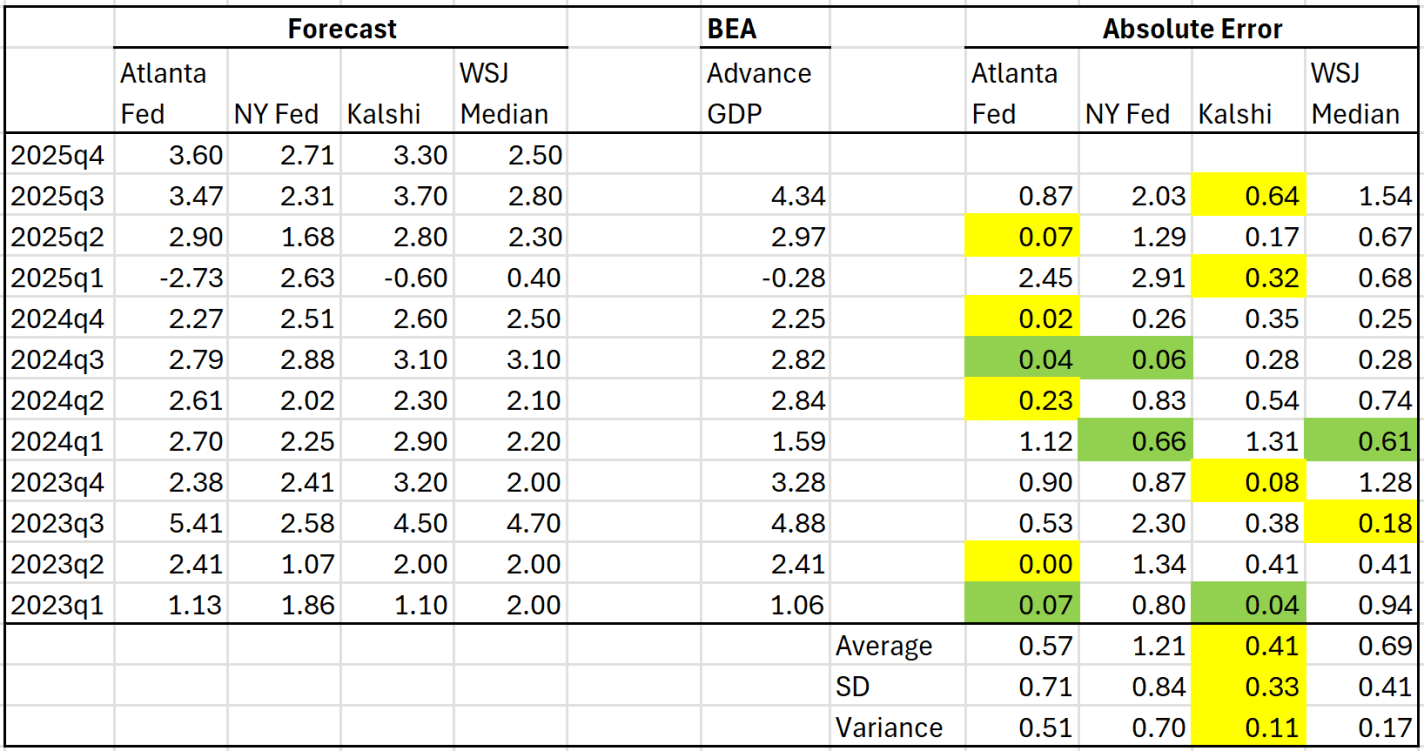
In April 2025 I wrote about several different forecasts for GDP growth. At the time the latest GDP quarter available was 2025Q1. We’ve had two more quarters of data since then, plus a highly anticipated report for Q4 coming out this Friday. How have these different predictions done recently? Here is the updated table from that prior post:
When I wrote the post in April 2025, I said that a simple average of the Atlanta Fed and Kalshi forecasts was the best simple predictor of the actual BEA advance figure. Based on the middle quarters of 2025, I think that continued to be true: each of them was the best estimate in one quarter, and perhaps just as importantly the NY Fed and WSJ survey of economists understated GDP growth pretty significantly.
There is still one more Atlanta Fed GDPNow update coming tomorrow before we get the actual BEA data on Friday, but based on where the numbers are now, we should expect Q4 to be around 3.4-3.5% (annualized) growth rate. This would put the total 2025 calendar year growth at around 2.3% — decent, but still below 2024’s 2.8% growth.
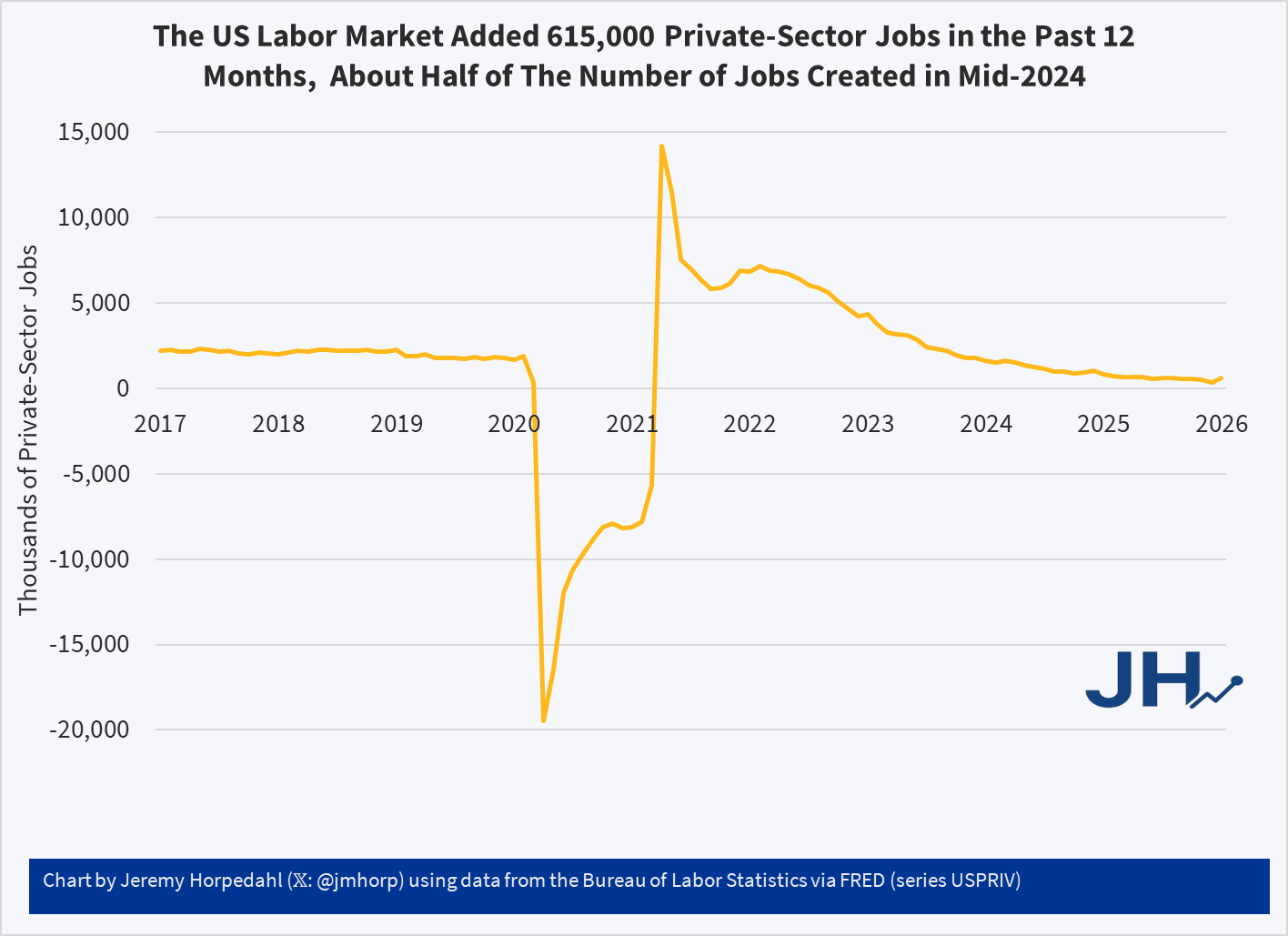
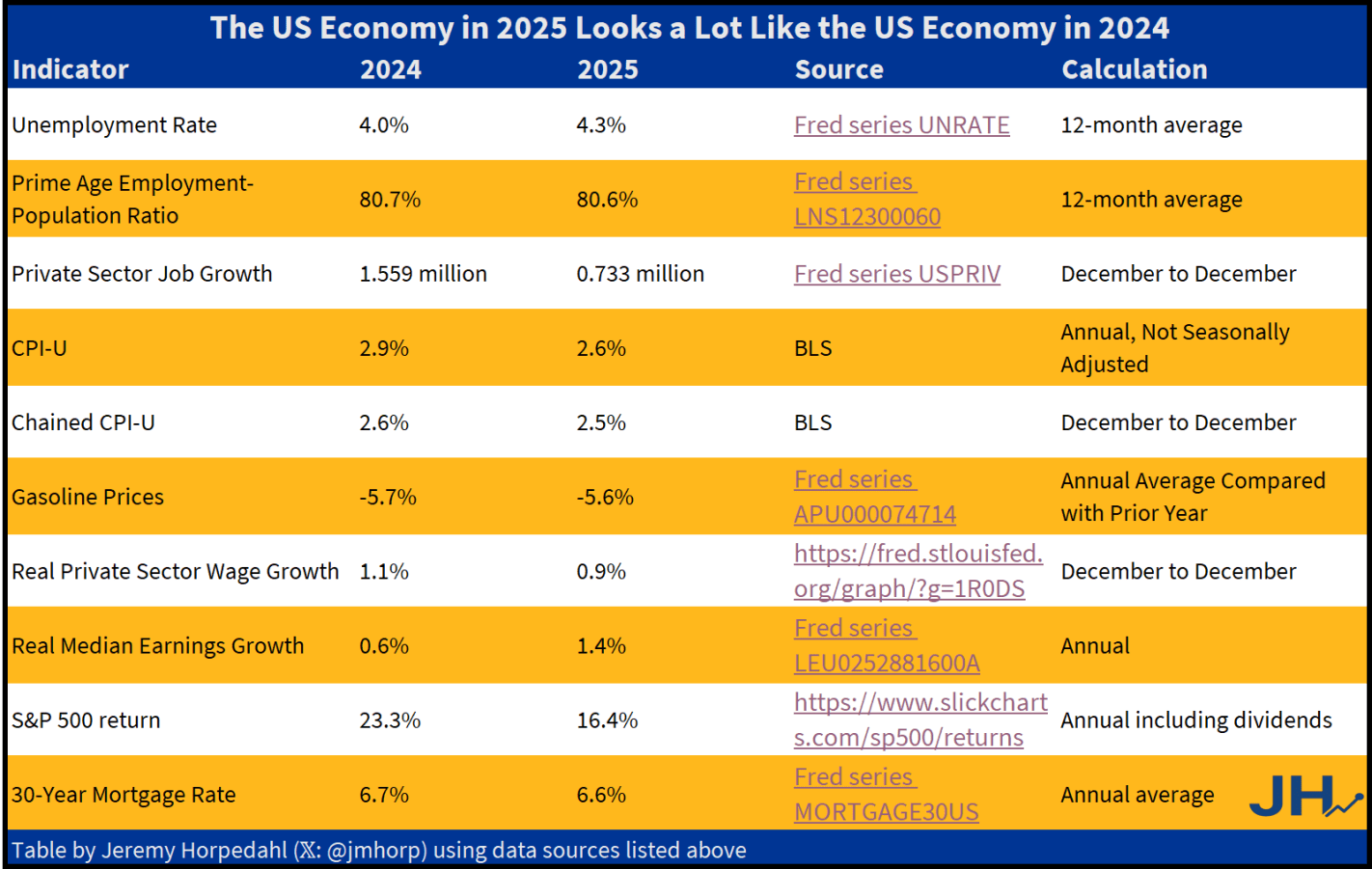
So what is the truth? I have put together what I think are the best economic indicators to judge how the economy is doing. And what does it tell us? I think the fairest read is that 2025 was a pretty good year, but based on most economic data it was almost identical to 2024.
The only indicator that is clearly better is private-sector job growth in 2024. We might add S&P 500 in 2024 growth too, although some other assets such as gold have performed better in 2025. Inflation in 2025 is a tad lower, but not the massive improvement Trump suggests. This is especially the case for one of his favorite prices, gasoline. Yes, 2025 is a little lower than 2024… just like 2024 was a little lower than 2023.
And what of that greatest of all macroeconomic indicators, GDP? We don’t yet have Q4 data for GDP, which means we don’t have full-year 2025 data yet. But the growth rate of real GDP in 2024 was 2.8%, and betting markets are currently predicting 2.3% for 2025. Betting markets could be wrong! But it seems unlikely it would be much above 2.8% (those same betting markets only think there is a 4% chance it will be over 3.0%).
None of this is to say that the 2024 and 2025 economies are exactly the same. Certainly there is more uncertainty due to the shifting tariff policy, but on the other hand even with that uncertainty the economy is still performing fairly well. And my table above only includes economic outcomes, not any changes to government budgets, nor important social indicators such as crime. These are important too, but my focus in this post is only on the economic data.
It seems that in those surveys about whether the economy is better now or under Biden, it would be useful to offer an “about the same” option. Of course, in 2021-2022 inflation was much worse under Biden — but job growth was much better. A lot of this was baked in from the pandemic, 2020 monetary and fiscal stimulus, etc. Once we were back to a semi-normal economy in 2024, it was a decent year. Not blockbuster, but decent. So was 2025.
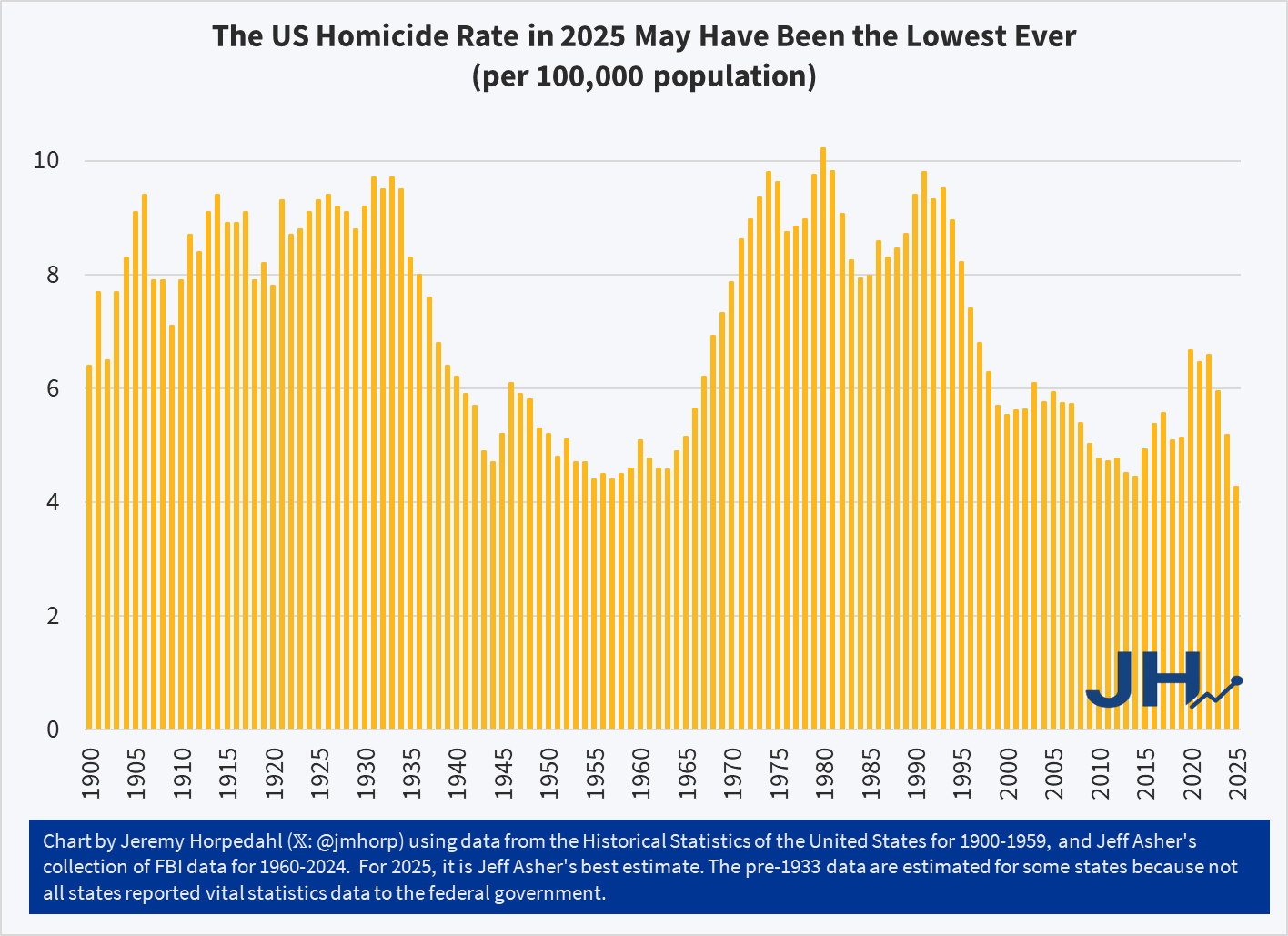
The following chart merges two data sources to create a long-run series on homicides in the US. Based on early estimates for 2025 from Jeff Asher, the homicide rate may be as low as 4.3 murders per 100,000 population. That would be the lowest since at least 1900, and possibly the lowest US homicide rate ever since the best evidence suggests it was even higher pre-1900. The current record low was 4.4 murders per 100,000, which the US saw in 1955, 1957, and 2014.
Declining fertility rates have been in the news a lot lately, and with good reason. Some countries, such as South Korea, have seen massive declines in fertility rates, and they face huge social problems and population decline resulting from these declining rates. But does the United States face the same problem?
To be clear, fertility rates are down in the US. Using the most common measure, the total fertility rate, births per woman in the US fell from a peak of over 3.5 births at the peak of the Baby Boom in the late 1950s and early 1960s, to around 2 births per woman in the 1990s and 2000s, and fell further to 1.6 births in 2023 (note: it had been around 2 births in the 1930s as well — the Baby Boom was a very real).
But the total fertility rate, or the number of births per woman of child-bearing age (usually 15-49) in a particular year is not a perfect measure. As Saloni Dattani clearly explains, if the timing of births is changing, this can make the TFR temporarily fluctuate. If women on average are delaying births to a later age, the TFR will fall initially even if women end up having the exact same number of children.
An alternative measure suggested by Dattani is the completed cohort fertility rate. This measure looks at the total number of children that women from a particular birth year in a country have throughout their child-bearing years. This rate also shows a decline for the US, but it is much more gradual: for women born in the 1930s (who would eventually become mothers during the Baby Boom), they peaked at about 3.25 births per woman, which declined to right at about 2.0 births in the 1950s (the Baby Boomers themselves), and has gradually risen since then to about 2.20 for women born in the early 1970s.
How does the US completed cohort fertility rate compare with other countries?
One of the major goals of the new Trump administration, particularly the DOGE unit, was to shrink the size of the federal government’s budget. Did they achieve this goal?
Last spring both my co-blogger Zachary and I pointed to a tool from the Brookings Institution to track federal spending, pulling in data directly from the US Treasury in a convenient format. Back in March I said “this will be a useful tool to follow going forward.” Now we have a full year of spending data for 2025.
When we look at total spending for Calendar Year 2025, it was about $318 billion higher than 2024, or about 4 percent higher. So, it seems that by that measure, the cuts that the Trump administration made were too small to overcome the other areas that grew.
But…
It may be more useful to remove some spending from the equation. In particular, entitlement programs and interest spending are very large spending categories that aren’t subject to the annual budgeting process. Of course, any program is ultimately under the control of Congress, so it’s a little bit of a cheat to remove Social Security and Medicare, but those programs are on autopilot with respect to the annual federal budget process. They are worth talking about, but they are probably worth talking about separately (especially because they have their own funding mechanisms). And interest on the debt isn’t something a President can control directly: it can only be reduced in future years by closing the budget gap today.
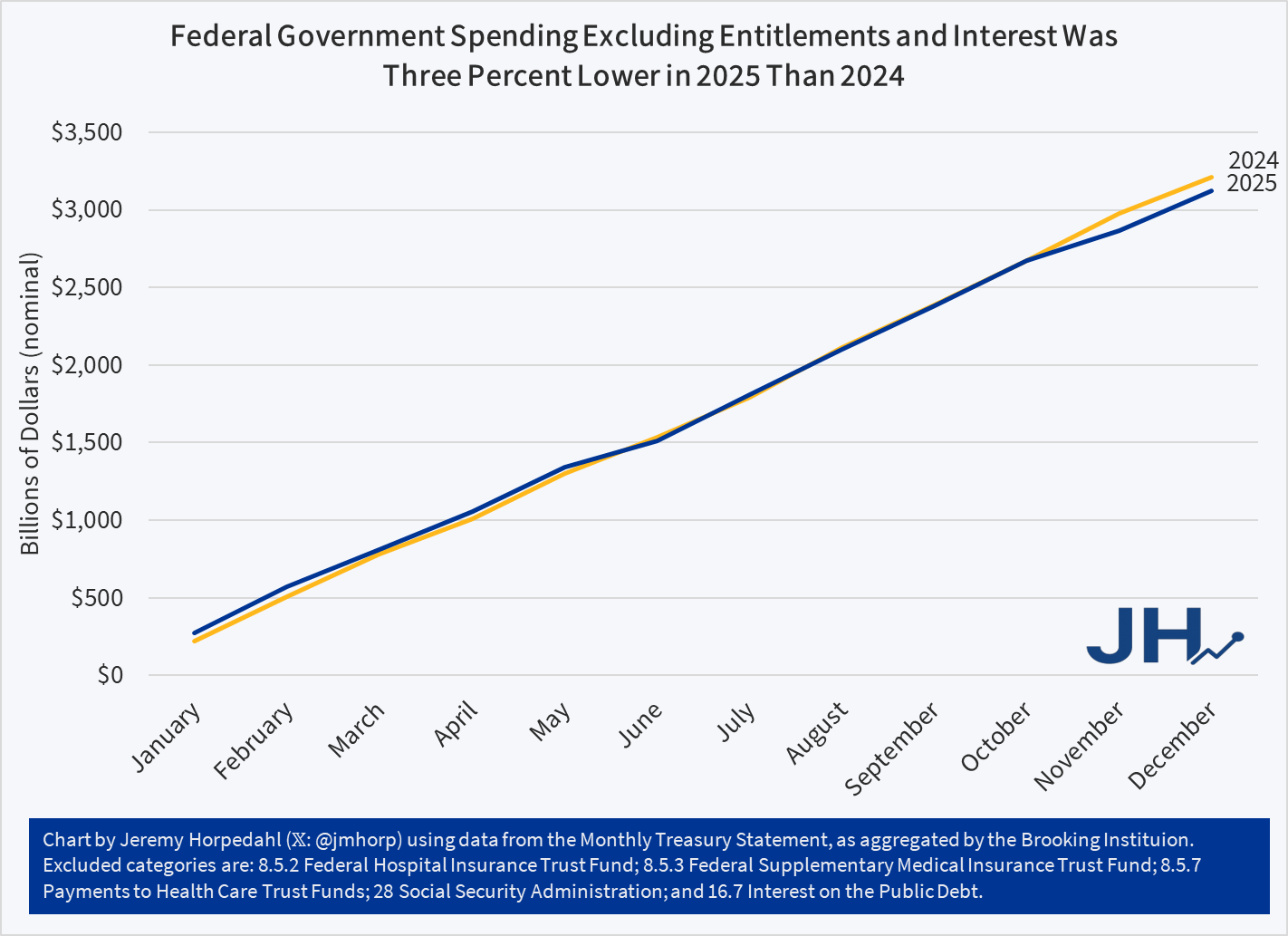
Removing those programs — which constitute about $4.8 trillion of the $7.9 trillion in 2025 spending (so a lot!) — gives you this chart (note: figures have been slightly updated with more complete data since I originally posted this chart):
Federal spending by this measure was about $85 Billion lower in 2025 than the prior year, or about 5 percent. And that’s in nominal terms: it is an even bigger cut if we adjust for inflation. Notice too that the pattern fits what we might expect: spending was slightly higher in the first half of the year (before any Trump changes could have had much of an effect), almost exactly equal for most of the second half, and then slightly below once we get to November and December (after the Deferred Resignation Program layoffs in October). If we ignore the first two months of the year (when it would have been really hard for Trump to have an effect), the drop in spending is about 8 percent.
What were the biggest cuts that led to the $85 billion drop? Keep in mind that some programs increased spending, such as military spending, so there are more than $85 billion in cuts. Using the Daily Treasury Statement categories, here are the big ones:
Federal Financing Bank (Treasury): $59 billion
Department of Education: $46.8 billion
USAID: $30.2 billion
EPA: $17 billion (though EPA seems to have gone on a spending binge at the end of 2024. Compared with 2023, the first Trump year was 50% higher!)
Federal Employee Insurance Payment (OPM): $16.3 billion
Those are all the programs I could find that declined by at least $1 billion, totaling a little over $200 billion. There were some other highly salient cuts that were under a billion dollars (such as the Corporation for Public Broadcasting, which was completely eliminated). Looking at that list I don’t think there is an easy way to sum up a “theme,” but I think the real theme is that if the Trump administration wants 2026 discretionary spending to be even lower than 2025, they will really need some major action from Congress. These cuts are mostly low-hanging fruit, and some are long-running goals of the GOP (such as Dept. of Education, foreign aid, and public television).
Of course, to really get federal spending under control, Congress will have to tackle entitlement reform and shrink the budget deficit to lower interest costs. Social Security, Medicare, and interest payments — the bulk of federal spending, over 60% of the total — increase by 9% in 2025. Again, it was probably unreasonable to expect Trump and Congress to have done anything major with them in a single year, but something must be done soon: the Social Security Old Age trust fund will be depleted in about 8 years, and the Medicare Part A trust fund will be depleted in about 10 years.
With the arrest of Venezuelan President Maduro, the US is potentially attempting to remake the institutions of yet another country. I say potentially because, as of now, all that has happened is that Maduro was removed. His VP stepped in to replace him, and it appears that, for now, the rest of the structure of government is in place.
Nonetheless, any time the US intervenes in the affairs of another country, it brings back the old debates about regime change, nation building, exporting democracy, etc. Many want to discuss the legal and moral implications of these actions — and these are certainly worth discussing! — but as social scientists we should also ask “does it work?”
For example, one excellent paper on regime change via CIA covert intervention is from Absher, Grier, and Grier. They look at five cases during the Cold War in Latin America of CIA-sponsored regime change, and find moderate declines in income and large declines in democratic institutions. Not a good case for regime change and exporting democracy!
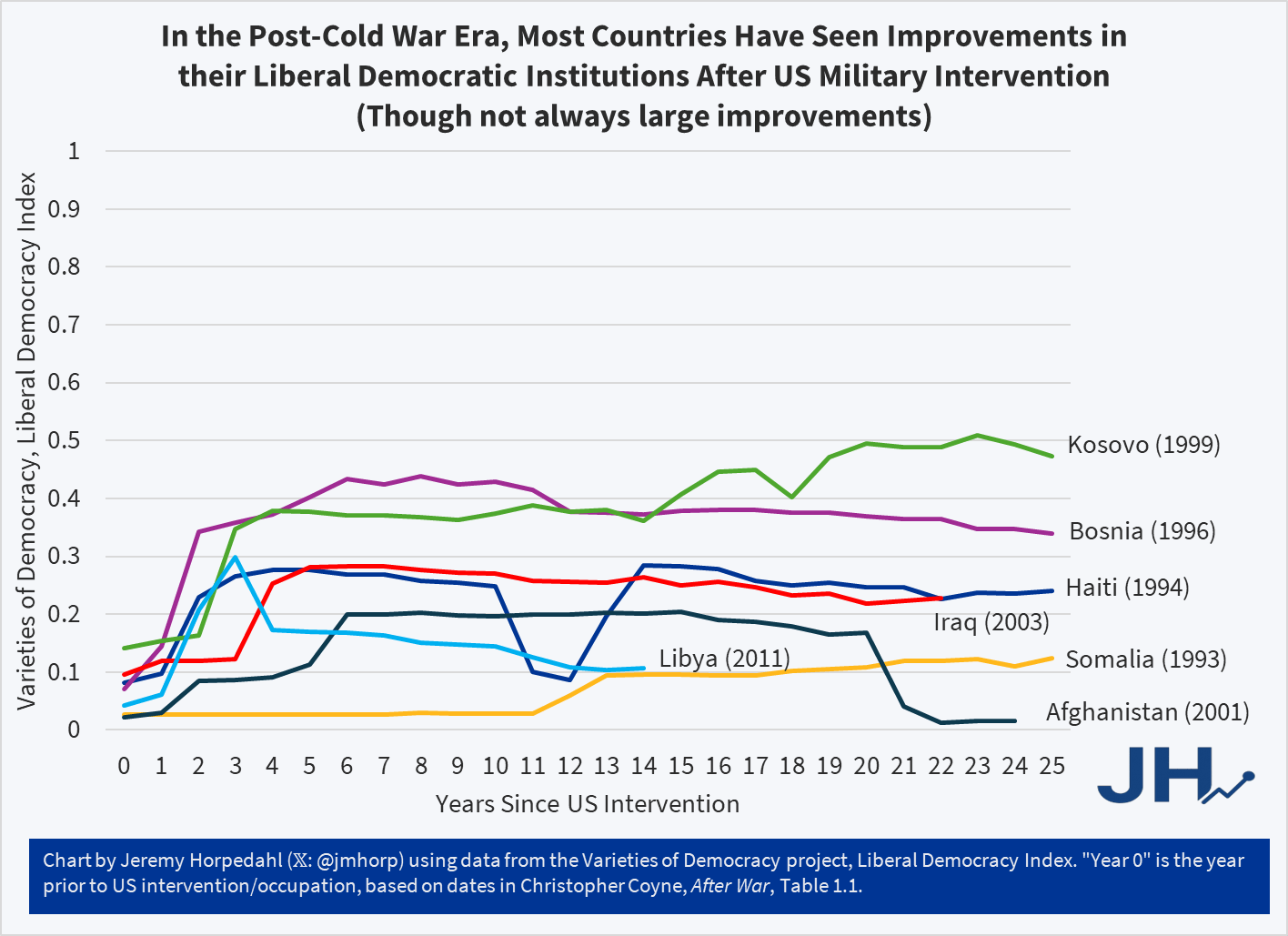
But what if we look at more recent interventions — post-Cold War — and look at direct military interventions by the US, rather than covert CIA operations or indirect funding of factions within a country. This is more in line with what might be happening in Venezuela right now (if regime change is ultimately what the US military pushes for). Using a list from Chris Coyne’s book After War (table 1.1) as a starting point for the relevant cases, and then using data from the V-Dem Liberal Democracy Index, we have seven cases since 1990 to examine (note: I have added Libya to Coyne’s list, which I believe is the only new addition of explicit military intervention since he created the list):
The first thing you might notice is that relevant to their starting position (pre-US military intervention), all except one of these countries saw improvements in their V-Dem Liberal Democracy Score after 25 years (or whatever the end point is for those more recent than 25 years). Some of the improvements — such as Libya, Somalia, and Iraq — are quite small, around 0.1 points on the 1-point scale. But other improvements — especially Kosovo and Bosnia — are quite large, around 0.3 points on the 1-point scale.
The one decline is Afghanistan, though you will note that during the occupation (which lasted a very, very long time, until 2021) their liberal democracy score did improve slightly, about as much as Iraq. I should also note that if we didn’t use my 25-year cut-off, Haiti would also have slipped back to roughly where they were in 1993, with a large decline happening since 2020.
For reference on this scale: the US scores 0.75 in 2024, the best scoring country is Denmark with 0.88, the World average is 0.37 (or 0.29 weighted by population), and the European average is 0.62 (or 0.56 weighted by population).
So while the improvements in Kosovo and Bosnia are impressive, they still fall below the average score in Europe. And those examples point to another problem with my simple analysis: we don’t have the counterfactual of what their score would be without US intervention. That kind of sophisticated analysis is what the above-mentioned Absher paper does (using synthetic control), but it’s more than I can do in a short blog post. Nonetheless, we should note that while we can’t say that US intervention caused these improvements, things didn’t get worse in most countries (as many critics of intervention assume always happens) — Afghanistan being the notable exception after the US ended the occupation.
Now that I’ve got the causation caveat out of the way, we should note a few more limitations of my analysis. First, perhaps the V-Dem Liberal Democracy Index isn’t the best one to use. Our World in Data has seven democratic measurement sets to choose from, and even from V-Dem there are others we could have used. I think Liberal Democracy best captures what we are usually talking about in terms of “does it work?” but you could use another measure. However, glancing through the other available measures, such as Polity, I don’t think the picture would be radically different with another measure of liberal democracy. 25 years is also somewhat arbitrary of a cut-off, though in Coyne’s book he uses 20 years, so I’m going beyond that.
Finally, I want to stress even more than on the causation point: none of these improvements mean the intervention passes a cost-benefit test. There was much destruction of lives and property in all of these cases, the use of US tax dollars, and some other harms to the US and international law (e.g., restrictions of civil liberties in the US from the War on Terror). I do not want to suggest that this means the interventions were worth the cost, merely that they did not fail on this one measure of improving democracy. It is also not a prediction that future interventions, such as in Venezuela, will succeed. Instead, I wrote this post because it goes against my priors (I would not have guessed improvements in 6/7 cases).
By almost any measure, 2025 was a great year for the United States.
Despite inflation remaining elevated and the damage from new tariffs, the economy did well. Inflation-adjusted median earnings are higher than a year ago, though only by about 1.3%. While most prices are still rising, one bright spot for affordability is that home prices are falling in much of the country (according to Zillow estimates).
The unemployment rate did tick up slightly, from 4.2% last November to 4.6% currently. This is definitely an indicator to watch over the next few months, but it is still well below average.
But even outside of the economy, there is plenty of good news in the data. Crime rates are plummeting. The murder rate fell something like 20%, as well as every major category of crime (violent crime overall is down 10%). This are some of the largest one-year drops in crime the US has ever seen.
Homicides aren’t the only category of deaths that are falling in 2025. For most categories of death as tracked by the CDC, there is a long lag (6 months or more) before all of the deaths are categorized. So we can’t look at complete 2025 data yet. For example, drug overdoses have increased massively in recent years, especially during the pandemic. But after plateauing in 2021-23, drug ODs started falling in 2024 and have continued to fall in early 2025. For the 12 months ending in April 2025, drug OD deaths were 26% lower than the prior 12 months. If we look at just the first 5 months of the year, 2024 was 20% lower than 2023, and 2025 was another 20% lower than 2024. For the first five months of 2025, ODs are basically back down to the same level as 2018 and 2019. Motor vehicle deaths also increased during the pandemic, but they are down 8% in the first half of 2025, essentially back down to 2018-19 levels.
Was it all good news? No, you can certainly find some data to be pessimistic about. For example, despite the efforts of DOGE and other attempts to cut federal government spending, over $2 trillion was added to the national debt in 2025, up 6 percent from the end of 2024 and surpassing $38 trillion. And as I mentioned above with the unemployment rate, there is some evidence the labor market may be weakening.
Not all is rosy as we head into 2026, but 2025 was a year filled with many positive trends on the economic front and in society more generally. May your new year be prosperous and healthy!