Saba Closed-End Funds ETF (CEFS): Have Finance Legend Boaz Weinstein Manage Your Closed End Fund Investments

Boaz Weinstein and the London Whale

Boaz Weinstein is a really smart guy. At age 16 the US Chess Federation conferred on him the second highest (“Life Master”) of the eight master ratings. As a junior in high school, he won a stock-picking contest sponsored by Newsday, beating out a field of about 5000 students. He started interning with Merrill Lynch at age 15, during summer breaks. He has the honor of being blacklisted at casinos for his ability to count cards. 

He entered into heavy duty financial trading right out of college, and quickly became a rock star. He joined international investment bank Deutsche Bank in 1998, and led their trading of then-esoteric credit default swaps (securities that payout when borrowers default). Within a few years his group was managing some $30 billion in positions, and typically netting hundreds of millions in profits per year. In 2001, Weinstein was named a managing director of the company, at the tender age of 27.

Weinstein left Deutsche Bank in 2009 and started his own credit-focused hedge fund, Saba Capital Management. One of its many coups was to identify some massive, seemingly irrational trades in 2012 that were skewing the credit default markets. Weinstein pounced early, and made bank by taking the opposite sides of these trades. He let other traders in on the secret, and they also took opposing positions.

(It turned out these huge trades were made by a trader in J. P. Morgan’s London trading office, Bruno Iksil, who was nick-named the London Whale. Morgan’s losses from Iksil’s trades mounted to some $6.2 billion.)

For what it’s worth, Weinstein is by all accounts a really nice guy. This is not necessarily typical for many high-powered Wall Street traders who have been as successful as he.

Weinstein and the Sprawling World of Closed End Funds

If you have a brokerage account, you can buy individual securities, like Microsoft common stock shares, or bonds issued by General Motors. Many investors would prefer not to have to do the work of screening and buying and holding hundreds of stocks or bonds. No problem, there exist many funds, which do all the work for you. For instance, the SPY fund holds shares of all 500 large-cap American companies that are in the S&P 500 index, so you can simply buy shares of the one fund, SPY. 

Without going too deeply into all this, there are three main types of funds held by retail investors. These are traditional open-end mutual funds, the more common exchange-traded funds (ETFs), and closed end funds (CEFs). CEFs come in many flavors, with some holding plain stocks, and others holding high-yield bonds or loans, or less-common assets like spicy CLO securities. A distinctive feature of CEFs is that the market price per share often differs from the net asset value (NAV) per share. A CEF may trade at a premium or a discount to NAV, and that premium or discount can vary widely with time and among otherwise-similar funds. This makes optimal investing in CEFs very complex, but potentially-rewarding: if you can keep rotating among CEF’s, buying ones that are heavily discounted, then selling them when the discount closes, you can in theory do much better than a simple buy and hold investor.

I played around in this area, but did not want to devote the time and attention to doing it well, considering I only wanted to devote 3-4% of my personal portfolio to CEFs. There are over 400 closed end funds out there. So, I looked into funds whose managers would (for a small fee) do that optimized buying and selling of CEFs for me.

It turns out that there are several such funds-of-CEF-funds. These include ETFs with the symbols YYY and PCEF, CEFS, and also the closed end funds FOF and RIV. YYY and PCEF tend to operate passively, using fairly mechanical rules. PCEF aims to simply replicate a broad-based index of the CEF universe, while YYY rebalances periodically to replicate an “intelligent” index which ranks CEFs by yield, discount to net asset value and liquidity. FOF holds and adjusts a basket of undervalued CEFs chosen by active managers, while RIV holds a diverse pot of high-yield securities, including CEFs. The consensus among most advisers I follow is that FOF is a decent buy when it is trading at a significant discount, but it makes no sense to buy it now, when it is at a relatively high premium; you would be better off just buying a basket of CEFs yourself.

I settled on using CEFS (Saba Closed-End Funds ETF)  for my closed end fund exposure. It is very actively co-managed by Saba Capital Management, which is headed by none other than Boaz Weinstein. I trust whatever team he puts together. Among other things, Saba will buy shares in a CEF that trades at a discount, then pressure that fund’s management to take actions to close the discount.

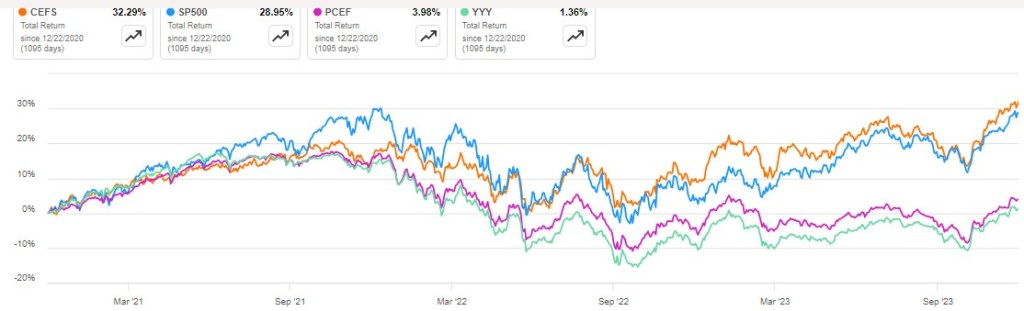
The results speak for themselves. Here is a plot of CEFS (orange line) versus SP500 index (blue), and two passively-managed ETFs that hold CEFs, PCEF (purple) and YYY (green) over the past three years:

The Y axis is total return (price action plus reinvestment of dividends). CEFS smoked the other two funds-of-funds, and even edged out the S&P in this time period.  It currently pays out a juicy 9% annualized distribution. Thank you, Mr. Weinstein, and Merry Christmas to all my fellow investors.

Boilerplate disclaimer: Nothing in this article should be regarded as advice to buy or sell any security.

Former Treasury Official Defends Decision to Issue Short Term Debt for Pandemic;  I’m Not Buying It

We noted earlier (see “The Biggest Blunder in The History of The Treasury”: Yellen’s Failure to Issue Longer-Term Treasury Debt When Rates Were Low ), along with many other observers, that it seemed like a mistake for the Treasure to have issued lots of short-term (e.g. 1-2 year) bonds to finance the sudden multi-trillion dollar budget deficit from the pandemic-related spending surge in 2020-2021. Rates were near-zero (thanks to the almighty Fed) back then.

Now, driven by that spending surge, inflation has also surged, and thus the Fed has been obliged to raise interest rates. And so now, in addition to the enormous current deficit spending,  that tsunami of short-term debt from 2020-2021 is coming due, to be refinanced at much higher rates. This high interest expense will contribute further to the growing government debt.

Hedge fund manager Stanley Druckenmiller  commented in an interview:

When rates were practically zero, every Tom, Dick and Harry in the U.S. refinanced their mortgage… corporations extended [their debt],” he said. “Unfortunately, we had one entity that did not: the U.S. Treasury….

Janet Yellen, I guess because political myopia or whatever, was issuing 2-years at 15 basis points[0.15%]   when she could have issued 10-years at 70 basis points [0.70 %] or 30-years at 180 basis points [1.80%],” he said. “I literally think if you go back to Alexander Hamilton, it is the biggest blunder in the history of the Treasury. I have no idea why she has not been called out on this. She has no right to still be in that job.

Unsurprisingly, Yellen pushed back on this charge (unconvincingly). More recently, former Treasury official Amar Reganti has issued a more detailed defense. Here are some excerpts of his points:

( 1 ) …The Treasury’s functions are intimately tied to the dollar’s role as a reserve currency. It is simply not possible to have a reserve currency without a massive supply of short-duration fixed income securities that carry no credit risk.

( 2 ) …For the Treasury to transition the bulk of its issuance primarily to the long end of the yield curve would be self-defeating since it would most likely destabilise fixed income markets. Why? The demand for long end duration simply does not amount to trillions of dollars each year. This is a key reason why the Treasury decided not to issue ultralong bonds at the 50-year or 100-year maturities. Simply put, it did not expect deep continued investor demand at these points on the curve.

( 3 ) …The Treasury has well over $23tn of marketable debt. Typically, in a given year, anywhere from 28% to 40% of that debt comes due…so as not to disturb broader market functioning, it would take the Treasury years to noticeably shift its weighted average maturity even longer.

( 4 ) …The Treasury does not face rollover risk like private sector issuers.

Here is my reaction:

What Reganti says would be generally valid if the trillions of excess T-bond issuance in 2020-2021 were sold into the general public credit market. In that case, yes, it would have been bad to overwhelm the market with more long-term bonds than were desired.  But that is simply not what happened. It was the Fed that vacuumed up nearly all those Treasuries, not the markets. The markets were desperate for cash, and hence the Fed was madly buying any and every kind of fixed income security, public and corporate and mortgage (even junk bonds that probably violated the Fed’s bylaws), and exchanging them mainly for cash.  Sure, the markets wanted some short-term Treasuries as liquid, safe collateral, but again, most of what the Treasury issued ended up housed in the Fed’s digital vaults.

So, I remain unconvinced that the issuance of mainly long-term (say 10-year and some 30-year; no need to muddy the waters like Reganti did with harping on 50–100-year bonds) debt would have been a problem. So much fixed-income debt was vomited forth from the Treasury that even making a minor portion of it short-term would, I believe, have satisfied market needs. The Fed could have concentrated on buying and holding the longer-term bonds, and rolling them over eventually as needed, without disturbing the markets. That would have bought the country a decade or so of respite before the real interest rate effects of the pandemic debt issuance began to bite.

But nobody asked my opinion at the time.

Charlie Munger’s Rule for a Happy Life

A big piece of news in the investment world has been the passing of Charlie Munger on Nov 28 at age 99. He was vice chair of Berkshire Hathaway, and Warren Buffett’s right-hand man there.

Munger grew up in Omaha, Nebraska, which is Warren Buffett’s hometown as well. They met at a dinner party there in 1959, and hit it off with one another personally.  Munger was a really smart guy. After joining the US Army Air Corps in1943, he scored highly on an intelligence test and was sent to study meteorology at Caltech. After the war he was accepted into Harvard Law School despite lacking a formal undergraduate degree, and graduated summa cum laude.

In his 50s, Munger lost his left eye after cataract surgery failed. A doctor warned he could lose his right eye too, so he began learning braille, but the condition improved.

He entered law practice, and eventually started his own firm, but he became more interested in investing. He racked up 19.8% annual returns investing on his own, between 1962 and 1975. Buffett convince Munger to give up law and join him as vice-chairman of Berkshire Hathaway in 1978.

Perhaps Buffett’s most famous investing saying is “It’s far better to buy a wonderful company at a fair price than a fair company at a wonderful price”. He credits this approach to Munger: “Charlie understood this early – I was a slow learner.”  Before being influenced here by Munger, Buffett had been more inclined to buy very low-priced shares in mediocre companies.  

Munger was heavily involved with Buffett’s decisions. “Berkshire Hathaway could not have been built to its present status without Charlie’s inspiration, wisdom and participation,” Buffett said following Munger’s death. That tribute is no overstatement: from the time Munger joined Berkshire Hathaway in 1978 till now, shares of the company soared 396,182% (i.e.,  $100 invested in Berkshire Hathaway in 1978 is worth $396,282 today). This performance dwarfs the 16,427% appreciation of the S&P 500 over the same time period. When he died, Munger was personally worth $2.6 billion.

(See more on Berkshire Hathaway’s formula for success at: Warren Buffett’s Secret Sauce: Investing the Insurance “Float” )

Quotations From Vice-Chairman Charlie

The internet is rife with sites displaying memorable or useful quotes from Charlie Munger. For example, “I never allow myself to have an opinion on anything that I don’t know the other side’s argument better than they do”;   and three rules for a career: “1) Don’t sell anything [to others] you wouldn’t buy yourself; 2) Don’t work for anyone you don’t respect and admire; and 3) Work only with people you enjoy.”

Some of these quote lists focus on sayings which provide guidance to individual investors, such as this from CNBC:

“I think you would understand any presentation using the word EBITDA, if every time you saw that word you just substituted the phrase,  ‘bull—- earnings.’ ″

The 2003 Berkshire shareholder meeting was one of the many occasions Munger called out what he saw as shady accounting practices, in this case EBITDA — a measure of corporate profitability short for earnings before interest, taxes, depreciation and amortization.

In short, Munger felt that companies often highlighted convoluted profitability metrics to obscure the fact that they were severely indebted or producing very little cash.

“There are two kinds of businesses: The first earns 12%, and you can take it out at the end of the year. The second earns 12%, but all the excess cash must be reinvested — there’s never any cash,” Munger said at the same meeting. “It reminds me of the guy who looks at all of his equipment and says, ‘There’s all of my profit.’ We hate that kind of business.”

To invest like Munger and Buffett, don’t fall for the flashiest numbers in the firms’ investor presentations. Instead, dig into a company’s fundamentals in their totality. The more a company or an investment advisor tries to win you over with esoteric terms, the more skeptical you should likely be.

As Buffett put it in his 2008 letter to shareholders: “Beware of geeks bearing formulas.”

Munger’s Secret to Happiness

Out of all these witty and helpful quotes, I’ll conclude by zeroing in on what Charlie Munger thought was the single most important factor in achieving personal happiness. He said it a number of different ways:

The secret to happiness is to lower your expectations. …that is what you compare your experience with. If your expectations and standards are very high and only allow yourself to be happy when things are exquisite, you’ll never be happy and grateful. There will always be some flaw. But compare your experience with lower expectations, especially something not as good, and you’ll find much in your experience of the world to love, cherish and enjoy, every single moment.

and

The world is not going to give you extra return just because you want it. You have to be very shrewd and hard working to get a little extra. It’s so much easier to reduce your wants. There are a lot of smart people and a lot of them cheat, so it’s not easy to win.

and finally:

A happy life is very simple. The first rule of a happy life is low expectations. That’s one you can easily arrange. And if you have unrealistic expectations, you’re going to be miserable all your life. I was good at having low expectations and that helped me. And also, when you [experience] reversals, if you just suck it in and cope, that helps if you don’t just stew yourself into a lot of misery.

Stock Options Tutorial 1. Options Fundamentals

Put simply, a stock option is a contract to buy (if it is a call option) or to sell (if it is a put option) a given stock at some particular price (“strike price”), by some particular expiration date.

Example: Buying Apple Call Option Instead of the Stock


In a little more detail: if you buy a call option on a stock, that gives you the right to buy that stock at the strike price (“call” the stock away from some current stockholder).
For most American stocks the option holder can exercise this right at any time, up till the end of the expiration day. (For so-called European options, you can only exercise the option on the expiration date itself.)
Let’s jump into an example. As of late morning 11/27/2023 when I am writing this, the price of Apple stock is $190 per share.  Suppose I have a strong conviction that within the next month or so, Apple will go up by 10 dollars (5%) to $200/share.

One thing I can do is plunk down 100 x $190= $19,000 to buy 100 shares of Apple, and wait. If Apple does indeed reach my target price of $200 in some reasonable timeframe, and I sell it there, I will make a profit of 100 shares x $10 / share = $1000 on my initial investment of $19,000. That represents a 5.3% return on my investment.


But suppose because of some unexpected factor (Taiwan invasion?), that the price of Apple plunges by say 30% to $133/share, and remains there for the indefinite future. If I want to get my money out of this affair and move on, I would face a huge loss of 100 shares x (190-133)= $5,700 dollars on my large $19,000 investment.

Instead of buying the stock outright, I could buy a call option. There are a number of specific strategies and choices here, but to keep it simple, I could buy an Apple call option with a strike price of 190 (the current price of Apple) and an expiration date of say December 29, 2023. At the moment, that call option would cost me $3.80 per share, or $380 dollars for a standard options contract that involves 100 shares.


If Apple stock hits my price target of $200 sometime in the next month, I could exercise this option and purchase 100 Apple shares for $19,000 dollars, (100 x $ 190 strike price) and immediately sell them into the market 100 x $200/share = $20,000 dollars. That would give me a net profit of: (profit on stock buy & sell) minus (cost of call option) =  100 x ( ($200 – $190 ) – $3.80 ) = $620. That is a return of 163% on my $380 investment. Woo hoo!
(If I did not want to actually exercise the call, I could have sold it back into the options marketplace; the value of the call would have risen by somewhat less than $10 dollars since the time I bought it, so I could take my profit that way, without going through the cycle of actually buying the shares and immediately selling them.)

If Apple stock fails to rise by more than the $3.80 dollars a share that I paid for the call option, I will lose money on this trade. If Apple stays at or below 190, this call option expires valueless, and I will have lost 100% of my option purchase price. (If say two weeks goes by and the share price is hovering just below 190, this call option might still be worth something like $1.90/share, and I might choose to sell it and bail on this trade, to recover half of my $3.80 instead of risking the loss of all of it; there are many, many ways to trade options).

Now, in the event that Apple shares plunge by 30% and stay low indefinitely, I would only lose the $380 that the options cost me, instead of the $5,700 dollars I would lose if I had bought the stock outright.

This example demonstrates some of the benefits of buying stock options: You can make a huge return on your invested/risked capital if your stock price thesis plays out, and you can be shielded from any losses other than the cost of the option. The big weakness of this approach is that your hoped-for stock move must occur within a limited timeframe, before the expiration date, or else you can lose 100% of your investment. Folks who trade options for a living make lots and lots of small trades, knowing that they will lose on a significant percentage of these trades, hoping that their wins will outweigh their losses.

Buying Put Options for Hedging and Speculation

This has been a somewhat long-winded explanation of one way of utilizing options, namely, buying calls. Buying a put option, on the other hand, gives you the right to require that someone will buy a stock from you at the strike price (here, you are “putting” the stock to the person who sold you the option).

Puts are often used as for protective hedging. Suppose I own 100 shares of Apple stock that is currently valued at 190 dollars a share, and I want to protect against the effects of a possible plunging share price. As an example, I might buy a March 15, 2024 put with a strike price of 175, for $2.80. If Apple price falls, I would absorb the first 15 dollars per share of the losses, from 190 to the strike price of 175. However, that put would protect me against any further losses, since no matter how low the share price goes, I could sell my shares at $175. (Again, instead of actually selling my shares, I might sell the puts back into the market, since their value would have increased as Apple share price fell).
Buying puts in this manner is like buying insurance on your portfolio: it costs you a little bit per month, but prevents catastrophic losses.

Buying puts can also be used for speculative trading. Suppose I was convinced that Apple stock might fall well below $175 in the next three months. Without owning Apple shares, I might buy that March 2024 175 put for $2.80 per share, or $280 for a 100-share contract. If Apple share price went anywhere below (175 – 2.80 = 172.20), I would make money on this trade. If the price went back down to its recent low of 167, my net profit would be around 100 x (172.2 – 167) = $520. This would be nearly doubling the $280 I put into buying the puts. But again, if Apple price failed to fall as hoped, I might lose all of my $280 option purchase price.

Where to Find Options Prices

There are lots of YouTube tutorials on trading stock options. Here is quick ten-minute intro: Stock Options Explained, by The Plain Bagel. If you want to check out the prices of options, they are shown on websites like Yahoo Finance, Seeking Alpha (need to give email to sign in; you can ignore all the ads to make you purchase premium), and your own broker’s software.

I usually prefer to sell options, rather than buy them, but that is another post for another time. As usual, this discussion does not constitute advice to buy or sell any security.

Mutiny in Silicon Valley:  OpenAI Workforce May Quit and Join Microsoft If Board Does Not Resign and Bring Back Former CEO Sam Altman

The bombshell news in the tech world as of late Friday was that, in a sudden coup, the board of OpenAI fired CEO and tech entrepreneur Sam Altman, and demoted company cofounder and former president Greg Brockman. The exact grounds for their decision remain somewhat murky, but apparently Altman wanted to move faster with AI deployment and monetization than some board members were comfortable with.

The OpenAI organization burst on the scene in the past year with the release of advanced versions of ChatGPT. This “generative” AI technology can crank out computer code and human-like text articles and reports and images. Naturally, students have taken to employing ChatGPT to write their essays for them. And so, professors now use AI to detect whether their students’ essays were machine written or not.

Fellow blogger Joy Buchanan has addressed the rising problem of erroneous information (“hallucinations”) that can appear in AI generated material. There is a movement to slow down the development of AI, for fear it will lead to The End Of The World As We Know It (TEOTWAWKI).  (Interestingly, all of the business commentators I listened to today dismissed the alleged world-ending dangers of generative AI as largely deliberate hype on the part of AI developers, to create a buzz – which it has.)

Having hitched itself technically to OpenAI technology, and having poured something like $13 billion into funding OpenAI, giving it a 49% ownership stake in part of the business, Microsoft was obviously concerned about the effect of Altman’s dismissal on its own AI plans.  As it became clear that the board action would lead to substantial dysfunction at OpenAI, Microsoft carried out its own coup, by hiring Altman and Brockman to run a big in-house AI research initiative, and making it clear that anyone else who wanted to resign from open AI could have their old jobs back, under their old leaders, in Seattle.  And indeed, as of late Monday, nearly all of OpenAI’s employees had signed an open letter stating that unless the OpenAI board quits, they “may choose to resign from OpenAI and join the newly announced Microsoft subsidiary.”

Investors are still trying to figure out what all this means for Microsoft. A pessimistic take is that the corporation has to take a big write down on a $13 billion investment, if the OpenAI organization  (valued a month ago at $90 billion) loses its momentum. An optimistic take is that Microsoft may get the human capital crown jewels of this leading tech outfit for simply the cost of salaries (and signing bonuses), instead of shelling out to buy the enterprise as such. Also, having the technology all in-house would remove the vulnerability of Microsoft currently faces with having a key piece of its future in the hands of a separate organization. There is debate on how much the intellectual property held by OpenAI would inhibit Microsoft from forging ahead with its own version of ChatGPT.

According to Wikipedia:

Shares in Microsoft fell nearly three percent following the announcement.   According to CoinDesk, the value of Worldcoin, an iris biometric cryptocurrency co-founded by Altman, decreased twelve percent.   After hiring Altman, Microsoft’s stock price rose over two percent to an all-time high.  

According to The Information, Altman’s removal risks a share sale led by Thrive Capital valuing the company at US$86 billion.   A potential second tender offer for early-stage investors is also at risk.   Altman’s removal could benefit OpenAI’s competitors, such as Anthropic, Quora, Hugging FaceMeta Platforms, and GoogleThe Economist wrote that the removal could slow down the artificial intelligence industry as a whole.  Google DeepMind received an increase in applicants, according to The Information. Several investors considered writing down their OpenAI investments to zero, impacting the company’s ability to raise capital. Over one hundred companies using OpenAI contacted competing startup Anthropic according to The Information; others reached out to Google CloudCohere, and Microsoft Azure.

There is a slight possibility that the open AI board could take a big hit for the team, and bring back Altman and Brockman and then resign in order to keep the organization intact. If that happens, the deployment of generative AI would accelerate – – which might destroy the world.

THIS JUST IN: ALTMAN BACK IN CHARGE AT OPENAI

If there was a prize for “worst board decision of the year” it would have to go to the move late last week to fire Sam Altman. But just when you thought there was no more drama to be milked out of this scene, the news Wednesday is that the OpenAI board is out, and Altman is back in as CEO at OpenAI. Microsoft is presumably happy to have the organization intact, and it seems that those pesky timid souls who were trying to go slow on AI proliferation have been swept aside. TEOTWAWKI here we come…

“The Biggest Blunder in The History of The Treasury”: Yellen’s Failure to Issue Longer-Term Treasury Debt When Rates Were Low

That extra $4 trillion or so that the feds dumped into our collective checking accounts in 2020-2021 – -where did it come from? Certainly not from taxes. It was created out of thin air, via a multi-step alchemy. The government does not have the authority to simply run the printing presses and crank out benjamins. The  U.S. Treasury sells bonds to Somebody(ies), and that Somebody in turn gives the Treasury cash, which the Treasury then uses to fund government operations and giveaways. In 2020-2021, the Somebody who bought all those bonds was mainly the Federal Reserve, which does have the power to create unlimited amounts of cash, in exchange for government bonds or certain other investment-grade fixed income securities.

What is causing a bit of a kerfuffle recently is public assessment of what sorts of bonds that Janet Yellen’s Treasury issued back then. Interest rates were driven down to historic lows in that period, thanks to the Fed’s monster “quantitative easing” (QE) operations. The Fed was buying up fixed income hand over fist: government bonds, mortgage securities, even corporate junk bonds (which was probably illegal under the Fed’s charter, but desperate times…). This buying frenzy drove bond prices up and rates down.

All corporate CFOs with functioning neurons and with BB+ credit ratings refinanced their company debt in that timeframe: they called in as much of their old bonds as they could, and re-issued long-term debt at near-zero interest rates. Or they just issued 5, 10, 20 year low-interest bonds for the heck of it, raising big war-chests of essentially free cash to tide them through any potential hard times ahead. And of course, millions of American homeowners likewise refinanced their mortgages to take advantage of low rates.

What about the federal government? Was the Treasury, under Secretary  Yellen, similarly clever? No, not really. Because there is little serious doubt that the U.S. government will be able to pay its debts (grandstanding government shutdowns aside), the government can always find takers for 20- and 30-year bonds, as well as shorter maturity securities. A mainstay of government financing is the 10-year bond. And in 2020-2021, the Fed would have consumed whatever kinds of bonds the Treasury wanted to sell, so the Treasury could have issued a boatload of long-term bonds.

It seems that the Treasury issued a lot of 2-year bonds, rather than longer-term bonds. If they had issued say ten-year bonds, the government would have had a decade of enjoying very low interest payments on that huge slug of pandemic-related debt. But now, all those 2-year bonds are being rolled over at much higher rates and thus much greater expense to the government. (Since the federal debt only grows, almost never shrinks, maturing earlier bonds are not simply paid down, but are paid by issuing yet more bonds).

Veteran hedge fund manager Stanley Druckenmiller (reported net worth: $6 billion) commented in an interview:

When rates were practically zero, every Tom, Dick and Harry in the U.S. refinanced their mortgage… corporations extended [their debt],” he said. “Unfortunately, we had one entity that did not: the U.S. Treasury….

Janet Yellen, I guess because political myopia or whatever, was issuing 2-years at 15 basis points[0.15%]   when she could have issued 10-years at 70 basis points [0.70 %] or 30-years at 180 basis points [1.80%],” he said. “I literally think if you go back to Alexander Hamilton, it is the biggest blunder in the history of the Treasury. I have no idea why she has not been called out on this. She has no right to still be in that job.

Ouch.

Druckenmiller went on:

When the debt rolls over by 2033, interest expense is going to be 4.5% of GDP if rates are where they are now,” he warned. “By 2043—it sounds like a long time, but it is really not—interest expense as a percentage of GDP will be 7%. That is 144% of all current discretionary spending.

Unsurprisingly, Yellen demurs:

 “Well, I disagree with that assessment,” Yellen said when asked to respond to the accusation during an interview on CNN Thursday night. She said the agency has been lengthening the average maturity of its bond portfolio and “in fact, at present, the duration of the portfolio is about the longest it has been in decades.”

According to Druckenmiller, this is not quite true. It does seem that of the federal bonds held by the public (including banks), the average maturity (recently as long as 74 months) has indeed been a bit longer than usual in the past several years. However, this ignores the huge amount of government bonds held at the Fed:

“The only debt that is relevant to the US taxpayer is consolidated US government debt,” Druckenmiller said. “I am surprised that the Treasury secretary has chosen to exclude $8 trillion on the Fed balance sheet that is paying overnight rates in the repo market. In determining policy, it makes no sense for Treasury to exclude it from their calculations.”

Druckenmiller makes an important point. However, how this plays out depends on how the Fed treats these bonds going forward. If the Fed keeps these bonds on its balance sheet, and buys the replacement bonds, there will be actually very little interest expense to the government going forward. The reason is that the Fed is required to remit 90% of its profits back to the Treasury, so the gazillions of interest payments on those bonds and their replacements will largely flow right back to Treasury. However, if the Fed continues with reducing its balance sheet, forcing the Treasury to go the open market to roll these bonds over, Druckenmiller’s dire warnings will prove correct.

Because of this enormous debt overhang and the ongoing need for the government to sell bonds, I do not expect interest rates to go down as low as 2021 or even 2019 levels, unless there is a financial catastrophe requiring the Fed to become a gigantic net buyer of bonds once again.

Bored?  You Can Join in a Giant Tomato Fight in Spain!!

The other day I was chatting on Zoom with a friend. She noted that she and a couple of girl friends go on an interesting vacation each year. They start off by each of them writing down their top three destinations, and then comparing notes. This year, it is a tour of the Danube region.

Thinking of a similar “Where do we go next year for kicks, guys?” scenario in the movie City Slickers, I jokingly suggested running with the bulls in Pamplona. That is kind of a guy thing (50-100 injuries each year, occasional fatal goring), but it triggered a comeback from her: “Well, maybe the tomato festival instead.”

So of course I started poking around the internet to see what was up with tomato festivals. They sounded less than exhilarating, on a par with a midwestern pumpkin growing contest.
Now, in Lancaster County, PA (Amish country), some of the tomato festivals feature..wait for it….a bounce house! That’s nice, but maybe not worth a plane flight to get there.

Nashville goes all out with their Tomato Art Fest, with food vendors, live performances and people walking around costumed as giant tomatoes. This year’s theme was, ““THE TOMATO: A Uniter, NOT A Divider! – Bringing Together Fruits & Vegetables.” In Leamington, Ontario they get really physical by putting a layer of tomatoes in kiddie pools on the ground, so you can take off your shoes and socks and step in and squoosh those tomatoes under your bare feet. Woo hoo!

But it turns out the real action is La Tomatina in Bunol, near Valencia (Spain). Excitement builds as truckloads of ripe tomatoes are brought into town:

Source https://allthatsinteresting.com/wordpress/wp-content/uploads/2016/08/tomato-stockpile.jpg

Then there is the greasing of a tall pole with lard; a ham is perched at the top of the pole. And then (since the pole is unclimbable), enthusiastic people pile their bodies up around the pole till someone can reach the top of the pole and cast down the ham, whereupon a signal cannon fires.

That is the signal for total mayhem to erupt – 20,000 people (you have to buy a ticket beforehand) hurling tomatoes at each other, until the whole town square is deep in squishy red pulp. Participants are asked to hand-squash each tomato before throwing it.

PHOTO  https://www.centives.net/S/wp-content/uploads/2015/08/082715_1146_TheEconomic1.jpg

After an hour, a second cannon fires to signal cease firing. Local residents may hose you off, or you can go wash off in the river. (Tips include bringing a change of clothes, because you aren’t allowed on the train or bus with your gooey clothes). Afterward, the firetrucks come and hose down the town square. Reportedly, due to the annual rinsing with acidic tomato juices, the town streets appear remarkably clean. During the days leading up to the main event, there are local parades and tours and a paella cooking contest. (Paella is an amazing local rice-based dish, worth of a blog article of its own)

So if you want to do something memorable in Spain but you are too lazy to walk 500 miles on the  Camino de Santiago pilgrimage, or you are too chicken to run in front of a crowd of angry bulls, put La Tomatina on your bucket list.

Great Presents: Fiskars Scissors That Will Cut Nearly Anything and Leatherman Micra Tool

My rave product for this year is “Fiskars 9 Inch Serrated Titanium Nitride Shop Shears”, available from Amazon here. I randomly bought these scissors a few years ago for a relative, and then realized how useful they were. So, I got a pair for our household, and it became our go-to scissors. When we lost that pair a few months ago, we felt the loss keenly enough to go and buy a replacement.

What is so great about them? Unlike some thick, heavy, or stubby heavy-duty shears, these have the feel of regular scissors, with fairly long, narrow blades. The handles are fairly substantial, and very comfortably contoured to the hand/thumb. The real magic is in the blades. They are sharp, with a very hard titanium nitride coating. Also, they have fine serrations in the cutting edge, that tend to grip the material in place as you are cutting. They will set you back about $24. Made in China, of course.

Two images from the Amazon site are:

With 935 ratings, the average rating on Amazon is a stratospheric 4.9/5.  Reviewers find themselves reaching for superlatives:

We have an embroidery shop and find regular scissors dull quickly. These do not. They cut through everything!

The best heavy duty scissors. Period… These pups will handle any cutting job even remotely appropriate for this tool.

My wife has multiple pair of shears that she uses on her sewing table. She would not miss one pair if I were to borrow them for the shop, right? Well, that did not work. I’m in purgatory for that, for sure. So… I bought these. These shears are MY shears. I get to use them for all of those things in the shop that need to be cut. No, I don’t cut asphalt roofing shingles and corrugated steel roofing with them, but I cut rough and heavy and coarse and dirty stuff that needs cut with the accuracy of using shears. Stuff where a razor knife is not quite adequate. You know the stuff I mean. Ladies, do the old man a favor… and do yourself a really good deed… and buy a pair of these for him. He’ll hopefully not be using yours any more.

The best pair of shears I’ve ever used… I swear, you could split the atom with these things. Matter simply parts at their touch. I’ve been using them daily for all my shearing needs for the last six months, and they’re as sharp and perfect as the day I received them.

Well, you get the picture. We use them for food cutting in the kitchen, cutting cloth, cardboard, thin sheet metal, wire, etc. They can also handle ordinary cutting of paper, although they do leave fine teeth marks.

Honorable Mention: Leatherman Micra Tool

Another cutting implement I find very useful is the Leatherman Micra Tool. At about 2 inches long all folded up, it is small enough to easily fit in a pocket or purse, though just a bit heavy to hang on a keychain. It has small but very capable scissors (can cut fingernails well) ; a very sharp little knife ; a diamond-grit file for nails, etc.; some light-duty screwdrivers; tweezers (not the best); and an old-fashioned bottle-cap opener. Also, it has ruler markings, which I have used on occasion. So many items now come packaged in very tough, clear plastic covering that you can’t peel or rip with your fingers. It is great to be able to whip out this Micra and quickly slice through that plastic. The quality of the workmanship is so good that anyone who appreciates tools will feel good about it.

This is an easy win as a present. If someone has no use for it, they can easily regift it. Once upon a time when I was a project leader, I bought one for everyone as a celebration for reaching milestone. I got them from Leatherman, engraved with the project name. They were a hit.

The only downside is the price. I am used to getting these for like $25 or so. But when I just looked on Amazon, I see the new price has jumped to $57 (though you can get them cheaper at the Leatherman.com site). That seems kind of steep. These are made in the U.S.A.  You can purchase Chinese knock-offs for much less, though the quality may vary.

There is, however, a lively market for used Micra tools. Below are two images for one for sale on eBay, for $13.00 plus $4.75 shipping. If you are getting one for yourself or say a son/father/brother or buddy, getting a high quality tool with a few scratches and no packaging may be fine. Other recipients may not appreciate a used item.

Analysts See Sweeping Financial Impact of New Weight Loss Drugs; Reality May Fall Short

Wall Street analysts love to get out ahead and tout The Next Big Thing. Earlier this year it was Generative AI that was going to Change Everything. I am old enough to remember a surge of enthusiasm when fractal number sets were going to Change Everything  (“How did we manage to get along without fractals?” was a question that was really asked), so I tend to underreact to these breathless hot takes.

Well, The Next Big Thing as of last week seemed to be the new generation of weight loss drugs. With names like Ozemic and Wegovy and Mounjaro (who thinks up these names, anyway?), these are mainly GLP-1 blockers which up till now have been mainly used in treating Type 2 diabetes.

From the august Mayo Clinic:

These drugs mimic the action of a hormone called glucagon-like peptide 1. When blood sugar levels start to rise after someone eats, these drugs stimulate the body to produce more insulin. The extra insulin helps lower blood sugar levels.

Lower blood sugar levels are helpful for controlling type 2 diabetes. But it’s not clear how the GLP-1 drugs lead to weight loss. Doctors do know that GLP-1s appear to help curb hunger. These drugs also slow the movement of food from the stomach into the small intestine. As a result, you may feel full faster and longer, so you eat less.

I’ll append a table at the end with a bunch of these drug names, for reference. At this point, most of them are only FDA approved for diabetes treatment, but are being prescribed off-label for weight control. It is no secret that obesity is rampant in America, and is spreading in other regions. The knock-on health problems of obesity are also well-known. So, these treatments might be very helpful, if they pan out.

What does Wall Street think of all this? Well, there is first the potential profit to accrue to the makers of these wonder drugs. You typically take them via daily or weekly skin injections, similar to insulin shots. A month’s worth of these meds may cost a cool $1000. Cha-ching right there, for makers like Novo Nordisk and Eli Lilly.

But wait, there’s more – Jonathan Block at Seeking Alpha calls out a number of possible financial angles for these drugs:

While at first glance the impact of these medications — known as GLP-1 agonists — might just impact food and beverages, the reality is that they could influence many other consumer industries.

Apparel retailers, casino/gaming names, and even airlines are just some of the industries that could see an impact from the growing popularity of weight loss drugs.

The thinking is that folks who lose 15 pounds will go out and buy a whole new wardrobe, which is good for clothing makers and retailers. On the other hand, gambling is highly correlated with obesity, so maybe casino business will fall off.  There are claims that kidney health is so improved with these drugs that purveyors of dialysis equipment may be under threat.

Fuel represents some 25% of airlines’ expenses, so somebody with a sharp pencil at Jefferies sat down and calculated that for one airline (United) the cost savings would be $80 million per year if the average passenger shed 10 pounds.  And who know, if people get really thinner, maybe the airlines can pack in an extra row of seats…

A concern over declining food sales has cut into the prices of companies like Walmart:

Analysts estimate that nearly 7% of the U.S. population could be on weight loss drugs by 2035, which could lead to a 30% cut in daily calorie intake due to the consumption changes for the targeted group. There is also some conjecture that the increased attention to dieting and weight loss in general could have a downstream impact on the consumption of snacks and sweets.

Real World Efficacy of Weight Loss Drugs May Fall Short of Clinical Trials

Throwing buckets of cold water on these scenarios of slenderized Americans is a study by RBC Capital Markets suggesting that the actual impact of these meds may be much less than indicated by clinical trials:

“Unlike clinical studies, insights from real-world use of these drugs imply weight loss can be limited or short-lived as a result, making it difficult for some users to justify the treatment’s lofty price tag,” RBC analyst Nik Modi said. “Recent insurance claims data on 4k+ patients who started taking GLP-1s in 2021 indicate only 32% remained on therapy and just 27% adhered to treatment after 1 year, citing an increase in healthcare costs.” He mentioned one study on 3.3k subjects that found after a year on the drugs, patients saw an average of just 4.4% weight loss. That is significantly less than declines cited by Novo Nordisk (NVO) and Eli Lilly (LLY) in their studies.

Also, he said IQVIA data found that the growth in GLP-1s is due mostly to new prescriptions, not refills, “making us question its sustainability.” Given this information, “we believe GLP-1s have genuine hurdles to prolonged use that have the potential to limit their long-term societal/economic impact.” To back up his argument, Modi provided several real-life examples of drugs or products where hype that it would shake up a consumer segment ended up falling flat.

The clinical trials for the GLP-1 blockers were paid for by the manufacturers, so they tend to be skewed to the positive. It is not clear whether these flattish real-world results are due to the drugs themselves not being so effective, or to other factors. These factors include side effects, unpleasantness of self-injection, and the  huge out-of-pocket cost (~ $12,000/year).  Weight loss drugs are often not covered by insurance, since obesity is considered a behavioral outcome, not a disease.

My guess is the final outcome will fall somewhere between mass weight loss and nothing. We hope that progress continues to be made in this area, since so many other health conditions are worsened by being overweight. For instance, fellow blogger Joy Buchanan recently  linked to an article by Matt Iglesia in which he described significant and long-lasting weight loss from bariatric surgery.

And as promised, that list of diabetes/weight-loss meds:

Why Is Stock Market Volatility ( VIX ) So Low?

What is the VIX and why should you care? The CBOE Volatility Index (VIX) is a measure of the expected near-term price swings in the S&P 500 stock index (SPX). The VIX value is derived from the prices that market participants are willing to pay for options that expire roughly 30 days in the future. Typically, movements upward in VIX correspond to movements downward in broad market averages, since price volatility is usually associated with some “problem” cropping up. During market turbulence, the VIX can shoot up very high, very fast, with a percentage of change far higher than for stock prices.

The VIX is know as the “fear gauge,” since it provides a standardized measure of market volatility expectations. It is thus a number that conveys significant information about the attitudes of market participants. Also, it provides opportunities for investors to make (or lose) a lot of money quickly. You cannot invest directly in the VIX (it is just a calculated number), but you can buy/sell VIX futures and options on those futures. Also, there are convenient funds that buy (e.g., VXX) or short (e.g., SVIX) the VIX futures. Because the VIX makes much bigger percentage moves than stock themselves, you can make a killing with a modest investment, providing you get the timing right.

For instance, over the past twelve months, the SPY S&P 500 fund has gone up by about 18%, so $10,000 would have gone to $11,800. That’s pretty nice. But in that same period, SVIX went up by 143%, which would take $10,000 to $24,300 (see below).  (Nerdy notes: (a) SVIX shorts the VIX, so it generally goes up when VIX goes down, i.e., when stocks go up. (b) There is another factor with SVIX called the monthly roll, when tends to make it rise something like 2-4% a month on average. This monthly roll factor is layered on top of the rise and fall in SVIX value based on VIX level. So even if VIX is flat, SVIX may go up something like 30% in a year. )

SVIX and SPY share prices for the past year. Source: Seeking Alpha

Of course, the price swings on SVIX cut both ways. It is down hugely from its highs a month ago, as VIX has increased from roughly 14 to 20. You can go even more crazy by purchasing/shorting VIX-related funds like UVXY that are leveraged at more than 1.0X.

Even you were even more clever, you could have made even more, much more, by working VIX options. Also, if you just want to hedge your stock portfolio against sudden drops, it is often more economical to do that by buying (call) options on the VIX, than by buying (put) options on the stocks (e.g., SPX, SPY) themselves.

During long periods of market stability, the VIX tends to slowly drift downward, to an asymptote  somewhere in the 12-13 range. For example, in the five-year plot below, VIX spend much of 2019 around 13, then shot up over 80 within a month when the scope of the COVID pandemic became apparent. It then drifted downwards (with many spikes along the way, especially during the big bear market of 2022), getting down to around 14 for much of June-September of this year.

VIX Level for past five years. Source: Seeking Alpha.

It is notable for VIX to be this low, considering a number of serious current market concerns (the relatively high valuation of the stock market, stubborn inflation, hawkish fed, gridlock in Washington, etc.). And now with serious conflict in the Middle East resulting from the massive attacks on Israeli civilians, the VIX has so far only risen to 20.

A number of market commentators have noted the seemingly anomalously low level of the VIX, and have proffered various explanations. They observe that macroeconomic outlook continues to look probably OK. They also point to some fundamental changes in the stock market operations. One factor is the rise of zero-day options, very short-term stock options that expire within one day. More of the speculative action has gone to those options, with proportionately less in the month-out options that drive the VIX.

Also, the stock exchanges have implemented various “circuit-breakers,” which halt trading for specified time periods, if swings in stock prices get out of hand. This gives participants a chance to cool off and recalibrate, and not have to make frantic, quick (possibly losing) trades in order to protect themselves. Here is a diagram illustrating these circuit breakers, which are triggered by big moves in the broad S&P 500 stock average:

 Source: Seeking Alpha, article by Christopher Robb

There are also Limit Up/Limit Down (LULD) rules in place that temporarily halt trading in an individual stock if its price swings exceed some designated band.  is designed to stop excess volatility in a single stock.  With these protective circuit-breakers in place, market participants seem less worried about huge price swings coming at them, and hence may feel less of a need to “buy insurance” by purchasing options. This suppression of stock option prices in turn leads to a lower calculated VIX.

As usual, this blog post is not meant to be advice to buy or sell any security. (And seriously, the “never bet more than you can afford to lose” rule applies doubly with the high-volatility products discussed here).