Boy Wonder Leopold Aschenbrenner Blows Up His $45 Billion Situational Awareness Hedge Fund

Leopold Aschenbrenner is a very bright guy. Born in Germany to physician parents, he skipped enough grades to graduate from high school at age 15, allowing him to enroll at Columbia University in 2017 at that same age. He went on to graduate from Columbia at age 19 as valedictorian with a degree in economics and mathematics-statistics. An econ prof at the time said his “record of scholarship exceeds that of any student in the department in the previous 20 years.” The Mercatus Center, a think tank at George Mason University, recognized his potential, awarding him an Emergent Ventures grant.

Leopold Aschenbrenner, Columbia Class of 2021 Valedictorian

After graduation, Aschenbrenner moved into the effective-altruism research and grantmaking world, making notable contributions in various ways. In 2023, he joined the newly created “Superalignment” team at OpenAI, that was charged with making conceptual and engineering progress on aligning systems “much smarter than humans” before such systems were built. The next year he was discharged by OpenAI; the company said it was because of a security leak, but his version (which I find more credible) is that he was ousted as retaliation for circulating an internal memo arguing that the company’s protections against model-weight theft and algorithmic exfiltration were inadequate for AGI-relevant work.

Two months after his departure from OpenAI, he self-published Situational Awareness: The Decade Ahead, which you can download here.    This monograph synthesized scaling-law extrapolations, geopolitical analysis, and AI-lab security commentary into a single forecast: that the largest AI labs, on current trends, will plausibly reach AGI around 2027 and that an intelligence explosion to superintelligence could occur in the subsequent few years. This work went viral on Wall Street, and before you can say “monetization”, he was leading a hedge fund named, appropriately enough, Situational Awareness. There he put into practice his convictions that the demand for compute would be voracious, and would be limited by physical constraints such as electricity and chip fabs.

Thus, in his fund he went long companies like SanDisk (memory fab), Bloom Energy (makes solid oxide fuel cells), and Nebius (builds whole data centers). Very long, in fact, with leverage reportedly as high as 400%. He tried to hedge this long book by shorting software companies which are viewed as vulnerable to disruption by AI. This strategy worked fabulously for a while. His assets under management (AUM) climbed to $45 billion, with returns in the first 6-7 months of 2026 approaching 400%. Not bad for a 25-year-old.

But then, genius failed (yet again)- -in a stunning reversal, the market rebelled in late July against big AI capex spends, dumping memory fabs and infrastructure, and bought into the maligned software (SaaS) sector. So, BOTH his long and short legs went against him, followed in due course by the dreaded margin calls. Aschenbrenner’s $45 billion shrank to a measly $10 billion in a matter of days, as he was forced to sell off his public equities at a discount to those friendly capitalist sharks at Citadel. Wise old heads wagged, saying, yup, this sort of Black Swan event always happens sooner or later, and you then get carried out on a stretcher if you run a highly leveraged bet that is not truly hedged.

Down, but not out – – The word on the Street is that folks with money to invest are already lining up to entrust more bazillions to our altruistic wizard. We have not heard the last of Leopold Aschenbrenner.

AI Innate Preferences Paper on Arxiv

Please check out my new paper, with Joshua Foster

The Innate Economic Preferences of Language Models (arXiv link)

Abstract: Language models increasingly settle real resource tradeoffs on behalf of principals yet their economic preferences remain unobserved. We demonstrate their generation rule is isomorphic to the random utility model of discrete choice. This allows internal logit scores to structurally identify preferences. Estimating risk attitudes across twelve models in a portfolio task reveals universal but heterogeneous risk aversion. Although models reject strictly dominated options, their elicited preferences fail invariance tests and violate the independence of irrelevant alternatives across varying experimental prompts. Finally, fine tuning establishes that a principal can explicitly engineer a target risk attitude.

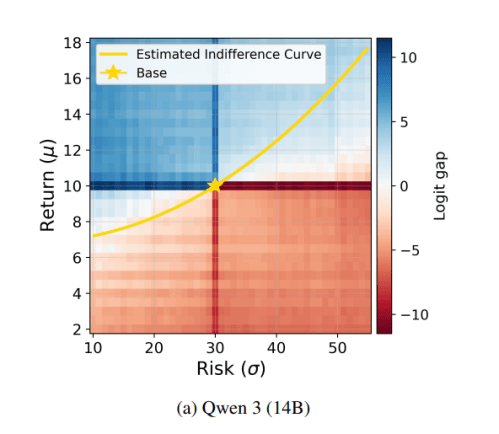
I hope you will refer to the manuscript for details, but I will share one picture here. This is panel (a) of Figure 3: Empirical indifference curves for open-weight models mapped over the portfolio space.

In simple language, what the red/blue picture shows is that the Qwen language model is picking the portfolios that offer more money (in expectation, with a distaste for excessive risk). That’s basically what a rational actor should do. We find that the language models make fairly consistent choices and rarely violate the monotonicity requirement for a well-behaved utility function.

How we describe this figure in the paper: “Starting from a base bundle with expected return µ = 10 and risk σ = 30, we sweep over the dense grid of alternative portfolios from our experimental protocol and record the position-corrected logit gap between each grid portfolio and the base. The yellow dashed line overlays the indifference curve implied by the mean-variance structural estimates, and the heatmap colors encode the sign and magnitude of the logit difference, with blue regions preferred to the base and red regions dispreferred. Several patterns emerge from these plots. All six models produce upward-sloping indifference curves, confirming that higher risk must be compensated by higher expected return.”

We think this basic research on behavior is important, for alignment research and for business applications with delegating work to AI agents. The first question to ask, before testing whether we can impose our preferences on AI agents, is whether those agents have preferences at all in a consistent sense.

Suggested citation: Buchanan, J., & Foster, J. (2026). The innate economic preferences of language models [Preprint]. arXiv. https://doi.org/10.48550/arXiv.2607.26288

The Academic Data Project That Turned Into $375 Million

What could be better than creating data so valuable that an institution is happy to host and update it forever, like the Sean Lahman baseball database?

Creating data that sells for $375 million, like the Center for Research in Security Prices. University of Chicago professors assembled this series of finance datasets over decades, starting in 1960 with an effort to track every transaction of every publicly traded security. U Chicago sold CRSP to Morningstar last year for $375 million.

Why could they sell it for so much? It helps to be working in finance, where the willingness to pay is the highest. It also represents 65 years of work from what became a large team that included Nobelists like Eugene Fama. The data was valuable enough to become widely used by key institutions even though CRSP charged for it:

Today, $3 trillion in fund assets are linked to CRSP Market Indexes, including U.S. equity ETFs run by Vanguard, and more than 600 subscribers across 35 countries use CRSP Research Data Products.  

Did U Chicago sell CRSP at the right time? On the one hand, I wonder if this was a fire sale driven by federal grant cuts putting pressure on the U Chicago budget. On the other hand, assembling datasets like this is only going to get easier in the age of AI, so perhaps Chicago sold at the top.

For now though there is still an edge in having restricted datasets that AIs haven’t trained on and can’t access. When I ask myself what advantage my human research assistants have over AIs in 2026, the most obvious answer is that they can legally access restricted databases like CRSP or, in my current case, HeinOnline.

Fable on Legibility

Claude Fable is Anthropic’s most capable publicly available “Mythos-class” model. It is optimized for long-running autonomous tasks and deep knowledge work. The roll out of this product has been dramatic. Little people like me have access to it for only two weeks, and I doubt I will be able to afford it thereafter. With my window of access, I posed it the following prompt:

“This article indicates that a much smarter model might not be possible because the universe is opaque. Since Tyler Cowen made this statement, AI has helped people make breakthroughs in math and biology. Write this again in 2026 using the latest state of technology. Is the smartest LLM today much smarter than GPT-4? And is the universe legible?” and I copied in my blog post Is the Universe Legible to Intelligence?

Fable replied in 3 pages of text which you can download as a Word doc here.

One line from Fable’s response: “Notice where the wins clustered: mathematics with checkable proofs, protein structures with experimental ground truth, contest problems with known answers. These are the maximally legible domains — places with a fixed target and a way to verify that you hit it.”

The writing is coherent and contains no obvious hallucinations. Is the answer true, and does it tell the whole truth?

Whenever you read something think about who wrote it, and keep in mind that every author/model has a bias and limitations. In my paper with Will Hickman, we found that just reminding people that a paragraph has an author (whether the author is human or AI) increased the demand for fact checking from readers. LLMs will become more persuasive and closer to (but never completely) correct. Keep reading all things with some skepticism whether they are written by scientists, politicians, or AI.

Regardless, there is definitely such a thing as making the known world more legible to AI today. Thus, people are talking about increasing funding for data availability and the possible demise of the “research paper.”

Research papers are more like stories than facts. The demand for stories is not going away, but I definitely cannot predict the future of the write-for-pay scientist.

AI, potentially, could go and get its own new data, instead of waiting for humans to archive it. Thus, the self-improving AI might take us beyond the current models… unless they run up against something that is not legible to intelligence…

Expressionism Is To Cameras As…. Caity Weaver?…. Is To Writing?

I don’t think it’s a coincidence that movements like expressionism, impressionism, and abstract art took off after the invention of the camera. Photorealistic paintings are impressive, but once they are duplicating what a camera does, they’re less interesting.

We’re due for similar movements in other fields to emerge as reactions to AI. Like writing in a way totally different from how an AI would write- ideally better than an AI would write, but even writing worse than an AI can be interesting if it is at least different.

It’s still early days for both AI and our reactions to it. But since the release of ChatGPT in 2022, what is the good new essay or book that you’re most confident was not written by AI, one that was written in an almost deliberately extra-human manner?

Continue reading →