2025 In Books

What I read in 2025:

Econ Books I Wrote Full Reviews Of:

The Little Book of Common Sense Investing: “John Bogle, the founder of Vanguard, wrote a short book in 2006 that explains his investment philosophy. I can sum it up at much less than book length: the best investment advice for almost everyone is to buy and hold a diversified, low-fee fund that tracks an index like the S&P 500.”

The Little Book that Beats the Market: “Greenblatt offers his own twist on value investing that emphasizes just two value metrics- earnings yield (basically P/E) and return on capital (return on assets). The idea is to blend them, finding the cheapest of the high-quality companies…. Greenblatt’s Little Book is a quick and easy way to learn a bit about value investing, but I think Bogle’s Little Book has the better advice.”

When Genius Failed: “Myron Scholes was on top of the world in 1997, having won the Nobel Prize in economics that year for his work in financial economics, work that he had applied in the real world in a wildly successful hedge fund, Long Term Capital Management. But just one year later, LTCM was saved from collapse only by a last-minute bailout that wiped out his equity (along with that of the other partners of the fund) and cast doubt on the value of his academic work…. The story is well-told, and the lessons are timeless”

The Art of Spending Money: “Its main point is that people tend to be happier spending money on things they value for their own sake- rather than things they buy to impress others, or piling up money as a yardstick to measure themselves against others (this is repeated with many variations). Overall it is well-written at the level of sentences and paragraphs with well-chosen stories and quotes, but I’m not sure what it all adds up to.”

Non-fiction I didn’t previously mention here:

The Napoleonic Wars: A Global History, Alexander Mikaberidze: Aims to educate us about the surprisingly major effects of the Napoleonic Wars outside of Europe. Succeeds wildly; I also learned a lot about the main European theatre. Hadn’t realized how poor British Russian relations were in this era, since they defeat Napoleon together in the end. But they were heading for war early on until a czar was assassinated, then actually went to war in the middle over Sweden and trade. Outside Europe, Britain briefly took Buenos Aires and Montevideo, and accidentally (?) captured Iceland, along with all the French and Dutch overseas colonies.

Talent: How to Identify Energizers, Creatives, and Winners Around the World, Tyler Cowen and Dan Gross: A business book that works best for someone who hires a lot. How to attract and retain diverse candidates, including but not limited to the most-discussed types of diversity. Tyler says that when he lived in Germany people often thought he was Turkish, and one told him to ‘get out of here, you Turk’.

Almost Human: The Astonishing Tale of Homo Naledi and the Discovery That Changed Our Human Story, Lee Berger and John Hawks: The story of how the authors excavated a cave in South Africa that held many remains from a previously unknown type of early human. Good storytelling, good explanations of what we know about early humans from other discoveries, and surprisingly frank discussions of the academic politics behind getting paleontology research funded.

The Ends of the World, Peter Brannen: The book explains Earth’s 5 previous mass extinctions and the geology / science behind how we found out what we know about them. Written explicitly about what all this means for current global warming; see my full review on that here.

Annals of the Former World, John McPhee: New Yorker writer follows geologists from New York to San Fransisco to learn about the land in between. Published as a series of 4 books (Basin and Range, In Suspect Terrain, Rising from the Plains, Assembling California), each one focusing on a different geologist and region. McPhee is known as an excellent stylist but the books are also quite substantive, I feel like I learned a lot.

Fiction

The Works of Dashiell Hammet: My friend Dashiell mentioned that this is who he was named after, and that Red Harvest was a good book of his to start with. He was right, and it lead me to read many others: The Thin Man (you may have heard of Hammet because of the movies adapted from this and The Maltese Falcon), Best Cases of the Continental Op, Honest Gain: Dicey Cases of the Continental Op. Almost every story has a twist more interesting than “the murderer isn’t who you suspected”.

Tress of the Emerald Sea, Brandon Sanderson. Sanderson is one of the most prolific authors of our time, so where do you start with him? He suggestsMistborn or Tress of the Emerald Sea, depending if they want something more heisty and actiony or something more whimsical.”

The Frugal Wizard’s Handbook for Surviving Medieval England, Brandon Sanderson: Sanderson doing his best impression of Terry Pratchett rewriting Mark Twain’s Connecticut Yankee in King Arthur’s Court, with shades of Scott Meyer’s Off to Be the Wizard.

Janissaries, Jerry Pournelle: What if instead of going to a more primitive world alone, you got sent there with an army?

The Narrow Road Between Desires, Patrick Rothfuss: Enough of an expansion of The Lightning Tree to be worth reading, but at this point anything Rothfuss does other than finally finish Doors of Stone can’t help but be disappointing.

Beguilement, Lois McMaster Bujold: Her Sci Fi works are great so I looked forward to her take on the Fantasy genre, but this turns out to be her take on the Romance genre.

Meta

This year I realized that Hoopla has a lot of books that Libby doesn’t, it is worth checking both apps for a book if you have access to libraries that offer both

Do Required Personal Finance Classes Work?

41 states now require students to take a course in economics or personal finance in order to graduate high school:

Source: Council for Economic Education

12 states representing 21% of US high schoolers passed mandates for personal finance classes just since 2022. This sounds like a good idea that will enable students to navigate the modern economy. But does it work in practice?

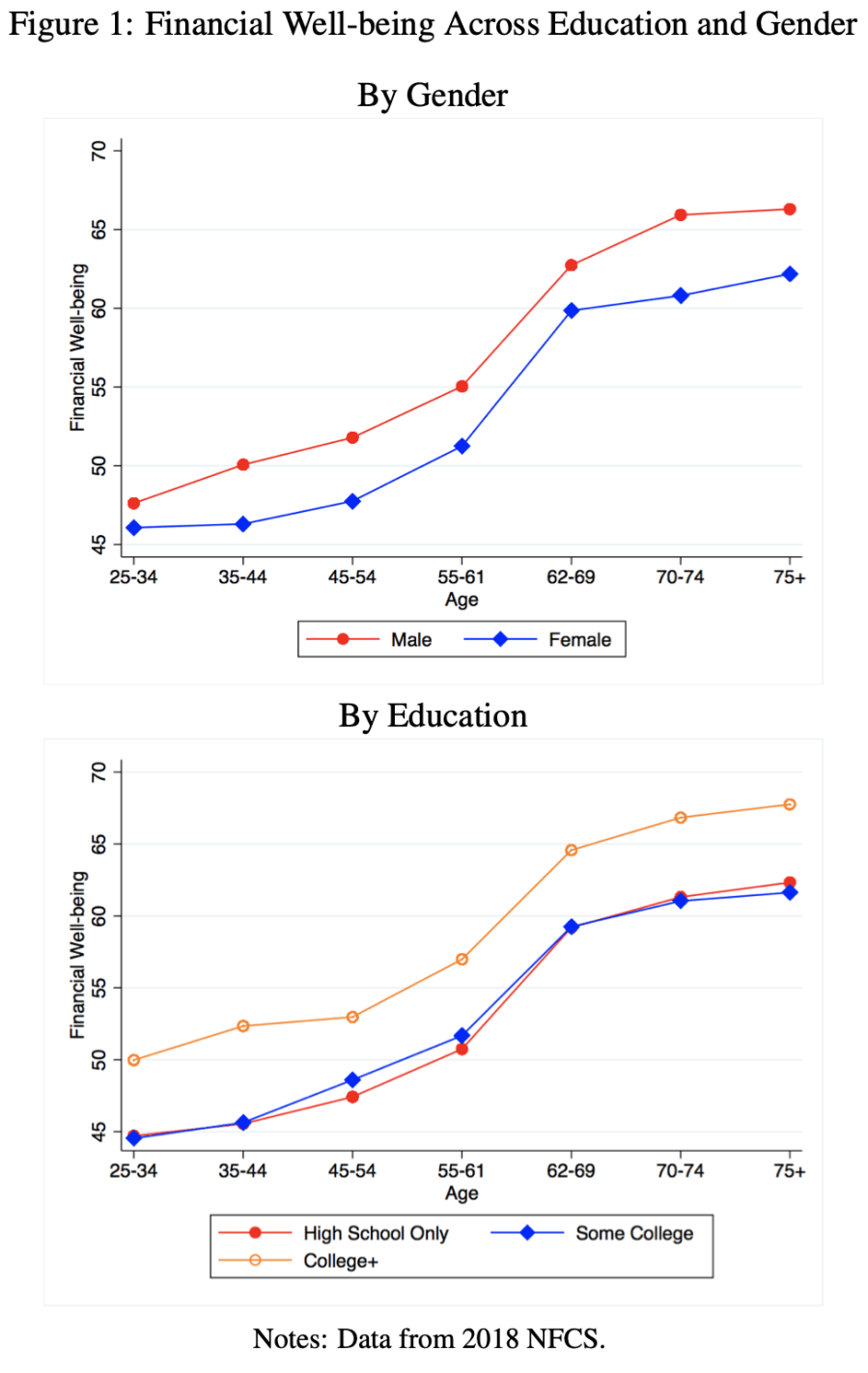
A 2023 working paper “Does State-mandated Financial Education Affect Financial Well-being?” by Jeremy Burke, J. Michael Collins, and Carly Urban argues that it does, at least for men:

We find that the overall effects of high school financial education graduation requirements on subjective financial well-being are positive, between 0.75 and 0.80 points, or roughly 1.5 percent of mean levels. These overall effects are driven almost entirely by males, for whom financial education increases financial well-being by 1.86 points, or 3.8 percent of mean financial well-being.

The paper has nice figures on financial wellbeing beyond the mandate question:

As soon as I heard about the rapid growth in these mandates from Meb Faber and Tim Ranzetta, I knew there was a paper to be written here. I was glad to see at least one has already tackled this, but there are more papers to be written: use post-2018 data to evaluate the new wave of mandates, evaluate the economics mandates in addition to the personal finance ones, and use a more detailed objective measure like the Survey of Consumer Finances.

There’s also more to be done in practice, hiring and training the teachers to offer these new classes:

our estimates are likely attenuated due to poor compliance by schools subject to new financial education curriculum mandates. Urban (2020) finds evidence that less than half of affected schools may have complied. As a result, our estimated overall and differential effects may be less than half the true effects

Economic Freedom Updates

In September we covered the release of the Fraser Institute’s 2025 Economic Freedom of the World report. I said then:

The authors are doing great work and releasing it for free, so no complaints, but two additional things I’d like to see from them are a graphic showing which countries had the biggest changes in economic freedom since last year, and links to the underlying program used to create the above graphs so that readers could hover over each dot to identify the country

Well, now Matthew Mitchell of the Fraser Institute has done that:

I can only post a screenshot of a scatterplot here, but if you click through to the Fraser report you can hover over any dot to see which country it represents:

Now Published: Prohibition and Percolation

My new article, “Prohibition and Percolation: The Roaring Success of Coffee During US Alcohol Prohibition”, is now published in Southern Economic Journal. It’s the first statistical analysis of coffee imports and salience during prohibition. Other authors had speculated that coffee substituted alcohol after the 18th amendment, but I did the work of running the stats, creating indices, and checking for robustness.

My contributions include:

  • National and state indices for coffee and coffee shops from major and local newspapers.
  • A textual index of the same from book mentions.
  • I uncover that prohibition is when modern coffee shops became popular.
  • The surge in coffee imports was likely not related to trade policy or the end of World War I
  • Both demand for coffee and supply increased as part of an intentional industry effort to replace alcohol and saloons.
  • An easy to follow application of time series structural break tests.
  • An easy to follow application of a modern differences in differences method for state dry laws and coffee newspaper mentions.
  • Evidence from a variety of sources including patents, newspapers, trade data, Ngrams, naval conflicts, & Wholesale prices.

Generally, the empirical evidence and the main theory is straightforward. I learned several new empirical methods for this paper and the economic logic in the robustness section was a blast to puzzle-out. Finally, it was an easy article to be excited about since people are generally passionate about their coffee.


Bartsch, Zachary. 2025. “Prohibition and Percolation: The Roaring Success of Coffee During US Alcohol Prohibition.” Southern Economic Journal, ahead of print, September 22. https://doi.org/10.1002/soej.12794.

Economic Freedom of the World 2025

The Fraser Institute released their latest report on the Economic Freedom of the World today, measuring economic policy in all countries as of 2023. They made this excellent Rosling-style graphic that sums up their data along with why it matters:

In short: almost every country with high economic freedom gets rich, and every country that gets rich either has high economic freedom or tons of oil. This rising tide of prosperity lifts all boats:

This greater prosperity that comes with economic freedom goes well beyond “just having more stuff”:

The full report, along with the underlying data going back to 1970, is here. The authors are doing great work and releasing it for free, so no complaints, but two additional things I’d like to see from them are a graphic showing which countries had the biggest changes in economic freedom since last year, and links to the underlying program used to create the above graphs so that readers could hover over each dot to identify the country (I suppose an independent blogger could do the first thing as easily as they could…).

FRDM is an ETF that invests in emerging markets with high economic freedom (I hold some), I imagine they will be rebalancing following the new report.

Is the Fed’s Inflation Target Really 2%?

The Fed has had an official inflation target of 2% since 2012, a commitment they reaffirmed just last month after their policy review:

The Committee reaffirms its judgment that inflation at the rate of 2 percent, as measured by the annual change in the price index for personal consumption expenditures, is most consistent over the longer run with the Federal Reserve’s statutory maximum employment and price stability mandates.

But since 2020, they haven’t been acting like it. Lets look at their preferred measure of inflation, the annual change in the PCE price index:

The last time annual inflation was at or below 2.0% was February 2021. The Fed just cut rates despite inflation being at 2.6%. If you didn’t know about their 2% target and were trying to infer their target based solely on their actions, what would you guess their target is?

Considering the post-Covid period, I see their actions as being more consistent with a 3% target than a 2% target. They stopped raising rates once inflation got below 3.4%, and started cutting them again once inflation got below 2.4%. The Fed’s own projections show more rate cuts coming despite the fact that they don’t expect inflation to get back to 2.0% until 2028! Bloomberg’s Anna Wong does the math and infers their target is 2.8%:

Perhaps the Fed’s target should be higher than 2%, but if they have a higher target, they should make it explicit so as not to undermine their credibility. Or at least make explicit that their target is loose and they’d rather miss high than low, if that is in fact the case. This is what Greg Mankiw would prefer:

I feel strongly that a target of 2 percent is superior to a target of 2.0 percent….. It would be better if central bankers admitted to the public how imprecise their ability to control inflation is. They should not be concerned if the inflation rate falls to 1.6. That comfortably rounds up to 2. And they should be ready to declare victory in fighting inflation when the inflation rate gets back to 2.5. As the adage goes, that is good enough for government work. Maybe the Fed should even ditch a specific numerical target for inflation and instead offer a range, as some other central banks do. The Fed could say, for example, that it wants to keep the inflation rate between 1 and 3. Doing so would admit that the Fed governors are notquite as godlike as they sometimes feign.

The Fed seems to have taken Mankiw’s approach to heart, except with a preferred range of 2.0-3.5%. I take Mankiw’s point about not being able to fine-tune everything, but given the bigger picture I think the Fed should if anything err on the low side of 2.0%. The Federal deficit is in the trillions and rising, inflation has been above target since 2021, and consumers never got over the Covid-era increase in the price level:

Source: Michigan Consumer Survey

The Fed let inflation stay mostly below 2% during the 2010s, to the detriment of the labor market. They updated their policy framework in 2020 to allow for “Flexible Average Inflation Targeting”, where they would let inflation stay above 2% for a while to make up for the years of below 2% inflation. This is part of why they let inflation get so out of hand in 2022. This made up for the 2010s and then some- our price level is now 3-4% higher than it would be if we’d had 2.0% inflation each year since 2007. But the sudden big burst of inflation in 2022 led the Fed to abandon this flexible targeting idea in the 2025 framework. The lack of “make up” policy latest framework means that they don’t see themselves as needing to do anything to repair their 2022 mistake- “just don’t do it again”.

We’re certainly being stuck with permanently higher prices as a result, and I worry we will be stuck with higher inflation too.

$1 Million or I Quit: CTE Deaths in Football and Hockey

Former teammates of athletes who died of CTE would require $6 million to offset this disamenity and $1 million to be indifferent between exiting and staying in the profession.

So concludes a paper by Josh Martin. I thought this paper would be about a small group, since CTE deaths mostly happen among long-retired players with few or no former teammates still playing. But it turns out there were a fair number of early deaths, and each player had many teammates who can be affected, totaling 23% of NHL players and 14% of NFL players:

But teams mostly won’t pay worried players enough extra to stay, especially in hockey. So many of them retire early:

Athletes who were teammates with a former teammate who died with CTE for three or more years and played for a team with them at least two years before their death are 7.22 percentage points more likely to retire than characteristically similar non-treated players in the same years. Relative to the pre-treatment mean, this represents a 69% increase.

People still respond to incentives though, and if you do pay them enough they mostly take the risk and stay:

The remaining players will take measures to protect themselves, like skipping games to recover from concussions:

Michael previously pointed out here that these concerns matter more for certain positions, like running backs:

If you want millionaires to show up every week to willingly endure the equivalent of a half-dozen car accidents, you’re going to have to pay them.

This all makes for a good illustration of the theory of compensating differentials, which is sometimes surprisingly hard to observe in the labor market. But sports tend to have the sort of data we can only dream of elsewhere. Which other workers have millions of people observing, measuring, and debating their on-the-job productivity and performance?

This summer I was one of thousands of people crowding into Foxborough just to watch them practice:

The NFL season kicks off today, and I say the players deserve the millions they are about to earn.

You Read It Here First

The subjects of two of our posts from 2023 are suddenly big stories.

First, here’s how I summed up New Orleans’ recovery from hurricane Katrina then:

Large institutions (university medical centers, the VA, the airport, museums, major hotels) have been driving this phase of the recovery. The neighborhoods are also recovering, but more slowly, particularly small business. Population is still well below 2005 levels. I generally think inequality has been overrated in national discussions of the last 15 years relative to concerns about poverty and overall prosperity, but even to me New Orleans is a strikingly unequal city; there’s so much wealth alongside so many people seeming to get very little benefit from it. The most persistent problems are the ones that remain from before Katrina: the roads, the schools, and the crime; taken together, the dysfunctional public sector.

The New York Times had a similar take yesterday:

Today, New Orleans is smaller, poorer and more unequal than before the storm. It hasn’t rebuilt a durable middle class, and lacks basic services and a major economic engine outside of its storied tourism industry…. New Orleans now ranks as the most income-unequal major city in America…. In areas that attracted investment — the French Quarter, the Bywater and the shiny biomedical corridor — there are few outward signs of the hurricane’s impact. But travel to places like Pontchartrain Park, Milneburg and New Orleans East that were once home to a vibrant Black middle class, and there are abandoned homes and broken streets — entire communities that never regained their pre-Katrina luster…. Meanwhile, basic city functions remain unreliable.

I wrote in 2023 about a then-new Philadelphia Fed working paper claiming that mortgage fraud is widespread:

The fraud is that investors are buying properties to flip or rent out, but claim they are buying them to live there in order to get cheaper mortgages…. One third of all investors is a lot of fraud!… such widespread fraud is concerning, and I hope lenders (especially the subsidized GSEs) find a way to crack down on it…. This mortgage fraud paper seems like a bombshell to me and I’m surprised it seems to have received no media attention; journalists take note. For everyone else, I suppose you read obscure econ blogs precisely to find out about the things that haven’t yet made the papers.

Well, that paper has now got its fair share of attention from the media and the GSEs. Bill Pulte, director of the Federal Housing Finance Agency and chairman of Fannie Mae and Freddie Mac, has been going after Biden-appointed Federal Reserve Governor Lisa Cook over allegations that she mis-stated her primary residence on a mortgage application:

Pulte has written many dozens of tweets about this, at least one of which cited the Philly Fed paper:

Now President Trump is trying to fire Cook. Federal Reserve Governors can only be fired “for cause” and none ever have been, but Trump is using this alleged mortgage fraud to try to make Cook the first.

The Trump administration seems to have made the same realization as Xi Jinping did back in 2012– that when corruption is sufficiently widespread, some of your political opponents have likely engaged in it and so can be legally targeted in an anti-corruption crackdown (while corruption by your friends is overlooked).

I’m one of a few people hoping for the Fed to be run the most competent technocrats with a minimum of political interference:

But I’m not expecting it.

Remember, you read it here first.

Parental Job Lock

The Affordable Care Act was supposed to make it easier for American workers to switch jobs by making it easier to get health insurance from sources other than their current employer. Mostly it didn’t work out that way. But a new paper finds that one piece of the ACA actually made people less likely to switch jobs.

The ACA Dependent Coverage Mandate required family health insurance plans to cover young adults though age 26, when prior to the 2010 passage of the ACA many had to leave the family plan at age 18 or 19. I thought these newly covered young adults would be more likely to switch jobs or start businesses, but there turned out to be absolutely no effect on job switching, and no overall increase in businesses (though it did seem to increase the number of disabled young adults starting businesses, and other parts of the ACA increased business formation among older adults).

But while the Dependent Coverage mandate seems not to have reduced job lock for young adults, it increased job lock among their parents. That is the finding of a new paper in the Journal of Public Economics by Hannah Bae, Katherine Mackel, and Maggie Shi. Using a large dataset with exact months of age and coverage, MarketScan, allows them to estimate precise effects:

We find that dependents just to the right of the December 1985/January 1986 cutoff—those eligible for longer coverage—are more likely to enroll and remain covered for longer once the mandate is in effect. Dependent enrollment increases by 1.8 percentage points at the cutoff, an increase of 9.2 % over the enrollment rate for dependents born in December 1985. In addition, the enrollment duration increases by 9.7 days (14.6 %). Turning to their parents, we find that parental job retention likelihood increases by 1.0 percentage point (1.8 %) and job duration increases by 5.8 days (1.6 %) to the right of the cutoff. When scaled by the estimated share of dependents on end of year plans, our findings imply that 12 additional months of dependent coverage correspond to a 7.7 % increase in job retention likelihood and a 7.0 % increase in retention duration.

Source: Figure 2 of Bae, Mackel and Shi 2025

I believe in this parental job lock effect partly because of their data and econometric analysis, and partly through introspection. I plan to work for years after I have the money to retire myself in order to keep benefits for my kids, though personally I’m more interested in tuition remission than health insurance.

On top of working longer though, benefits like these enable employers to pay parents lower money wages. A 2022 Labour Economics paper from Seonghoon Kim and Kanghyock Koh found that the Dependent Coverage Mandate “reduced parents’ annual wages by about $2600 without significant reductions in the probability of employment and working hours.” But at least their kids are better off for it.

Is A Music Major Worth It?

Our new paper concludes that the answer is a resounding “It Depends”.

It depends on your answer to the following questions:

  1. If you didn’t major in music, would you major in something else, or not finish college?
  2. How dead set are you on a career in music?
Source: Figure 1 of Bailey and Smith (2025)

We found that

  1. Music majors earn more than people who didn’t graduate from college, even if they don’t end up working as musicians
  2. Among musicians, music majors earn more than other majors
  3. But among non-musicians, other majors earn much more than music majors

So on average a music major means higher income if you would be a musician anyway, or if you wouldn’t have gone to college for another major, but lower income than if you majored in something else and worked outside of music. The exact amounts depend on what you control for; this gets complex but this table gives the basic averages before controls:

Source: Table 2 of Bailey and Smith (2025), showing wage plus business income for respondents to the 2018-2022 American Community Survey

For better or worse, a music major also means you are much more likely to be a musician- 113 times more likely, in fact (this is just the correlation, we’re not randomizing people into the major). Despite that incredible correlation, only 9.8% music majors report being professional musicians, and only 22.3% of working musicians were music majors.

Sean Smith had the idea for this paper and wrote the first draft in my Economics Senior Capstone class in 2024. After he graduated I joined the paper as a coauthor to get it ready for journals, and it was accepted at SN Social Sciences last week. We share the data and code for the paper here.

Continue reading