Tyler Supporting Women in the GOAT book

Ladies, Tyler Cowen has done us a solid. He included John Stuart Mill as a contender for the greatest economist of all time in large part because of his insights on gender equality.

I’m short on time at the moment. I’d like to do a better job than this, with more nuance about Hayek, but here’s the most I can do this week:

More here: “John Stuart Mill on women, as explained by TC

Or read the (free) GOAT book. I might say you should just jump to the Mill chapter, but it makes more sense in context if you read the whole thing.

Arbitrary Framing & Economic Reality

Subjectivism is popular at many universities. I am not talking about the economics kind in which people have a diversity of preferences. I’m talking about the subjectivism that permits different and conflicting assertions of truth to be simultaneously correct. This is where the ‘my truth’ language enters. Having a diversity of feelings is one thing – and unavoidable. Having different practical claims about the material world is another. Many universities have embraced Descartes’s unreliability of the senses writ large. The result is that people of seeming plentiful intellectual capacity dogmatize themselves into speaking such that nothing is considered a default. Nothing “is normal”, there is only “normal for someone”.

It’s a perfectly defensible model of the world. And, as we know, models are applicable only insofar as they’re useful. The subjectivist model is great at describing the diversity of preferences and priorities. The model is bad for math and achieving material ends. Further, it can serve to hinder our understanding of worldly or social phenomena.

Here’s an example.

Consider people who don’t speak the same language. They may or may not have some other compensatory skill. For Mandarin speakers, we can rightfully say that they can’t speak or communicate as effectively with the English-speaking majority of people in the US. We can also say the converse: The English-speaking majority can’t speak Mandarin or communicate as effectively with the Mandarin-speaking minority. There’s a certain symmetrical beauty to being able to interpret reality both ways. It exercises our cerebral cortex.

However, modeling the descriptive statements as intrinsically equivalent harms our ability to sensibly understand and analyze the circumstances. Specifically, we need to talk about opportunity costs.

Consider an urban storeowner in America who speaks only Mandarin. Consider also an only-English-speaking customer who has a question about an item for sale. We can perform the same symmetrical analysis as above saying that they both speak different languages. Importantly, however, they face substantially different opportunity costs in two ways.

First, the English-speaking customer has low-cost alternatives. The language barrier need not be insurmountable. If the transaction cost of more difficult communication is adequate, then the English-speaking customer can go elsewhere relatively easily and purchase from the English-speaking storeowner down the block. They have plenty of low-cost opportunities for gains from trade. Clearly, there is nothing intrinsically advantageous about speaking English. What’s advantageous is speaking the more popular language.

By having access to the larger market, the English speaker has access to greater specialization and to more buyers and sellers. If the language difference is the only difference between two people, then the one who speaks the majority language has an economic advantage. I mean ‘economic’ in both the pecuniary and non-pecuniary sense. Speaking the majority language has the consequence of greater income. But that comes from the very real differences in costs and benefits associated with trade. If the exact same person spoke only a minority language, then their income would be lower along with their lesser access to trading partners. Therefore, while it is symmetrically true that the English speaker can’t speak Mandarin and that the Mandarin speaker can’t speak English, it is not true that they face the same opportunity costs.

Second, and probably more trivially, it may be that most English speakers never have occasion to interact with any Mandarin-only speakers. Whereas Mandarin speakers in the US have constant potential interactions with English speakers. It would therefore belie the costs and benefits to simply say that they symmetrically can’t speak the same language. Indeed, many English-speakers have no motivation nor awareness of potential Mandarin-speaking trade partners. At the same time, in the US, Mandarin speakers would very much have an awareness and occasion to interact with English speakers. While it is true that they don’t speak the same language, they differ by their access to potential trade partners who speak a different language. It wouldn’t reflect the incentives to say that the English speaker is less able to communicate with Mandarin speakers when they largely lack even the awareness of the minority language.

Conclusion

An analysis of English and Mandarin speakers in the US is not a symmetrical analysis. It doesn’t matter whether we frame English speakers has having a lower opportunity cost to trading with Mandarin speakers, or whether we frame Mandarin-speakers as having a higher opportunity cost to trading with English speakers. The economic truth is that the opportunity costs differ, no matter how we might try to equivocate about what normal is. Obviously, the above analysis isn’t specific to Mandarin and English, nor to language necessarily. While framing a circumstance with a default is an arbitrary modelling decision, asserting that two alternatives means or practices have the same opportunity cost or the same productive capacity is indefensible and often doesn’t reflect the underlying economic reality.


Medicaid Cuts Mean Credit Card Debt

My paper “Missouri’s Medicaid Contraction and Consumer Financial Outcomes” is now out at the American Journal of Health Economics. It is coauthored by Nate Blascak and Slava Mikhed, researchers at the Federal Reserve Bank of Philadelphia. They noticed that Missouri had done a cut in 2005 that removed about 100,000 people from Medicaid and reduced covered services for the remaining enrollees. Economists have mostly studied Medicaid expansions, which have been more common than cuts; those studying Medicaid cuts have focused on Tennessee’s 2005 dis-enrollments, so we were interested to see if things went differently in Missouri.

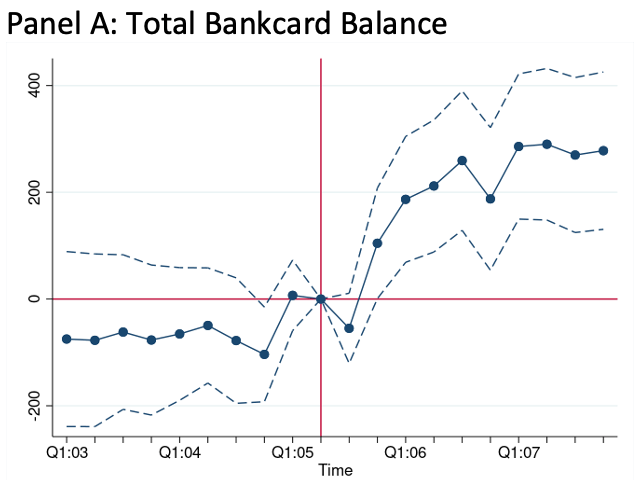
In short, we find that after Medicaid is cut, people do more out-of-pocket spending on health care, leading to increases in both credit card borrowing and debt in third-party collections. Our back-of-the-envelope calculations suggest that debt in collections increased by $494 per Medicaid-eligible Missourian, which is actually smaller than has been estimated for the Tennessee cut, and smaller than most estimates of the debt reduction following Medicaid expansions.

We bring some great data to bear on this; I used the restricted version of the Medical Expenditure Panel Survey to estimate what happened to health spending in Missouri compared to neighboring states, and my coauthors used Equifax data on credit outcomes that lets them compare even finer geographies:

The paper is a clear case of modern econometrics at work, in that it is almost painfully thorough. Counting the appendix, the version currently up at AJHE shows 130 pages with 29 tables and 11 figures (many of which are actually made up of 6 sub-figures each). We put a lot of thought into questioning the assumptions behind our difference-in-difference estimation, and into figuring out how best to bootstrap our standard errors given the small number of clusters. Sometimes this feels like overkill but hopefully it means the final results are really solid.

For those who want to read more and can’t access the journal version, an earlier ungated version is here.

Disclaimer: The results and conclusions in this paper are those of the authors and do not indicate concurrence by the Agency for Healthcare Research and Quality or the US Department of Health and Human Services. The views expressed in this paper are solely those of the authors and do not necessarily reflect the views of the Federal Reserve Bank of Philadelphia or the Federal Reserve System. Any errors or omissions are the responsibility of the authors.

Younger Generations Have Higher Incomes Too (and it’s probably not explained by the rise of dual-income families)

Regular readers know that I’ve written numerous times about the wealth levels of younger generations, such as this post from last month. Judged by average (and usually median too) wealth, younger generations are doing as well and often better than past generations. This is not too surprising, if you generally think that subsequent generations are better off than their parents, but many people today seem to think that progress has stopped. The data suggest it hasn’t stopped!

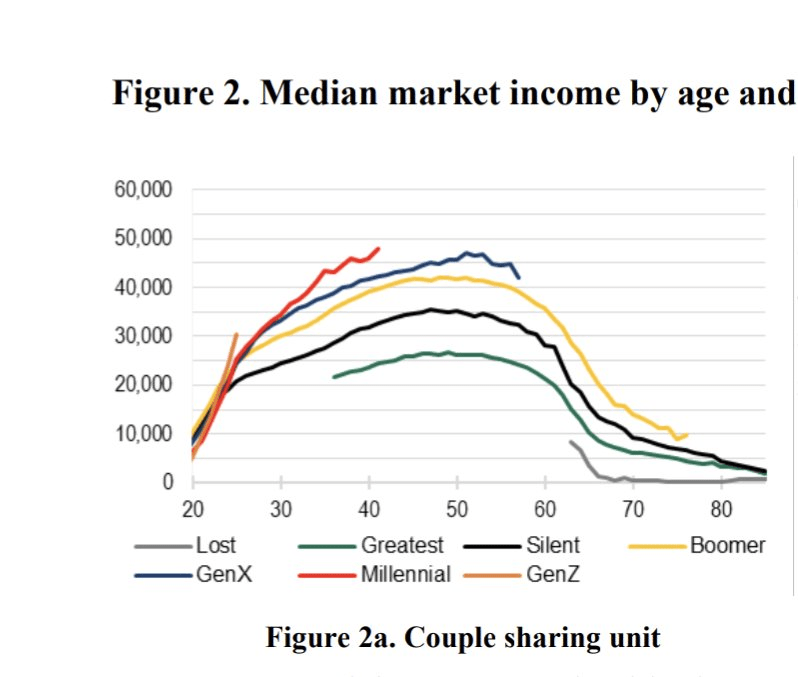
Now there’s a great new paper by Kevin Corinth and Jeff Larrimore which looks at not wealth but income levels by generation. The look at income in a variety of different ways, including both market income and post-tax/transfer income. But the result is pretty consistent: each generation has higher incomes (inflation adjusted) than the previous generation. Here’s a typical chart from the paper:

Continue reading

Historical State GDP Data

Data on Gross State Product prior to 2017 has disappeared from the main page of the Bureau of Economic Analysis. It is also gone from some third party hosts like FRED. It turns out BEA is in the middle of revising how they calculate state GDP; they have the new version done back to 2017, and took down the older inconsistent estimates until they can recalculate them. After that, they tell me they will repost pre-2017 state Gross Domestic Product:

In the mean time, they offer some messy and seemingly incomplete versions of pre-2017 GDP here, and you can find 1980-2021 state GDP (along with many other nice variables) in a nice panel from the University of Kentucky Center for Poverty Research’s National Welfare Data.

You can find more details on the actual changes BEA is making to how they calculate GDP here. Most changes seem relatively minor for states, but might have more impact on the measured relative size of industries. For instance, “equity REITs will be reclassified from the funds, trusts, and other financial vehicles industry to the real estate industry, while mortgage REITs will remain classified as funds, trusts, and other financial vehicles”.

Why Was Federal Tax Revenue Down in 2023?

The year 2023 was a pretty good one for the economy, whether judged by the labor market or economic growth. Despite this good economic growth, total receipts of the federal government were down about 7 percent from 2022 (note: I’m using calendar years, rather than fiscal years). Here’s a chart (note: in NOMINAL dollars) of total federal revenue since 2009:

I want to stress that these are nominal dollars (there, I’ve said it three times, hopefully there is no confusion). Nominal dollars are usually not the best way to look at historical data, but for purposes of looking at recent government budgets, sometimes it is. Especially when revenue is declining: if I adjusted this for inflation, the decline in 2023 would be even larger!

You’ll notice also that the decline in 2023 is even larger than the decline in 2020, the height of the pandemic when many people were out of work due to government regulations and changes in consumer behavior. The 2023 decline is big!

So, what the heck in going on with federal revenue in 2023?

Continue reading

Government Purchases and How Markets Avoid Messes

The government is unique among economic institutions insofar as it can use coercion legally. But not all activities are coercive. Clearly, taxation is overwhelmingly coercive. Some people say that they are happy to pay taxes, but the voluntary gifts to the US Treasury are itsy-bitsy (just over $1m for FY 2023). Most regulations also include the threat of fines or jail time for non-compliance.

But once the government has the money in their coffers, there is plenty that they can do consensually. Once they have the resources, they are often just another potential transactor in the markets for goods and services. While the government can transact as well as anyone else, there is a fundamental theoretical difference for how we should interpret those transactions. Specifically, there is a principal-agent problem such that we can’t quite identify the welfare that is enjoyed by consumers when the government makes purchases. We really have very little idea.

Garett Jones uses the analogy of the government confiscating potatoes. The worst use would be for the government to throw the valuable resources into the river. Those resources help no one. Improved welfare would be yielded if the government just transferred those potatoes back to people. Sure, there’s the transaction cost of administration, but people get their potatoes back. Finally, the great hope is that the government takes the potatoes and makes tasty potato fritas such that they return to the public something more valuable than they took. These might be things that fall into the public goods category or solving collective action problems generally.

The above examples illustrates that how the government spends matters a lot for the welfare implications of the newly purchased government resources. But, we need to recall that there is an entire private segment of the market that is affected by the government transactions.

Short-Run Analysis

In a competitive market, firms face increasing marginal costs and make decisions about their levels of output. When the government makes purchases, it’s simply acting as another demander. How does the entry of a larger demander affect everyone else in the market? See the below GIF.

Continue reading

Does More Health Spending Buy Better Outcomes for States?

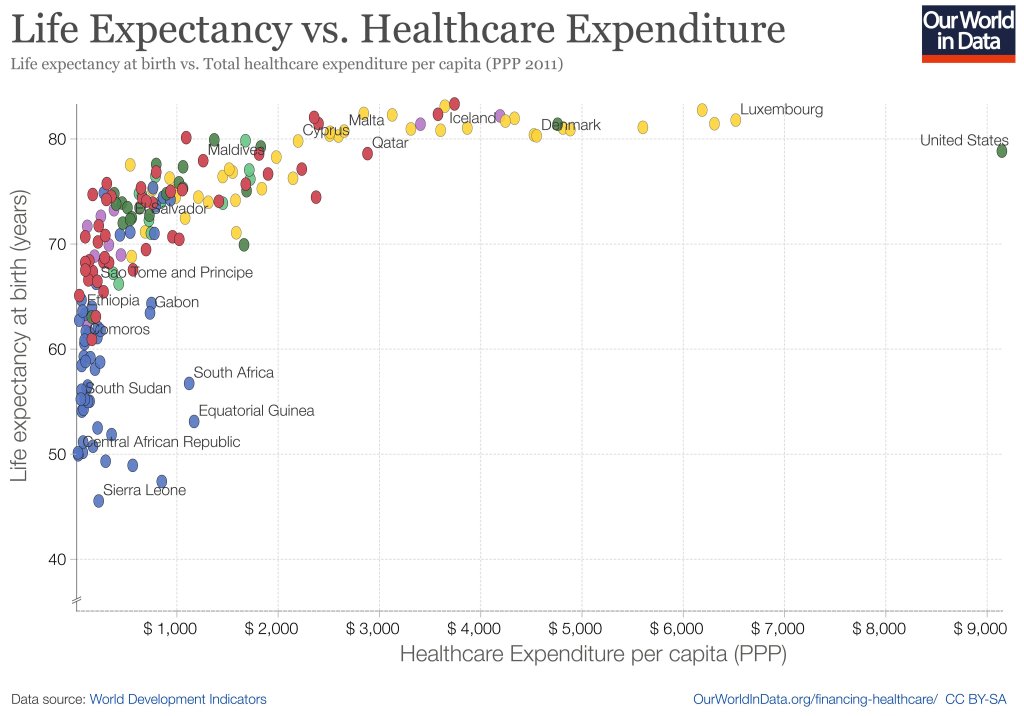
When you look across countries, it appears that the first $1000 per person per year spent on health buys a lot; spending beyond that buys a little, and eventually nothing. The US spends the most in the world on health care, but doesn’t appear to get much for it. A classic story of diminishing returns:

Source: https://twitter.com/MaxCRoser/status/810077744075866112/photo/1

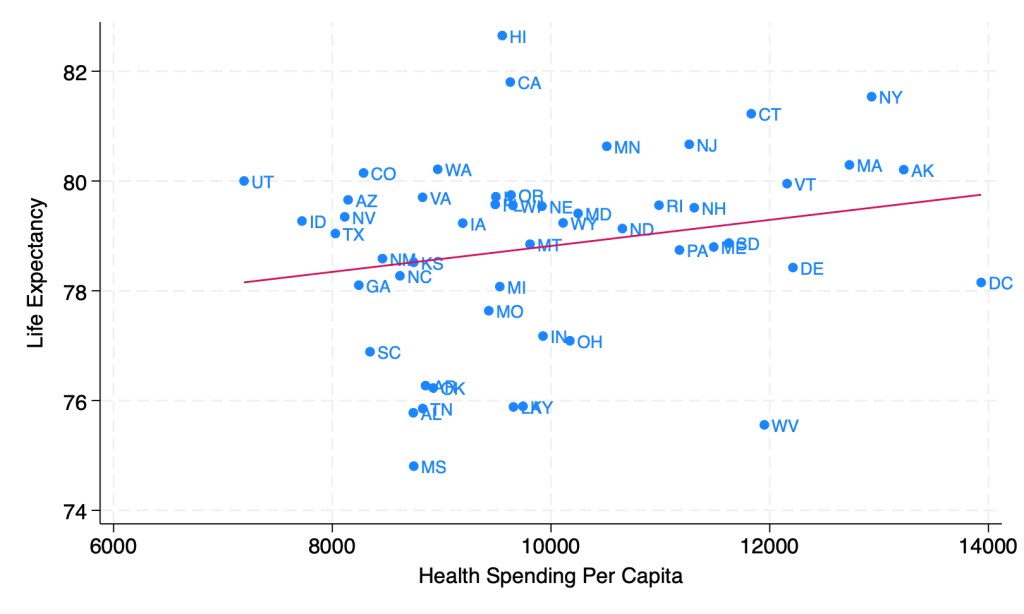
This might tempt you to go full Robin Hanson and say the US should spend dramatically less on health care. But when you look at the same measures across US states, it seems like health care spending helps after all:

Source: My calculations from 2019 IHME Life Expectancy and 2019 KFF Health Spending Per Capita

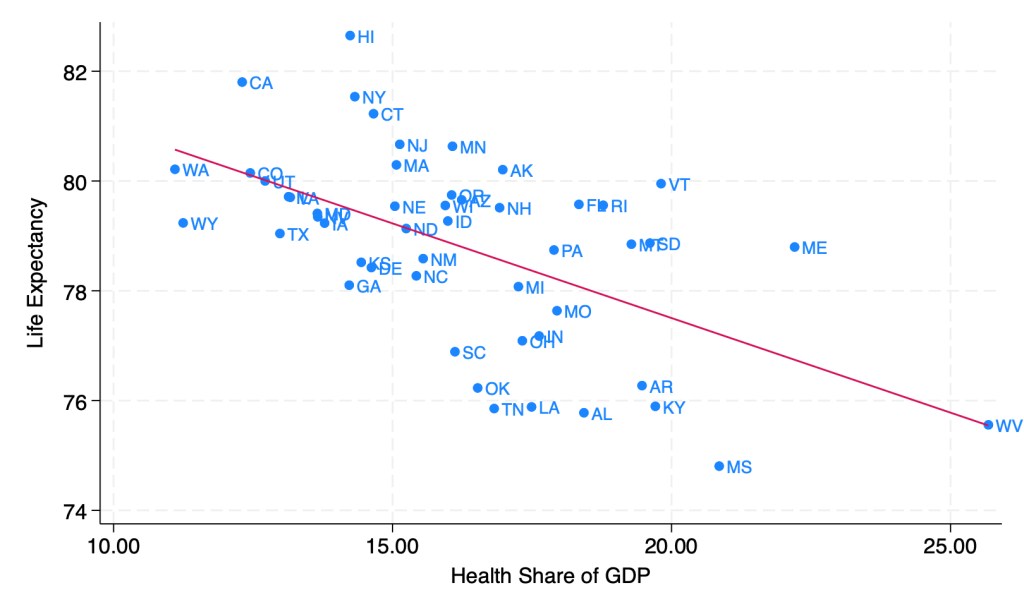
Last week though, I showed how health spending across states looks a lot different if we measure it as a share of GDP instead of in dollars per capita. When measured this way, the correlation of health spending and life expectancy turns sharply negative:

Source: My calculations from 2019 IHME life expectancy, Gross State Product, and NHEA provider spending

Does this mean states should be drastically cutting health care spending? Not necessarily; as we saw before, states spending more dollars per person on health is associated with longer lives. States having a high share of health spending does seem to be bad, but this is more because it means the rest of their economy is too small, rather than health care being too big. Having a larger GDP per capita doesn’t just mean people are materially better off, it also predicts longer life expectancy:

Source: My calculations from 2019 IHME life expectancy and 2019 Gross State Product

As you can see, higher GDP per capita predicts longer lives even more strongly than higher health spending per capita. Here’s what happens when we put them into a horse race in the same regression:

The effect of health spending goes negative and insignificant, while GDP per capita remains positive and strongly significant. The coefficient looks small because it is measured in dollars, but what it means is that a $10,000 increase in GDP per capita in a state is associated with 1.13 years more life expectancy.

My guess is that the correlation of GDP and life expectancy across states is real but mostly not caused by GDP itself; rather, various 3rd factors cause both. I think the lack of effect of health spending across states is real, between diminishing returns to spending and the fact that health is mostly not about health care. Perhaps Robin Hanson is right after all to suggest cutting medicine in half.

Young People Have a Lot More Wealth Than We Thought

I’ve written numerous times about generational wealth on this blog. My biggest post was one comparing different generations using the Fed’s Distributional Financial Accounts back in September 2021. I’ve posted several updates to that post as new the quarterly data was released, but this post contains a major update. I’ll explain in great detail below about the updates, but first let me present the latest version of the chart (through 2023q3):

Regular readers will notice a few differences compared with past charts. The big one is that young people have a lot more wealth than it appeared in past versions of this chart! You’ll also notice that I have relabeled this line “Millennials & Gen Z (18+)” and shifted that line over to the left a few years to account for the fact that this isn’t just the wealth of Millennials, and therefore the median age of this group is lower than in my past charts. The two dollar figures I highlighted are at the median age of 30 for these age cohorts (unfortunately we don’t have data for Boomers at that age).

Continue reading

Teaching Taxes w/GIFs

Last time the gifs were simply about price & quantity and welfare. I’m sharing some more GIFs, this time in regard to welfare and taxes.

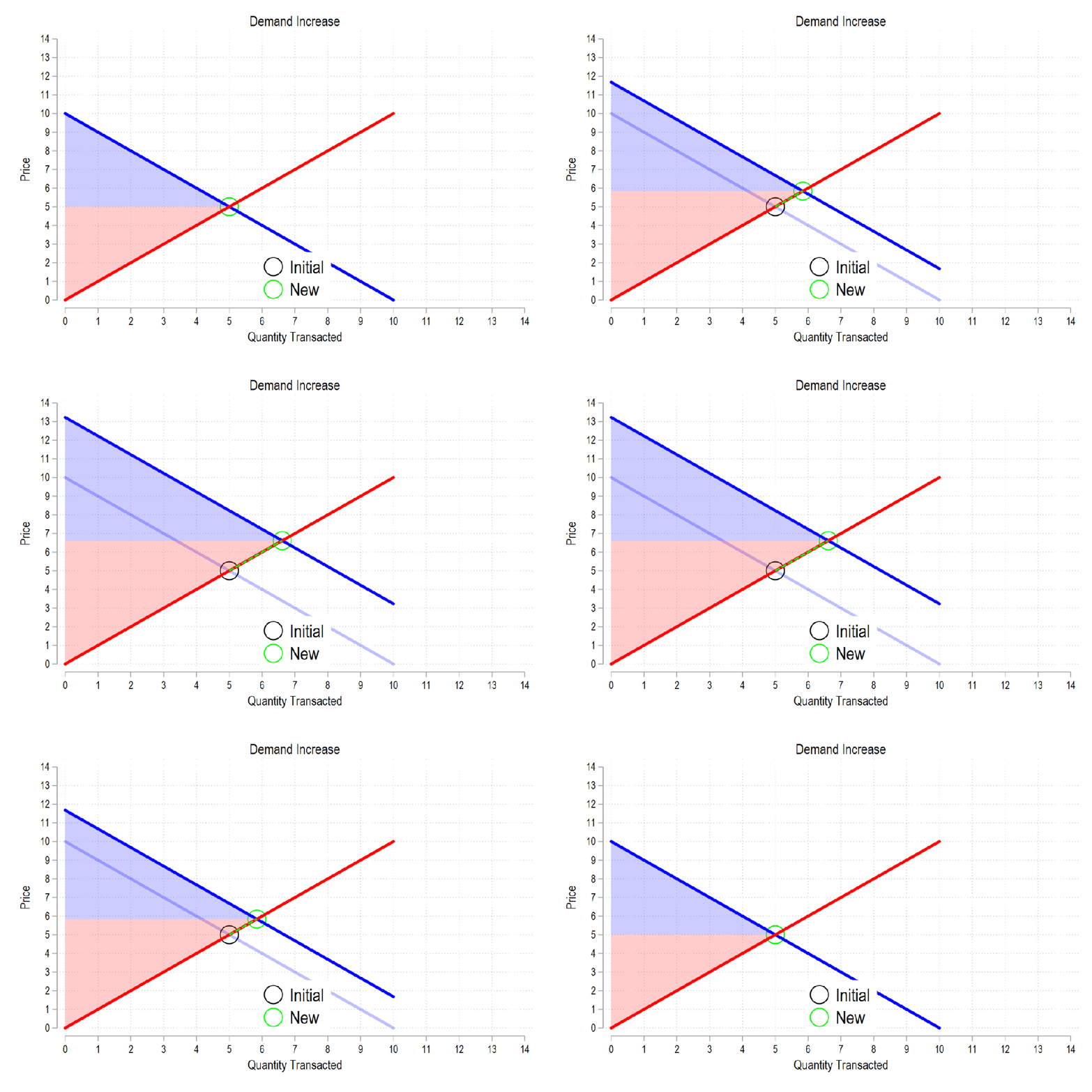
First, see the below gif. It shows us that both consumer surplus (blue area) and producer surplus (red area) always rise if there is a demand increase (assuming the law of supply and law of demand).

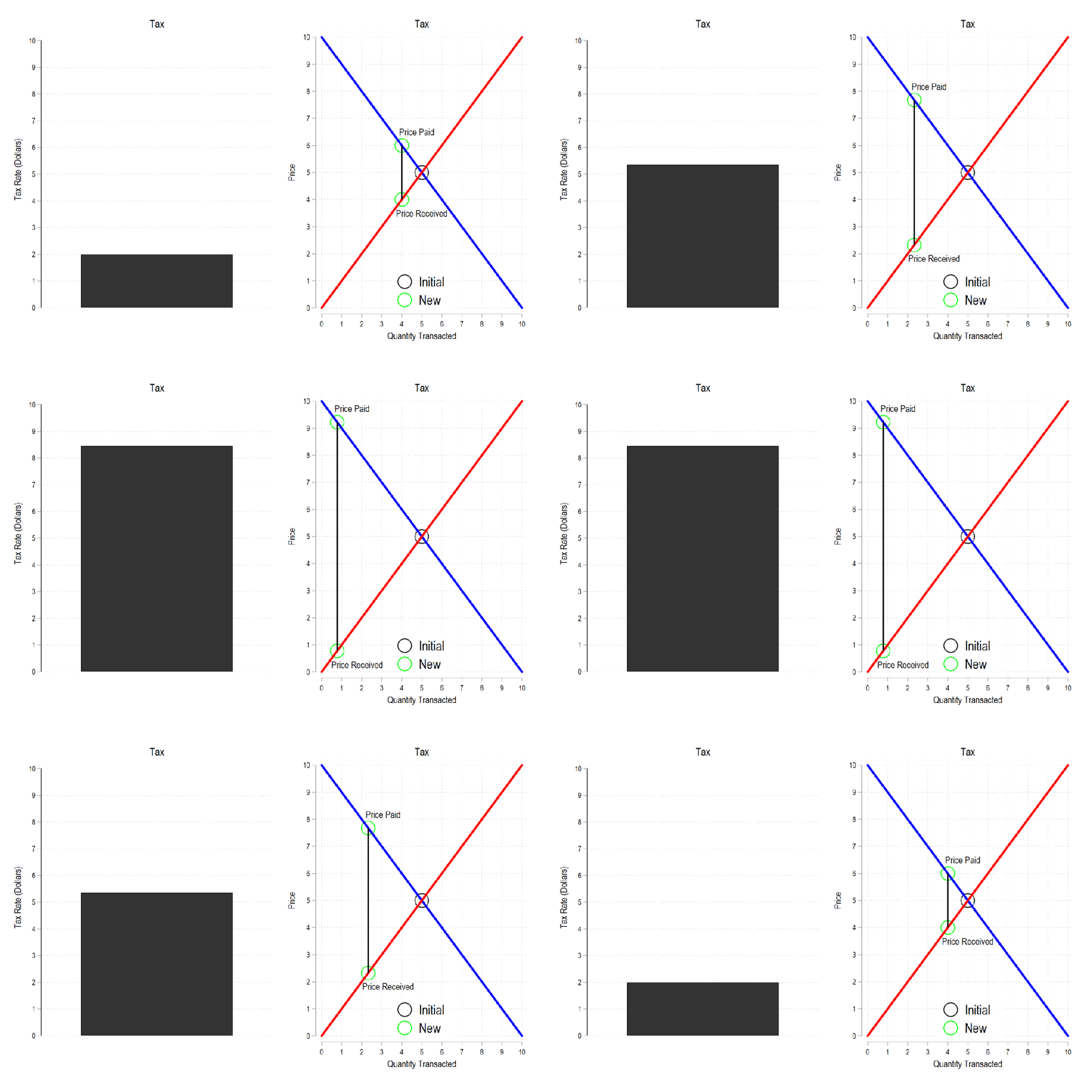
Next, let’s consider a basic tax. We can represent it as the difference between what the demander pays and what the supplier receives. The bigger the tax, the bigger the difference between the two.

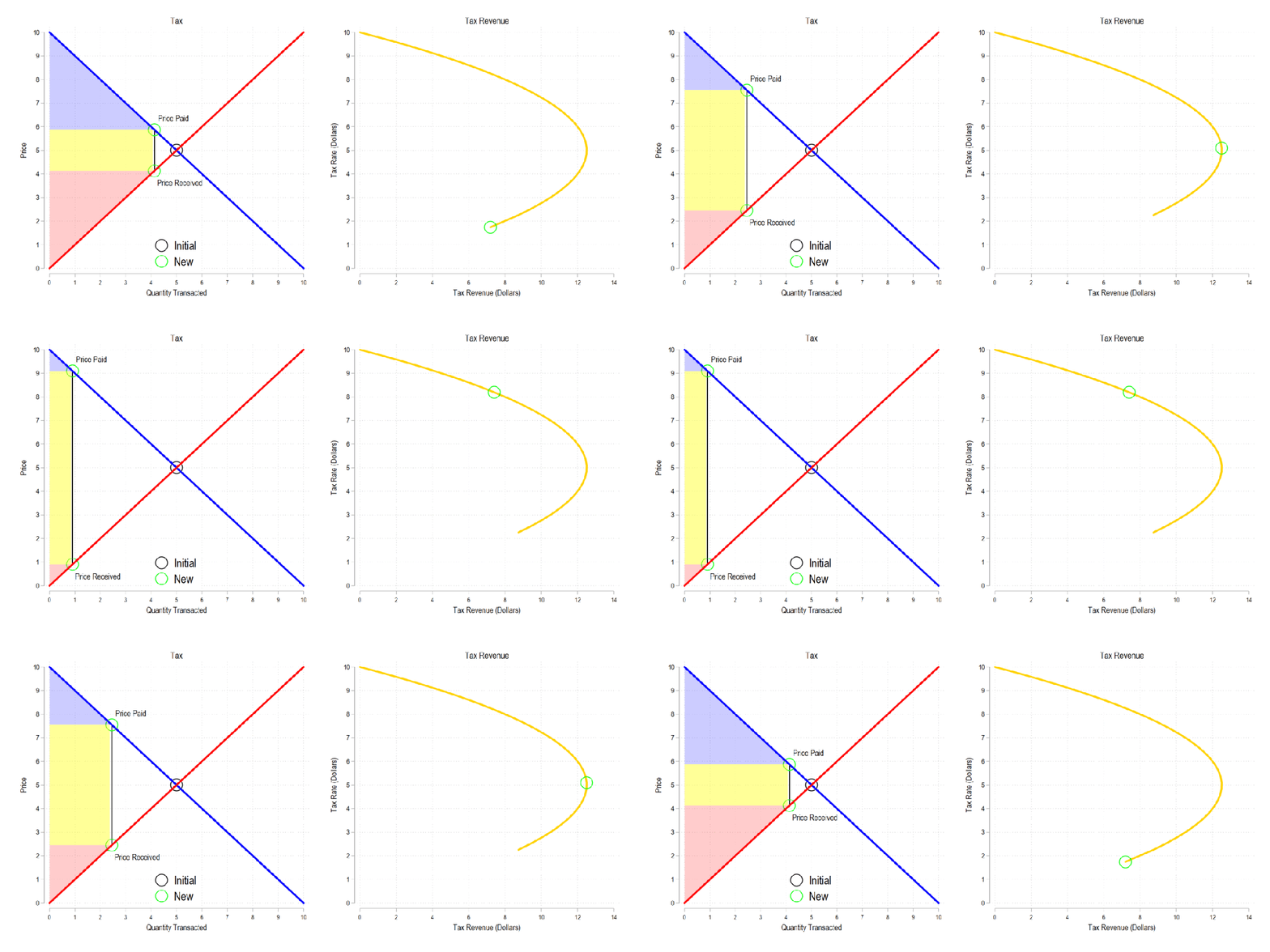
Now let’s combine the tow ideas: If taxes rise, then the quantity transacted falls, price paid rises, price received falls, and both consumer and producer surplus fall. Not only that, since there is an inverse relationship between the tax rate and the quantity transacted, it may be that increasing the tax rate more *reduces* revenue. The idea that there is a tax revenue maximizing tax rate is illustrated below right and is known as the Laffer curve.

Continue reading