Anti-coercive ways to fight Delta

Two weeks ago I predicted that Covid cases would continue to spike for at least two weeks due to the Delta variant, but argued against general shutdowns as a way to combat this spike. Two weeks later cases have indeed spiked, and while localities and organizations have been mandating masks and vaccines, we have largely avoided new lockdowns, at least in the US (Australia is reverting to its roots as a prison). In the last post I mostly said what we shouldn’t do to fight Delta, so today I want to show what a better response looks like.

The tendency of authorities to reach first for coercive solutions is a natural product of their incentives, but I’ve been disappointed to see the same tendency among the chattering classes. I think this is due to polarization- people are most interested in debating solutions that are identified with a specific side in politics or the culture war. Masks became blue-coded, so many reds oppose them even though they probably work. Likewise with vaccines, even though they definitely work well and funding them early was the greatest achievement of the Trump presidency. Meanwhile certain medications became red-coded, leading blues to oppose them before the evidence even came in. But many of the best non-coercive and anti-coercive solutions barely get discussed because they have no political valence, or a mixed one.

Fully Approve the Vaccines Already!

The Covid vaccines are still being distributed under an emergency use authorization. This lack of full approval is a source of vaccine hesitancy. More concretely, it also means that pharmaceutical companies aren’t allowed to advertize their vaccines, even though they are much more effective than the typical pharmaceutical you see advertized. The randomized control trials testing the vaccines have been complete for months, we are just waiting on the FDA to do their job.

Authorize Vaccines for Kids

The FDA still bans children under 12 from receiving the vaccine, saying they are waiting for more trial data. Last week, the American Academy of Pedicatrics argued that we have enough data to justify an Emergency Use Authorization for children aged 5-11 given, you know, the emergency. The government is going to make my 5 year old wear a mask to kindergarden won’t allow me (or my physician wife!) to get him a vaccine which would protect him and others much better than a mask.

Ventilation

Opening windows, modifying HVAC systems to bring in more outside air, and using air purifiers is about as effective as requiring masks and is definitely less of an imposition on people. But we don’t talk about it, partly because people took so long to recognize that Covid is spread through the air more than through droplets, and partly because it is less of an imposition on people and so never became a culture-war debate. Ventilation might be too boring to advocate but I think staying alive is very exciting.

Outpatient Treatments that Work

Repurposing existing drugs to fight Covid is a great idea that has not yet lived up to its promise, aside from the widespread use of Dexamethasone for inpatients with severe cases. The core problem is that it takes large randomized controled trials to really prove that a drug works, and these are expensive. Worse, pharmaceutical companies don’t want to pay for these expensive trials once their drug has gone off patent. This means that many promising treatments have been ignored, while a few have been over-promoted on the basis of observational studies and tiny RCTs (and worse, still promoted once large RCTs showed they probably don’t work). But the British government stepped up to fund the large trials that found Dexamethasone effective last year, and private donors have funded mid-size trials that just found Fluvoxamine reduced Covid hospitalization by 31%. This is excellent news because Fluvoxamine is a cheap and relatively safe anti-depressant that people can take at home. There are other promising treatments that have yet get funding for large RCTs; this is exactly the sort of thing that NIH should be throwing money at. While we’re waiting on compentent government, you can ask a doctor about outpatient treatment if you do get Covid.

Overall, many of our best tools for fighting Covid are being ignored despite, or perhaps because of, the fact that they maintain or increase our freedom.

Generous Health Insurance Makes Employees Stay

The idea of “job lock” is well established in the academic literature- employees leave firms that don’t offer health insurance more often than they leave firms that do. But this literature has always measured employer-provided health insurance as a simple binary: either they offer it or they don’t. In fact employers vary widely in the generosity of their plans, both in the quality of the insurance and in how much of the cost is paid by the employer. Some employers pay all of the premiums, some pay none, and most pay part:

Data are from the Current Population Survey, which uses top-coding to protect privacy (values greater than 9997 are reported as 9997)

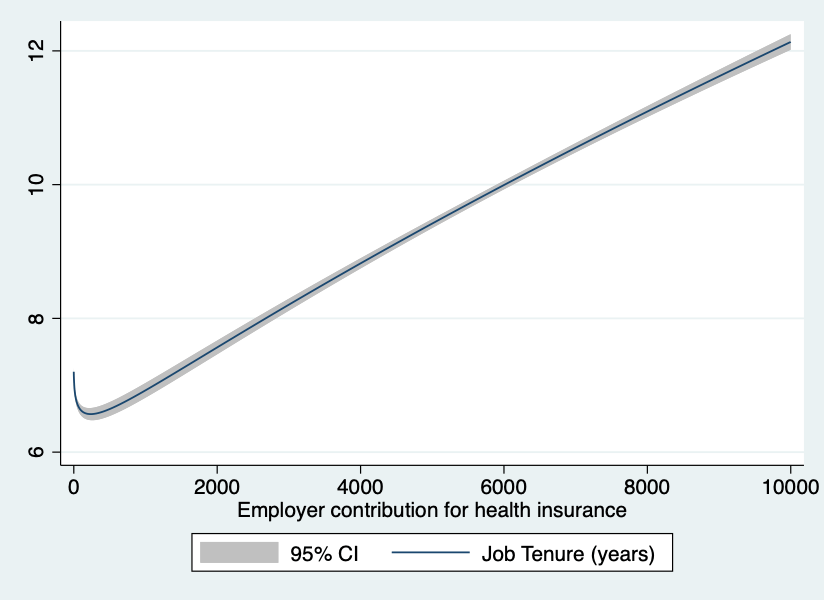
In an article published last week in Applied Economics Letters, my colleague Michael Mathes and I combine two supplements of the Current Population Survey to test whether employers who contribute more towards health insurance see their employees stay longer. Perhaps not surprisingly, we find that they do. We run lots of regressions to establish this, but this simple fit plot tells the story best:

What we found more surprising was the magnitude of this effect: a thousand dollar increase in employer contributions to health insurance is associated with at least 83 additional days of job tenure, compared to less than 10 additional days for a thousand dollar increase in wages. We conclude that:

For employers trying to increase retention, increasing contributions to health insurance appears to lengthen employee tenure far more than increasing wages by a similar amount.

Why the difference? Probably employees rationally valuing $1000 in untaxed contributions to health insurance above $1000 in taxable wages. Why don’t employers shift more compensation away from wages and toward health insurance, given that employees seem to prefer it? Here I’m less sure, and they could simply be making a mistake, but one possibility is that they worry about increasing their costs as couples whose employers both offer insurance choose the more generous one for a family plan. Another is that while generous health insurance plans are better for retention, higher wages could be better for attracting new employees, who tend to be younger and for whom the salary number could be more salient.

Age ___ Do you smoke Y/N Will you get vaccinated Y/N

Jonathan Meer wrinkled my brain:

“Hospitalizations for COVID are almost entirely confined to those who are not vaccinated, often at the cost of tens or hundreds of thousands of dollars…why should the vaccinated bear those financial costs? Insurers, led by government programs, should declare that medically-able, eligible people who choose not to be vaccinated are responsible for the full financial cost of COVID-related hospitalizations, effective in six weeks….Standing up for your beliefs means being willing to bear the consequences. Otherwise, it’s just cheap talk.”

In summary, anti-vaccination positions are effectively being subsidized by taxpayers, members of insurance pools, and the vaccinated. It’s an expressive form of moral hazard. It’s selfishness, signaling, and group identity as club good. It’s cheap talk. It’s at least 5 different chapters of your microeconomics textbook. It’s a great article and I want to talk about it.

  1. “Cheap talk” doesn’t mean “costless.”

“Cheap talk” means you don’t have sufficient costs or benefits committing you to follow through on the future behavior you are promising. But I think a lot of people have painted themselves in a very public corner. If you spend 6 months telling everyone who will listen that Covid is just the flu, that the vaccines are dangerous or don’t work, then you’ve got a lot of social capital within your peer network (or audience) that will be destroyed if you publicly change your mind or are observed getting vaccinated. For most private citizens, the answer may be found in a hat and fake moustache. Nonetheless, the talk isn’t that cheap. Only a 1/3 of unvaccinated people claimed they’d be more likely to get vaccinated for $100. What Meer proposes is to “uncheapen” their talk at a far greater level, where $25k to $100k price tags are not out of the question. I think such a policy would work specifically because it creates an expected incentive greater than either peer stigma or any feasible reward policy for vaccination, and at levels large enough where loss aversion may likely kick in. Funny thing about people – we don’t plan for low probability events very well, often treating ~1% negative events as an impossibility. I know it may sound crazy, but a 10% chance of being impoverished may actually be a more powerful incentive than a 0.5% chance of dying.

2. It’s really hard to write complete contracts i.e. your health insurance company desperately wishes it could have included vaccination in your premium calculus.

“Knightian Uncertainty” i.e. when you don’t know what you don’t know remains one of the all-time “obviously important, but hard to operationalize” concepts in an economic analysis. If you write an economic model where people are purely backward looking you will get a lot of pushback for making your agents too myopic, too stupid. At the same time, if anyone out there has started a museum of apartment leasing contracts, I have no doubt they have grown at a near perfectly linear rate over time, as tenants forever explore the space for unanticipated holes and landlords continue to supplement their contracts in response. Every new paragraph in a lease tells the story of a previously unanticipated cost. Your health insurance is the same. For decades you’ve had to tell them if you smoke. Here’s a prediction: In the future you’ll have to tell them if you’ll receive FDA-approved vaccines.

3. Given the state of modern democracy, even for problems where government mandates are the first-best solution, we may have little choice but to rely on market- and community-based solutions going forward.

One of the big advantages of government mandated solutions over market alternatives is completeness i.e. you can make everyone do it (with concomitant provision, monitoring, and punishment). What the pandemic has made clear is that simply isn’t the case anymore, for the simple reason that our politics are so polarized and, more importantly, so efficient in polarizing any policy. Any issue where a universal mandate is the optimal policy will immediately be polarized into for/against constituencies, which will slow down and eventually weaken any possible mandate.

I’m honestly not sure we could pull off the small pox vaccination program today, and it is arguably the greatest government program in world history. That was the first-best means to eradicating small pox. So what’s the second-best means to coping with Covid? If health insurance wrote separate premium contracts for vaccinated and unvaccinated customers, maybe that could get us to herd immunity. Medicare and Medicaid could have similar contingencies for reimbursement, but I suspect it’s hospitals that would end up on the hook. If hospitals refused care to unvaccinated Covid patients, I don’t think it would go down very well politically.

What this leaves are the smaller groups within our nesting doll of associations (state, local… church, synagogue, university, Rotary club, hockey league, pub trivia, the eight people you always see on the bus). It may be within these smaller, more voluntary groups, with their easier entry and exit, that we may observe that necessary accepted coercion to produce club immunity. And while vaccination mandates as a series of parallel club goods is clearly inferior to its provision as a monolithic national public good, its still superior to purely independent production.

4. Could HMO’s have their moment?

Health Management Organizations (HMOs) have been pretty stagnant for a while. Skepticism over management incentives to provide optimal healthcare has always lingered, combined with the fact that health insurance does seem to work pretty well for the people that have it (it’s the 28 million Americans that don’t have health insurance where the bulk of problems lie). Given limits on in-network care and the difficulties assuring prospective members that physician and patient interests are aligned, HMOs have always had a hard time presenting a compelling sales pitch relative to traditional insurance.

The club nature of HMO’s, however, may give them a new structural advantage in the post-Covid world. They can exclude people from membership, from taking up limited resources and sharing space with potentially vulnerable members. Would I at this very moment prefer being sent to a hospital that only allowed vaccinated people to work or receive care in it? Yes, I would. If Covid variants become seasonal, if we’re entering an age of pandemics, or if we’re simply watching the emergence of costly medical luddites as a significant portion of the population, then a lot of us might give HMO’s a second look. (NB: This ability of HMOs to “exclude” is, of course, also their potential downfall. The power to exclude is, historically, almost always abused. The idea that healthcare would become a domain not just characterized, but driven, by the power to exclude should cause trepidation. If you thought there were going to be solutions without tradeoffs to the problem of vaccine refusal, get used to disappointment.)

5. Would universal healthcare (or “Medicare for All”) mandate vaccinations? Can they?

I’m genuinely curious about where policy proponents sit on this. If vaccinations are required to receive care, then it requires denying sick people care. Healthcare policy is a great topic to argue about on twitter, but it’s all cheap talk until orderlies are shoving dying patients out the door.

I’m not the kind of person that reads a lot of philosophy, but that’s really what this boils down to– moral philosophy. It’s easy to call yourself a “libertarian” until your personal freedom not to get a shot in your arm is literally killing millions. It’s easy to call yourself a “socialist” until the newly created levers of power to coerce hundreds of millions into receiving a drug today will set the precedent for the “next Trump” to use those same levers for their own nefarious ambitions. There’s always a risk, a trade-off, no matter how many capital letters you use to yell at me.

It’s all cheap talk, but that doesn’t mean it’s costless.


Delta: Danger is Rising, but 2021 is not 2020

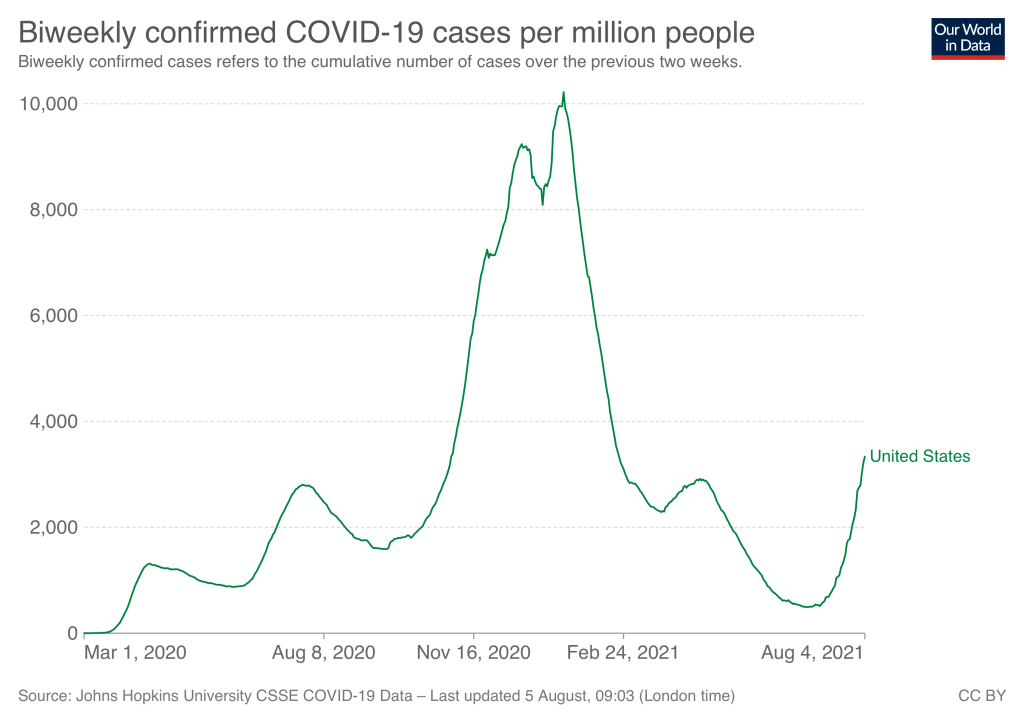
Covid cases are rising rapidly in the US thanks to the more contagious delta variant.

Based on the experience of 2020, this has many states, cities, and organizations considering a return to mask mandates and shutdowns. But our situation in the US has changed substantially since 2020 as we now have better knowledge, better masks, and above all abundant vaccines.

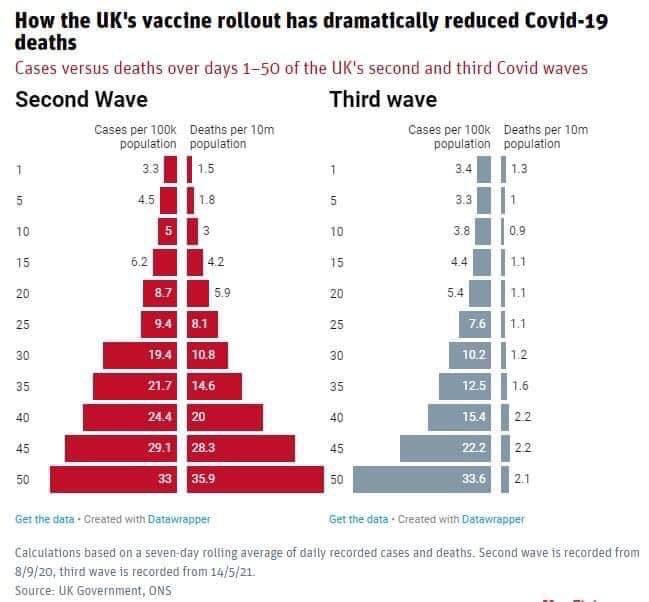
We can see this difference clearly when looking at countries hit by the Delta wave before us. It first devastated India, where less than 10% of the population was fully vaccinated, officially killing 400,000 people and unofficially perhaps 10 times that. In constrast the UK, where more than half the population was fully vaccinated, saw a major spike in cases that did not translate into a major spike in deaths:

The delta waves seem to come and go quickly, with cases rising more rapidly than previous waves, but also falling rapidly 6-8 weeks after they began to rise in India, the UK, and the Netherlands. Cases began rising in the US at the beginning of July, so if this pattern holds we have about 2-4 more weeks of rising cases before a rapid drop.

My worry is that a spike in cases just before the school year will lead schools to shut down just as the danger begins to recede, and when vaccines mean the danger was never as great as in previous waves. Externality-based arguments for shutdowns and mask mandates are now substantially less valid than in 2020 but I don’t know that policymakers have internalized this. The Biden admin actually does seem to get it, calling this a “pandemic of the unvaccinated“- i.e., if you’re worried, get vaccinated, and if other people don’t, that’s their problem. Even with delta the vaccines reduce covid’s danger to you by ~10x, and so also reduce the protection you gain from controlling others by ~10x.

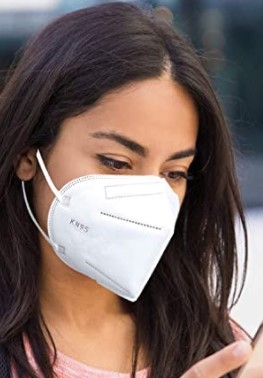
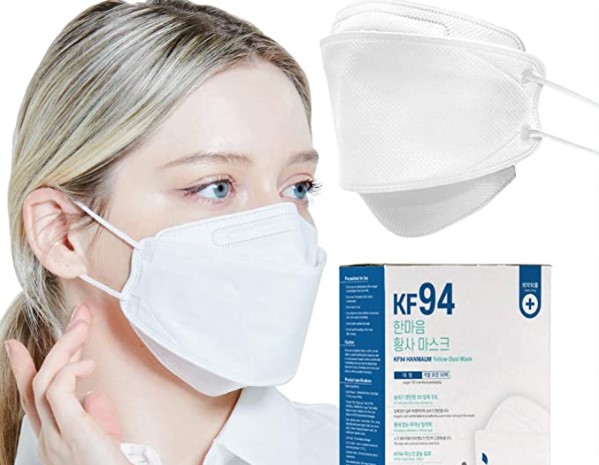
The situation with masks has also changed. Cloth masks have limited effectiveness in protecting you from others, but decent effectiveness in protecting others from you, which meant there was a strong externality-based case for mask mandates. But now in 2021 high-quality KN-95 and even N-95 masks are easily available, and unlike cloth masks they offer excellent protection FROM others, as well as FOR others. Anyone who is vaccinated and wearing an N-95 really has nothing to worry about anymore, and little reason to force masks onto others.

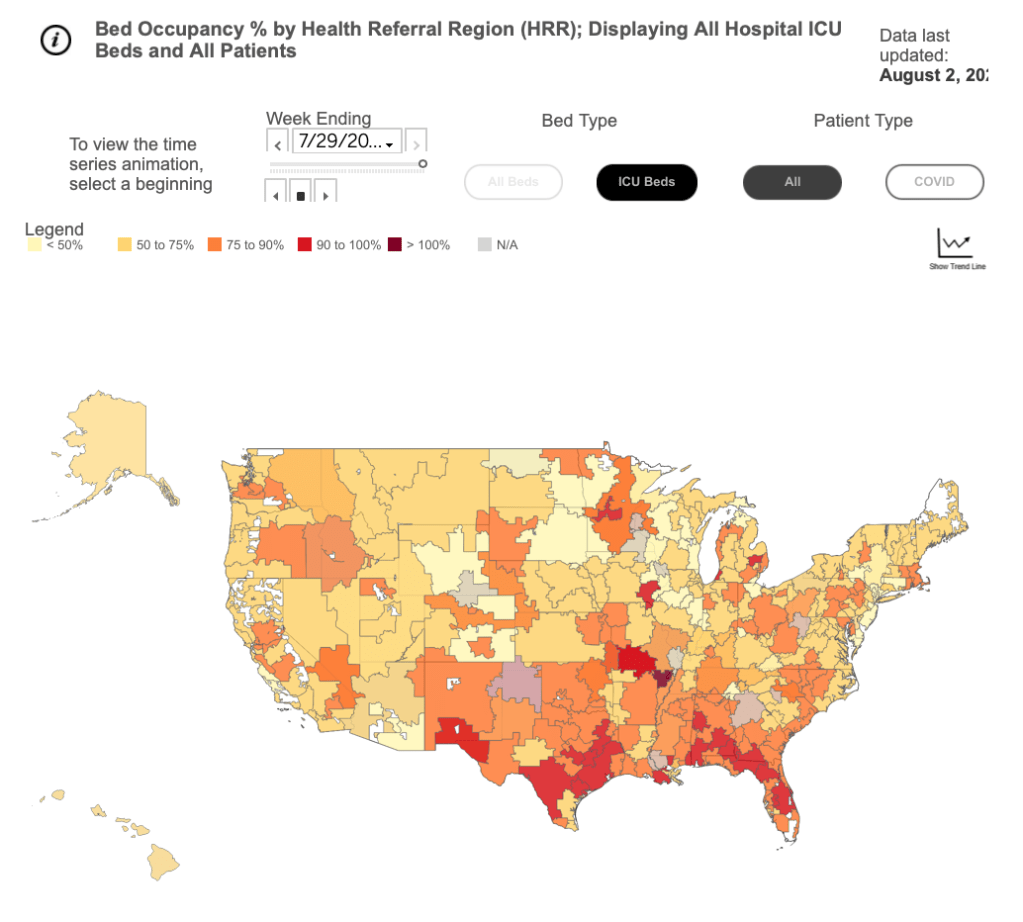
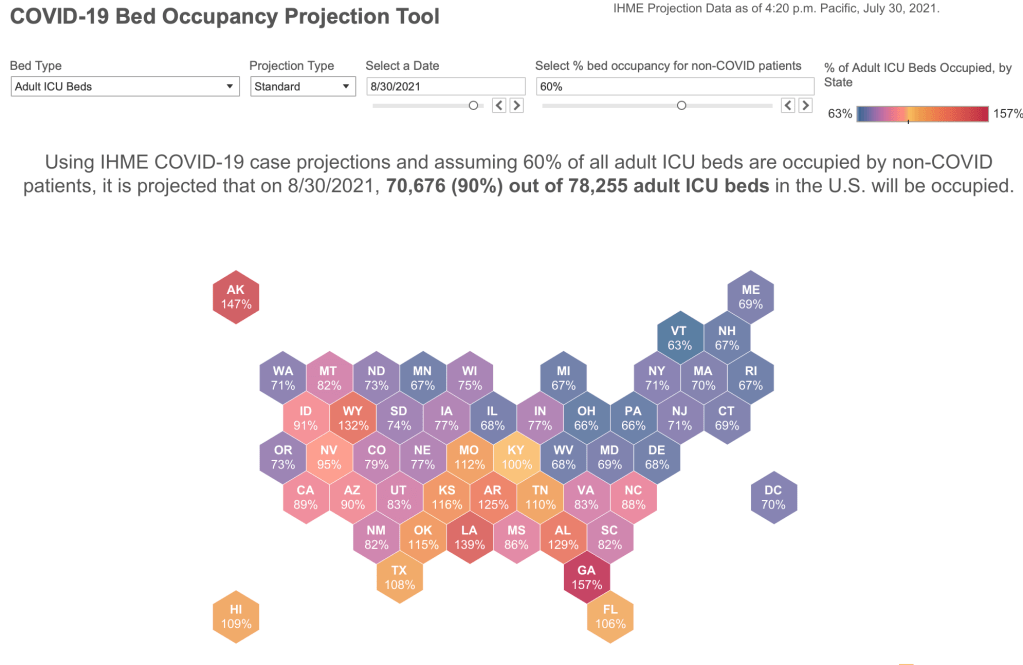
The main externality-based arguments that could still work are for vaccine mandates and for restrictions in areas where hospitals are overwhelmed by unvaccinated Covid patients in a way that substantially worsens care for non-Covid patients. But outside of areas with low vaccination rates leading to overwhelmed hospitals, I no longer see a good case to impose mask requirements or restrictions on movement or events.

According to one set of projections, by the end of August adult ICUs (though not hospitals overall) will be over capacity in most low-vaccination states:

If you want to wear a mask and avoid crowds, you can, and in fact probably should do at least one of those during the Delta wave of the next month. But the externality-based case for restrictions is mostly gone, and governments would do better to focus on continuing vaccine rollout in the US and ensuring vaccines are available worldwide to help other countries and to prevent more variants from emerging and finding their way here. Personally I’m glad that my employer has a vaccine mandate but, at least currently, no mask mandate. For those who do still want Covid restrictions I ask- what are you waiting for? What event or number would make you say “ok, now we can go back to normal”? When do you expect that to happen? For me, what I was waiting for was vaccines available for everyone and now, at least in the US, we are lucky to have that.

Vaccine Lotteries: They Work!

To try and encourage vaccination during the on-going COVID pandemic, there have been many public and private incentives offered. For example, free doughnuts. Or offering $200 to state employees in Arkansas (taxable income, of course!).

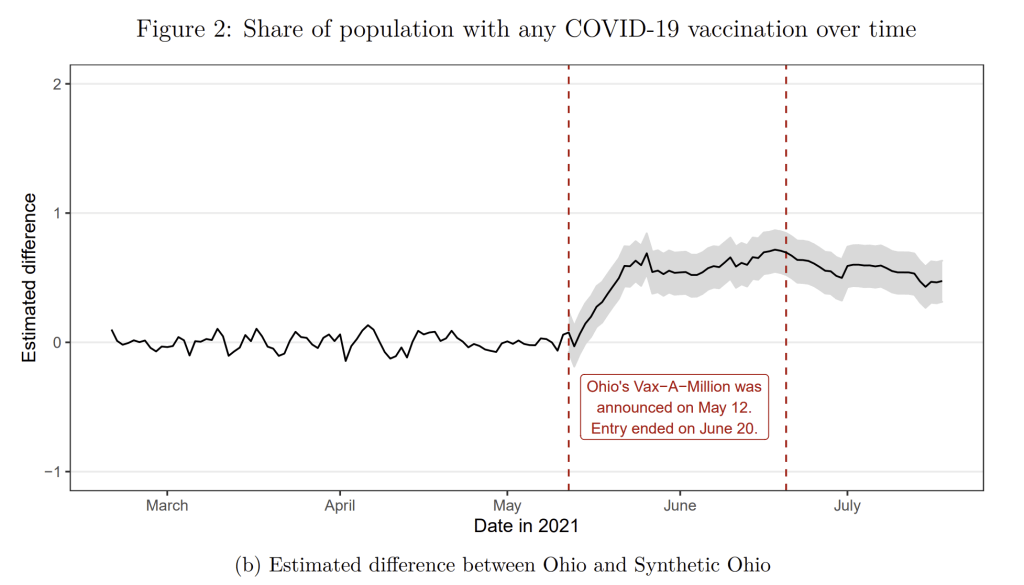
But when the governor of Ohio announced on May 12, 2021 that they would be offering a $1 million lottery prize, with 5 winners, it took the incentive game to a new level (college scholarships were also a prize for 5 winners under 18).

So do the lotteries “work”? Do they get more people vaccinated? And even if they do “work,” does it pass a cost benefit test? Many expressed concern that, even if more people get vaccinated, that this is a lot of money to spend in uncertain budget times.

A new working paper by Andrew Barber and Jeremy West attempts to answer these questions. And they do so using synthetic control, one of the better methods social scientists have for attempting to identify causal relationships (which can be tricky).

What do they find? First, vaccine lotteries do work! They estimate that vaccination rates increased by 1.5% in Ohio because of the lottery. This amount is above and beyond the increase that would have been expected without the lottery (by comparing Ohio to other states that didn’t use a lottery — this is what the synthetic control method does).

But does it pass a cost-benefit test?

Continue reading

Why is the COVID Delta Variant So Infectious?

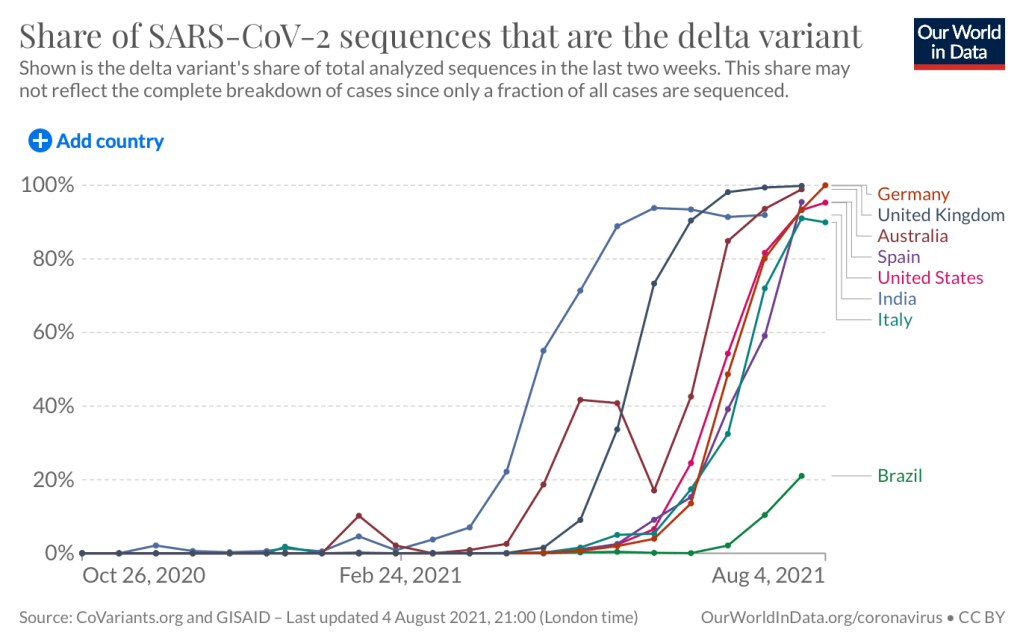
The “delta variant” of COVID-19 is far more virulent than the original strains, and is largely responsible for the recent surges in COVID cases in the U.S. and worldwide. Centers for Disease Control and Prevention Director Rochelle Walensky told the Senate on July 15  that the delta variant now makes up 83% of U.S. cases, up from 50% at the beginning of this month. It was first detected in India, then spread to the U.K. and the U.S., and around the world.

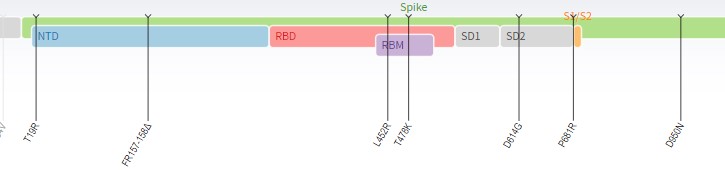
What is it that makes the delta variant so infectious? From a molecular point of view, here are the known functional mutations in the DNA that produces the “spike” proteins in the virus which bind to human cells:

Source: Stanford

Four of these mutations in particular are believed to contribute to the virulence of this strain, as discussed here. Among other things, they can cause the spike protein to bind more strongly to our cells, and inhibit our immune response. See here for 3-D model of the virus spike binding to human receptor, showing the locations of those mutated proteins.

As a result of those mutations the delta variant grows faster inside people’s respiratory tracts and reaches much higher levels. Per NPR,

On average, people infected with the delta variant had about 1,000 times more copies of the virus in their respiratory tracts than those infected with the original strain of the coronavirus, the study reported.

In addition, after someone catches the delta variant, the person likely becomes infectious sooner. On average, it took about four days for the delta variant to reach detectable levels inside a person, compared with six days for the original coronavirus variant.

… People who have contracted the delta variant are likely spreading the virus earlier in the course of their infection.

How can we stop it? It is pretty simple:  get vaccinated (or never be in a closed space with other unvaccinated humans). Vaccines don’t totally prevent you from getting COVID initially, so you might still have early symptoms and also be able to spread the virus to others for a few days. However, vaccines are highly effective in helping your immune system to quickly shut down any infection you do get before the symptoms get severe. This is true for all for essentially all strains of COVID, including delta.

Again per NPR,

Preliminary data shows that in some U.S. states, 99.5% of COVID-19 deaths in the past few months were among people who weren’t vaccinated, said CDC director Dr. Rochelle Walensky at a White House press conference in early July.

And 97% of those currently hospitalized with COVID-19 are unvaccinated, according to Walensky.

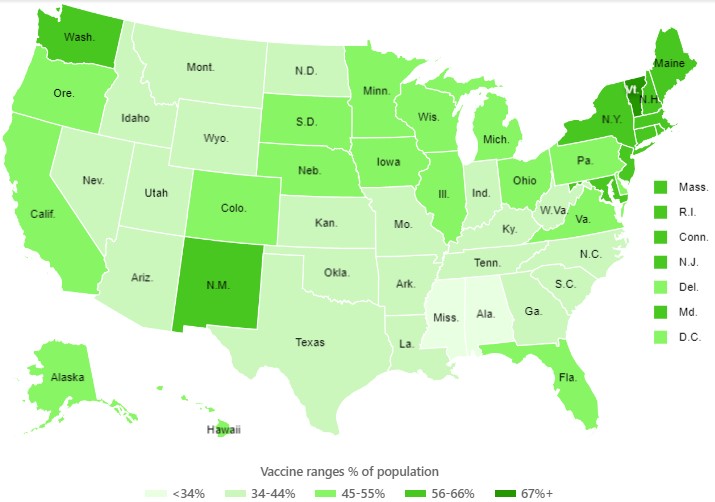
Just compare the two maps below of which American states have high/low vaccinations and high/low COVID incidence, and draw your own conclusions:

Percent Vaccinations. Image source: ABCnews

COVID Case Density. Image source: ABCnews

How to Talk to People (elderly and children)

This is a great Youtube video on how to talk to people with memory loss. It’s for family and caregivers. It’s a helpful free practical resource for an aging population. (40 minutes, but you can get a lot out of the first 20)

Even if you have good intentions, it is surprisingly easy to say something hurtful to another person. Ultimately, these scripts are shortcuts for what I think you would say if you had deep empathy and spent time getting to know the person you are speaking to. To save time, if you can find a good script writer, steal their lines. Economists speak of “money on the sidewalk”. Learning tricks that enable you to express what you actually mean to people seems like free money, speaking as a life-long awkward person.

On the other end of life, there is an Instagram account @biglittlefeelings with good tips for talking to toddlers. Here’s a video with Danny Silk on kids and and how they interpret attempts to control them.

Informational Diabetes

We all recognize that in the Internet Age, it is easy to communicate and to access information.

For the infovores, this is a cause for celebration.

Others worry that this leads to “information overload”, and to the spread of “disinformation” and “misinformation”. While this is clearly true, complaints about it typically seem to come from elites longing for the days when they had the only microphone, before the Revolt of the Public. Its hard to banish “misinformation” without screening out differences of opinion and correct contrarians even if you want to- and for some, such “collateral damage” would in fact be the main goal. But clearly something is wrong with the current information environment.

In a recent podcast appearance, Balaji Srinivasan used a metaphor I like better- Informational Diabetes:

Continue reading

COVID Deaths and Middle Age

We have known for a long time (basically since the start of the pandemic) that COVID primarily affects the elderly. Infection fatality rates are hard to calculate (since not all infections are reported), but most of the data suggest that the elderly are much more likely to die from COVID than other age groups.

For some, this has become one of the most important aspects of the pandemic. For example, Don Boudreaux emphasizes the age distribution of deaths many times in a recent episode of Econtalk, and he uses this point to argue that we addressed the pandemic incorrectly (to say the least). Boudreaux specifies that COVID is only deadly for those 70 and older. And while I won’t rehash the argument here, please also see my exchange with Bryan Caplan, where he argues that elderly lives are worth a lot less than younger lives (I disagree).

At first blush, the data seems to bear that out. The CDC reports that almost 80% of COVID-involved deaths were among those aged 65 and older (I will use the CDC’s definition of COVID-involved deaths throughout this post). In other words, of the currently reported almost 600,000 COVID deaths in the US, about 475,000 were 65 and older. Throw in the 50-64 age group, and you’ve now got 570,000 of the deaths (95% of the total).

But is this the right way to think about it? Remember, the elderly always account for a large share of deaths, around 75% in recent years. So it shouldn’t surprise us that most deaths from just about any disease are concentrated among the elderly.

Continue reading

Editing: You Figure It Out

If you want to change how a field works, you have a few options. You can do what you want to see more of, but you are only one person, and perhaps not the one best equipped to make things better. Or you can encourage others to work differently- but why would they listen to you?

Academics often serve as peer reviewers for the work of others. If a reviewer recommends that a paper be rejected, it usually is; if you recommend specific minor changes they usually get made. But you can’t really tell people that they should work on a totally different topic. Journal editors for the most part simply have a scaled-up version of the powers of peer reviewers to steer the field. But unlike reviewers, their positions are public and fairly long-lasting. This means they can credibly say “this is the sort of work I’d like to see more of- if you do this kind of work, there’s a good chance I’ll publish it”.

This is part of why I’ve been hoping to be a journal editor some day, and why I’m excited to be guest-editing for the first time: a special issue on Health Economics and Insurance for the Journal of Risk and Financial Management. The description notes:

Continue reading