Europe Doesn’t Have to Be A Defenseless Museum

America has withdrawn aid from Ukraine. Contra the Vice-President, we could easily afford to reverse this, and I hope we will. I know we could afford it because even the much poorer Europeans can, and I think they might finally be ready to try.

Until now, Europe has been fighting with both hands tied behind their back- letting their economic growth fall far behind America’s due to poor policy, and committing only a tiny share of that economy to defense. Here’s how Polish Prime Minister Donald Tusk put it:

500 million Europeans are asking 300 million Americans to defend them against 140 million Russians.

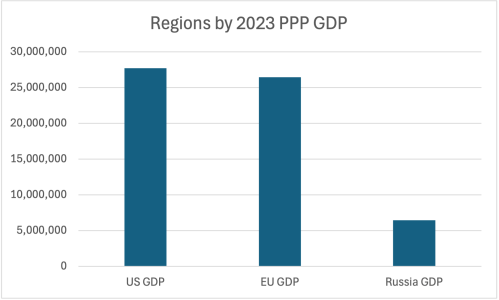
Europe may be significantly poorer than the US on a per-capita basis, but it has significantly more people, so the total size of their economy is almost as large as the US and over 4 times larger than Russia:

Source: my graph of World Bank data

But Europe has put only a small fraction of their economy toward defense for a long time. Russia alone spends more on their military than the rest of Europe combined despite their much smaller economy, by putting a much larger fraction of their GDP toward the military:

When European countries spend so little on their own defense, they have little to share with Ukraine. Many leaders complaining about the end of US support have contributed much less themselves, even as a share of their smaller economies:

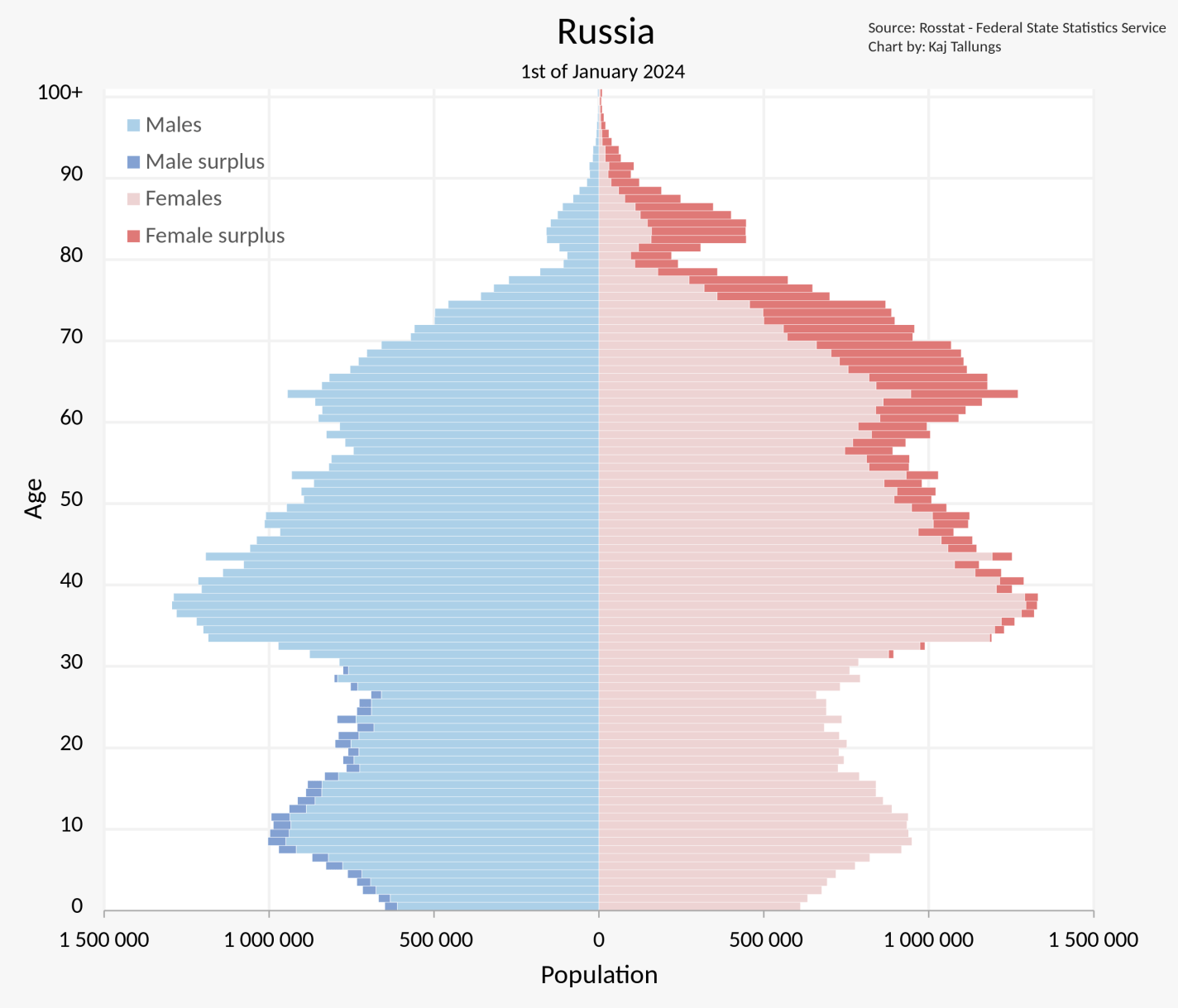
Europe can be much stronger than Russia, but only if they start trying at least half as hard as Russia. Yes, Europe has poor demographics, but Russia’s are worse; Europe has many more military-age men:

Yes, Russia has nukes, but so do Britain and France, and France might actually take advantage of this.

Economically speaking, is this a good time for Europe to rearm? To me it looks fine. The best time would have been the late 2000s to early 2010s, both because it could have been in time to dissuade Russia from starting this war, and because their economic problems then were much more about a lack of aggregate demand. But right now inflation is fine at 2.4%, NGDP growth is fine at 4.3%, and 10-year bond yields the major countries are around 3-4%. Overall this looks like AD is currently about right, but markets expected that economic growth could turn negative this year, and a burst of defense spending could head that off:

This would be especially valuable if it can be paired with the supply-side reforms that European leaders know they should to do anyway, and that would allow for more growth without pushing up inflation. Europe has fallen far behind the US in productivity, to the point that it is now a bigger issue than their higher unemployment and lower hours worked in explaining why the US is much richer:

The silver lining here is that the further behind the US they fall, the faster they could potentially grow- catchup growth is easier than frontier growth, you just need to copy the technologies and implement the strategies already figured out by the frontier economies. Europe easily has the human capital to do this, they just haven’t had the will- have preferred to regulate new technologies like fracking and AI into oblivion, along with older technologies like nuclear power. They won’t drill for oil and gas themselves in the name of decarbonization but have spent hundreds of billions on Russian oil and gas just since the war began. But if they ever decided to change their policy, their economy could rapidly improve- like letting go of the rubber band you’ve been pulling back.

European leaders appear to finally be realizing this. The European Commission just proposed a 150 billion Euro joint defense fund. This week Germany proposed spending half a trillion on infrastructure and defense, sending European stocks above their previous all-time high set in the year 2000 (!).

The EU always used to be able to excuse their economic failings by saying “at least we brought peace to a continent formerly full of war.” But this is no longer the case. If they cannot settle the war on good terms, they have no excuse. The good news is that European decline has been a choice, and it is a choice they could decide to change at any moment. Victory awaits those who will it.

Information Regarding Russia

2004: In September 2004, Ukrainian presidential candidate Viktor Yushchenko was poisoned while running against pro-Russian candidate Viktor Yanukovych. After a dinner meeting, Yushchenko fell severely ill and his face became dramatically disfigured with cysts and lesions (chloracne). Medical tests in Vienna confirmed extreme dioxin poisoning.
https://www.bbc.com/news/av/world-europe-43611547
The American liberal mind struggles to understand the difficulty of using elections under these conditions.

2018: “On March 4, 2018, British authorities say Russian agents poisoned Sergei Skripal—a former Russian military intelligence officer and U.K. double agent—and his daughter using a Novichok nerve agent…. With the immediate attack area isolated and the cleanup underway, the nation was shocked once again when two British nationals were poisoned by the same nerve agent nearly three months later in the neighboring town of Amesbury. One of the two, Dawn Sturgess, fell ill within 15 minutes of contact with the agent and died just over a week later. ” https://mwi.westpoint.edu/modern-day-nerve-agent-attack-military-lessons-salisbury/

If you get news from the internet and social media, be aware that some online participants are paid trolls from foreign governments.

Another pillar of this strategy involves botnets: swarms of fake, automated accounts created and controlled by Russian agents. These botnets hijack trending algorithms on social media platforms and thereby expose Western audiences to particular messages. They often share precisely worded posts to ensure that certain phrases—such as #WelcomeRefugees or #EndNetZero—trend in people’s news feeds. And they incessantly ‘like’ and repost content from pro-Kremlin influencers and trolls.

The aim here is twofold. First, it is an attempt to expand the reach of what would otherwise remain fringe opinions. They expose ever more people to Russian propaganda, and help create an illusion of popularity that serves to normalise pro-Kremlin talking points. But this is not merely intended to convert people into passionate Putinistas. The second goal is to promote the most inflammatory and divisive voices on either side of a given political issue. This helps spread the distrust and disillusionment that are so corrosive to liberal democratic society—and which have reached record levels on social media.

That is from https://quillette.com/2024/11/24/the-kremlins-bots-trolls-and-influencers-russia-disinformation/ , and if you would like a different news source then https://www.cnn.com/2024/10/30/europe/russian-disinformation-harris-walz-us-election-intl/index.html

How FRASER Enhances Economic Research and Analysis

Most of us know about FRED, the Federal Reserve Economic Data hosted by the Federal Reserve of St. Louis. It provides data and graphs at your fingertips. You can quickly grab a graph for a report or for a online argument. Of course, you can learn from it too. I’ve talked in the past about the Excel and Stata plugins.

But you may not know about the FRED FRASER. From their about page, “FRASER is a digital library of U.S. economic, financial, and banking history—particularly the history of the Federal Reserve System”. It’s a treasure trove of documents. Just as with any library, you’re not meant to read it all. But you can read some of it.

I can’t tell you how many times I’ve read a news story and lamented the lack of citations –  linked or unlinked.  Some journalists seem to do a google search or reddit dive and then summarize their journey. That’s sometimes helpful, but it often provides only surface level content and includes errors – much like AI. The better journalists at least talk to an expert. That is better, but authorities often repeat 2nd hand false claims too. Or, because no one has read the source material, they couch their language in unfalsifiable imprecision that merely implies a false claim.

A topical example would be the oft repeated blanket Trump-tariffs. That part is not up for dispute. Trump has been very clear about his desire for more and broader tariffs. Rather, economic news often refers back to the Smoot-Hawley tariffs of 1930 as an example of tariffs running amuck. While it is true that the 1930 tariffs applied to many items, they weren’t exactly a historical version of what Trump is currently proposing (though those details tend to change).

How do I know? Well, I looked. If you visit FRASER and search for “Smoot-Hawley”, then the tariff of 1930 is the first search result. It’s a congressional document, so it’s not an exciting read. But, you can see with your own eyes the diversity of duties that were placed on various imported goods. Since we often use the example of imported steel and since the foreign acquisition of US Steel was denied, let’s look at metals on page 20 of the 1930 act. But before we do, notice that we can link to particular pages of legislation and reports – nice! Reading the Smoot-Hawley Tariff Act’s original language, we can see the diverse duties on various metals. Here are a few:

Continue reading

WSJ: Nothing Important Happened in China, India, or AI This Year

I normally like the Wall Street Journal; it is the only news page I check directly on a regular basis, rather than just following links from social media. But their “Biggest News Stories of 2024” roundup makes me wonder if they are overly parochial. When I try to zoom out and think of the very biggest stories of the past five to ten years, three of the absolute top would be the rapid rise of China and India, together with the astonishing growth in artificial intelligence capabilities.

All three of those major stories continued to play out this year, along with all sorts of other things happening in the two most populous countries in the world, and all the ways existing AI capabilities are beginning to be integrated into our businesses, research, and lives. But the Wall Street Journal thinks that none of this is important enough to be mentioned in their 100+ “Biggest Stories”.

To be fair, China and AI do show up indirectly. AI is driving the 4 (!) stories on NVIDIA’s soaring stock price, and China shows up in stories about spying on the US, hacking the US, and the US potentially forcing a sale of TikTok. But there are zero stories regarding anything that happened within the borders of China, and zero that let you know that AI is good for anything besides NVIDIA’s stock price.

Plus of course, zero stories that let you know that India- now the world’s most populous country, where over one out of every six people alive resides- even exists.

AI’s take on India’s Prime Minister using AI

This isn’t just an America-centric bias on WSJ’s part, since there is lots of foreign coverage in their roundup; indeed the Middle East probably gets more than its fair share thanks to “if it bleeds, it leads”. For some reason they just missed the biggest countries. They also seem to have a blind spot for science and technology; they don’t mention a single scientific discovery, and only had two technology stories, on SpaceX catching a rocket and doing the first private spacewalk.

The SpaceX stories at least are genuinely important- the sort of thing that might show up in a history book in 50+ years, along with some of the stories on U.S. politics and the Russia-Ukraine war, but unlike most of the trivialities reported.

I welcome your pointers to better takes on what was important in 2024, or on what you consider to be the best news source today.

Post-Pandemic Lumber Market

Remember that one time, back when we had a global pandemic, when interest rates fell really low and everyone was borrowing and refinancing? Good times. But they were also times of surging demand for durable goods, supply chain disruptions, and shortages. Specifically, the price of lumber surged by 54% between 2019 and 2022. There were stories of contractors who were unable to do their jobs at their typical prices. Some of them went without work. Others did much less work. Theft of precious lumber was in the news.

As we know, sudden price spikes often make the front pages and the social media rounds. But they peter out and the subsequent decline in prices hardly ever gets coverage in the same way. People used to talk about higher gasoline prices all the time, but never discussed with the same enthusiasm when prices fell. The same is true for lumber. We heard hysterical stories of record high prices, alleged shortages, and the sawmills that lacked adequate capacity to keep up with demand.

What’s going on in the lumber market?

Continue reading

More Immigrants, More Safety

The headlines often read with the criminal threats that illegal/undocumented immigrants pose to the US native population. The story usually includes a heart wrenching and tragic story about a native minor who was harmed by an immigrant and a politician to help propose a solution. There’s also usually a number cited for how many such crimes happened in the most recent year with data. Stories like this are designed to provoke feelings – not to provoke thinkings.

First, the tragic story is probably not representative. Even if it is, the citation of a raw count of crimes is not communicative in a helpful way.  Sometimes politicians will say something like “one victim of a crime by an illegal immigrant is too many”.  But that seems like a silly argument to make *if* immigrants reduce the probability of being a victim of a crime.

I argue that (1) immigrants who commit crimes at a lower probability than the native population cause the native population to be safer and, counterintuitively, (2) immigrants who commit crimes at a *higher* probability than the native population cause the native population to be safer.

Continue reading

Oster on Haidt and Screens

Emily Oster took on the Jonathan Haidt-related debate in her latest post “Screens & Social Media

Do screens harm mental health? Oster joins some other skeptics I know. She doesn’t fully back Haidt, and she does the economist thing by mentioning “tradeoffs.”

Oster, ever practical, makes a point that sometimes gets lost. Maybe social media doesn’t cause suicide. Maybe there is no causal relationship concerning diagnosed mental health conditions, as indicated by the data. That doesn’t mean that parents and teachers should not monitor and curtail screen time. Oster says that it’s obvious that kids should not have their phones in the classroom during school instruction.

Here’s a personal story from this week. My son wants Roblox. The game says 12+, and I’ve told him that I’m sticking to that. No. He can’t have it now and he can’t start chatting with strangers online. We aren’t going to re-visit the conversation until he’s 12. Is he mad at me? Yes. You know what he does when he’s really bored at home? He starts vacuuming. I’ve driven him to madness, with these boundaries I set, or to vacuuming. (Recall he likes these books. Since hearing Harry Potter 1 as an audiobook in the car, he’s started tearing through the series himself via hardcover book.)

An innocent tablet game I let him play (when he’s allowed to have screen time) is Duck Life. Rated E for everyone.

Previously, I wrote “Video Games: Emily Oster, Are the kids alright?

And more recently, Tyler had “My contentious Conversation with Jonathan Haidt” Maybe Tyler should debate Emily Oster next about limiting phone use.

It’s Not Too Late to Get Your Eclipse Glasses for the April 8 Solar Eclipse

Surely you have heard by now that a solar eclipse is coming. As the April 8 date approaches, the media/social media coverage will likely rise to a roar. I think we all know that the experience of being in the path of a total solar eclipse is eerie and memorable – – birds and insects can fall silent as night-like darkness falls, and a noticeable chill may be felt in the air.

Maps abound of the eclipse path across North America. For the U.S.,  it starts in Texas around 1:30 Central time, traverses southern Indiana and northern Ohio around 3:10 Eastern and ends in northern Maine about 3:30. Here is a snip I took from this NASA map, where I zoomed in the Midwest/Northeast section, and traced in red the lines of 90% totality:

If you really want the 100% experience, and if you want it to last the full four minutes, you must be in a relatively narrow strip. And if you want to have good chance of not having clouds obscure the fun, you may need to fly to central Texas. Buffalo, New York is in the middle of the eclipse path, but it is a notoriously overcast place.

But lots of folks, including residents of Chicago, Toronto, and the Boston-Washington corridor, live within the zone of (nearly) 90% totality, where you can see the moon sliding across most of the sun’s disk over the course of a few minutes, and experience significant darkening. The next solar eclipse to touch the U.S. will not be until 2044, and that will be barely visible from three less-populated states, Montana, North Dakota, and South Dakota.

So, I suggest you take the opportunity to enjoy this one to the max. This absolutely entails using special glasses with filters designed for safe viewing of the sun. Do not even think of looking at the sun without such glasses, and be alert lest children pick up the wrong cues and try to look at the sun.

The good news is that eclipse glasses are still available. I ordered some from Amazon a couple days ago that arrived two days later, and I saw them for sale in Lowe’s today. I got some extra to share with random friends and strangers. This can be a great chance to interact with neighbors and children.

The price per pair of glasses varies a lot, so do comparison shop.  I look for ones that say “CE and ISO Certified” like these. Be safe and have fun!

Bride Who Called Off Wedding Donates $15,000 Reception to Special Needs Families; and Other Good News.

My eye was caught my a recent random headline, “Bride Donates $15,000 Reception to Special Needs Families After Calling off Her Wedding”:

In the true definition of a worst-case scenario, an unnamed California bride-to-be is reported to have called off her entire non-refundable wedding reception worth $15,000, after learning something about her fiance.

But…she took the disaster and turned it on its head, donating the reception party complete with dinner, dessert, drinks, DJ, dancing, and photo booth to a non-profit called Parents Helping Parents which provides community support to parents with children who have special needs.

…Organizers at PHP sent out invitations for the “Ball for All” and had all the seats reserved 48 hours before the event. … “Nearly everyone [there] was a young adult with special needs, their parent or a member of the care team,” Daane said. “Their joy and delight really told the story about how special and unique this event was—the moment the ballroom was opened, and we all filed into a beautiful candlelit room with tables draped in white linen.”

Yay!

This cheering item is on the “Good News Network”, which I had never heard of before. Other headlines on this site include:

Irishman Whips Out Fiddle to Entertain Passengers in Flight–and People Dance a Jig in the Aisle (WATCH)

Singing or Playing Music Throughout Life is Linked with Better Brain Health While You Age

and

She’s a Pet Detective Who’s Tracked Down and Reunited 330 Lost Dogs with Owners for Free–Using Thermal Imaging.

 I think it is great to publicize such civic acts. Let’s make this the new normal.

Axios Survey of Americans on AI Regulation

Axios just surveyed over 2,000 U.S. adults to find that “Americans rank the importance of regulating AI below government shutdowns, health care, gun reform…” Without pressure from the public to pass new legislation, Congress might do nothing for now, which will lead to the rapid advance of LLM chatbots into life and work.

The participants seem more worried about AI taking jobs than they are excited about AI making life better. There is some concern about misinformation.** So, they don’t think AI will have no impact on society, but they also don’t see enacting regulation as a top priority for government.

At my university, the policy realm I know best, we will probably not be “regulating” AI. We have had task forces talking about it, so it’s not because no one has considered it.

The Axios poll revealed gender gaps in attitudes toward AI. Women said they would be less permissive about kids using AI than men. Also, “Parents in urban areas were far more open to their children using AI than parents in the suburbs or rural areas.” Despite those gaps in what people say, I expect that the gaps in what their children are currently doing with technology are smaller. Experimental economists are suspicious of self-reported data.

**Our results did not change much when we ran the exact same prompts through GPT-4. A version of my paper on AI errors that I blogged about before is up on SSRN, but a new manuscript incorporating GPT-4 is under review: Buchanan, Joy, Stephen Hill, and Olga Shapoval (2023). “ChatGPT Hallucinates Nonexistent Citations: Evidence from Economics”. Working Paper.