The US government is great at collecting data, but not so good at sharing it in easy-to-use ways. When people try to access these datasets they either get discouraged and give up, or spend hours getting the data into a usable form. One of the crazy things about this is all the duplicated effort- hundreds of people might end up spending hours cleaning the data in mostly the same way. Ideally the government would just post a better version of the data on their official page. But barring that, researchers and other “data heroes” can provide a huge public service by publicly posting datasets that they have already cleaned up- and some have done so.
That’s what I said in December when I added a data page to my website that highlights some of these “most improved datasets”. Now I’m adding the Behavioral Risk Factor Surveillance Survey. The BRFSS has been collected by the Centers for Disease Control since the 1980s. It now surveys 400,000 Americans each year on health-related topics including alcohol and drug use, health status, chronic disease, health care use, height and weight, diet, and exercise, along with demographics and geography. It’s a great survey that is underused because the CDC only offers it in XPT and ASC formats. So I offer it in Stata DTA and Excel CSV formats here.
Let me know what dataset you’d like to see improved next.
It is a pleasure to be able to report on a successful microfinance outfit that helps the poorest of the poor. I heard a talk recently from Dale Stanton-Hoyle, CEO of the Five Talents organization. (He is as nice in person as he looks in this photo).
This group was birthed at Truro Anglican Church, in Fairfax, Virginia. An Anglican bishop from Tanzania noted that he had many thousands of people under his care who were suffering so much from hunger and other concomitants of poverty that they had little inclination or energy to listen to elevating spiritual messages. As he put it, “An empty stomach has no ears.”
Inspired by Jesus’ parable of the talents, where servants were each entrusted with some large sum of money (expressed in “talents”) and were expected to multiply that money productively, a group was formed in 1998 to help people living in the most extreme poverty to build productive enterprises.
Their approach would be classified as micro-credit, which nowadays is well-known and well-regarded approach. The modern stream of micro-credit, which is a subset of microfinance, has its roots In the Grameen Bank of Bangladesh, founded by micro-finance pioneer Mohammed Yunus in the 1970s.
A micro-enterprise development organization that helps the world’s most vulnerable families escape poverty. Partnering with local churches around the world, we train men and women, mostly women living in extreme poverty, to form savings groups, take out loans, and build their own businesses. It may seem surprising, but even those living in extreme poverty can save a little each week, start a tiny business, and fulfill their God-given potential.
In general, Five Talents does not give handouts. They support a limited number of full-time trainers, who in turn train local volunteer trainers, who do most of the actual organizing and leading. They found that when Western sources provided the initial seed capital, the money was not valued as much, and the loan payback rates were unsustainably low, around 60% or so.
So their model is to form a group of 20 or more people, and have them save their own money for at least six months. This develops tremendous accountability for borrowed funds. You are borrowing precious money from your group of friends and associates, and they all have a stake in helping your business succeed so you can repay it.
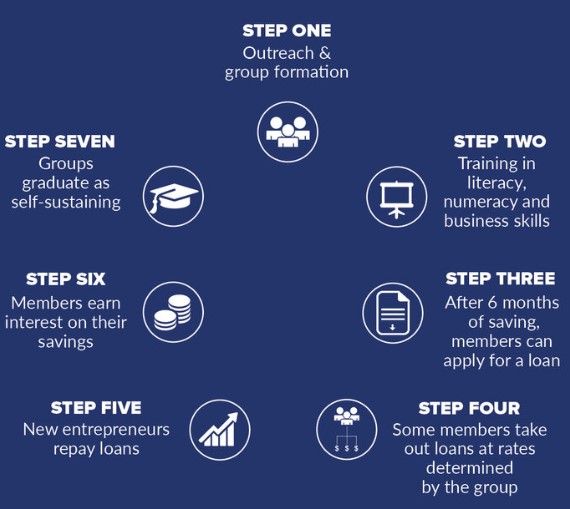
During those initial 6 to 12 months, the organization provides training: first, basic literacy (many are illiterate) and math skills which are essential for running a small business. Then, they provide training for more specific business planning and operation. This graphic depicts the process:
A typical loan might be $30-$150. This might be used to buy a goat to raise, or some beans to sell in the market. The local people can be creative in coming up with enterprises. The speaker told of a woman who was stuck in a refugee camp, who had been beaten up by life and was bitter and hopeless. All she could see were wretched poor people, and not much else. But the trainer persisted in asking her, “But what has God blessed you with?” The subsequent conversation went something like this: “Well there is this large river nearby. And…there are unemployed men in the camp who used to have skilled jobs. I could probably pay some of them to make me a dugout canoe, then I could ferry people across the river for a fee. And…there are all these ragged children running around underfoot… I could probably buy them some fishing gear and pay them to catch me fish in the river, that I could sell in the market.” So this insightful local person was able to identify two completely new business ideas that the trainer had not thought of.
Some 80% of their participants are women. These women get a huge boost in self-confidence and community status, as well as income and food for their families.
Five Talents typically operates in concert with the local Anglican church in a country, which gives them some credibility and support and structure to start with. They are currently active in nine countries, mainly in central and eastern Africa along with Bolivia and Myanmar. They aim for countries with largest numbers of people living in extreme poverty. There is a wide range of development among so-called Third World countries. Many African countries already have a nascent middle class economy, so Five Talents directs its effort elsewhere.
According to their tracking, they have developed some 95,000 businesses so far, with a total of 1.4 million family members supported. They currently train about 10,000 people a year, and hope to increase that to 20,000 people. As with most development NGOs, the ultimate holy grail is to have your development project become independent and self-sustaining. Happily, Five Talents reports a great deal of success in getting groups to become self-funding after about one and a half years.
We have six weekly contributors here at EWED and I try to read every single post. I don’t always read them the same day that they are published. Being subscribed is convenient because I can let my count of unread emails accumulate as a reminder of what I’ve yet to read.
Shortly after my fourth child was born over the summer, I understandably got quite behind in my reading. I think that I had as many as twelve unread posts. I would try to catchup on the days that I stayed home with the children. After all, they don’t require constant monitoring and often go do their own thing. Then, without fail, every time that I pull out my phone to catch up on some choice econ content, the kids would get needy. They’d start whining, fighting, or otherwise suddenly start accosting me for one thing or another – even if they were fine just moments before. It’s as if my phone was the signal that I clearly had nothing to do and that I should be interacting with them. Don’t get me wrong, I like interacting with my kids. But, don’t they know that I’m a professional living in the 21st century? Don’t they know that there is a lot of good educational and intellectually stimulating content on my phone and that I am not merely zoning out and wasting my time?
No. They do not.
I began to realize that it didn’t matter what I was doing on my phone, the kids were not happy about it.
I have fond childhood memories of my dad smoking a pipe and reading the newspaper. I remember how he’d cross his legs and I remember how he’d lift me up and down with them. I less well remember my dad playing his Game Boy. That was entertaining for a while, but I remember feeling more socially disconnected from him at those times. Maybe my kids feel the same way. It doesn’t matter to them that I try to read news articles on my phone (the same content as a newspaper). They see me on a 1-player device.
So, one day I printed out about a dozen accumulated EWED blog posts as double-sided and stapled articles on real-life paper.
The kids were copacetic, going about their business. They were fed, watered, changed, and had toys and drawing accoutrement. I sat down with my stack of papers in a prominent rocking chair and started reading. You know what my kids did in response? Not a darn thing! I had found the secret. I couldn’t comment on the posts or share them digitally. But that’s a small price to pay for getting some peaceful reading time. My kids didn’t care that I wasn’t giving them attention. Reading is something they know about. They read or are read to every day. ‘Dad’s reading’ is a totally understandable and sympathetic activity. ‘Dad’s on his phone’ is not a sympathetic activity. After all, they don’t have phones.
They even had a role to play. As I’d finish reading the blog posts, I’d toss the stapled pages across the room. It was their job to throw those away in the garbage can. It became a game where there were these sheets of paper that I cared about, then examined , and then discarded… like yesterday’s news. They’d even argue some over who got to run the next consumed story across the house to the garbage can (sorry fellow bloggers).
If you’re waiting for the other shoe to drop, then I’ve got nothing for you. It turns out that this works for us. My working hypothesis is that kids often don’t want parents to give them attention in particular. Rather, they want to feel a sense of connection by being involved, or sharing experiences. Even if it’s not at the same time. Our kids want to do the things that we do. They love to mimic. My kids are almost never allowed to play games or do nearly anything on our phones. So, me being on my phone in their presence serves to create distance between us. Reading a book or some paper in their presence? That puts us on the same page.
Since early in graduate school I’ve kept a running list of ideas for economics papers I’d like to write and publish some day. I’ve written many of the papers I planned to, and been scooped on others, but the list just keeps growing. As I begin to change my priorities post-tenure, I decided it was time to publicly share many of my ideas to see if anyone else wants to run with them. So I added an ideas page to my website:
Steal My Paper Ideas! I have more ideas than time. The real problem is that publishing papers makes the list bigger, not smaller; each paper I do gives me the idea for more than one new paper. I also don’t have my own PhD students to give them to, and don’t especially need credit for more publications. So feel free to take these and run with them, just put me in the acknowledgements, and let me know when you publish so I can take the idea off this page.
Here’s one set of example ideas:
State Health Insurance Mandates: Most of my early work was on these laws, but many questions remain unanswered. States have passed over a hundred different types of mandated benefits, but the vast majority have zero papers focused on them. Many likely effects of the laws have also never been studied for any mandate or combination of mandates. Do they actually reduce uncompensated hospital care, as Summers (1989) predicts? Do mandates cause higher deductibles and copays, less coverage of non-mandated care, or narrower networks? How do mandates affect the income and employment of relevant providers? Can mandates be used as an instrument to determine the effectiveness of a treatment? On the identification side, redoing older papers using a dataset like MEPS-IC where self-insured firms can be used as a control would be a major advance.
You can find more ideas on the full page; I plan to update to add more ideas as I have them and to remove ideas once someone writes the paper.
Thanks to a conversation with Jojo Lee for the idea of publicly posting my paper ideas. I especially encourage people to share this list with early-stage PhD students. It would also be great to see other tenured professors post the ideas they have no immediate plans to work on; I’m sure plenty of people are sitting on better ideas than mine with no plans to actually act on them.
The US government is great at collecting data, but not so good at sharing it in easy-to-use ways. When people try to access these datasets they either get discouraged and give up, or spend hours getting the data into a usable form. One of the crazy things about this is all the duplicated effort- hundreds of people might end up spending hours cleaning the data in mostly the same way. Ideally the government would just post a better version of the data on their official page. But barring that, researchers and other “data heroes” can provide a huge public service by publicly posting datasets that they have already cleaned up- and some have done so.
I just added a data page to my website that highlights some of these “most improved datasets”:
the IPUMS versions of the American Community Survey, Current Population Survey, and Medical Expenditure Panel Survey
I hope to keep adding to this page as I find other good sources of unofficial/improved data, and as I create them (one of my post-tenure goals). See the page for more detail on these datasets, and comment here if you know of existing improved datasets worth adding, or if you know of needlessly terrible datasets you think someone should clean up.
On Twitter, folks have been supporting and piling on to a guy whose bottom line was that we are able to afford much less now than we could in 1990 (I won’t link to it because he’s not a public figure). The piling on has been by economist-like people and the support has been from… others?
Regardless, the claim can be analyzed in a variety of ways. I’m more intimate with the macro statistics, so here’s one of many valid stabs at addressing the claim. I’ll be using aggregates and averages from the BEA consumer spending accounts.
I make a hobby of reading, and sometimes acting on, investment advice, particularly regarding high-yielding securities (many of my holdings are now yielding over 10%/year). One of the best authors on the Seeking Alpha investing site writes under the name of Colorado Wealth Management. He mainly writes on REIT (real estate investment trust) stocks, but recently opined on the wisdom of raising interest rates to combat inflation regarding some of the major components of CPI.
His article, Why High Yields Will Be Popular Again, may be behind a paywall for some readers, so I will summarize some key points. He kind of sidesteps the influence of massive federal deficit spending that injected trillions and trillions of new dollars into the economy for COVID, which I think has been the major driver for this inflation; and the reignited deficit spending which is already on the books for November and likely even huger for December of this year. However, he does make some interesting (and new to me) points regarding food prices in particular.
He sees the price 2021-2022 price increases in some major food items as being driven by supply constraints, rather then by excessive demand. Specifically eggs, coffee, and vegetable oils have been hit by exogenous factors which have constrained supply; raising interest rates will not help here, and may even hurt if higher rates make it harder for farmers to recover and re-start high production. I’ll transition to his charts and mainly his excerpted words, in italics below:
Avian Flu, Culled Hens, and the Price of Eggs
The background here is that tens of millions of chickens, including egg-laying hens, have been deliberately killed (“culled”) this year in an attempt to slow the spread of avian flu. This, of course, cuts into the egg supply and raises egg prices. We went through a similar cycle in 2015 with avian flu, where culling led to a rise in egg prices, but then prices fell naturally as a new crop of chicks grew into egg-laying hens. Similarly, the current shortage in eggs should correct itself:
Raising interest rates has never produced additional eggs. Raising interest rates and driving a recession (with larger credit spreads) only makes it more difficult for farmers to get the funding necessary to replace tens of millions of hens that were culled to slow the spread of the avian flu….If interest rates don’t work, what will? The cure for high prices is high prices. We can see how it played out with the Avian flu in 2015:
Is Jerome Powell going to lay even one egg? Probably not.
Are farmers going to focus on turning their chicks into egg-laying hens? Absolutely.
Since eggs go into several other products, it drives inflation throughout the grocery store. Even if a product doesn’t use eggs, the drop in egg production means more people eating other foods.
Drought in Brazil and the Price of Coffee
Coffee prices have been rising rapidly. Well, domestic prices have been rising rapidly. Global prices actually declined since peaking in February 2022:
So, what drove the price up? Brazil normally produces over 35% of the world’s coffee and bad weather in Brazil (not to mention the pandemic impacts) drove dramatically lower production in 2021. As the shortfall in production became evident, global prices began rising rapidly. That’s why the global [wholesale] prices were ripping higher in 2021, not 2022. However, [retail] consumers are seeing most of the impact over the last several months.
War in Ukraine and the Price of Sunflower Oil
Margarine requires vegetable oil. Soybean, palm, sunflower, and canola oil are the key ingredients. What country produces the most sunflower oil? Ukraine. This is one of several inflationary impacts of the war. You can see the impact of reduced supply in the following chart:
Government Bungling in Indonesia and the Price of Palm Oil
What happened to palm oil? How could it soar so much and then fall so hard?
The first issue is that dramatic increases in the price of fertilizer made production more expensive. … That contributed to a reduction in supply. However, Indonesia is the world’s largest exporter of palm oil. Yet exports of palm levy were subject to a huge levy. That made exporting far more expensive. Despite the levy, it was still worth producing and exporting palm oil. Then the Indonesian government decided to simply ban exports over concern about higher domestic prices. Banning exports for a country that produces 59% of the world’s total palm oil exports had a predictable impact.
If you guessed that the supply of palm oil couldn’t be sold domestically, you’d be right. The ban was lifted. However, it was only after:
“High palm oil stocks have forced mills to limit purchases of palm fruits. Farmers have complained their unsold fruits have been left to rot. There were 7.23 million tonnes of crude palm oil in storage tanks at the end of May, data from the Indonesian Palm Oil Association (GAPKI) showed on Friday.“
With palm oil prices at all time-record highs, nearly triple the level from two years prior, the supply was left to rot. Each business tried to make the best decision they could, given the ban on exports. Rather than record profits for mills and record profits for farmers, the produce was wasted. That’s supply constraints for the global market, and it destroys the local economy.
Global prices are plunging now as mills seek to unload their storage. As bad as the higher prices were for the rest of the world, no one suffered worse than the farmers whose product became worthless as a result of government failure.
Contrary to today’s popular opinion, higher interest rates won’t do anything to improve production of vegetable oil.
Many of my classes consist of a large writing component. I’ve designed the courses so that most students write the best paper that they’ll ever write in their life. Recently, I had reason to believe that a student was using AI or a paid service to write their paper. I couldn’t find conclusive evidence that they didn’t write it, but it ended up not mattering much in the end.
My wife and I have different preferences for the kind of gifts that we like to receive. She likes earrings, flowers, massages, and electronics. I like hand tools, power tools, and any other item that makes domestic life more efficient. I can really appreciate a nice new pair of dockers or a button-down.
If you have a dad, husband, or anyone else in your life who appreciates practical gifts, then this list is for you. Below are four gift ideas that are sure to make the practical person in your life very happy – even if they may not be what you would want to receive. I’ve personally vetted all of the below items, so I can attest to the satisfaction that they are sure to provide that hard-to-shop-for person.
Is your life in disarray? Are your cords and chargers in disarray? Then look no further. Nothing compares to the knowledge that the nest of cords behind your wall unit is no more. Use Velcro to bind and truncate your computer cords and your kitchen appliance cords. Do you have a drawer or box full of tangled extras? Velcro is nice because you can cut it to your custom length and reuse it with minimal loss of life. You can also use it in electrical applications or in the cabin of your vehicle. Do you have a phone charger beside your bed that keeps falling on the ground? Just Velcro it to the nightstand lamp and it will stay exactly where you want it. AND, because it’s reusable, you can easily remove it and keep the cords in your luggage nice and compact.
Growing stuff is hard. But flowers, greenery, or even vegetables are nice. Yes, I’m basically recommending that you give someone dirt. But it’s awesome dirt. There’s this stuff called coconut coir. It’s coconut fiber that’s been compressed into a small disc or brick that’s ideal for shipping and delivery. Just add water and you’ve got some fancy dirt just waiting for an application. Coconut coir is all plant-based material, drains well, and it’s easy to store. You may not think of dirt as something that has a shelf life, but regular potting soil can definitely grow some unsavory things if you let it sit for long enough. Coconut coir is the solution to all of your spur of the moment small-scale horticultural endeavors.
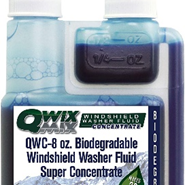
Shipping items to our homes has been a game changer for shopping. But home delivery is not sensible for low priced heavy items like some liquids. My family was frequently running out of windshield wiper fluid and we’d end up stopping at a grocery store and overpaying. But no more! Qwix Mix is a windshield wiper fluid concentrate. Just an ounce in addition to a gallon of water saves us unplanned trips, high prices, and the storage cost of purchasing gallons of fluid ahead of time. I can’t vouch for the de-icing formulation, but the southern climate formula does exactly what it’s supposed to do.
Since the Covid recession, many of us have taken up our hand at cutting hair at home. For a while, we were borrowing a neighbor’s clippers. They were loud and had a short cord. But I’ve since purchased Ufree clippers and they are so much more convenient. They’re quiet, cordless, charge with a USB cord, and have a battery level display. But the battery lasts so long that you don’t even need to think about it. This kit comes with a beard trimmer, several guards, and a cape (throw the cape away, it’s bad). The clippers are metal and have some heft to them. Several colors are available – they come in black, silver, and gold finishes. But how can one not choose the gold ones?
That’s my list of great gifts for practical people. IDK your gift limit, but if you buy all 4 of these gifts you’ll spend about $100. That might leave room left over for stocking stuffers and chocolate.
(We’re not paid for any of these recommendations. But using our links is always helpful.)
I teach macroeconomics, finance, and other things.
Often, I use Excel to complete repetitive calculations for my students. The version that I show them is different from the version that I use. They see a lot more mathematical steps displayed in different cells, usually with a label describing what it is. But when I create an answer calculator or work on my own, I usually try to be as concise as possible, squeezing what I can into a single cell or many fewer cells. That’s what brings me to to the sumproduct excel function that I recently learned. It’s super useful I’ll illustrate it with two examples.
Example 1) NGDP
One way to calculate NGDP is to sum all of the expenditures on the different products during a time period. The expenditures on a good is simply the price of the good times the quantity that was purchased during the time period. The below image illustrates an example with the values on the left, and the equations that I used on the right. That’s the student version. There is an equation for each good which calculates the total expenditure on the individual goods. Then, there is a final equation which sums the spending to get total expenditures, or NGDP.





 Economist Writing Every Day