Don’t arbitrage time with friends

As you may have already heard, the US suicide rate dropped 6% last year. During a pandemic. During a lockdown. During a time when rates of depression have reportedly increased. This is all quite surprising to many people, myself included. I don’t have a convincing explanation, only a single relevant thought.

I think we’ve rediscovered regular long-distance communication with people that have drifted out of our lives and many of us are better for it. I know I am.

While I think that loneliness and isolation are major force behind a lot of social ills, I also know that the “loneliness epidemic” was always a poorly constructed metaphor at best, and possibly only weakly observed at worst. But I also suspect that loneliness and isolation are phenomena in the tails of the distribution. Isolation doesn’t happen to people with average or even below-average social networks. It happens to people entirely without them, for whom their strongest connections with other humans have dissolved. Such things do not always reveal themselves statistically, at least not without looking really hard.

We have observed the emergence, and now dominance, of asynchronous communication. We text, email, tweet. We post on Instagram, Facebook, Snapchat, or TikTok. These are all means of communication, but (with the possible exception of texting) these forms of communication exist outside of real-time. They don’t command chunks of contiguous time– they arbitrage the fractions of time that previously existed between activities and went uncommitted to a narrowly defined task.

I don’t know what causes loneliness, but I do know that its much easier to not feel lonely when you are spending fully committed time, and not arbitraged fractions, communicating with another human being. If you’re under the age of 40, its almost socially illegal to voice call a friend to talk. For many it would be viewed as an act of emotional aggression, an imposition of social need, if not anxiety, on another. The irony of this millennial norm I’ve unfairly placed on them through nothing but my own unreliable observations is that it strikes me as an accelerated path to friendless boomer sad-dad suburban isolation.

The pandemic hit and many of us had to start Zooming in to work. And we had to explain Zoom and Google Meetings to our parents so we could talk to them. But I think a lot of us started catching up with old school buddies, too. Folks you sent Christmas cards to or caught up with at a cookout the Sunday after Thanksgiving. It became completely normal to schedule a call in advance – to put it on a calendar and reserve that time. And I think a lot of people who moved for work or relationships, who after 10 years changed to a new office where they didn’t know anyone, who maybe had simply fallen out of step with friends after the first four years of trying to keep triplets fed — I think a lot of people really enjoyed the pandemic-driven need for reserving time for contiguous social interaction in a manner entirely unconstrained by geography. And maybe they ended up feeling less lonely for it.

Keep Zooming your friends far away. Keep putting it on the calendar. Do it forever.

The Tall and Short of Student Experience

Every semester in my intro STAT course I have my students create a variety of survey questions. After I combine their questions into a single survey, they collect responses from the student body at Ave Maria University. Most of the questions are vanilla. Other are not. They typically get in excess of 100 responses from the ~1,100 person student body.

While exploring the data, I found a really beautiful example for the week that we spend on multiple regression and dummy variables.  The survey results illustrate a clear, linear association between student height (inches) and their student experience at AMU (scored 1-10).

So strange! Why might this be? Except for that solitary 7 ft+ student on the basketball team, how in the world might height matter for student experience?

As it turns out a separate relationship holds the key.

Confirmed with a simple unpaired t-test (unequal variances), women rank their student experience much more highly. For this, students have multiple explanations at the ready.

  • Our school is in a rural location and women are more socially satisfied.
  • Men are less happy generally.
  • Men are less studious or have lower grades.
  • Men get less sleep and stay up later

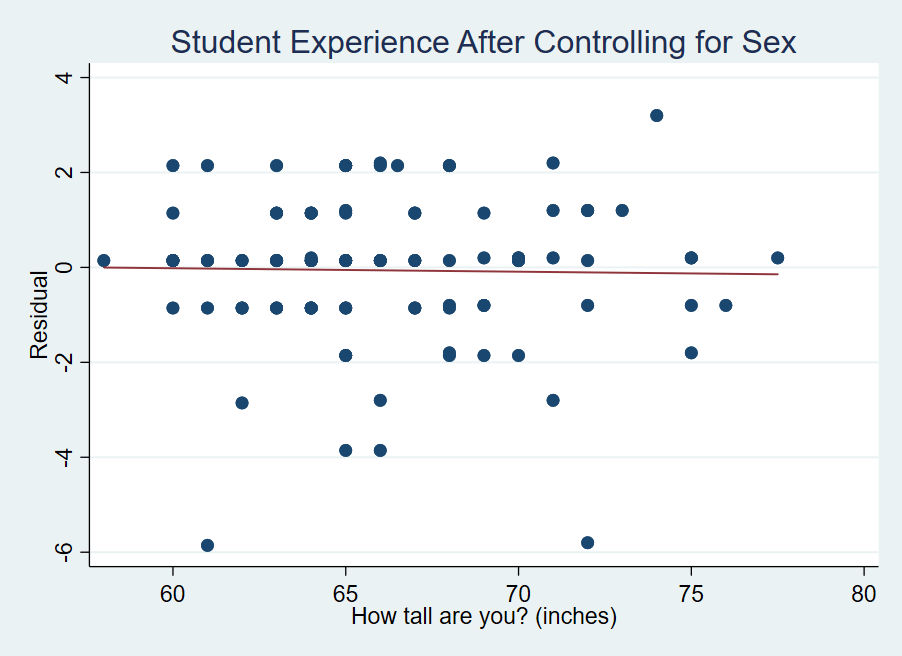
The list goes on and I don’t know what the reasoning is or which ones actually play a role. But what I do know, is how to make fun scatterplots in Stata. As it turns out, if you control for sex, height loses all of its effects on student experience. Men are taller on average and they aren’t happy students relative to women (apparently). We can see in the figure below that all of the action in the two fitted lines occurs in the intercept. The slopes are practically flat for both men and women. In other words, height neither adds nor subtracts from a student’s experience rating.

What’s going on is that neither men’s nor women’s experience is affected by being taller. But, what’s actually going on here – you know – statistically? The simple version is that the bar chart above dominates the scatter plot. If we subtract the mean male experience score from the male values and do the same for the females, then we’re left with what is practically white-noise. How do all those other students of a different height experience the world? Well, as students, not so differently from you.

The Problem is the Science

The University has been the engine of basic science in the US and abroad for a long time. Any hand-wringing in recent years over its imminent obsolescence was borne of advances in remote learning and new found capacities to exponentially scale single instructors to reach tens, if not hundreds, of thousands of students across the globe. How, in this brave-ish new world, would matriculant tuition accruing to a handful of instructional specialists/celebrities continue to subsidize the scientific mission?

If the arrival of YouTube and Khan Academy gave credence to the academic apocalypse theory, then the coronavirus pandemic and the global adoption of Zoom instruction would surely make a reality of it. I will admit, for the first time in my career, I’m seeing the cracks in the edifice of the academy. And, yes, it was the pandemic that made them more prominent to me.

But its not on the educational side of our dual mission. It’s the science.

Dr. Katalin Kariko is very likely to win a Nobel prize for her immense contributions to our understanding of messenger RNA (mRNA) and how it can be manipulated to create an entirely new class of vaccines that, it is not hyperbole to say, stand to offer a global shift in health. The prospect is there for not just an HIV vaccine, or a broad-spectrum influenza vaccine, or a malaria vaccine, but the broad mitigation of viruses as a burden on humanity.

Dr. Kariko has been pursuing her scientific mission with a single-mindedness that jumps off the page in everything that has been written about her. What also jumps off the page, at least to those of use who have been trying make a career in academic research, is the university system that has worked diligently for decades to push Dr. Kariko, and her scientific mission, out of the academy. At every stage of the hiring, retention, and grant application process, Dr. Kariko’s research has been bludgeoned with not so much criticism or doubt, but what seems more like horrifying indifference. Grant reviewers saw little value, her colleagues noted that she lacked finesse in writing grant applications, and the academic institutions that employed her saw little value in employing someone, even for less than $60k a year in salary, that was unable to consistently bring in large grants (sidenote: her husband often estimated her effective wage to be roughly a dollar an hour: from the university’s point of view, it wasn’t the expense she represented on the balance sheet, it was the opportunity cost of the grants she wasn’t winning that someone else in her slot would).

This is a problem.

To be clear, this indifference is far more damning than any sort of broad disagreement would have been. The nature of science is such that most advances are incremental, but every now and then there are the rare revolutionary upheavals, where something we thought we absolutely knew for sure turns out to be completely wrong. That scientific mavericks that push such theories, most of which are completely wrong, meet resistance is natural (and probably optimal). But indifference is a problem, because indifference does more to reveal the underlying incentives propelling researchers. Universities were indifferent to her research because it wasn’t generating grant money, and that is the job she was hired to do.

Patents are great. Prestigious awards are welcome. Published papers are not entirely a waste of your time. But make no mistake, if you don’t successfully apply for grants, your days in academic science are numbered. I spent three years as an oddly appointed economist in arguably the greatest medical school of the last decade. I got to hang around brilliant physicians who spent a lot of their time every week actually (not figuratively or indirectly) saving lives. I also witnessed dedicated researchers break down into tears upon receiving the news that their grant application had been denied, which meant their contract with the university would not be renewed and their research career effectively terminated. I saw how little grant application aptitude correlated with talent or passion. I saw people thrive in system while others failed, with little in the way of scientific aptitude to distinguish them.

The most practical advice I was privy to was this: work in someone’s lab, pursue your project in parallel with their resources. Once you have an advance that would be worthy of a grant application, write up the application for a project you‘ve already completed. List your previous PI as a collaborator, promise exactly the results you already have, describe your budget, schedule, and proposed outputs in shocking detail, and then radically oversell the importance of the discovery. Once you win the grant, use that money to pursue your next project while writing up the outcome of your previous one. Once you have results, apply for yet another retrospective funding grant, and continue to daisy chain that until you win a massive grant, a coveted NIH R-1 perhaps, within which you can bundle a series of projects, hiring as many post-docs and early researchers as you can. You will then manage this team who will execute your research while hopefully starting their own retrospective grant application daisy chains. Is this a common strategy? I don’t know – it seems odd that the dates of human subjects testing could be obscured. But the point was made to me – this isn’t about science, this is a career life-or-death game where only the 20% of applicants are funded.

To be honest, I don’t care that people are gaming funding institutions. And, to be clear, “playing the game” is part of any career, no matter how idealistic you want to be. Academic research science is in deep, deep trouble, however, if grant application gamesmanship dominates scientific ingenuity in the talent acquisition and retention strategies of major universities. It means we’re no longer scientists, we’re rent-seekers. We’re the person in the village best at memorizing Mao’s Little Red Book: smart, talented, but in the end wasted. Or, much worse, we’re just poseurs.

Piecing together what I’ve read in articles and her Wikipedia entry, after Penn demoted her to adjunct status, Dr. Kakri found a home at BioNTech in 2013, where they and other biotech firms saw tremendous value in her work, yada yada yada, her research with Draw Weissman saved millions of lives going forward and maybe just the whole damn world.

Two takeaways:

  1. If Penn, after demoting her to being an adjunct, tries to claim her and her work as their own we riot.
  2. What is the marginal value of university research if all we’re producing is grant applications?

Part of the blame, of course, has to be placed at the door of the NIH and NSF grant application review process. But how much longer are they going to matter either?

  1. 2021 NSF Budget: $8.5 Billion
  2. 2021 NIH Budget: $43 Billion
  3. Tesla Market Cap: $650 Billion
  4. Elon Musk net worth: $167 Billion

The whole point of the NSF, NIH, and the academic research project is the production of the public good that is basic science. Absent private profit incentives, they should be able to pursue the big picture project that are too broad in application for private companies and the high risk-high reward projects that are or venture too risky even for venture capital.

The advantages of government agencies, however, are limited if they are overwhelmingly surpassed in scale by private market science. Even if 99% of firms can’t overcome the public goods problem, the 1% (ironically within public economics what would be referred to as “privileged groups”) of firms that stand to profit from advancing basic science have the scale to execute such ambitions. More importantly, however, they may also have better incentives. Yes, they are greedily trying to make a profit off of their innovations, but at least the innovation remains their goal.

I’m not worried about the value of university professors as educators. It turns out that education doesn’t scale as well as we thought. That there is tremendous value to be in a room together when you’re trying to pass on explicit, complex, and tacit knowledge. Nor am I worried in the slightest about capital-S Science. There is a bright future for any and every institution producing science, even the most basic, broadest science that no private company or patent strategy could ever exclude others from benefiting from. But, I’m afraid, there is no future for the production of grant applications or the institutions that pursue them at the expense of brilliant minds trying to solve our most important puzzles.


Compulsory Schooling by Sex

My previous posts focused on the aggregate school attendance and literacy rates for whites before and after state century compulsory schooling laws were enacted. When aggregates fail to deviate from trend after a law is passed, the natural next step is to examine the sub groups.

How did attendance rates differ by sex before and after compulsory school attendance? I’ll illustrate a plausible story. Prior to law enactments, boys attended more school because girls were needed to perform domestic duties and the expectations for female education was lower. As a result, boys had higher literacy rates due to higher school attendance. After law enactments, both girls and boys attended school more and the difference between their attendance rates is eliminated. Similarly, literacy rates converge and differences are eliminated. In short, the story is consistent with an oppressed – or at least disadvantaged – position for girls that was corrected by compulsory schooling.

Formally, the hypotheses are:

Continue reading

On Cylindrical Revolutions

The three technological innovations new to my life in the last year with the greatest impact are:

  1. Pfizer mRNA vaccines (price = $19.50, input costs: no less than $2 Billion, probably more)
  2. Amazon Basics Foam Roller (price $18.99, input costs: $4.44 per ounce of styrofoam)
  3. Zoom teleconferencing (price: $no idea what my school pays for it, input costs: $146 Million in venture funding)

The vaccine, of which I am scheduled to receive my first dose of tomorrow, will allow me to (sort-of) return to my pre-pandemic life. The introduction and regular use of a cylinder of high-density styrofoam has given me a better functioning left leg than I’ve enjoyed in 5 years. Zoom has arguably done more to maintain my the short-term integrity of my income (i.e. it’s allowed me to teach online effectively).

That is a very oddly shaped distribution of investments in high-utility yield innovations.

Biotechnology and medicine as a high investment, high risk, big payoff innovation game is well understood. Less known was whether or not a rapid “innovation on demand” vaccine project was an achievable outcome, no matter how much money was thrown at it. Turns out it was, and we’re left with what might be the most impressive feat of willed innovation since the moon landing. High-resolution teleconferencing technology, on the other hand, is exactly the kind of product we’ve grown accustomed to modern tech firms producing– the supply of such innovative products via the private capital-entrepreneurship pipeline is almost always less in question than the eventual demand it may or may not find in the marketplace.

But what of treating your muscles like sugar cookie dough? This is neither a sophisticated new composition of materials nor, at face value, a particularly complex theory of musculature. But, to my knowledge, this is not something even professional athletes were doing 7 years ago, yet now is both the bleeding edge of physical maintenance and such common knowledge that everyone who’s strained a muscle in the last 6 months currently has one of these cylinders leaning against a wall in their home. And, while I don’t mean to oversell it, the introduction of foam rolling has massively improved the quality of my life, not just when I try to play any sort of sport, but when I walk down a flight of stairs. It’s not crazy to suggest it may buy me an extra decade of easy use of my preferred mode of transportation, and while using my natural knees at that.

Investment in innovation is an interesting thing – there appears to be significant returns to scale at the micro, meso, and macro levels. Firms flush with capital can focus teams on single problems, fill them with talent, and grant them the keys to every piece of equipment deemed to hold even the slightest possibility of aid en route to an end product. There are simply innovative outcomes on the horizon for the Pfizers of the world that will never be available to scrappy new start-ups. At the same time, we can see the network-driven returns to scale in markets, a la Silicon Valley or Hollywood, that only begin to appear when a critical mass of agents all find themselves drawn to the bubbling creative soups that appears in the diners, salons, and coffee shops of whatever place has become the place.

But there are scale returns at the most macro of macro levels as well, and that is where we get miraculous cylinders of foam, as well as wheels on suitcases and the polymerase chain reaction. People are many things. Occupiers of space. Emitters of carbon dioxide. Consumers of fried dough. Sometimes while doing all three they also come up with ideas.

Humans as idea machines lies at the core of Michael Kremer’s theory of economic growth, and it is perhaps my favorite idea within economics in the last 40 years. Simply put, more people leads to more ideas. Population growth is not just a product of innovation, it is a source of it. Every individual is a lottery ticket that we hope pays off with a world changing eureka moment that the rest of us can benefit from and build on for all time going forward. More people, more lottery tickets.

Those organic globules of cognitive betting slips coalesce into the long tail of innovation return on investment. We take the brightest minds, throwing them and piles of cash at our biggest problems, hoping that for the closest thing to a assured payoff. But it’s within the billions of people, and their billions of bad ideas that sometimes aren’t, within which we get countless miracles that change our lives for the better bit by bit, one smoothened middle-aged stride at a time.

Chip Shortages Shutting Down Auto Assembly Lines; Buy Your Car Now Or Else

Global supply chains and just in time inventory work great – – until they don’t. Every car these days is a rolling computer, with semiconductors in every vehicle. No chips, no cars. For various reasons, there is a big worldwide shortfall in the chips needed for cars and trucks, which is causing auto assembly lines to shut down for extended periods. Car prices are already rising in response.

Chip production as a whole was slowed down this past year because of Covid effects at the factories. More importantly, chip production was switched away from automobiles to lighter consumer products. Auto assembly lines were curtailed due to the virus, resulting in reduced demand for those specific chips in 2020. The thinking among chip makers was that in the midst of a deadly pandemic, consumers would be sitting home ordering goodies from Amazon or Alibaba, rather than cruising car dealers or spending on travel. Indeed, U. S. spending on durable goods exploded in 2020, fueled in part by generous unemployment and stimulus payments, and this has soaked up existing chip production.

However, car buying has come back earlier than expected. Chip manufacturing is a lengthy process, taking some 26 weeks from start to finish. Chip makers are scrambling to add new capacity and to reconfigure their manufacturing lines for autos, but this shortage will not resolve until later in the year.

Continue reading

Can 5G Hurt You?

One of the many self-inflicted wounds on humanity right now is a fear of new vaccines that is somehow associated with fear of new 5G cell phone technology. This BBC story documents some really nutty stuff including a cell phone tower being attacked in Bolivia where there is not yet any 5G service.

I have my opinion of these people, but what’s the point of printing that? Let’s try to shed some light on what 5G actually is.

Continue reading

School Attendance as State Capacity

Who knows what state capacity was 150 years ago? After all, DMV jokes are only a little out of date. There is a lot of richness and specificity to state capacity. That’s why we can’t look at an identical law in two different places or times and assume that their enforcement and evasion are the same.

Interested readers can see my previous post for a figure that illustrates the timing of compulsory education legislation across US states. The effects on literacy were a bit ambiguous. The explanation might be that effective enforcement by the various states might have differed (substantially). The figure below illustrates the average rates of attendance by age and census year.

Just as an increasing number of states began to enact compulsory school attendance, we can see that school attendance rates rose over time. But we can’t tell from the figure whether attendance laws caused or were merely coincident with increasing attendance.

One hint is to group the people by whether their state had compulsory attendance laws on the books. See the figure below.

Continue reading

Consumption as Inflation Hedge

The emerging market in digital art as nonfungible tokens is the strongest signal of expected inflation I’ve seen to date.

Let’s back up.

Digital art is being sold as nonfungible tokens (NFTs). Is this a bubble? Don’t know. Is this art? Don’t care. Is a piece of digital art as an NFT harder easier or harder to duplicate? I imagine it is easier for the artist, but they have an incentive not to issue duplicates, because doing so erodes the market value of all future digital art NFTs the producer might issue. Is a piece of digital art as NFT harder to duplicate for a forger? I imagine so. The NFT as both art and artists signature is certainly harder to duplicate than traditional media and penmanship. Which is to say we have little reason to worry about the value of a piece of art being inflated away by the artist or criminal forgers.

Now that’s interesting.

The general rule of thumb is that the more consumption value a good offers, the worse it will perform, on average, as an investment. Art, baseball cards, comic books, vinyl records, memorabilia, homes – these are all generally inferior to equities as investments. It stands to reason, though I certainly haven’t checked, that the same logic applies to hedging against inflation as well. Precious metals, while less fun, should offer a superior hedge against inflation than art, particular in relation to art by living artists, where the supply is anything but fixed.

In this regard, however, NFTs are a bit of a game changer. The supply of any given Beeple NFT is fixed forever at one, and there is as yet no reason to believe otherwise. Storage and security costs approach zero, which is something that can’t be said about a 20-foot tall metallic balloon dog. The consumption value is subjective and I’ll leave it to market auctions to suss that out. The inflationary hedge value, however – in this manner NFTs may be an game-changing innovation for prominent living artists, allowing them to capture rents from the value they create that has previously eluded them prior to shedding their mortal coil.

The bond market isn’t giving unambiguous signals of inflationary pressures yet, but signs are creeping in, and among those signs I include seemingly rabid excitement for mixing cultural-status consumption with cryptocurrency-enabled hedges against the prospect of what would be the first real wave of inflation we’ve seen in 40 years.

Which is a long winded way of saying I’m not rooting for inflation, but I’d also be happy to sell my mint-condition complete set of 1987 Fleer baseball cards if you’re looking to hedge your portfolio.