I mentioned this in conversation yesterday and they found it of interest, so here is the prospective usecase for blockchain/crypto that is the main reason I am bullish and things like ethereum:
Artificial Intelligent agents will eventually get to the point where we are comfortable letting them act autonomously on our behalf. For them to maximize their value to us, however, they will need to be able to contract with other AI agents without human middlemen slowing down the process. This means they need a way to form contracts outside of the traditional legal system, particularly since we are unlikely to grant them personhood or power of attorney any time soon. Tokens and the blockchain offer an immutable ledger that will serve as a form of credible contracting for agents absent any legal institutions in real time. I expect they legal human agents will remain necessary for early stage formation and late stage ex post adjudication of disputes, but the micro (nano) contracting facilitated in real time will allow for an allocation (and arbitraging) of personal private capital not previously accessible to any but the largest personal and corporate wealth agglomerations.
There you go. That’s why I own a little bit of ethereum and plan on holding it for a few more decades. Don’t know if it will end up being worth anything, but that’s why I own it. NB: I didn’t google it, so I’m not sure if this is a standard usecase or not.
This is a transcript of Lex Fridman Podcast #419 with Sam Altman 2. Sam Altman is (once again) the CEO of OpenAI and a leading figure in artificial intelligence. Two parts of the conversation stood out to me, and I don’t mean the gossip or the AGI predictions. The links in the transcript will take you to a YouTube video of the interview.
(00:53:22) You mentioned this collaboration. I’m not sure where the magic is, if it’s in here or if it’s in there or if it’s somewhere in between. I’m not sure. But one of the things that concerns me for knowledge task when I start with GPT is I’ll usually have to do fact checking after, like check that it didn’t come up with fake stuff. How do you figure that out that GPT can come up with fake stuff that sounds really convincing? So how do you ground it in truth?
Sam Altman(00:53:55) That’s obviously an area of intense interest for us. I think it’s going to get a lot better with upcoming versions, but we’ll have to continue to work on it and we’re not going to have it all solved this year.
Lex Fridman(00:54:07) Well the scary thing is, as it gets better, you’ll start not doing the fact checking more and more, right?
Sam Altman(00:54:15) I’m of two minds about that. I think people are much more sophisticated users of technology than we often give them credit for.
Sam Altman(00:54:21) And people seem to really understand that GPT, any of these models hallucinate some of the time. And if it’s mission-critical, you got to check it.
Lex Fridman(00:54:27) Except journalists don’t seem to understand that. I’ve seen journalists half-assedly just using GPT-4. It’s-
Sam Altman(00:54:34) Of the long list of things I’d like to dunk on journalists for, this is not my top criticism of them.
As EWED readers know, I have a paper about ChatGPT hallucinations and a paper about ChatGPT fact-checking. Lex is concerned that fact-checking will stop if the quality of ChatGPT goes up, even though no one really expects the hallucination rate to go to zero. Sam takes the optimistic view that humans will use the tool well. I suppose that Altman generally holds the view that his creation is going to be used for good, on net. Or maybe he is just being a salesman who does not want to publicly dwell on the negative aspects of ChatGPT.
I also have written about the tech pipeline and what makes people shy away from computer programming.
Lex Fridman(01:29:53) That’s a weird feeling. Even with a programming, when you’re programming and you say something, or just the completion that GPT might do, it’s just such a good feeling when it got you, what you’re thinking about. And I look forward to getting you even better. On the programming front, looking out into the future, how much programming do you think humans will be doing 5, 10 years from now?
Sam Altman(01:30:19) I mean, a lot, but I think it’ll be in a very different shape. Maybe some people will program entirely in natural language.
Someday, the skills of a computer programmer might morph to be closer to the skills of a manager of humans, since LLMs were trained on human writing.
In my 2023 talk, I suggested that programming will get more fun because LLMs will do the tedious parts. I also suggest that parents should teach their kids to read instead of “code.”
The tedious coding tasks previously done by humans did “create jobs.” I am not worried about mass unemployment yet. We have so many problems to solve (see my growing to-do list for intelligence). There are big transitions coming up. Sama says GPT-5 will be a major step up. He claimed that one reason OpenAI keeps releasing intermediate models is to give humanity a heads up on what is coming down the line.
I teach one hour-forty minute classes on Tuesdays and Thursdays. And I allot only sixty minutes for exams. While student enjoy having the unexpected spare time after an exam, that’s a lot of learning time to miss. Therefore, after my midterms, we do an in-class activity that is a low-stakes, competitive game (and, entirely voluntary).
I call this game “The Extent of the Market” and it has three lessons. Here’s how the game works:
I have a paper handout, a big bag of variety candy, and a URL. The handout is pictured below-left and lists the types of candy. Each student rates their preference with zero being the least preferred candy. Whether they keep their preferences a secret is up to them. Next, I distribute two pieces of candy to each of them. Importantly, their candy endowment is random and they don’t get to choose or trade (yet). Finally, the URL takes them to a Google sheet pictured below-right where they can choose an id and enter there ‘value score’ under Round 0 by summing the candy ratings of their endowment.
Round 1 is where they get to make choices. I tell students that their goal is to maximize their score and that there is a prize at the end. They are now permitted to trade with anyone at their table or in their row. It doesn’t take long since their candy preferences compose of only the short list, their endowments are small, and the group of potential trade partners is small. When trading is finished, they enter there new scores under round 1.
Lesson #1: Voluntary trade makes people better off.
For each transaction that occurred, someone’s score increased. And in most cases two people’s scores increased. Not everyone will have traded and not everyone will have a higher score. But no one will have a lower score, given the rules and objective of the game. Importantly, the total amount and variety of candy in the little classroom economy hasn’t changed. But the sum of the values in Round 1 increased from Round 0. Trade helps allocate resources where they provide the most value, even if the total amount of physical stuff remains fixed. If it’s a microeconomics class, then this is where you mention Pareto improvements.
Round 2 follows the same process, but this time they may trade with anyone in their quadrant or section of the room. After trading concludes, they enter their scores at the URL under round 2.
Lesson #2: More potential trade partners increases the potential gains from trade.
Again, the variety and total amount of candy in the room remains constant. The only thing that increased was the size of the group of people with whom students could trade. And, they again earn higher scores or, at least, scores that are no lower. People have diverse resources and diverse preferences, and the more of them that you can trade with, the more opportunities to find complementary gains. Clearly, this means that increasing the size of the pool of trading partners is beneficial. One among the many reasons that the USA has had great economic success is that we are a large country geographically with diverse resources and a population of diverse preferences. This means that we have a large common market with many opportunities for mutually beneficial trade. The bigger that we make that common market, the better. Clearly, the implications run afoul of buy-local and protectionist inclinations.
Round 3 proceeds identically with students able to trade with anyone in the room and they enter their scores. At this time the game is finished. It’s important to identify the cumulative class scores across time and to reemphasize lessons #1 & #2. Often, the cumulative value-score will have doubled from Round 0, despite the fixed recourses, making no one worse off. If trading with a row, and then a section, and then the whole class results in gains, then there is an analogy to be drawn to a state, country, and the globe.
Lesson #3: Trade changes the distribution of resources.
Despite an initial distribution of resources, voluntary trade changed that distribution. While no one is worse off and plenty of students are better off, measured inequality may have been affected. Regardless, once a voluntary trade occurs, the distribution of candy and of scores changes. This has implications for redistributive policies. If income or wealth is redistributed in order to achieve some ideal distribution, then the ability to freely trade alters that distribution. The only way to achieve it again would be for another intervention to change the candy distribution by force or threat thereof. Consider that sports superstar Lebron James became rich by playing basketball for people who like to watch him. If we redistribute his income, and then permit him the freedom to voluntarily play basketball again, then the income distribution will change as he again trades and increases his income. Similarly, giving money to a low marginal product worker can provide some short-term relief. But, if the worker resumes their prior behavior and productivity, then the same determinants and resulting income persist.
It’s a fund game and students enjoy it. There are some important limitations. #1: There is no production in this game nor incentives for production. This is a feature for the fixed resources aspect of the game. But this is a bug insofar as students think about US jobs vs international jobs. I can assert that the supply side works similarly to the demand side, but students see it less clearly (it helps to draw these parallels throughout the semester). #2: While there is a maximum possible score in the game, the value created in reality is unbounded. There is no highest possible score IRL. #3: There are no feedback dynamics. Taxes associated with income redistribution cause workers to require higher pay, worsening pre-tax inequality. People respond to incentives, and the tax/subsidy component that determined the initial distribution of candy is absent.
It’s a fun game. If you try it, then please let me know how it goes or leave suggestions in the comments.
*By default, Google Sheets anonymizes users. You could have them sign in or use an institutional cloud drive to remove problems that might be associated anonymity.
**If your student can’t handle choosing their own id, then you can just list your students.
***Ideally, each increased trade-group is a superset of the prior round’s potential trading partners.
****You can do more than 3 rounds, but the principle doesn’t change
*****More trade will occur with more students, a greater variety of possible candies, and with more candies endowed per person. You can alter these as needed depending on the classroom limitations.
I’ve always told my health economics students that Medicaid is both better and worse than all other insurance in the US for its enrollees.
Better, because its cost sharing is dramatically lower than typical private or Medicare plans. For instance, the maximum deductible for a Medicaid plan is $2.65. Not $2650 like you might see in a typical private plan, but two dollars and sixty five cents; and that is the maximum, many states simply set the deductible and copays to zero. Medicaid premiums are also typically set to zero. Medicaid is primarily taxpayer-financed insurance for those with low incomes, so it makes sense that it doesn’t charge its enrollees much.
But Medicaid is the worst insurance for finding care, because many providers don’t accept it. One recent survey of physicians found that 74% accept Medicaid, compared to 88% accepting Medicare and 96% accepting private insurance. I always thought these low acceptance rates were due to the low prices that Medicaid pays to providers. These low reimbursement rates are indeed part of the problem, but a new paper in the Quarterly Journal of Economics, “A Denial a Day Keeps the Doctor Away”, shows that Medicaid is also just hard to work with:
24% of Medicaid claims have payment denied for at least one service on doctors’ initial claim submission. Denials are much less frequent for Medicare (6.7%) and commercial insurance (4.1%)
Identifying off of physician movers and practices that span state boundaries, we find that physicians respond to billing problems by refusing to accept Medicaid patients in states with more severe billing hurdles. These hurdles are quantitatively just as important as payment rates for explaining variation in physicians’ willingness to treat Medicaid patients.
Of course, Medicaid is probably doing this for a reason- trying to save money (they are also trying to prevent fraud, but I have no reason to expect fraud attempts are any more common in Medicaid than other insurance, so I don’t think this can explain the 4-6x higher denial rate). This certainly wouldn’t be the only case where states tried to save money on Medicaid by introducing crazy rules hassling providers. You can of course argue that the state should simply spend more to benefit patients and providers, or spend less to benefit taxpayers. But the honest way to spend less is to officially cut provider payment rates or patient eligibility, rather than refusing to pay providers as advertised. In addition to being less honest, these administrative hassles also appear to be less efficient as a way to save money, probably because they cost providers time and annoyance as well as money:
We find that decreasing prices by 10%, while simultaneously reducing the denial probability by 20%, could hold Medicaid acceptance constant while saving an average of 10 per visit.
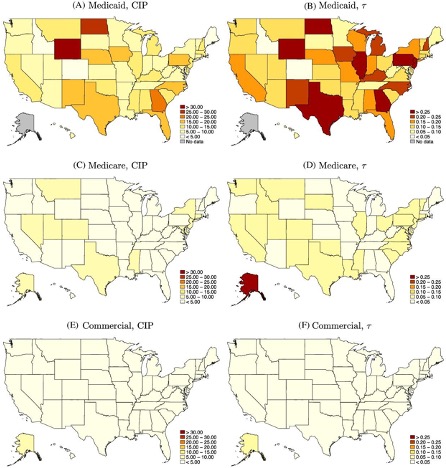
Medicaid is a joint state-federal program with enormous differences across states, and administrative hassle is no exception. For administrative hassle of providers, the worst states include Texas, Illinois, Pennsylvania, Georgia, North Dakota, and Wyoming:
Source: Figure 5 of A Denial a Day Keeps the Doctor Away, which notes: “The left column shows the mean estimated costs of incomplete payments (CIP) by state and payer. The right column shows the mean CIP as a share of visit value by state and payer. “
Lately on Twitter this chart has been going around:
The chart comes from Bloomberg journalist Justin Fox, who always puts together interesting economic data. You can read his interpretation of the data at Bloomberg, but the folks posting it on Twitter all seem to have the same shock and awe: Detroit was the richest big city in 1949. And of course we all know that today it isn’t. Still, the Detroit MSA has done OK since 1949, even though it is no longer anywhere near the top.
How well has Detroit done? Despite industrial decline and many other major problems, median household income of the Detroit MSA was around $71,000 in 2022 according to the Census Bureau. How does this compare to the $3,627 median income in 1949? It’s about double in real terms: you can multiply it by about 10 using the Census’ preferred inflation adjustment for household incomes since 1949 (the C-CPI-U since 2000, and the R-CPI-U-RS before that).
Back in 2021, interest rates had been so low for so long that that seemed to be the new normal. Yields on stable assets like money market funds were around 0.3% (essentially zero, and well below inflation), as I recall. As a yield addict, I scratched around for a way to earn higher interest, while sticking with an asset where (unlike bonds) the dollar value would stay fairly stable.
It was an era of crypto flourishing, and so I latched onto the notion of decentralized finance (DeFi) lending. I found what seemed to be a reputable, honest company called BlockFi, where I could buy stablecoin (constant dollar value) crypto assets which would sit on their platform. They would lend them out into the crypto world, and pay me something like 9 % interest. That was really, really good money back then, compared to 0.3%.
On this blog, I chronicled some of my steps in this journal. First, in signing up for BlockFi, I had to allow the intermediary company Plaid complete access to my bank account. Seriously, I had to give them my username and password, so they could log in as me, and not only be able to withdraw all my funds, but see all my banking transactions and history. That felt really violating, so I ended up setting up a small auxiliary bank account for Plaid to use and snoop to their heart’s content.
BlockFi assured me that they only loaned my assets out to “Trusted institutional counterparties” with a generous margin of collateral. What could possibly go wrong?
What went wrong is that BlockFi as a company got into some close relationship with Sam Bankman-Fried’s company, FTX. Back in 2021-2022, twenty-something billionaire Sam Bankman-Fried (“SBF”) was the whiz kid, the visionary genius, the white knight savior of the crypto universe. In several cases, when some crypto enterprise was tottering, he would step in and invest funds to stabilize things. This reminded some of the role that J. P. Morgan had played in staving off the financial panics of 1893 and 1907. SBF was feted and lauded and quoted endlessly.
For reasons I never understood, BlockFi as a company was having a hard time turning a profit, so I think the plan was for FTX to acquire them. That process was partway along, when the great expose’ of SBF as a self-serving fraudster occurred at the end of 2022. He effectively gambled with his customers’ money. This would have made him even richer if his bets had paid off, but they went sour, which brought everything crashing down.
FTX quickly declared bankruptcy, which forced BlockFi to go BK as well. SBF was eventually locked up, but so were the funds I had put into BlockFi. The amount was not enough to threaten my lifestyle, but it was enough to be quite annoying.
Sam’s parents are both law professors at Stanford who are now resisting returning to FTX’s creditors the $32 million (!!!) in assets (cash and real estate) that SBF had given them out of FTX’s operations. Some of that $32 million they are hoarding is mine, since BlockFi needs to recover its claims against FTX in order to make BlockFi clients whole. Sam’s mother has denounced the legal judgment against her son as “as “McCarthyite” and a “relentless pursuit of total destruction,” which is enabled by “a credulous public.” One wonders what little Sammy imbibed in the way of practical ethics in that household of idealistic Stanford law professors – the “effective altruism” that the Bankman-Fried family touts is perhaps a gratifying concept, until it actually costs you something you don’t want to part with. But I digress.
BlockFi Assets Begin to Thaw
I got emails from BlockFi every few months, assuring customers that they would do what they could to return our assets. Their bankruptcy proceedings kept things locked, but now they are starting to return some money. A judge ruled in early 2023 that assets held by users in their BlockFi “wallet” belonged to the users and could be withdrawn. However, assets in the interest-bearing account (which is where my stablecoin was) technically still belong to the bankrupt company’s estate, and were not necessarily available for withdrawal. But now, following another legal agreement, BlockFi is returning funds from the interest accounts. The problem is that you will only get some fraction of what you put in. Some YouTube commenters have complained they only got 10-25% of their assets, and no one seems to know if they will ever get more. Ouch.
I got an email from BlockFi saying that I have assets to claim, but I need to set up an actual independent crypto wallet to receive them. BlockFi will only transfer the actual coin, not the dollar values. So, I am in the middle of this process. It’s one thing to open a wallet, where you can transfer crypto coins in and out. It is another to exchange or monetize your coin; for that you seem to need an exchange.
I have chosen to go with Coinbase. It is not the cheapest alternative, but it seems to be the most solid U.S. based crypto exchange. I have opened a Coinbase account now. As with BlockFi, I had to go through Plaid (ugh) for the connection to my bank account.
Next thing I need to do is to open a Coinbase wallet, and try to connect with BlockFi, and see what I get back. I will post later on what happens there.
Update: I got scammed in this process, see here. My bad for clicking on a link in an email, instead of going to the official website for the link…
My parents have moved into an elder community. Having a passing familiarity with nursing homes of decades past and elder care scams of decades current, my family spent considerable time researching options, reputations, and legal concerns. Now that it is done, however, I have sufficient peace of mind to make broader reflections.
The resulting institutions essentially looks like a hybrid college campus/country club, albeit less concerned with status projection than the different manners in which a human might lose their balance. More importantly, however, it is a small scale reminder of the powers of agglomeration and returns to scale. My middle class parents now enjoy greater total amenities than they ever have in their entire life, some for the first time ever. I assure you that it is the rare government engineer to who spends their prime earning years with a heated olympic swimming pool, jacuzzi, steam room, sauna, and modern gym equipment within 200 steps of their front door. A separate restaurant, cafeteria, and bakery sit on the campus. Community transit is available 12 hours a day to connect them to the broader region, but live culture, education, and entertain appear as daily options within each building. I won’t get into the myriad physical and mental healthcare options, but they’re there in spades.
Essentially my parents are living a city for the first time in 50 years. A small, niche catered, contract-chartered city, but a city nonetheless. It’s amazing how many amenities become affordable when you only have to pay for a 100th, 1000th, or 10,000th of the underlying cost of provision.
This raises some questions. First of all, why don’t more of us live like this? Which, with a little reflection, is simply asking why more people don’t live in cities, which in turn invites standard answers regarding preferences for more space and fewer neighbors while also further highlighting the immense costs of 40 years of construction and density obstructionism.
The more interesting question, I believe, is how many of us are going to live like this? When octogenerians peak as a fraction of the population, will we see a new golden age of agglomeration, but in private communities instead of cities? What sort of scales might these communities achieve? Will Boomers rediscover their affection for transit, but as a private club good rather than a government-provided public good? Will generations of rural and suburban Americans find themselves living in cluster micro-cities surrounding major cities, enjoying trips daytime trips into the very urban areas they’ve previously feared were overrun with imagined crimewaves? Who is going to run for mayor? What sort of power is constitutionally invested in the mayor of city whose citizens pay a flat tax i.e. community fees i.e. rent?
What’s going to happen when the Boomers pass on and subsequent Generation X members show up with greater urban affinities, but smaller numbers and fewer children to support them? Will some elder communities collapse and be absorbed into a smaller number of larger elder cities, breeding greater scale returns, but within the economic security of a generation of grown children to foot the bill if the money runs out? Will there be an Orange Julius and Tower Records for me to hang out at? Will chain wallets come back?
Come to think of it, why are we waiting until our 80s? What’s stopping us from living in tightly-knit condominium communities filled to the brim with the social and community public goods that increasingly lonely Americans seem to be in desperate need of? Why can’t I go on reddit and find the apartment complex whose emergent culture of tenants caters to my households specific interests in games, art, and sports?
I started this worried about how my parents were going to live and finished trying to figure out how to live more like them. What I’m saying is the YIMBYs need to win and make it snappy so my household can live its dream of living in a 3 bedroom condo on the 5th floor of a building built on top of the Startcourt mall.
As a millennial woman working through my 30’s, I increasingly see social media posts from my friends like this one:
One of the difficult things about infertility, for my friends going through it, is the uncertainty. Modern medicine seems legitimately short on information and predictive analytics for this issue. So… AGI to the rescue, someday?
All I’m writing about tonight is that I have created a growing to-do list, over roughly the past year, for the AGI. Would something smart enough to do all of the above be dangerous? I wouldn’t rule it out. As pure speculation, it feels safer to have an AI that is specifically devoted to being a personal chef but which strictly cannot do anything else beside manage food. An AI that could actually do all of those things… would be quite powerful.
Last year, Jeremy wrote “Where Can You Still Buy an Affordable Home in the US?” He pointed out a few metro areas in the US that are not classified as “unaffordable”. All of the biggest cities have nice amenities such as great restaurants but are very expensive.
There is such a thing as an American town that is too small to find a good restaurant. But you don’t have to go all the way to the middle of New York or Chicago to find interesting menus. If you love food and good creative restaurants, there are some smaller cities that can deliver. Parking and hotels should be cheaper, so you can spend more of your money on food. (I don’t have any data on hand with regard to how menu prices in Birmingham compare to menu prices in NYC. Presumably they are lower here where labor is relatively cheaper.)
I think I care more about food quality than “service.” Nothing has bothered me about the gradual nation-wide shift away from table service toward placing my order at the counter or from a computer screen.
I don’t do much with them, but Jeremy is an advocate for restaurant apps. If you track deals and order directly through the app, you might save around 10% on low-to-mid quality restaurant food.
On a side note, I’m wondering if and when AI will approach the service level of a personal chef. I wish I could outsource all family meals to someone else. I have experimented with grocery delivery and “meal kits” and recipe apps. Nothing ever feels like a personal chef, although some of those services are nice to have. I feel like a superintelligence could encompass all of the restaurant apps, and grocery delivery and family meal planning together. I wish I could just enter a list of taste and health preferences and then not think about it anymore.
Interest rates communicate the value of resources over time. For example, if you take out a loan, then the interest rate tells you how much you must to pay in order to keep that money over the life of the loan. The interest rate also reflects how much the lender will be compensated in exchange for parting with their funds. On the consumer side, the interest rate reflects the price that the borrower is willing to pay in order to avoid delaying a purchase.
When a business borrows, the interest rate reflects the minimal amount of value that they would need to create in order to make an accounting profit. For example, if a business borrows $100 for one year at an interest rate of 5%, then they need to earn $105 by the time that they repay the loan in order to break even with zero profit. The business would need to earn more than 5% in order to earn a profit on their borrowing and investment venture.
The longer the business takes to repay their loan, the more interest that accrues. And, the higher the interest rate, the more they need to earn in order to repay their loan.
This logic applies to all production because all production takes time. If production takes very little time, then the impact of the interest cost is miniscule. But, if production takes longer, then interest rates become increasingly relevant. These kinds of products include trees, cheese, wine, livestock, etc. Anything that ages, ferments, or has a lengthy production process will be more sensitive to the cost of borrowing.
How?
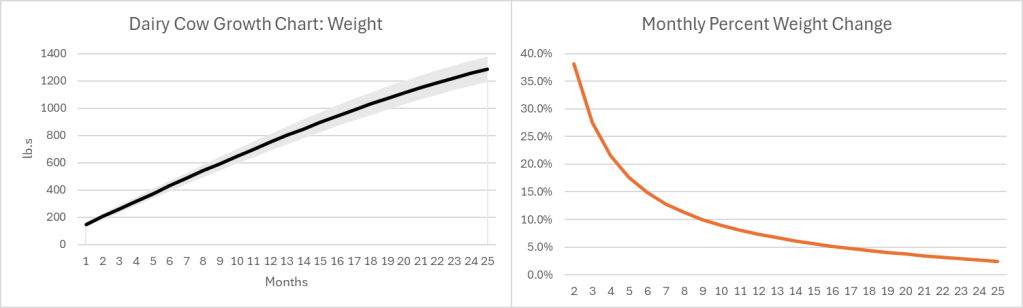
The growth pattern for most (all?) goods looks similar. Below-left is a growth chart for dairy cows . Notice that calves grow quickly at first, and their growth slows over time. For the sake of argument, let’s say that the change in value of a cow mimics the change in weight (Yes, I know that dairy and beef cows are different, but the principle is the same). Below-right is the monthly percent change. Even at an age of 25 months a cow is still growing in value at 2.4% per month or 33% per year.
Of course, there is a risk that some cows don’t survive to slaughter, lowering the expected growth rate. Since most cattle are slaughtered between 18 and 24 months of age, their growth rate at the time of slaughter is 4.4%-2.7% per month. As the interest rate at which farmers borrow rises, the optimal age at slaughter falls. Otherwise, the spread between the growth rate and the interest rate could go negative. Even so, what an investment! If you can borrow at, say, 8% per year, then you’ll make money hand-over-fist on the spread.
Except… Cows cost money to raise, and most of that cost is feed. According to the production indicators and estimated returns published by the USDA, the cost of feed in February of 2023 was $158.11 per hundred pounds of beef. The selling price of beef was $161.07. That leaves $2.96 or a profit of 1.87% earned over the course of 1.5-1.75 years. That investment is starting to look a lot less good, especially since it doesn’t include the cost of maintaining facilities, insurance, etc. It’s no wonder that farmers and ranchers are serious about their subsidies. Clearly, with such tight margins, farmers and ranchers are going to look good and hard at the interest rates that they pay on their debt. And, they do have debt.
However, the recent increase in beef prices is not caused by higher interest rates.
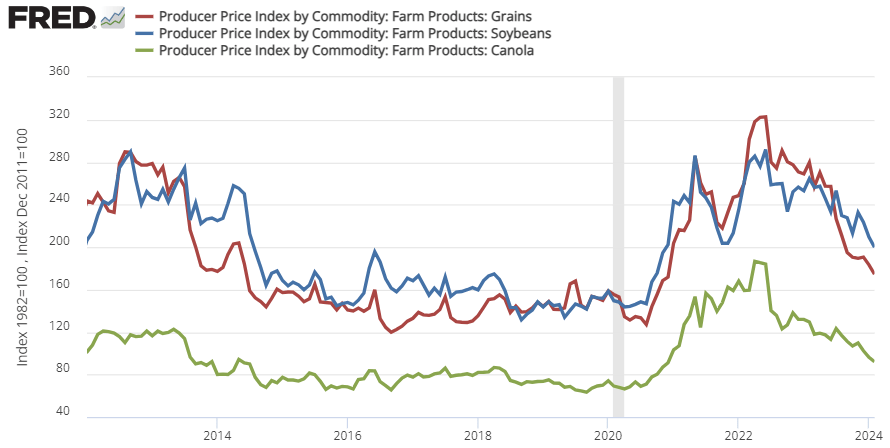
That 1.87% profit margin is at prices and costs from February 2023. Since 2020, the price of cattle feed ingredients (grain, bean, and oil) peaked in the summer of 2022 and are still substantially more expensive than pre-Covid (see below). That means that cows getting slaughtered right now were raised on more expensive feed. This February 2024, the cost of feed per 100lb. of cattle was $191.80. But the cattle selling price was only $180.75. That’s a $11.05 loss for cattle raising. Wholesale prices of cattle might be up recently, but the cost of feed is up by more. It’s not the cattle farmers who are benefiting from the high beef prices. In fact, they’re getting squeezed hard.
There is good news. The cost of feed ingredients has been falling recently, which means that beef farmers should begin to see some relief if the recent trend continues. For Consumers, the price of beef is already down from its 2023 peak.