Let’s talk about disability. The American Community Survey (ACS) identifies seven broad categories, not including the baseline case of ‘No Disability’. I’ve written before about how disability designations are difficult because many qualifying conditions are a matter of degree. Surely you’ve met a person who is legally blind but can see *some*. How much sight ability can remain while still being considered blind? If a person can identify the sun’s location, but nothing else, then is that person still blind? Similarly, who’s to say whether some physical or cognitive characteristic is disabling? Why not enabling – depending on the task?
Wisely, the ACS side-steps this entire discussion and simply asks respondents whether they have “difficulty”. We can be agnostic about the cause and degree while still trying to get at the heart of the matter. One downside is that people tend to have more difficulty as they age. Since that’s not relevant for earlier life economic outcomes, I only examine ages 24-45. Difficulty with “self care” is too small of a category in the 2024 ACS for the analysis here. Below are the other six difficulties identified:
- Hearing Difficulty (n=6,609)
- Seeing Difficulty (n=8,307)
- Cognitive Difficulty (n=26,792)
- Ambulatory Difficulty (physically getting around) (n=4,568)
- Independent Living Difficulty (n=5,997)
- No Disability (n=885,302)
We should say early on that many of the people who participate in “Deaf” (capitalized) culture do not consider deafness to be a disability and that any such suggestion is motivated by bias and hearing culture. I won’t engage with that here. But I can say that there is a long tradition going back through the 1800s that rejected alms-giving for deafness and instead supported independent living for deaf people. Historically, this manifested as outlawing panhandling while featuring deafness and rejecting government programs that provide simple transfers due merely to deafness. More recently, the push to reject the ‘disability’ label and its baggage has even been the motivation for some deaf people to oppose cochlear implants being covered by medical insurance. For ease, I’ll be using the colloquial terms for all of the above difficulties. Now that you have the greater context, let’s jump into the data (unweighted).
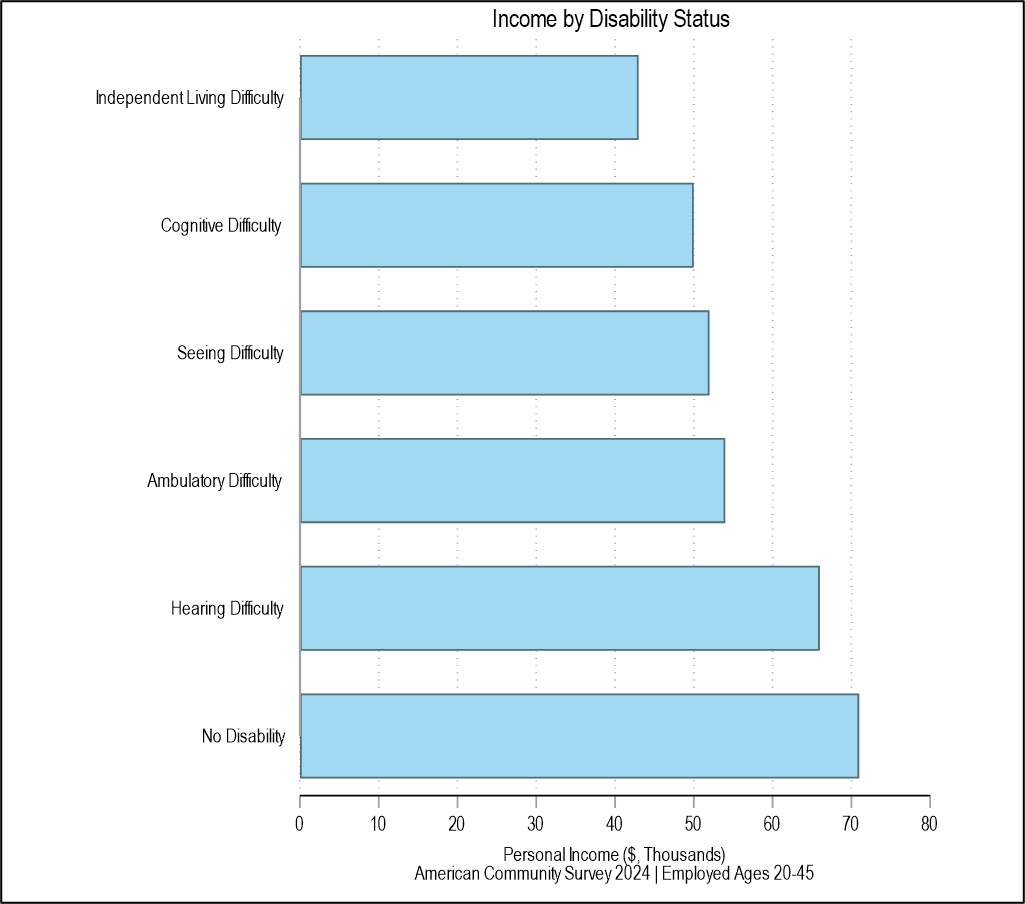
The baseline income chart is above. Given the above description, it should come as no surprise that deaf people have the highest average income among disability groups, conditional on employment. However, it’s also surprising that most of the above disabilities have incomes that I wouldn’t exactly call destitute. Many people who have a disability look much like everyone else. From an economic point of view, we all have a comparative advantage and it’s perfectly consistent with gainful employment and flourishing otherwise.
Continue reading
