Disability: Income, Unemployment, & Education

Let’s talk about disability. The American Community Survey (ACS) identifies seven broad categories, not including the baseline case of ‘No Disability’. I’ve written before about how disability designations are difficult because many qualifying conditions are a matter of degree. Surely you’ve met a person who is legally blind but can see *some*. How much sight ability can remain while still being considered blind? If a person can identify the sun’s location, but nothing else, then is that person still blind? Similarly, who’s to say whether some physical or cognitive characteristic is disabling? Why not enabling – depending on the task?

Wisely, the ACS side-steps this entire discussion and simply asks respondents whether they have “difficulty”.  We can be agnostic about the cause and degree while still trying to get at the heart of the matter. One downside is that people tend to have more difficulty as they age. Since that’s not relevant for earlier life economic outcomes, I only examine ages 24-45. Difficulty with “self care” is too small of a category in the 2024 ACS for the analysis here. Below are the other six difficulties identified:

  • Hearing Difficulty (n=6,609)
  • Seeing Difficulty (n=8,307)
  • Cognitive Difficulty (n=26,792)
  • Ambulatory Difficulty (physically getting around) (n=4,568)
  • Independent Living Difficulty (n=5,997)
  • No Disability (n=885,302)

We should say early on that many of the people who participate in “Deaf” (capitalized) culture do not consider deafness to be a disability and that any such suggestion is motivated by bias and hearing culture. I won’t engage with that here. But I can say that there is a long tradition going back through the 1800s that rejected alms-giving for deafness and instead supported independent living for deaf people. Historically, this manifested as outlawing panhandling while featuring deafness and rejecting government programs that provide simple transfers due merely to deafness. More recently, the push to reject the ‘disability’ label and its baggage has even been the motivation for some deaf people to oppose cochlear implants being covered by medical insurance. For ease, I’ll be using the colloquial terms for all of the above difficulties. Now that you have the greater context, let’s jump into the data (unweighted).
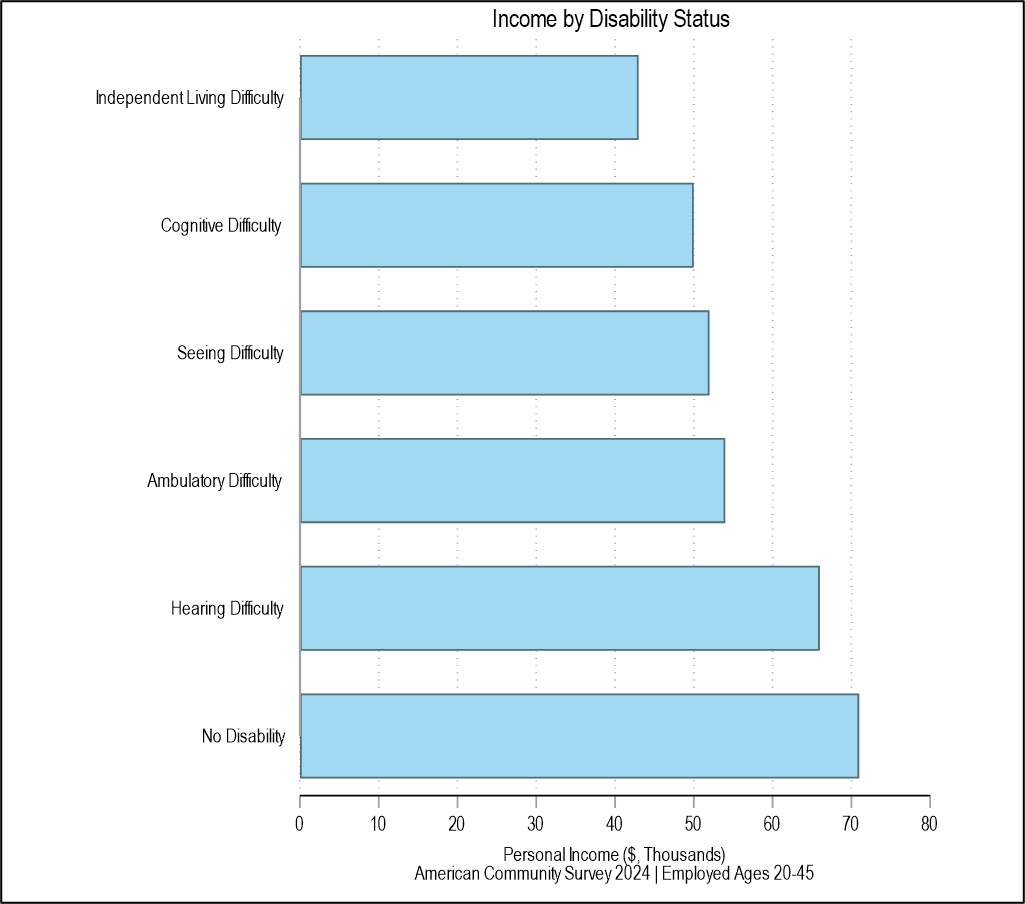
The baseline income chart is above. Given the above description, it should come as no surprise that deaf people have the highest average income among disability groups, conditional on employment. However, it’s also surprising that most of the above disabilities have incomes that I wouldn’t exactly call destitute. Many people who have a disability look much like everyone else. From an economic point of view, we all have a comparative advantage and it’s perfectly consistent with gainful employment and flourishing otherwise.

Continue reading →

Messy Disability Records in the Historical Censuses

The historical US Census roles of disability among free persons are a mess. Specifically for the 1850-1870 censuses, the census bureau was not professionalized and the pay was low (a permanent office wasn’t founded until 1902). So, the enumerators were temporary employees and weren’t experts of their art. To boot, their handwriting wasn’t always crystal clear. Second, training for disability enumeration was even less complete and enumerators did their best with whom they encountered and how they understood the instructions. Finally, the digitized data in IPUMS doesn’t perfectly match the census reports. What a mess.

Guilty by Association

Disabled people and their families often misreported their status out of embarrassment or shame. Given that enumerators had quotas to fill, they were generally not inclined to investigate claimed statuses strenuously. Furthermore, disabled people were humans and not angels. Sometimes they themselves didn’t want to be associated with other types of disabled people. In particular, the disability designation in question (13) on the 1850 census questionnaire asked  “Whether deaf and dumb, blind, insane, idiotic, pauper or convict”. Saying “yes” may put you in company that you don’t prefer to keep.

Summer censuses also sometimes missed deaf students who were traveling to or from a residential school.

Enumerator Discretion

The enumerator’s job was to write the disability that applied. What counts as deaf and dumb? That’s largely at the enumerator’s discretion. Some enumerators wrote ‘deaf’ even though that wasn’t an option. Was that shorthand for ‘Deaf and Dumb’? Or were they specifying that the person was deaf only and not dumb? We don’t know. But we do know that they didn’t follow the instructions. What if a person was both insane and blind? Then what should be written? “Blind/Insane” or “Blind and Insane” or “In-B” and any number of combinations were written. Some of them are easier to read than others.

Data Reading Errors

IPUMS is the major resource for using census data. The historical data was entered by foreign data-entry workers who didn’t always speak English. So, the records aren’t perfect. Some of the records are corroborated with Optical Character Recognition (OCR), but the historical script is sometimes hard to read. Finally, the fine folks at familysearch.org and Brigham Young University have used Church of Latter Day Saints (LDS) volunteers to proof data entries. Regardless, we know that the IPUMS data isn’t perfect and that the disability data is far from perfect. Usually, reports don’t dwell on it. They simply say that the data is incomplete.

The disability data is incomplete for a lot of reasons related to the respondent, the enumerator, the instructions, and the digital data creation. What a mess.