A Simple Way States Can Reduce Healthcare Spending

Repeal Certificate of Need requirements, assuming you are one of the ~35 states that have them.

That’s what I find in a paper with Shishir Shakya just published in Health Economics.

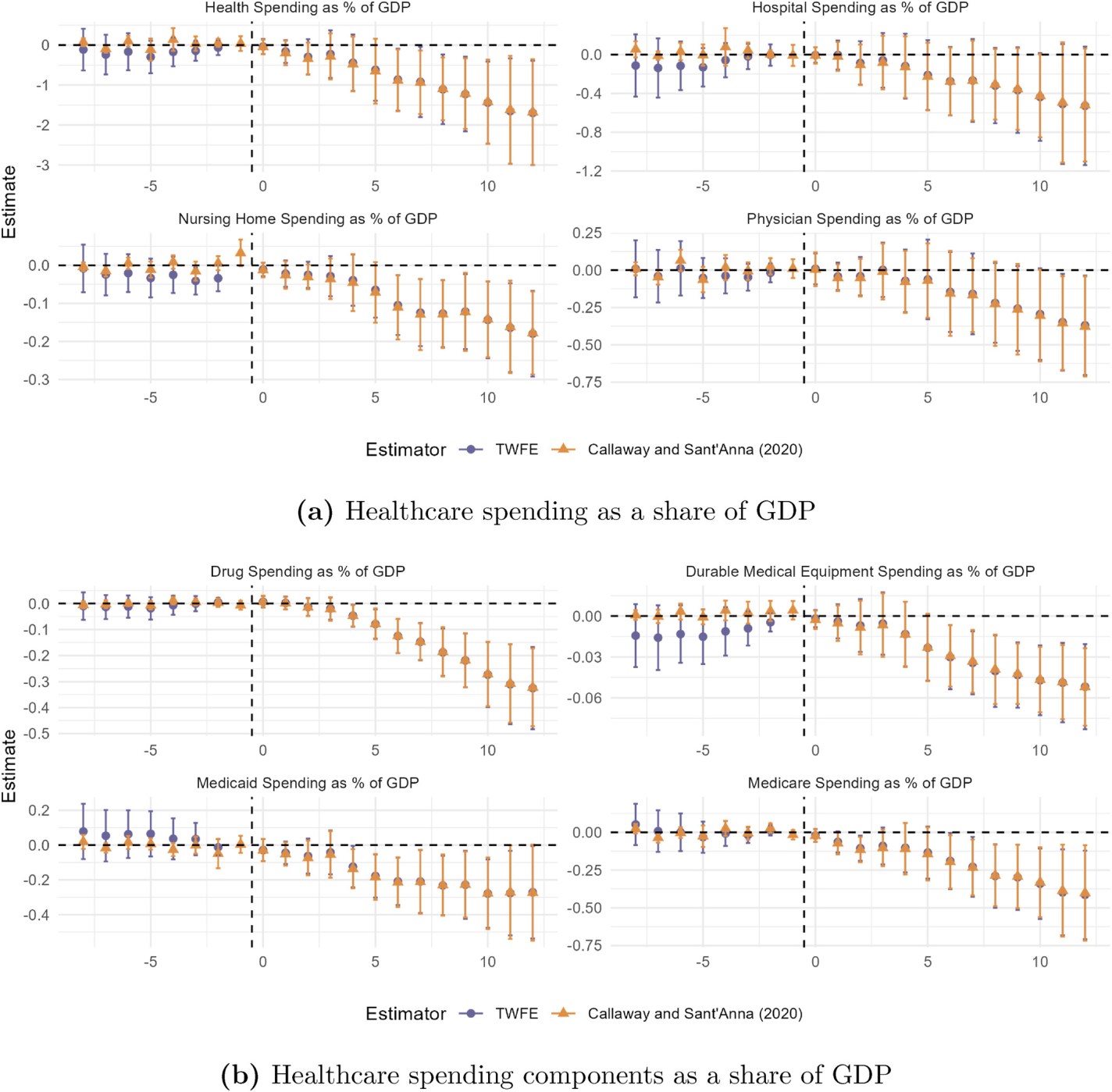
Certificate of Need laws require healthcare providers to obtain government approval before building new facilities or expanding services. The original intent of the laws was that less building would mean less spending, but critics worry that it means less competition and higher prices leading to higher spending. Our paper finds that the critics are right, as states repealing their Certificate of Need laws see their healthcare spending fall relative to those that maintain them.

Longtime readers may recall that back in 2022 I posted about another paper of mine with a similar result, and even that wasn’t the first word on the subject. So what’s new in this paper? Besides newer data, we measure health spending as a percentage of the state economy rather than in raw dollars, to try to account for how CON changes the true burden of healthcare spending. We also use newer regression techniques that are probably more accurate but definitely help make prettier graphs.

Here’s what we found happening to health spending when states repeal Certificate of Need:
Full published paper is here, ungated working paper version here.

The Journal of Healthcare Finance Is Back

Most academic journals are run by big for-profit publishing companies, and most of the rest are run by universities or big academic societies. The Journal of Healthcare Finance was an extreme outlier from this norm, run single-handedly by Editor-In-Chief James Unland since 1994. It was the rare journal that was free both for readers and authors.

I loved the idea of having a single person truly in charge and accountable without being slowed by a complex bureaucracy. But eventually a single person will want to, or have to, move on. Having an institution run a journal can ease this process, though an individual can still try to find their own successor.

In this case, The Journal of Healthcare Finance had been on hiatus since its Editor-In-Chief stepped back, with its last issue published in 2023. Their old website domain had expired- not a great look for anyone who published there and was going up for a job or tenure.

But now it is officially back at a new domain, with the single Editor-In-Chief replaced by a full editorial team, and accepting submissions again with the hope of releasing a new issue this year.

Selfishly, I’m happy to see this both because it means they will continue hosting my past publication, and to have a potential outlet for my future work. I recommend that other health economists and health services researchers give it a try, though as of now I have no personal experience with the new editorial team.