This is the seventh in a series of occasional blog posts on individual initiatives that made a strategic (not just tactical) difference in the course of the second world war.
History’s most important machines often have a stubborn, slightly obsessive person behind them. For the Soviet T-34 tank, that was Mikhail Koshkin. Koshkin ran the design bureau at the Kharkov tank and locomotive plant. What made him special was that he paid attention to how tanks died. The fighting against the Japanese at Khalkhin Gol in 1939, along with the lessons of Spanish civil war, showed that Soviet tanks were too thinly armored and caught fire too easily. Koshkin pushed for a diesel engine, thick sloped armor, wide tracks that could handle mud and snow, and a big gun. He didn’t just copy what already existed. He took the lessons of real combat and built a tank around them.
He made it very simple. For instance, in most tanks, there is a whole interior compartment, holding the tank crewmen, which rotates along with the turret. But with the T-34, only the upper visible turret (with its gun) rotated. That minimalist turret simplified construction, even though it meant the gun loader had to scramble around on the fixed floor to keep up with turret rotation. The T-34 was easy to build in staggering numbers, by workers who were often barely trained, and it cost far less than the elaborate German machines. Stalin supposedly said that quantity has a quality all its own. The Soviets eventually built over 50,000 T-34s. Here are links to an original (in Russian) T-34 gunnery manual (1942), and a complete maintenance manual (1944) with cutaway views of its construction.
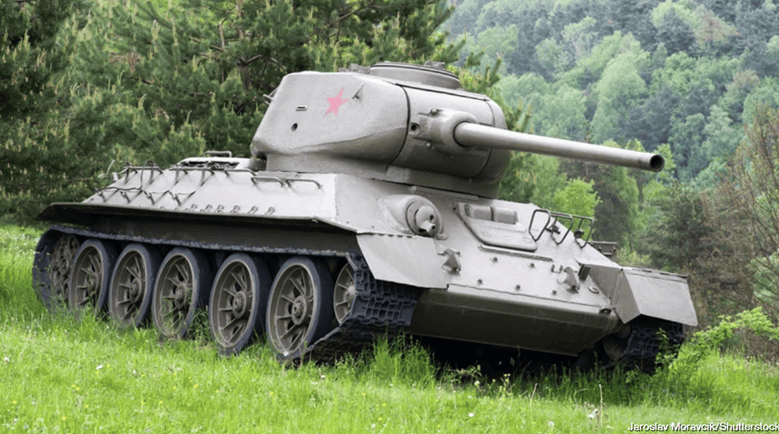
Soviet T-34 Tank (Looks like museum model, not combat-ready)
From 1939 through late 1942, the Germans looked unstoppable. Poland, France, and the Balkans all fell quickly. However, in the opening weeks of their 1941 invasion of the U.S.S.R, Barbarossa, the T-34 proved a nasty surprise for the German Army. German antitank shots bounced off its sloped front armor and its gun could take out most German vehicles.
The Germans were impressed. Field Marshal Ewald von Kleist later called it “the finest tank in the world.” Armor strategist General Guderian said the news was “very worrying” and that German tank superiority had ended for the moment. So, early in the war, the relatively few but potent T-34’s helped to slow down the Nazi onslaught enough to give the Soviets time to recover from their staggering losses. Later in the war, the sheer numbers of T-34’s gave the Soviets resilience and offensive punch. By 1944-45 the Germans were fielding gigantic Pather and Tiger tanks which could easily take out two or three T-34’s, but not a swarm of ten or twenty up-gunned T-34’s which could surround a Tiger and shoot it from the side.
Sadly, Koshkin never saw the vindication of his design. In early 1940, he insisted on proving his prototypes by driving them himself 500 miles from Kharkov (in today’s Ukraine) to Moscow, through cold and mud, to show the brass what they could do. The tanks made it. Koshkin didn’t. He caught a bad cold that turned into pneumonia and died in September 1940, at just 42, nine months before the Germans invaded. The man who gave the Red Army its best weapon spent himself on the proof that it worked.

