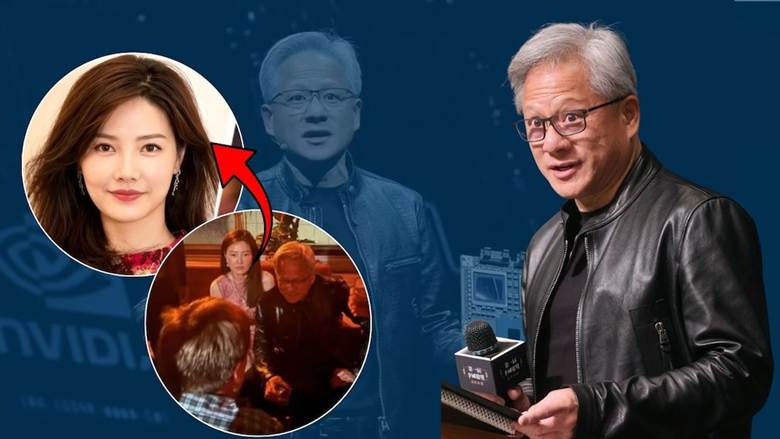
You couldn’t make this up. The CEO of the second most valuable company on earth, at the very center of the AI technology which is driving, well, everything, including the U.S./China rivalry – – Jensen Huang himself – – over the weekend acknowledged over the weekend in an internal Nvidia memo that he had had an extramarital affair, and the company announced an investigation. The issue is not his personal infidelity, but the fact that the other woman in the case is almost certainly one Alice Huang (a.k.a. Huang Le) who is suspected by U.S. intelligence (per the NY Times) to be a Chinese spy.
There seems no question about the affair. There are lots of public photographs indicating an intimate relationship, and Huang outright admitted it, although he refrained from naming names. But who is Alice Huang? That turns out to be a very, very difficult question to answer.
She is reportedly a Chinese citizen, and was presumably born and raised and schooled there. I could find no solid information on her background. I asked Claude, and got this non-answer:
Birthplace and upbringing: I found no source giving either. AFP calls public details about her sparse. france24
Education: Officechai says there is no verified public record of where she studied or what degrees she holds. A fund-database profile lists jobs but, as far as the reporting says, no schools, and AFP couldn’t verify that profile or who wrote it. officechaifrance24
Some sources claim that she worked as a TV reporter in China, but other news organizations have checked and found those claims to be baseless. So…you have this person from China, coming seemingly out of nowhere, who rather suddenly as head of as her own firm Huang Le Ltd (registered in the British Virgin Islands) became owner of a spinoff (Megaspeed) of a Chinese company, which in turn rather suddenly becomes one of the biggest Asian importers of those oh-so-special Nvidia chips. There seems to be no ready accounting for how her firm was financed to buy Megaspeed, and or how such a tiny new firm could buy $4.6 billion (!!) in chips from Nvidia. Thus, some invisible hand deftly placed this hot youngish woman from China in a position where she would almost certainly come in personal contact with Jensen Huang.
She apparently palled around with Jensen in the years 2024-2025, but now has disappeared from her management roles and from public view. She seems to have been well-enough advised to avoid making outright illegal business moves (thus evading criminal prosecution in Singapore), but all this caught the attention of U.S. authorities as early as the late Biden administration, leading them to believe she was a tool of Chinese state intelligence – at least, that is what various news outlets have reported. It’s impossible to know what did or did not transpire between Huang and Huang regarding chip technology or policies, whatever else they talked about. It is a positive that Jensen has publicly acknowledged this affair, since that removes the blackmail lever which is often the point of such “honey pot” entrapments.
What effect might this all have on Nvidia? Well, first, its stock price was down sharply on Monday, erasing some $200 billion in shareholder value, when the rest of the chip stocks were recovering smartly from the fears from the midterms that the Democrats would shut down data center construction.
A lengthy, messy investigation might compromise Jensen Huang’s iconic role at Nvidia, leading potentially to his departure. The company would forge ahead without him, but his loss would be a blow. Even if he stays, his public image of a loyal, disciplined, trustworthy man has been badly tarnished. I suspect a more focused fallout will be to muzzle him as a spokesman for selling more of his AI-critical (and military-enabling) chips to China. He has been pushing for chip sales for a long time, and now it will be tougher to take him seriously as someone speaking in America’s interest.