An intervention for children to change perceptions of STEM

Here is a a new paper related to the topic of women getting into technical fields (see previous post on my paper about programming).

Grosch, Kerstin, Simone Haeckl, and Martin G. Kocher. “Closing the gender STEM gap-A large-scale randomized-controlled trial in elementary schools.” (2022).

These authors were thinking about the same problem at the same time, unbeknownst to me. In their introduction they write, “We currently know surprisingly little about why women still remain underrepresented in STEM fields and which interventions might work to close the gender STEM gap.”

My conclusion from my paper is that, by college age, subjective attitudes toward tech are very important. This leads to the questions of whether those subjective attitudes are shaped at younger ages. Grosch et al. have run an experiment to target 3rd-graders with a STEM-themed game. I’ll quote their description:

The treatment web application (treatment app) intends to increase interest in STEM directly by increasing knowledge and awareness about STEM professions and indirectly by addressing the underlying behavioral mechanisms that could interfere with the development of interest in STEM. The treatment app presents both fictitious and real STEM professionals, such as engineers and programmers, on fantasy planets. Accompanied by the professionals, the children playfully learn more about various societal challenges, such as threats from climate change and to public health, and how STEM skills can contribute to combating them. The storyline of the app comprises exercises, videos, and texts. The app also informs children about STEM-related content in general. To address the behavioral mechanisms, the app uses tutorials, exercises, and (non-monetary) rewards that teach children a growth mindset and improve their self-confidence and competitive aptitude. Moreover, the app introduces female STEM role models to overcome stereotypical beliefs. To test the app’s effect, we recruited 39 elementary schools in Vienna (an urban area) and Upper Austria (a predominantly rural area).

This is a preview of their results, although I recommend reading their paper to understand how these measurements were made:

Girls’ STEM confidence increases significantly in the treatment group (difference: 0.047 points or 0.28 standard deviations, p = 0.002, Wald test), and the effect for girls is significantly larger than the effect for boys.

Result 2: Children’s competitiveness is positively associated with children’s interest in STEM. We do not find evidence that stereotypical thinking and a growth mindset is associated with STEM interest.

Lastly, my kids play STEM-themed tablet games. PBS Kids has a great suite of games that are free and educational. Unfortunately, I have not tried to treat one kid while giving the other kid a placebo app, so my ability to do causal inference is limited.


Cheers to Sumproduct!

I teach macroeconomics, finance, and other things.

Often, I use Excel to complete repetitive calculations for my students. The version that I show them is different from the version that I use. They see a lot more mathematical steps displayed in different cells, usually with a label describing what it is. But when I create an answer calculator or work on my own, I usually try to be as concise as possible, squeezing what I can into a single cell or many fewer cells. That’s what brings me to to the sumproduct excel function that I recently learned. It’s super useful I’ll illustrate it with two examples.

Example 1) NGDP

One way to calculate NGDP is to sum all of the expenditures on the different products during a time period. The expenditures on a good is simply the price of the good times the quantity that was purchased during the time period. The below image illustrates an example with the values on the left, and the equations that I used on the right. That’s the student version. There is an equation for each good which calculates the total expenditure on the individual goods. Then, there is a final equation which sums the spending to get total expenditures, or NGDP.

Continue reading

Bounce Houses are Surprisingly Cheap

Last year was the first time I saw a family that owned their own bounce house and just set it up in their living room. At the time I thought, what a lucky rich kid, that must cost at least a thousand dollars. But my wife looked into it and found out that bounce houses are surprisingly cheap these days. She got our kids this one last Christmas, its currently going for $234 on Amazon:

The kids love it and its still going strong ten months later, despite substantial use from kids and the presence of two sharp-clawed cats. It was certainly a bigger hit than the other major gift we tried last Christmas- telescopes are surprisingly hard to use.

The Only Analysis of the Pennsylvania Senate Debate That You Need To Read

Last night the major party candidates for Senate in Pennsylvania had their first and only debate. I didn’t watch it, since I don’t live in Pennsylvania. But judging by my Twitter feed, a lot of people did watch it, including (bizarrely to me) lots of people who don’t live in Pennsylvania. And overnight, tons of articles were written analyzing the debate, saying who “won” the debate, and so on (“5 Things You Need to Know About the Pennsylvania Senate Debate” etc.).

But this blog post is the only thing you need to read about that debate. And these charts are really all you need to look at.

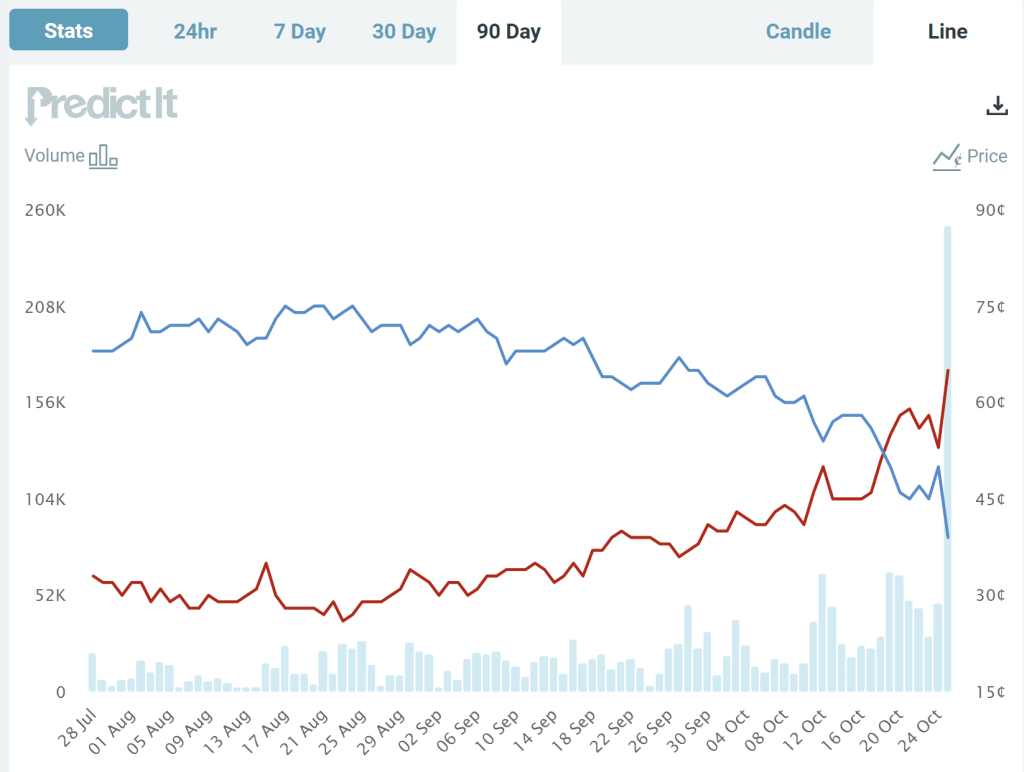
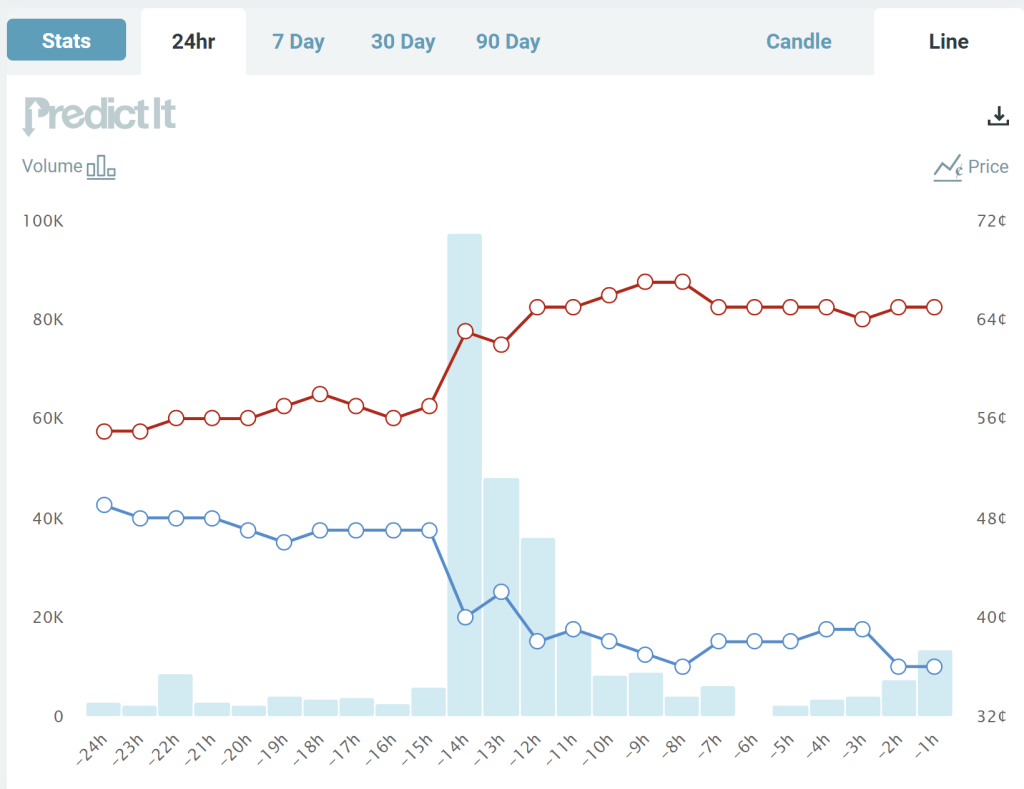
These two charts come from the prediction market website PredictIt. The charts show the “odds” (more on that below) that each candidate will win the Pennsylvania Senate race, over a 90-day time horizon (first chart) and the last 24 hours (second chart). What do we see? The Democratic candidate has been leading for the entire race up until a week ago, though with his odds falling gradually over the past month or two.

Notice though the big jump last night during the debate. The Republican candidate moved up from odds of about 57% to odds of about 63%, close to where it stands as I write (67%). Based on this result, it’s safe to say that the Republican candidate “won” the debate, though not so decisively that the election is now a foregone conclusion. You don’t need to wait for the polls, which have consistently showed the Democratic candidate in the lead (though with the gap closing in recent weeks) — though of course, these betting odds could change as new polling data is released.

But where do these odds come from?

Continue reading

Can You Use an Expired Home COVID Test?

Using a COVID test is a fairly serious matter – the results of such tests drive decisions on staying home and isolating or not, which in turn affect the spread of the virus in the population. I am known to use medicines that maybe expired six months earlier, figuring that the med will still be say 80% effective, but for a COVID test I want it to be as accurate as possible.

We all have on our shelves boxes of rapid COVID tests which were send out by the government in the first half of 2022. Most of these tests had nominal six-month lives, so according to what is stamped on the box, they are expiring right about now.

But wait – – that six-month life was just a (conservative) estimate from back when the tests were manufactured. For about a dozen out of the original 22 approved tests, subsequent data has shown that the tests remain accurate for longer than six months. Typically, the approved life is extended an additional six months or more. So before using or throwing out a box whose stamped expiration date has passed, go to this FDA link. You can quickly find your brand of test. The instructions for using this site are:

To see if the expiration date for your at-home OTC COVID-19 test has been extended, first find the row in the below table that matches the manufacturer and test name shown on the box label of your test.   

  • If the Expiration Date column says that the shelf-life is “extended,” there is a link to “updated expiration dates” where you can find a list of the original expiration dates and the new expiration dates.  Find the original expiration date on the box label of your test and then look for the new expiration date in the “updated expiration dates” table for your test.   
  • If the Expiration Date column does not say the shelf-life is extended, that means the expiration date on the box label of your test is still correct.  The table will say “See box label” instead of having a link to updated expiration dates.  

A couple more notes re COVID Tests:

( 1 ) The tests do detect the omicron BA.5 subvariant, which has driven much of the infections lately. However, if you have been exposed to COVID, the new recommendation is to take three (instead of just two) tests, at least 48 hours apart. (If you take the test too early, not enough antigen has built up to detect, so you might get a false negative).

( 2 ) Although the initial federal program for free tests has expired, there are several ways to still get free tests. Any health insurer will pay for them, as will Medicare. And there are other venues for uninsured or low-income people. See this article.

Elite private schools and the rents of early talent filters

An email from a (no doubt loyal) reader about my post last week:

“I’m a big believer that – for all the problems with our educational system – it’s a strength of the US that it’s possible to be a late bloomer and still succeed. But your piece also resonated with me because I’ve been revisiting  my thoughts about [Thomas Jefferson High School for Science and Technology of Northern Virginia, a public magnet school] through all of the recent controversies over promoting diversity. (Not my topic here. I’m for it, but that’s a whole other discussion.)

I will state up front that my opinion is not a popular one among the TJ crowd (as evidenced by the bemused reactions it got at my 25 year reunion), but here goes: 

I believe people are using the wrong baseline when they point to the success of TJ – most wonder “what would my life have been like if I hadn’t gotten into TJ?”   but I think the proper question is “what would my life have been like if TJ didn’t exist?” 

I think that is well observed, but lets unpack it a bit more. The broader framing of “Would admitted students’ lives be different if schools like TJ didn’t exist?” is an extremely useful one, especially if you compare them to the elite private schools whose entire sales pitch boils down to “For $60K a year we’ll give your child a real shot at getting into the Ivy League or the Supreme Court“. When that is your pitch and your price tag, schools have no choice but to invest significant resources ensuring that their graduates have not just an advantage, but pre-designated slots in the incoming classes of the elite undergradute institutions. They aren’t passively part of a filter system, they are actively working to ensure that their admissions process for those 13 or younger serve as a talent filters for the Ivy League.

Full Disclosure: I attended the Thomas Jefferson High School for Science and Technology in the mid-90s. It was no doubt less competitive to get in then, so don’t feel obligated to update your prior beliefs regarding my intelligence or insight. My time there was a lovely experience that I am grateful for, though, so I am no doubt biased.

For all of it’s incredible local reputation, TJHSST isn’t nearly as big a deal in the broader world, in part because it remains very much a public school, albeit one with an admissions process beyond pure geography. There is no board of trustees working actively to promote it as a filter, no club structure committed to the long-term prestige of the institution to be passed down through legacy admission​s. Part of the reason I find the TJ model more tolerable is that it promotes itself as an educational opportunity and adjuvant for its students, rather than a probabilistic ticket to the next stage of the social ladder.

The cost of TJ not existing is roughly equivalent to that borne by students who applied but were not admitted: a set of kids each year who receive an arguably inferior education, nothing more, nothing less. The external cost imposed by TJ admissions on the rest of the school system is largely neglible. Yes, the peer networks within each of the schools they pull from will be slightly weaker academically, but they are pulling from a lot of schools, so that cost is spread pretty thin.

What about the filter effect, you might ask? Are the students not admitted to TJ suffering at a disadvantage later applying to college? There may be some small signal disadvantage at the margin, but my suspicion is that it is pretty small. There are no resources dedicated to creating dedicated pipelines into elite schools, and absolutely no legacy systems incentivizing the creation of those generational pipelines. For an institution to become a talent filter it has to on some level, I believe , dedicate resources towards becoming a filter. It has to not just want that status, it has to have club members willing to invest in it acquiring that status.

Conversely, the effect of Georgetown Prep, the Phillips Academy, and others of their ilk not existing is, similarly, a probable decline in the quality of education of some subset of students. It would also mean, however, that the pool of consideration for Harvard and Yale would get wider and the relevant talent filters would be applied 4 years later in student development. As it stands, students not being admitted, not being unable to afford, or not even being aware of the existence of these educational institutions and opportunities is that they’ve been removed from the track to the professional elite. The composition of the Supreme Court and Congress are being indirectly determined by the admission boards (and legacy donors) sorting children before they’ve learned algebra or finished growing.

You want my opinion? Well here it is: we need more TJHSST’s, not less. We need more public magnet schools, more elite public colleges and universities. Schools where, yes, students are competing for admission, but for whom the prize of admission is the education itself and not entry into a club whose principal endeavor is procuring rents for their matriculants and the offspring of their alumni by offering signal value through their admission. If a filter occurs, it should occur through the quality of their educational outputs, not the narrowness of their admission criteria inputs.

In the end, private schools as early talent filters are an institution prime for capture by highly capitalized rent-seekers. Truly great public schools are not part of that problem. They may even be a solution to it.

Joy Recommends Stuff for Kids 2022

I recommend two games for teaching kids to read their “sight words”. In early school grades, learning sight words can mean doing boring homework or rote memorization of flash cards. Instead use

Zingo Sight Words

and

 Sight Word Swat 

These are both fun interactive games that will get kids reading and talking about sight words. Zingo Sight Words is easier, so I recommend starting there. It’s a lot like bingo with a fun plastic dispenser. Kids can do the matching task to win the game even if they are not yet confident with reading.

Sight Word Swat is a little more advanced but good for expanding vocabulary past the first 50 words. It’s fast paced and fun. Someone yells out a word and then two players compete to “swat” with a plastic mallet the correct “fly” that has the word. Also, if the kid isn’t competitive, they could swat the correct word without time pressure.

Next, I’ll recommend a game that will not remotely feel like an educational exercise. “Spot It” is a genius card game. The tin is small, so you can store it easily and travel with it. The game is easy to teach to new friends because it’s just matching visual patterns. Spot It requires zero reading – not even reading numbers. So, a kid as young as 4 could potentially jump in and start trying to get matches. One of the great things about Spot It is that you play a series of mini games. It’s not the nightmare of a Monopoly game that could take multiple days to finish. So, if you are a parent with limited time to spend on card games, you can parachute in and out quickly.

All of these items are under $20 and potentially all of them could make fun holiday gifts, although your mileage may vary for gifting books and getting smiles. Personally, I bought the sight word games when we needed them for learning instead of trying to make them Christmas gifts.

I had been looking forward to reading the Phantom Tollbooth with my kids for a long time. This is the kind of book that you should read as soon as they are ready to understand most of the action, but not before. If too much is going over their heads, then it isn’t fun. In my case, this book prompted a lot of questions and great conversations with the 7-year-old. The book will teach kids a lot, but if you keep your tone light it feels like just another adventure story.

What do they even want?: Inflation Edition

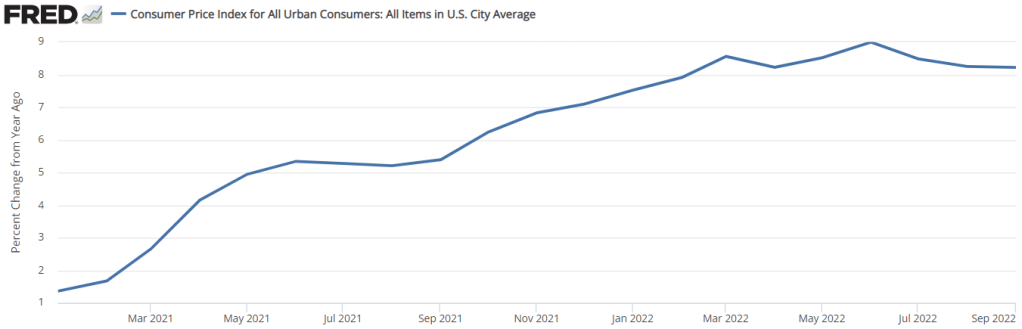
People were all excited last week when the CPI numbers were released because… the year-over-year rate of inflation did a whole lot of nothing. See below. The 12-month rate of inflation was practically constant. The 8.2% number was all over the headlines and twitter. We already know that news outlets don’t always report on the most relevant numbers. And I say that this is one of those times.

https://fred.stlouisfed.org/graph/?g=UQ4T

First of all, there is a problem with the year-over-year indicator. Well, not so much problem in the measure itself, but more a problem of interpretation. The problem is that the 12-month rate of inflation is the cumulative compound rate for 12 individual months. Each month that we update the 12-month inflation rate, we drop a month from the back of the 12-month window and we add a month to the front of the 12-month window. Below are both a graph and a table indicating the monthly rate of inflation and the 12-month periods ending in August 2022 (pink) and in September 2022 (green).

Continue reading

Should Virologists Regulate Themselves?

Last Friday a group of researchers mostly from Boston University posted a paper which revealed they had created a new chimeric coronavirus and used it to infect mice.

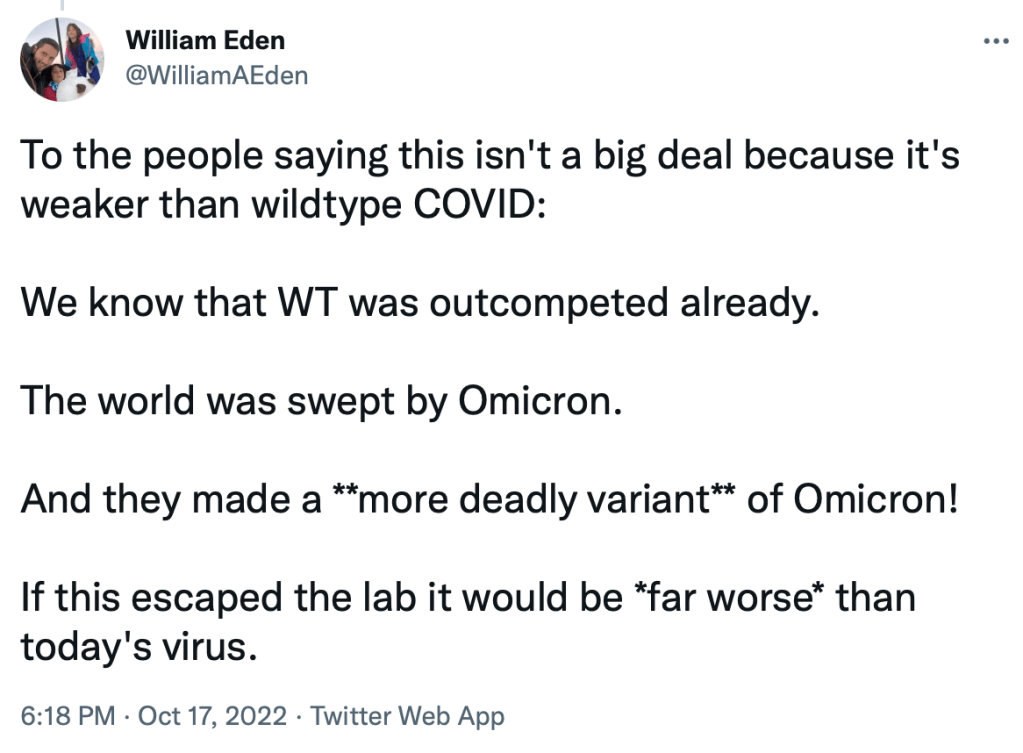
We generated chimeric recombinant SARS-CoV-2 encoding the S gene of Omicron in the backbone of an ancestral SARS-CoV-2 isolate and compared this virus with the naturally circulating Omicron variant. The Omicron S-bearing virus robustly escapes vaccine-induced humoral immunity, mainly due to mutations in the receptor-binding motif (RBM), yet unlike naturally occurring Omicron, efficiently replicates in cell lines and primary-like distal lung cells. In K18-hACE2 mice, while Omicron causes mild, non-fatal infection, the Omicron S-carrying virus inflicts severe disease with a mortality rate of 80%. 

Many people who heard about this expressed concern that the risk of creating more contagious and/or deadly versions of Covid that could escape from a lab outweigh any potential benefits of what we could learn from this research.

Several researchers have responded to these concerns with variants of “trust virologists to weigh the risks here, they know more than you.”

Don’t tell us virologists how to do our jobs; tell farmers, hunters, and veterinarians how to do theirs

Here’s the thing: the virologists do know the risks better than the public or potential regulators- but they also have different incentives. What I want to point out today is that virology isn’t special; this is true of just about every field. A nuclear engineer knows much more about what’s happening at their plant than voters do, or distant bureaucrats at the Nuclear Regulatory Commission. Should we leave it to the engineers on site to decide how much risk to take? Should federal regulators leave it to the financial experts at Bear Sterns and AIG to decide how much risk they can take?

To some extent I actually sympathize with these critiques; industry practitioners really do tend to have the best information, and voters often push regulatory agencies to be insanely risk-averse. With any profession this information problem is a reason to regulate less than you otherwise would, and/or pay to hire expert regulators.

But externalities are real- the practitioners who have the best information use it to promote their own interests, which tend to differ from the interests of the public. In finance this means moral hazard at best and fraud at worst (who are you to say Bernie Madoff is a fraud? You know more about finance than him?). In medicine it means doctors who get paid more for doing more; they gave the guy who invented lobotomies a Nobel Prize in Medicine. In research that involves creating new viruses, researchers get the private benefits of prestige publications for themselves, but the increased pandemic risk is shared with the whole world. In this case its not just outsiders who are concerned, some subject-matter experts are too (and not just “usual suspects” Alina Chan and Richard Ebright; see also Marc Lipsitch).

The main current check on research like this is supposed to be Institutional Review Boards. The chimeric Covid paper notes “All procedures were performed in a biosafety level 3 (BSL3) facility at the National Emerging Infectious Diseases Laboratories of the Boston University using biosafety protocols approved by the institutional biosafety committee (IBC)”. But there are many problems with this approach. The IRB is run by employees of the same institution as the researcher, the institution that also claims a disproportionate share of the benefits of the research.

IRBs are also incredibly opaque. The paper claims it was approved by Boston University’s institutional biosafety committee, but these committees don’t maintain public lists of approved projects; I e-mailed them Sunday to ask if they actually approved this project and they have yet to respond. There is also no public list of the members of these committees, although in BU’s case you can get a good idea of who they are by reading the meeting minutes. This chimeric Covid proposal appears to have been reviewed as the second proposal of their January 2022 meeting, reviewed by Robert Davey and Shannon Benjamin and approved by a 16-0 vote of the committee. During the January meeting the committee approved all 6 projects they considered unanimously, after hearing 6 reports of lab workers at BU being exposed to lab pathogens in the previous month, e.g.:

MD/PhD student reported experiencing low grade temperatures and other symptoms after he accidentally injured his thumb percutaneously on 12-6-21 while cleaning forceps that he had used to remove infected lungs from mice injected with NL63 virus

IRBs are supposed to protect research subjects from harm, but in practice largely serve to protect their institutions from lawsuits and PR disasters (part of why they’re often too strict). The fact that this did get institutional approval provides one silver lining here; if this chimeric Covid ever did escape and cause an outbreak, those infected by it could potentially sue for damages not only the individual researchers, but Boston University and its $3.4 billion endowment. Being able to internalize externalities in this way is one of many good reasons to be testing those infected with Covid to see what variant they have.

I think we should at least consider stronger national regulations against research like this, rather than leaving each decision to local institutional review boards (ask any researcher how much they trust IRBs). At the very least we should stop subsidizing it; NIH claims they don’t fund “gain of function” research like this, but the researchers who made a new version of Covid conclude their paper:

This work was supported by Boston University startup funds (to MS and FD), National Institutes of Health, NIAID grants R01 AI159945 (to SB and MS) and R37 AI087846 (to MUG), NIH SIG grants S10- OD026983 and SS10-OD030269 (to NAC)

Mortgage Affordability Since 1971

Mortgage interest rates are climbing quickly, while housing prices are still mostly high. These factors combined means that it is much more expensive to buy a home than in the recent past. But how much more expensive? And how does this compare with the past 50 years of history?

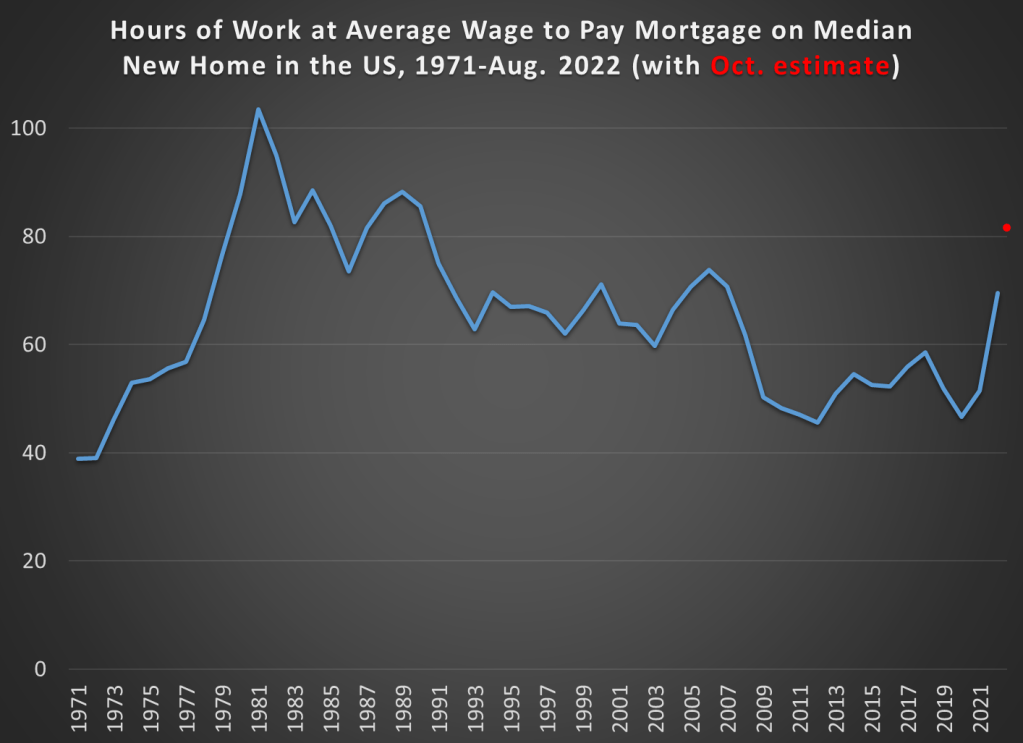
The chart below is my attempt to answer those questions. It shows the number of hours you would need to work at the average wage to make a mortgage payment (principal and interest) on the median new home in the US.

My goal here was to provide the most up-to-date estimate of this number consistent with the historical data. Thus, I had to use average wage data rather than median wage data, since the median hourly wage data is not available for 2022 yet. But as I’ve discussed before, while median and average wages are different, their rate of increase is roughly the same year-to-year, so it would show the same trends.

The final point plotted on the blue line in the chart is for August 2022, the last month for which we have median home price data, average wage data, and 30-year mortgage rates. Mortgage rates are the yearly average (or monthly average in the case of August 2022).

You’ll also notice a red dot at the very end of the series. This is my guess of where the line will be in October 2022, once we have complete data for these three variables (right now only mortgage rates are available in October for the three series I am using). I’m doing my best here to provide as much of a real-time picture as possible, given that rates are rising very sharply right now, while still providing consistent historical comparisons. If that estimate is roughly correct, mortgage costs on new homes are now less affordable than any year since 1990.

What do you notice in the chart?

Continue reading