I’m finally watching the Ken and Sarah Burns documentary on Da Vinci. It is, predictably, excellent. If you are heavily read on Da Vinci then there probably isn’t much that will be new to you, but the visual composition really adds something to what is less a propulsive story and more an attempt to capture the raw capaciousness of this person’s mind. It’s breathtaking, humbling, and inspiring.
There is a temptation to marvel at his dedication, ability to learn, and breadth. To relegate his accomplishments to the realm of outlier genius. Fight that temptation. Instead, take a moment to consider how dedicated he was to being unencumbered. To finding projects and patrons that would service to subsidize his pursuits in totality.
More than anything, observe a brilliant person for whom both the prospect and opportunity of boredom led him to follow his curiousity into whatever intellectual avenues it wanted to pursue, and then turning his imagination into product manifest in text and on canvas.
Boredom is an opportunity we increasingly don’t afford ourselves nearly enough of. We are starved for boredom. Allow for its sustenance.
The US Department of Health and Human Services has announced it is cutting 10,000 of its 82,000 jobs and restructuring:
As part of the restructuring, the department’s 10 regional offices will be cut to five and its 28 divisions consolidated into 15, including a new Administration for a Healthy America, or AHA, which will combine offices that address addiction, toxic substances and occupational safety into one central office.
AHA will include the Office of the Assistant Secretary for Health, the Health Resources and Services Administration, the Substance Abuse and Mental Health Services Administration, Agency for Toxic Substances and Disease Registry, and the National Institute for Occupational Safety and Health.
These divisions do many different jobs, but as usual what stands out to me is their data- both because it is what I have found directly useful in the past, and because it is what I still have some control over now. Writing your Representatives or writing an op-ed has a minuscule chance of changing Federal policy, but if you download data, you definitely have that data.
What worries me here is that some of the agencies being consolidated might discontinue some of their data products going forward, or even pull some of what they have already created offline. I don’t think this is farfetched given what has happened so far, and given that even in good times these agencies pull down data they painstakingly prepared. For instance, HRSA only publicly posts the State- and County-level Area Health Resources File back to 2019, even though they have annual data going back to 2001.
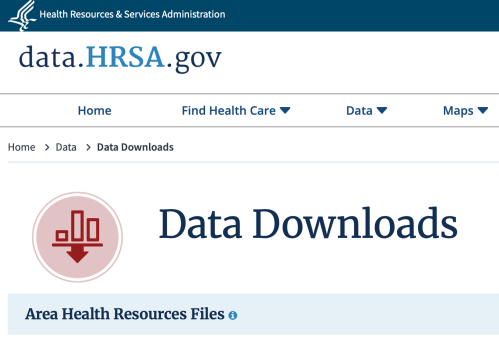
Probably all 13 of the reorganizing divisions have data worth looking into, and given the staff cuts, even data products in the other divisions could be at risk. But my plan is to focus on the two reorganizing divisions whose data I have previously found useful- HRSA and SAMHSA. HRSA has a nice data download page with 16 different datasets, including the Area Health Resources File, which offers detailed information on the health care workers and facilities in each US county. SAMHSA offers the National Substance Use and Mental Health Services Survey, the Treatment Episode Data Set, and the National Survey of Drug Use and Health. I have previously cleaned and archived the state-level version of the NSDUH, but not the individual-level version that is for now still available from SAMHSA.
All of these datasets are easy to download now, and some will probably become very hard to access later, so now is a good time to take a few minutes and save whatever you think you might need.
An Al Jazeera talk show called The Steam asked me to join a discussion on fast fashion as the contrarian or as “the economist.” The found me because of the my article “Fast Fashion, Global Trade, and Sustainable Abundance”
Katia Osei – lead researcher and bioengineer, Or Foundation
Joy Buchanan – associate professor, Samford University
I am a small part of the 25-minute show. You can hear me from about minute 9:20 to 11:35 and then at the end from 23:30 to 24:45.
The points I made are that “fast” fashion has a good side for consumers, even though people are worried about the environmental impact of clothing waste. I got a few seconds to talk about my ideas for solutions which include labels about clothing durability and AI help with sorting. At the end I said that, as people become more aware of the downsides of fast fashion, we could stop putting social expectations on each other to wear a new outfit to every party and buy a custom shirt for every club event.
The historical US Census roles of disability among free persons are a mess. Specifically for the 1850-1870 censuses, the census bureau was not professionalized and the pay was low (a permanent office wasn’t founded until 1902). So, the enumerators were temporary employees and weren’t experts of their art. To boot, their handwriting wasn’t always crystal clear. Second, training for disability enumeration was even less complete and enumerators did their best with whom they encountered and how they understood the instructions. Finally, the digitized data in IPUMS doesn’t perfectly match the census reports. What a mess.
Guilty by Association
Disabled people and their families often misreported their status out of embarrassment or shame. Given that enumerators had quotas to fill, they were generally not inclined to investigate claimed statuses strenuously. Furthermore, disabled people were humans and not angels. Sometimes they themselves didn’t want to be associated with other types of disabled people. In particular, the disability designation in question (13) on the 1850 census questionnaire asked “Whether deaf and dumb, blind, insane, idiotic, pauper or convict”. Saying “yes” may put you in company that you don’t prefer to keep.
The enumerator’s job was to write the disability that applied. What counts as deaf and dumb? That’s largely at the enumerator’s discretion. Some enumerators wrote ‘deaf’ even though that wasn’t an option. Was that shorthand for ‘Deaf and Dumb’? Or were they specifying that the person was deaf only and not dumb? We don’t know. But we do know that they didn’t follow the instructions. What if a person was both insane and blind? Then what should be written? “Blind/Insane” or “Blind and Insane” or “In-B” and any number of combinations were written. Some of them are easier to read than others.
Data Reading Errors
IPUMS is the major resource for using census data. The historical data was entered by foreign data-entry workers who didn’t always speak English. So, the records aren’t perfect. Some of the records are corroborated with Optical Character Recognition (OCR), but the historical script is sometimes hard to read. Finally, the fine folks at familysearch.org and Brigham Young University have used Church of Latter Day Saints (LDS) volunteers to proof data entries. Regardless, we know that the IPUMS data isn’t perfect and that the disability data is far from perfect. Usually, reports don’t dwell on it. They simply say that the data is incomplete.
The disability data is incomplete for a lot of reasons related to the respondent, the enumerator, the instructions, and the digital data creation. What a mess.
Certificate of Need laws require many types of health care providers to obtain the permission of a state board before they are allowed to open or expand in many US states. But there is a lot of variation from state to state in which types of providers are covered by these laws. I put together this map to show the 15 states that require new home health care agencies to obtain a Certificate of Need:
CON states see reduced competition, which tends to be bad news for patients and new entrants, but good for existing providers and the private equity firms consideringbuying them.
But some CON states like Rhode Island have proposed reforms that would exempt home health agencies from the CON process, putting them in line with the majority of states that put new entrants on an even footing with incumbent providers.
For your upcoming summer road trips, even with a family, I recommend you check out the Acquired podcast. Each episode is the history (or partial history) of one business, told in a way that is entertaining and informative on many levels.
I was first introduced to the podcast when someone recommended the episode on Costco. It’s 3 hours long. I thought to myself “Really? I’m interested in Costco, but isn’t 3 hours a bit much?” But I had a long road trip, so I gave it a try. I was floored by how much I learned about Costco, the history of retail in the US, and the connections to other businesses. For example, Sam’s Club, which I thought was just kinda doing the same thing as Costco in different geographic areas, but no — Sam Walton copied Costco, as well as many other ideas from Sol Price (what a great name for a retailer!), the man behind the companies that would eventually become Costco today.
If you are at all interested in the history of business (especially mid-to-late Twentieth century businesses, though they do have one on Standard Oil), you will love this podcast. But I have found that the podcast is also great for children — well, at least if you have a roughly eleven-year-old boy. They will have many questions, so you may stop the podcast often, but that’s OK with me.
I think the reason some of the episodes appeal to children is because many of the stories focus on a single entrepreneur that started a business, and the hosts always spend a little bit of time on the childhood of those entrepreneurs. Often, they were entrepreneurial or innovative in some way as a child. For example, Warren Buffett in the first Berkshire Hathaway episode (there are 3 episodes on BH, totaling over 9 hours!), selling sticks of gum and cans of Coke door-to-door. Or Ingvar Kamprad (founder of IKEA, told in a 3-hour episode) selling matchboxes and fountain pens. Or the young Bill Gates being privileged enough in middle school to have access to computers, but also turning this into a business in high school (told in the first of two episodes on Microsoft, totaling once again over 9 hours).
As I mentioned in the above paragraph, if you thought that 3 hours on Costco was a lot, just wait until you listen to some of the others. You probably can’t imagine yourself listening to 9 hours on the history of a single company, much less your kids following along too. But I highly recommend that you give it a shot.
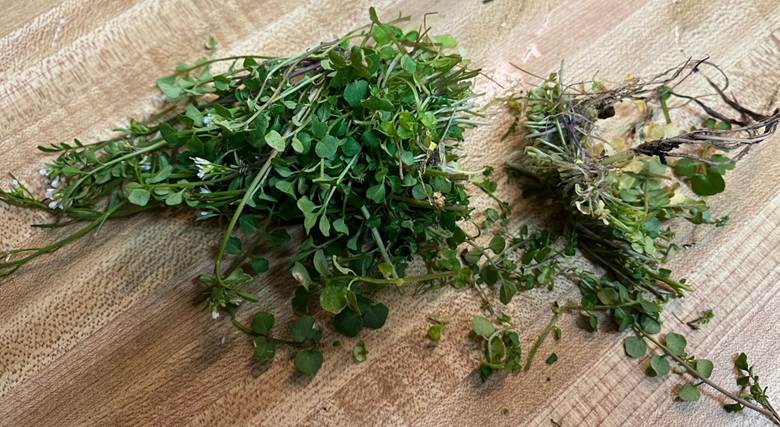
A number of weeds growing around your house are edible. Chickweed (Stellaria media) is found in lawns and random areas in cooler climates. It pops out ahead of most other plants in the spring, though it also grows year-round.
It can grow low, hiding in the grass, but it is easier to harvest as a taller standalone clump. Here is a clump from my yard, with the roots and tougher lower parts cut off:
People eat it raw, but I prefer to blanch it first to reduce any bitterness and to get rid of any critters or contaminants. To do that, I got two cups of water boiling in a Pyrex measuring cup, then dropped the chickweed in and stirred it around for a minute, followed by a cool water quench in a colander. The chickweed was then in a wilted state, but still green and crunchy and (as I understand) retaining nearly all its nutrients.
For me, chickweed functions like arugula or cilantro or Italian parsley, as an interesting and worthwhile addition to a salad or sandwich. I would not relish a whole plate of it.
Speaking of nutrients, in folk medicine chickweed is credited with amazing powers. Eat The Planet tells us that:
Chickweed is full of vitamins A, B1, B2, and C as well as fiber and protein. Due to its nutritional contents and numerous medicinal properties, this cold-weather herb has been used in folk medicine for hundreds of years. It can treat many different conditions, such as constipation, bowel problems, iron-deficiency anemia, asthma, bronchitis, joint pains, and blood disorders. It can also aid weight loss by making you feel fuller for longer.
You can also apply the herb directly onto the skin to treat itchiness, bruises, boils, ulcers, and psoriasis. To do this, you can either bruise the leaves or steep the stems in hot water before applying them directly onto the affected areas.
There is no indication that any of the plant’s constituents possess therapeutic activity. Its vitamin content is too low to be of therapeutic value.
Verywellhealth stakes out a middle ground, noting that chickweed has demonstrated significant anti-inflammatory and anti-viral activity in lab experiments with animals, but also noting that these results may or may not translate to efficacy in humans:
Juice or extracts made from chickweed have been studied in test tubes or mice models for the following conditions:
Hepatitis B. Chickweed was shown to have anti-hepatitis B virus activity in a test tube study.
Obesity. Chickweed extract given to overweight mice decreased the amount of food they consumed and their absorption of fats.
Diabetes. Chickweed leaf extract demonstrated antidiabetic effects, such as lowering blood sugar and hemoglobin A1c in mouse models.
Heart problems in people with diabetes. Chickweed tea given to diabetic rats did not improve their blood sugar levels but did seem to protect against cardiomyopathy.
Anxiety. Chickweed given to mice showed similar activity as diazepam, a classic anxiety medication in the benzodiazepine family.
“In a room sit three great men, a king, a priest, and a rich man. Between them stands a sellsword. Each of the great ones bids him slay the other two. Who lives and who dies?”
…“Power is a curious thing, my lord. Perchance you have considered the riddle I posed you that day in the inn?” “It has crossed my mind a time or two,” Tyrion admitted. “The king, the priest, the rich man—who lives and who dies? Who will the swordsman obey? It’s a riddle without an answer, or rather, too many answers. All depends on the man with the sword.” “And yet he is no one,” Varys said. “He has neither crown nor gold nor favor of the gods, only a piece of pointed steel.” “That piece of steel is the power of life and death.” “Just so… yet if it is the swordsmen who rule us in truth, why do we pretend our kings hold the power? Why should a strong man with a sword ever obey a child king like Joffrey, or a wine-sodden oaf like his father?” “Because these child kings and drunken oafs can call other strong men, with other swords.” “Then these other swordsmen have the true power. Or do they?” Varys smiled. “Some say knowledge is power. Some tell us that all power comes from the gods. Others say it derives from law. Yet that day on the steps of Baelor’s Sept, our godly High Septon and the lawful Queen Regent and your ever-so-knowledgeable servant were as powerless as any cobbler or cooper in the crowd. Who truly killed Eddard Stark, do you think? Joffrey, who gave the command? Ser Ilyn Payne, who swung the sword? Or… another?” Tyrion cocked his head sideways. “Did you mean to answer your damned riddle, or only to make my head ache worse?” Varys smiled. “Here, then. Power resides where men believe it resides. No more and no less.” “So power is a mummer’s trick?” “A shadow on the wall,” Varys murmured, “yet shadows can kill. And ofttimes a very small man can cast a very large shadow.” Tyrion smiled. “Lord Varys, I am growing strangely fond of you. I may kill you yet, but I think I’d feel sad about it.”
My first reaction is that, at the current state of technology, I feel like wishing for more IVF on women is cruel. If someone you love has gone through it, you wouldn’t wish it on more people. Supporting the careers of women who want to have children while they are young seems preferable and lower cost to society. The problem is that supporting mothers is a tricky collective action problem, so we seem stuck with this.
“The egg freezing process is also expensive, costing between $8,000 to $15,000 per cycle. Fortunately, more and more women are being covered by insurance plans that offer free egg freezing. According to a 2021 survey, 20 percent of American companies with over 20,000 employees and 11 percent of smaller companies offer such benefits – an increase from six and five percent respectively in 2015. But most women still have to pay out of pocket.” $15,000 is sort of a lot. It’s cheaper than a year of paid maternity leave for a PhD student, but the total cost of a “medical baby to an older couple” is pretty high.
Some of the technology Rux described was new to me and encouraging. If babies and birth becomes much more medicalized (and civilization doesn’t end), then I could imagine a world where most couples look like Simone and Malcolm Collins by choice with designer babies on demand after having a carefree childfree decade.
“The main advantage of IVM is that it allows immature eggs to be collected instead of mature ones, which significantly reduces the burden of hormonal stimulation.” Exciting! Think of how far we’ve come with cancer treatments or treating AIDS. If enough research goes into this, then potentially the cutting, injecting, pill popping hell that women have to go through for IVF could become smaller and more focused on exactly what is near certain to work.
Someone’s going to come along and grumble and say nature is better, but recall from earlier: “Supporting the careers of women who want to have children while they are young seems preferable and lower cost to society. The problem is that… “
On an optimistic note, I am witnessing a beautiful success story of embryo adoption among my relatives. It worked. A wonderful couple has twins now, and those twins are experiencing love and contact from both their birth family and genetic parents. That technology only became available in the late ’90s. Expect more stories like this.
We might even be close to AI childcare that works. Imagine a daycare where robots do 100% of the food and cleaning work so that the humans in the room can focus exclusively on emotional and relational work with the kids. That could make daycare better or cheaper or both.
The simple technology of food and grocery delivery has already helped parents. The founder of Shipt, Bill Smith, got the idea for grocery delivery by experiencing how hard it is to do grocery shopping with his young children. Guess what? We don’t have to take toddlers to the grocery store anymore, unless we want to.
Here I’ll outline a model of the optimal protein consumption bundle. What does this mean? This means consuming the quantities of protein sources that satisfy the recommended daily intake (RDI) of the essential amino acids and doing so at the lowest possible expenditure. Clearly, this post includes a mix of both nutrition and economics. Since a comprehensive evaluation that includes all possible foods would be a heavy lift, here I’ll just outline the method with a small application.
Consider a list of prices for 100 grams of Beef, Eggs, and Pork.* We can also consider a list that identifies the quantity that we purchase in terms of hundreds of grams. Therefore, the product of the two yields the total that we spend on our proteins.
Of course, not all proteins are identical. We need some characteristics by which to compare beef, eggs, and pork. Here, I’ll use the grams of essential amino acids in 100 grams of each protein source. Because there are different RDIs for each amino acid, I express each amino acid content as a proportion of the RDI (represented by the standard molecular letter).
Then, we can describe how much of the RDI of each amino acid that a person consumes by multiplying the amino acid contents by the quantities of proteins consumed.
Our goal is to find the minimum expenditure, B, by varying the quantities consumed, Q, such that the minimum of C is equal to one. If the minimum element of C is greater than one, then a person could consume less and spend less while still satisfying their essential amino acid RDI. If the minimum element is less than one, then they aren’t getting the minimum RDI.
How do we find such a thing? Well, not algebraically, that’s for sure. I’ll use some linear programming (which is kind of like magic, there’s no process to show here).
The solution results in consuming only 116.28 grams of Pork and spending $1.093 per day. The optimal amino acid consumption is also below. Clearly, prices change. So, if eggs or beef became cheaper relative to pork, then we’d get different answers.
In fact, we have the price of these protein sources going back almost every month to 1998. While pork is exceptionally nutritious, it hasn’t always been most cost effective. Below are the prices for 1998-2025. See how the optimal consumption bundle has changed over time – after the jump.





 Economist Writing Every Day