My children are getting more capable. They get more responsibility that comes with the independence that capability implies. Specifically, when getting ready in the morning they like to leave so that they arrive at school just barely on time. Except, when something comes up, they are rushed, flustered, short-tempered, and tardy. They lament that “if only the unforeseeable event X hadn’t happened, I would have been on time”.
It doesn’t matter what X is. Maybe they forgot to pack a lunch, or set out their clothes, or they have a flat tire on their bikes, or… whatever. The specific time-consuming event is unforeseeable. But, that *any* time-consuming event will occur is very foreseeable. What’s a Bayesian to do?
Before we even start the analysis, let’s acknowledge that being perfectly on time for some event usually involves stress and a lack of preparedness. Yes, you were ‘on time’, but given the probability of heavier traffic, difficulty finding a parking spot, or whatever, we know that tardiness is just one unforeseen event away.
Individual Punctuality
How long does it take to get somewhere? It takes both travel time and time preparing to depart. Let’s just generally call this ‘preparation’ time. Let’s assume that you complete everything that you would complete. That means that you aren’t forgoing a shower or breakfast or whatever lower priority you might choose to forgo to arrive at some obligation punctually.
Random events can occur either as you travel to work or as you prepare to depart, but let’s place the random travel events to the side and focus on what one can do to get out of the house ‘on time’. In my personal case, my children have a 30min interval during which they can arrive at school. They almost never arrive in the first 15min of that interval. That’s more of a policy choice than an accident. They don’t want to sit in a cold gymnasium for 20min if it’s avoidable. So, their planned arrival time has an effective 15min window.
Here is the problem. A time-consuming random event, X, is a right-skewed random variable. Discretely, the modal day includes X=0min. Though the most common delays are greater than 0min. See the distribution below. A 0min random event occurs 35% of the time. But, a time-consuming event happens 65% of the time. So, if you try to arrive exactly on time to your obligation, then you will be punctual 35% of the time and you will be tardy 65% of the time. That’s not a good look and not a good reputation to build – and that’s apart from building a habit of imprudence and the material consequence of not being ready for the task at hand.
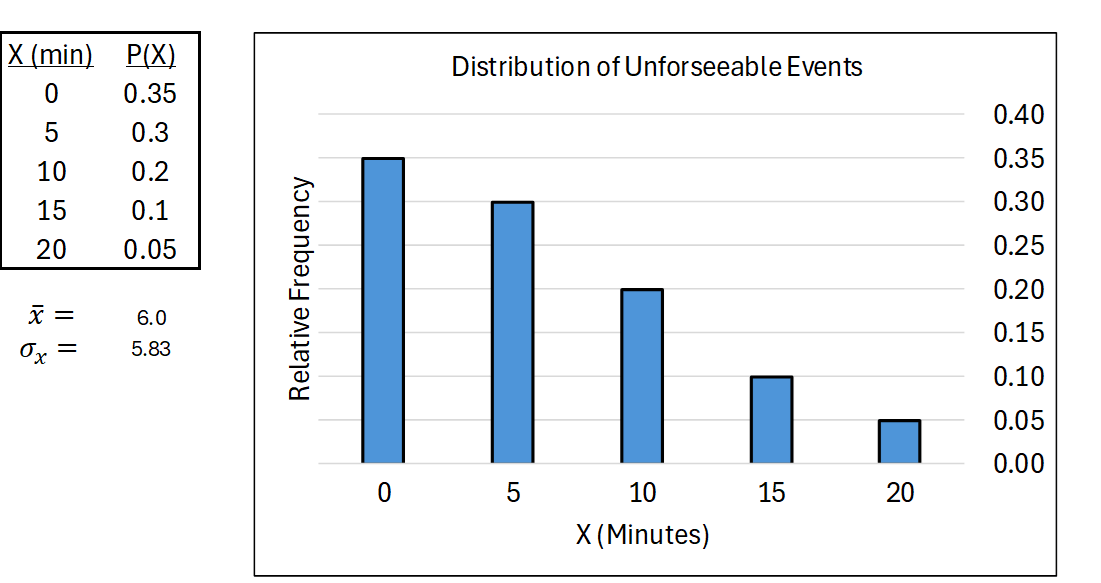
Someone with just enough insight to be dangerous might say ‘Ah! Instead, leave with enough time to accommodate the expected unforeseen event’. Mathematically, that’s the weighted average. In this case, that’s six minutes. So, if you plan to arrive 6min early, then you will be punctual – on average. But even that’s not really what we’re after. We’d like to be on time for a preponderance of the days. Building in a 6-minute buffer does two things. 1) Every time that there is a 0min or 5min unforeseen event, you get to your destination 6min or 1min early. That’s good for your nerves, performance, and reputation. But, that also means that you’re late whenever there is a 10min, 15min, or 20min unforeseen event – and those occur 35% of the time!

There are tradeoffs. One solution is to always try arriving to places 20min early. You’d never be late, but you may also not be spending your time well. After all, time is valuable and you want to spend it as if it’s valuable – not just sitting around waiting on others.* The prudential decision is to choose a threshold, accepting that you will be late some proportion of the time. How often you’re late and by how much requires a lot of context that I won’t address here.
So, when my kids are getting ready for the day and lament the unforeseen events that cause them stress and delay, I want to communicate this lesson to them. The specific unforeseen events are certainly unknown. But the general character of how time-consuming those events are is not unknown and it can be accommodated by building the habit of arriving early. That’s the heuristic that prevents us from having to engage in costly mental arithmetic. Just try to be early, almost always (but not always).
Family Punctuality
Living near a Catholic university, I know a lot of families with many children. Four children is pretty standard. More is not unusual. Double digits is unsurprising. Some, not all, of those families have a heck of a time arriving to places punctually. That’s because the arithmetic of punctuality changes when you introduce other people, each of whom is susceptible to the random, unforeseen events that consume Xmin. If each of these events has to be addressed in series, maybe because the parents need to step in, then we can sum the distributions. Assuming the Xs are independent, to get the relative frequency distribution we need to find

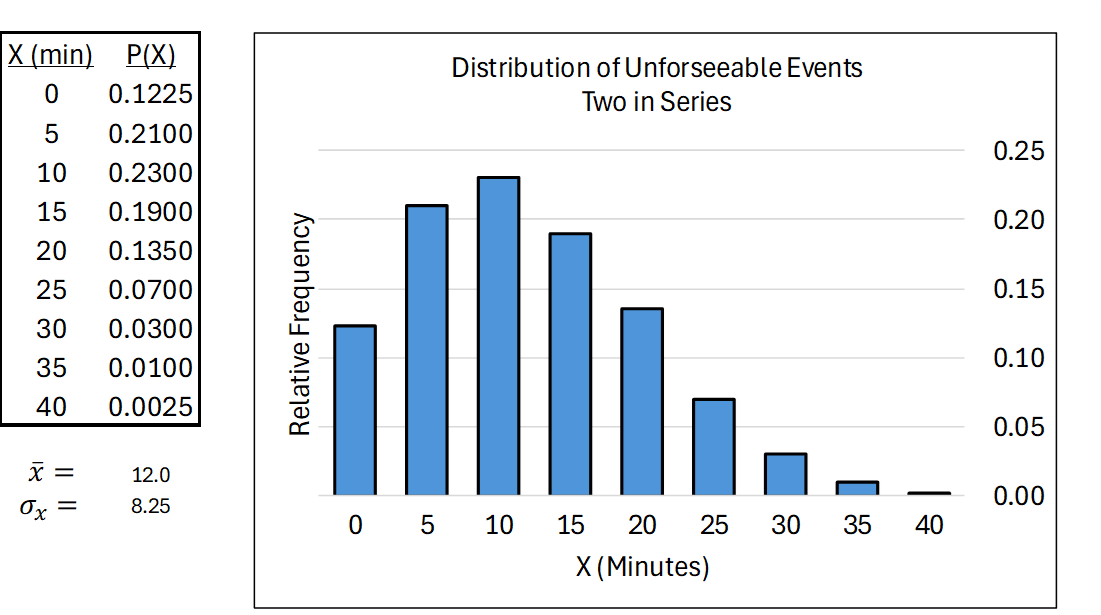
With two independent unforeseeable events that must be addressed in series, the new expected delay doubles from 6min to 12min. But the probability of no delay drops from 35% to 12.25%. Zero delay ceases to be the modal outcome, which is now 10min with a 23% probability. Families with many small children are more likely to be late. We might be tempted to argue ‘No. They should just leave 6+6 minutes early.’ While that would cause them to arrive punctually on average, it ignores that the spread of the distribution has also changed. Leaving 12min early results in punctuality only when there is a 0min, 5min, or 10min unforeseeable event. Those occur 56.25% of the time, implying that tardiness occurs 43.75% of the time! Increase the number of small children, and the spread of the distribution increases even more.
It’s possible that when there are similar types of unforeseeable events that the total time is not simply additive. For example, if two children forgot to pack their lunch, then economies of scale can reduce average time of X so that the total amount of time is somewhere between 1x and 2x.
What to do?
We can keep playing the game of trying to calculate the appropriate time to start getting ready and depart. But, the variance gets so big that the amount of time needed to arrive early becomes unrealistic. Instead, we can endogenize the probability of unforeseeable events. All we have to do is get ready systematically – way ahead of time. Setting out your clothes the night before reduces the probability of searching for clothes immediately prior to departure from something, say, a 30% likelihood to a 5% likelihood. In addition, the time required for looking for a single pair of socks is probably less than the time needed to find an entire outfit.
So, the final answer requires a two-pronged strategy. 1) Plan to arrive early and increase that buffer as more things can go wrong (with more people). 2) Compress probability distribution by preparing departure prerequisites way ahead of time before it’s even remotely close to departure time. This looks different for everyone.
We’ve tried having our children wear their school uniforms to bed. We’ve tried having them set out their clothes the day prior. But they would “accidentally” swap components and strife would ensue. Now, we have them make ‘sushi’, wherein they lay out their clothes and then roll them up into nice compact ‘sushi’ rolls so that nobody loses anything. It’s working pretty well for us.
The remaining bane of morning routines is the behavioral adjustment to having more time. Having prepared well the night prior, my kids will leisurely eat their breakfast and begin playing when they should be brushing their hair and teeth. They recognize that their time-budget is larger, and so afford more time goofing off.
I’m open to further suggestions.
*One nice feature of arriving early is that other people are often able to see you and begin the event early. I routinely arrive early for various appointments because the other person can almost always see me early. In part, that’s because other people run late!
 Economist Writing Every Day
I started paying my children a small amount of money every day if they can both be on time for school in the morning and upstairs on time for bed. Since kids respond to very small amounts of money, this might be the best money I’ve ever spent. But I wouldn’t claim that one tip solves every problem for me or for every family. Elites with nannies surely get a lot of their value by making this exact issue someone else’s problem. (does the nanny just do it for them? does that make the child less resilient later?)
LikeLike