Most people have an intuition that uncertainty can harm economic outcomes. Baker, Bloom, & Davis (2016) and Bloom (2009) demonstrated that industrial production and manufacturing decline in the face of policy uncertainty. The typical mechanism that people suggest is that uncertainty about the future causes people to engage in precautionary saving, resulting in fewer sales.
The theory continues that firms consequently decrease production as demand for their output declines. Firms aren’t interested in causing the quantities supplied and demanded to be equal. Rather, they don’t want to produce too many goods that don’t get sold or don’t get sold at an adequate markup. Production is costly. A related theory is that more persistent or longer-run uncertainty can also depress investment, since the riskier future increases the tail risk of losses.
Rather than make a risky investment, one could instead just hold off and wait for some of that uncertainty to get resolved. There’s tradeoffs to this, of course. As future costs and benefits become clearer, they also get priced-in to asset values. So, there is an optimization problem. The possible downside outcome is big and uncertain. If the risk of the investment gets resolved and the downside outcome is still too likely or harmful, then a project manager did the ex-post ‘right thing’ by waiting.
But, if the downside risk disappears or is found to be very small, then waiting to invest in the project incurs an economic cost. Either 1) the profitable project and its associated profits will occur later and less valuably, or 2) other firms also resolve their uncertainty and bid up the price of the project’s inputs. Invest too early, and the downside is large and uncertain. Invest too late, and you may lose the potential upside partially or entirely.
But can uncertainty systematically increase profits?
Walter Oi said yes.
Let’s start with increasing marginal cost and perfect competition. From the firm’s perspective, the firm faces an exogenous price. Simplifying the probability distribution, let’s just say that it’s either low or high. Each price also corresponds to a profit-maximizing quantity. If the demand/price is high, then firms simply produce the high profit-maximizing quantity. Similarly, a low demand/price results in producing the low quantity. That’s all straightforward. It’s MR=MC in the short run – all day, everyday.
Here’s a straightforward detail: Both total variable cost and profits rise convexly. See the below image from Oi’s original 1961 paper. X is the quantity, P is the price, and Y is the producer surplus which roughly translates to profit. Each increase in price adds an increasingly large area of profit – marginal profit is increasing.
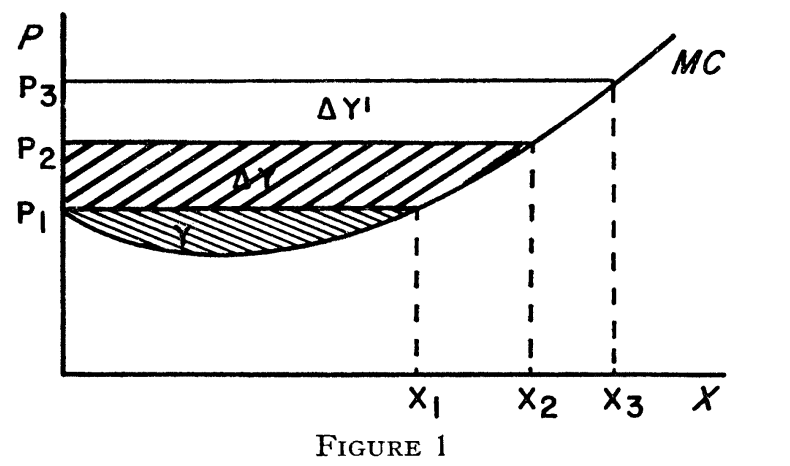
Figure 2 illustrates the correspondence between equilibrium profit and price. If alpha is the probability that that the price is high, then the average profit lies on the below dotted line that reflects the weighted average of profits. Because the profit function is convex, this average profit across periods of high and low prices is greater than the profit if markets were stable! Greater volatility causes *greater* profits in the short run perfectly competitive model! As a matter of conclusion, Oi is careful to emphasize that utility is lower in such a circumstance.

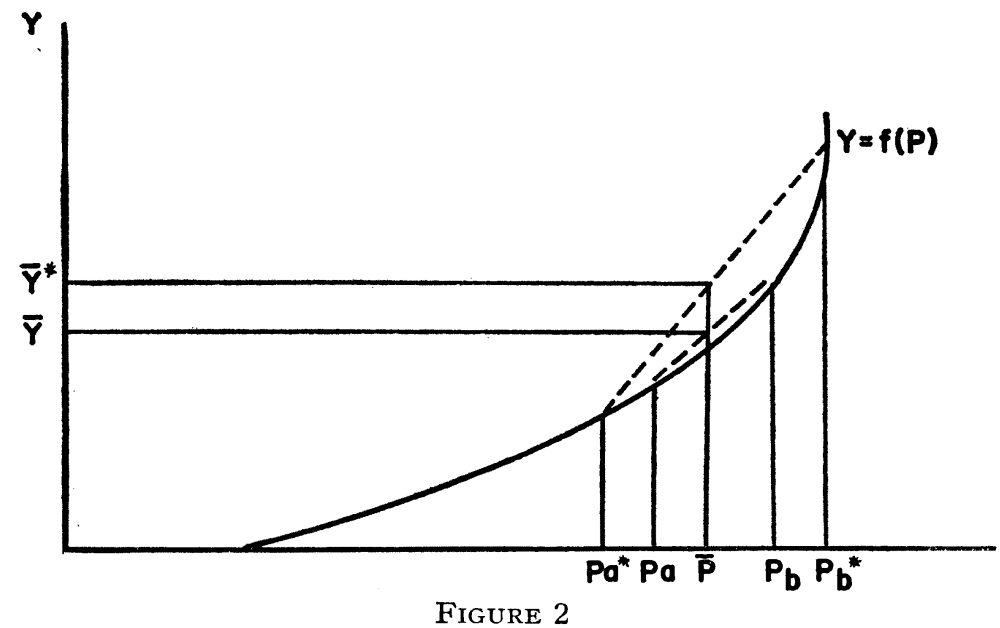
*Note: If the firm chooses the output prior to realizing the market price, then profit is lower than Oi’s finding. But still possibly higher than the case of certainty!
Baker, Scott R., Nicholas Bloom, and Steven J. Davis. 2016. “Measuring Economic Policy Uncertainty.” The Quarterly Journal of Economics 131 (4): 1593–636. https://doi.org/10.1093/qje/qjw024.
Bloom, Nicholas. 2009. “The Impact of Uncertainty Shocks.” Econometrica 77 (3): 623–85.
Oi, Walter Y. 1961. “The Desirability of Price Instability Under Perfect Competition.” Econometrica 29 (1): 58–64. https://doi.org/10.2307/1907687.

