Delta: Danger is Rising, but 2021 is not 2020

Covid cases are rising rapidly in the US thanks to the more contagious delta variant.
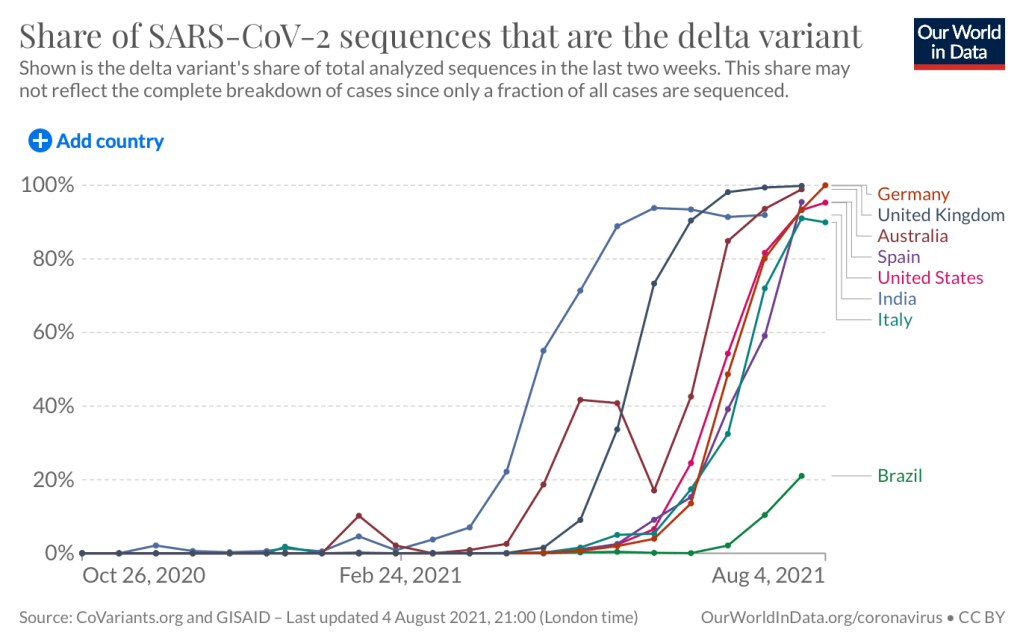
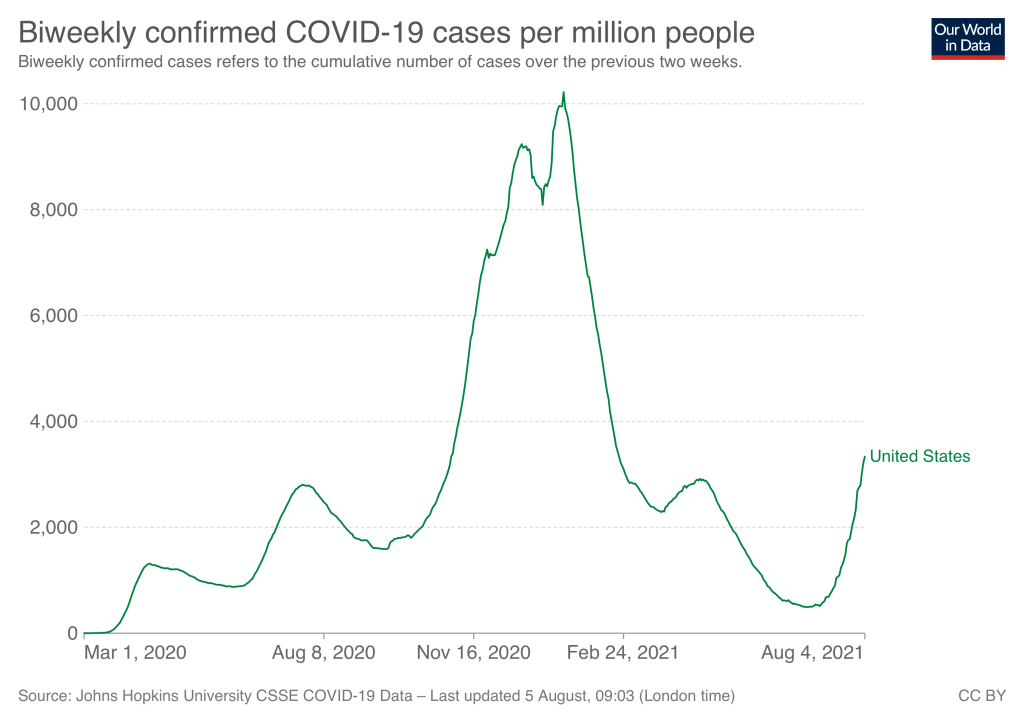
Based on the experience of 2020, this has many states, cities, and organizations considering a return to mask mandates and shutdowns. But our situation in the US has changed substantially since 2020 as we now have better knowledge, better masks, and above all abundant vaccines.

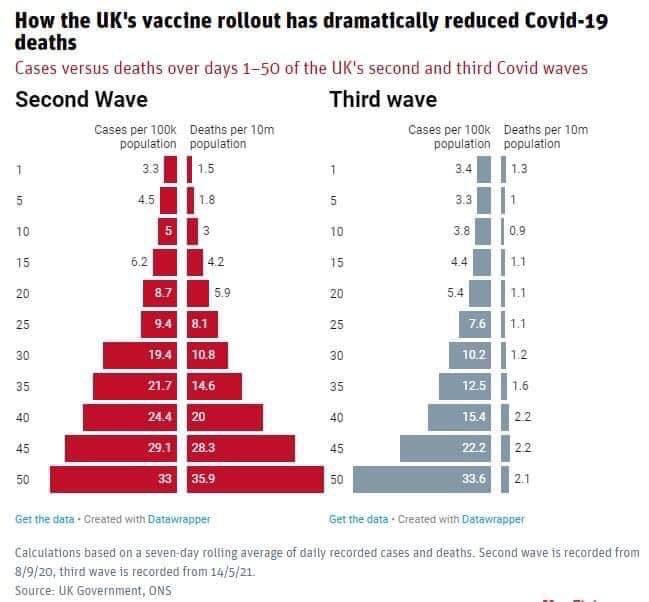
We can see this difference clearly when looking at countries hit by the Delta wave before us. It first devastated India, where less than 10% of the population was fully vaccinated, officially killing 400,000 people and unofficially perhaps 10 times that. In constrast the UK, where more than half the population was fully vaccinated, saw a major spike in cases that did not translate into a major spike in deaths:
The delta waves seem to come and go quickly, with cases rising more rapidly than previous waves, but also falling rapidly 6-8 weeks after they began to rise in India, the UK, and the Netherlands. Cases began rising in the US at the beginning of July, so if this pattern holds we have about 2-4 more weeks of rising cases before a rapid drop.

My worry is that a spike in cases just before the school year will lead schools to shut down just as the danger begins to recede, and when vaccines mean the danger was never as great as in previous waves. Externality-based arguments for shutdowns and mask mandates are now substantially less valid than in 2020 but I don’t know that policymakers have internalized this. The Biden admin actually does seem to get it, calling this a “pandemic of the unvaccinated“- i.e., if you’re worried, get vaccinated, and if other people don’t, that’s their problem. Even with delta the vaccines reduce covid’s danger to you by ~10x, and so also reduce the protection you gain from controlling others by ~10x.

The situation with masks has also changed. Cloth masks have limited effectiveness in protecting you from others, but decent effectiveness in protecting others from you, which meant there was a strong externality-based case for mask mandates. But now in 2021 high-quality KN-95 and even N-95 masks are easily available, and unlike cloth masks they offer excellent protection FROM others, as well as FOR others. Anyone who is vaccinated and wearing an N-95 really has nothing to worry about anymore, and little reason to force masks onto others.

The main externality-based arguments that could still work are for vaccine mandates and for restrictions in areas where hospitals are overwhelmed by unvaccinated Covid patients in a way that substantially worsens care for non-Covid patients. But outside of areas with low vaccination rates leading to overwhelmed hospitals, I no longer see a good case to impose mask requirements or restrictions on movement or events.
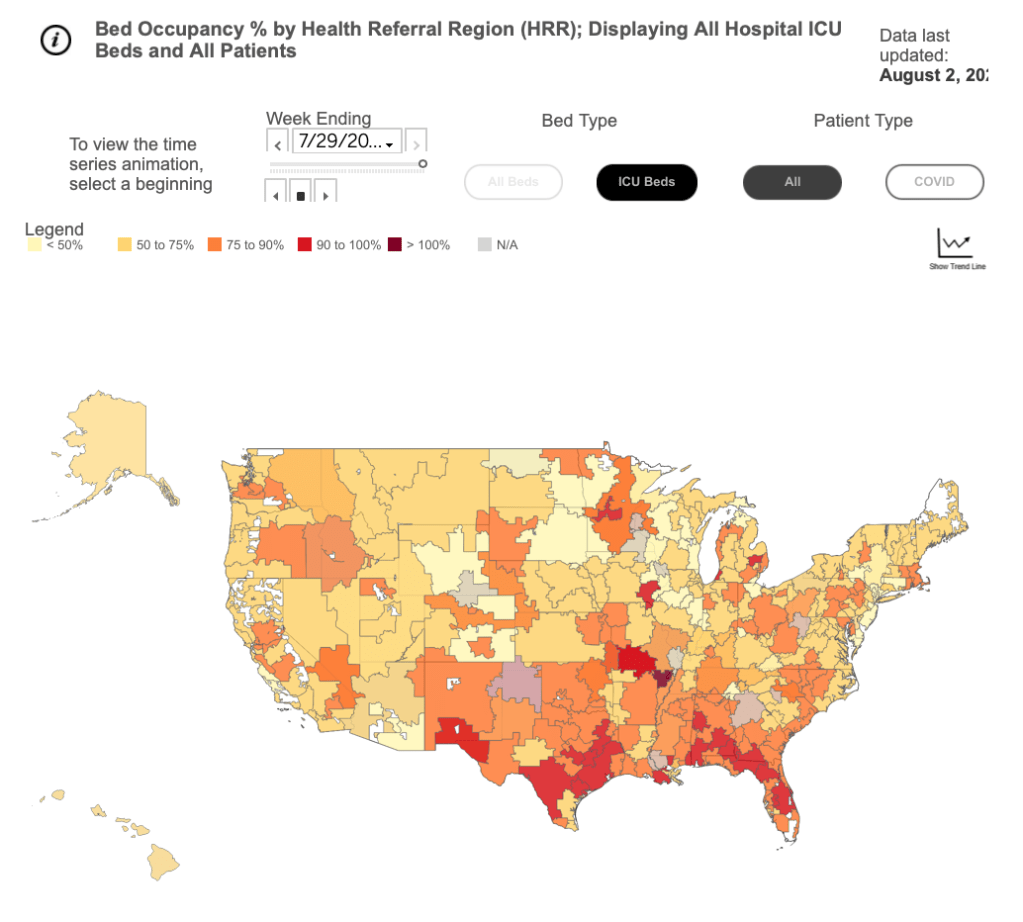
According to one set of projections, by the end of August adult ICUs (though not hospitals overall) will be over capacity in most low-vaccination states:

If you want to wear a mask and avoid crowds, you can, and in fact probably should do at least one of those during the Delta wave of the next month. But the externality-based case for restrictions is mostly gone, and governments would do better to focus on continuing vaccine rollout in the US and ensuring vaccines are available worldwide to help other countries and to prevent more variants from emerging and finding their way here. Personally I’m glad that my employer has a vaccine mandate but, at least currently, no mask mandate. For those who do still want Covid restrictions I ask- what are you waiting for? What event or number would make you say “ok, now we can go back to normal”? When do you expect that to happen? For me, what I was waiting for was vaccines available for everyone and now, at least in the US, we are lucky to have that.

Simone Biles and the Trojan War

When star gymnast Simone Biles decided to sit out the Olympics this week to ‘focus on herself’, both those praising her and those criticizing her seemed to treat this like a unique story that wouldn’t have happened in earlier generations. But it reminds me of one of the oldest recorded stories in the world, one that predates even the first ancient Greek Olympics of 776 BC- Achilles’ decision to sit out the Trojan War.

Here is Biles this week:

We also have to focus on ourselves, because at the end of the day we’re human, too… We have to protect our mind and our body, rather than just go out there and do what the world wants us to do.

Here is Achilles, greatest of the Greek warriors, thousands of years ago:

Him do I hate even as the gates of hell who says one thing while he hides another in his heart; therefore I will say what I mean. I will be appeased neither by Agamemnon son of Atreus nor by any other of the Danaans, for I see that I have no thanks for all my fighting. He that fights fares no better than he that does not; coward and hero are held in equal honour, and death deals like measure to him who works and him who is idle. I have taken nothing by all my hardships- with my life ever in my hand; as a bird when she has found a morsel takes it to her nestlings, and herself fares hardly, even so man a long night have I been wakeful, and many a bloody battle have I waged by day against those who were fighting for their women. With my ships I have taken twelve cities, and eleven round about Troy have I stormed with my men by land; I took great store of wealth from every one of them, but I gave all up to Agamemnon son of Atreus. He stayed where he was by his ships, yet of what came to him he gave little, and kept much himself….

Agamemnon has taken her from me; he has played me false; I know him; let him tempt me no further, for he shall not move me. Let him look to you, Ulysses, and to the other princes to save his ships from burning…. I will draw my ships into the water and then victual them duly; to-morrow morning, if you care to look, you will see my ships on the Hellespont, and my men rowing out to sea with might and main. If great Neptune vouchsafes me a fair passage, in three days I shall be in Phthia. I have much there that I left behind me when I came here to my sorrow, and I shall bring back still further store of gold, of red copper, of fair women, and of iron, my share of the spoils that we have taken; but one prize, he who gave has insolently taken away. Tell him all as I now bid you, and tell him in public that the Achaeans may hate him and beware of him should he think that he can yet dupe others for his effrontery never fails him.

As for me, hound that he is, he dares not look me in the face. I will take no counsel with him, and will undertake nothing in common with him. He has wronged me and deceived me enough, he shall not cozen me further; let him go his own way, for Jove has robbed him of his reason. I loathe his presents, and for himself care not one straw. He may offer me ten or even twenty times what he has now done, nay- not though it be all that he has in the world, both now or ever shall have; he may promise me the wealth of Orchomenus or of Egyptian Thebes, which is the richest city in the whole world, for it has a hundred gates through each of which two hundred men may drive at once with their chariots and horses; he may offer me gifts as the sands of the sea or the dust of the plain in multitude, but even so he shall not move me till I have been revenged in full for the bitter wrong he has done me. I will not marry his daughter; she may be fair as Venus, and skilful as Minerva, but I will have none of her: let another take her, who may be a good match for her and who rules a larger kingdom. If the gods spare me to return home, Peleus will find me a wife; there are Achaean women in Hellas and Phthia, daughters of kings that have cities under them; of these I can take whom I will and marry her. Many a time was I minded when at home in Phthia to woo and wed a woman who would make me a suitable wife, and to enjoy the riches of my old father Peleus. My life is more to me than all the wealth of Ilius while it was yet at peace before the Achaeans went there, or than all the treasure that lies on the stone floor of Apollo’s temple beneath the cliffs of Pytho. Cattle and sheep are to be had for harrying, and a man buy both tripods and horses if he wants them, but when his life has once left him it can neither be bought nor harried back again. 

My mother Thetis tells me that there are two ways in which I may meet my end. If I stay here and fight, I shall not return alive but my name will live for ever: whereas if I go home my name will die, but it will be long ere death shall take me. To the rest of you, then, I say, ‘Go home, for you will not take Ilius.’ Jove has held his hand over her to protect her, and her people have taken heart. Go, therefore, as in duty bound, and tell the princes of the Achaeans the message that I have sent them; tell them to find some other plan for the saving of their ships and people, for so long as my displeasure lasts the one that they have now hit upon may not be. 

In either case, economists aren’t surprised to see people stop showing up to work when they think the costs to them exceed the benefits, even when that work is itself unusual and could benefit their country.

Informational Diabetes

We all recognize that in the Internet Age, it is easy to communicate and to access information.

For the infovores, this is a cause for celebration.

Others worry that this leads to “information overload”, and to the spread of “disinformation” and “misinformation”. While this is clearly true, complaints about it typically seem to come from elites longing for the days when they had the only microphone, before the Revolt of the Public. Its hard to banish “misinformation” without screening out differences of opinion and correct contrarians even if you want to- and for some, such “collateral damage” would in fact be the main goal. But clearly something is wrong with the current information environment.

In a recent podcast appearance, Balaji Srinivasan used a metaphor I like better- Informational Diabetes:

Continue reading →

Cars Are Likely to Stay Expensive for Years

Yesterday Jeremy discussed what spiking car prices mean for overall inflation.

Today I’ll discuss the outlook for car prices themselves, based on what I heard at the Philly Fed’s conference on auto lending yesterday. Some (approximate) quotes:

The used market is red hot

Used prices are likely to stay elevated for a few years

Because used prices are so high, “If you can find the car you are looking for new right now, there’s a good chance it makes sense to buy it instead of going used.” But it could be hard to find that new car you want because inventories are so low, and even then you probably won’t be able to bargain the price down like you normally would- “75% of new cars now sell for MSRP or above, vs 36% last year”

The average new car now sells for $40k, partly because SUVs are increasingly popular, and partly to bother those who care about financial responsibility, like fellow Temple Econ PhD Adam Ozimek:

https://platform.twitter.com/widgets.js

Because of manufacturing disruptions from Covid and the chip shortage, “We’re at least a year out before we start to restock to normal dealer inventory levels” in the new market. Supply in the used market could stay low for 4-5 years because of the lower production of new cars and lower turnover of existing ones. Normally cars coming off lease & out of rental car fleets are a big sources of used cars for sale, but fleet purchases & leases are down from 40% of new car purchases to 25%. Reposessions, another source of used cars, actually decreased slightly through Covid despite the huge spike in unemployment.

All in all, its a good time to own a car and a bad time to try to buy one, and this state of affairs could persist for years absent an unexpected drop in demand or spike in supply.

Electric cars, though, seemed poised to take over much more of the market- the forecast was about 1/3 of new sales by 2030, driven by improvements in the technology, continued subsidies to new EV purchases & EV infrastructure, and car companies offering electric models in popular categories like SUVs and trucks where they are currently rare.

You Shouldn’t Be Writing (All the Time)

Many people get the idea that they should be working all the time. Certainly many academics do, which for us means a continuous internal reminder that “you should be writing”.

I thought this way in grad school but I don’t anymore. I now almost never work on nights & weekends, and often not on afternoons. Yet I get just as much work done, maybe more, and I’m much happier about it. How can this be?

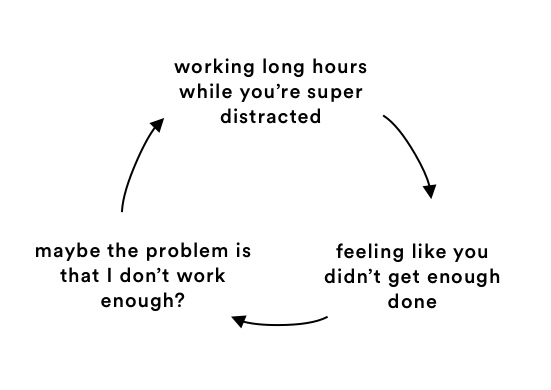
This post from Ava provides a great explanation. Its very short and you should read it, but I think it illustrates best through its literal illustrations:

Today is a good example. I’m writing this at noon, having just finished the revisions requested by a journal after 3 hours of solid work. Now, rather than start revising the next article & doing a bad job of it, I’ll take the rest of the day off. Real original thought is hard- I know I can do it for about 3 hours on a typical day, I have no one to impress by pretending to work longer, and one way or another the output will speak for itself. As remote work grows, this ability to do the real work and then stop rather than fill time “working” should be available to more people outside of academics.

Editing: You Figure It Out

If you want to change how a field works, you have a few options. You can do what you want to see more of, but you are only one person, and perhaps not the one best equipped to make things better. Or you can encourage others to work differently- but why would they listen to you?

Academics often serve as peer reviewers for the work of others. If a reviewer recommends that a paper be rejected, it usually is; if you recommend specific minor changes they usually get made. But you can’t really tell people that they should work on a totally different topic. Journal editors for the most part simply have a scaled-up version of the powers of peer reviewers to steer the field. But unlike reviewers, their positions are public and fairly long-lasting. This means they can credibly say “this is the sort of work I’d like to see more of- if you do this kind of work, there’s a good chance I’ll publish it”.

This is part of why I’ve been hoping to be a journal editor some day, and why I’m excited to be guest-editing for the first time: a special issue on Health Economics and Insurance for the Journal of Risk and Financial Management. The description notes:

Continue reading →

Predicting the NYC Mayoral Race

Yesterday, co-blogger Jeremy asked “Should Andrew Yang Wait To Concede?” in the New York City mayoral race. He argued that while Yang finished 4th in 1st-place primary votes, the new Ranked Choice Voting system meant he could still win. This is of course true in theory- but today I argue it is very unlikely in practice.

I say this not because I have scrutinized all the polls to predict the exact distribution of 2nd- and 3rd-place votes, or because I think I know more than Jeremy about political science or New York. Instead, any time I’m wondering about whether something will happen and I don’t have a strong opinion based on my own knowledge, I simply check what markets have to say. In this case, there are prediction markets bearing on this exact issue. The odds from PredictIt, shown below, have Adams (who finished with the most 1st-place votes, 32%) as the heavy favorite, with Yang reduced to an approximately 1% chance of winning.

But Jeremy is right to highlight that the Ranked-Choice system makes it less obvious who will win. You can see PredictIt traders still think that Garcia, who finished with 19% of 1st-place votes, is substantially more likely to win than Wiley, who finished with 22% (though the new system didn’t matter in the Republican primary, where Sliwa won with a clear majority of 1st-place votes).

Crypto-based betting platform Polymarket has actually closed their market for Yang already, declaring that he lost, though they agree with PredictIt that the overall election isn’t over and that Garcia still has a real chance despite coming in 3rd for 1st-place votes.

Of course, prediction markets aren’t perfect- they are certainly less accurate (easier to beat) than the stock market, as my track record of betting in both shows. But they make for a great first approximation on subjects you don’t know well, and if you think you do know better, they offer you the chance to make money and to make the odds more accurate. If you think Yang will still win, you can go bet on PredictIt and potentially 100x your money. Or if you think this ranked choice stuff is nonsense and Adams obviously won, you can pick up an easy 10% return. Or if you’re like me in this case, you can stay out of it, take a quick glance at the markets, and get a good idea of what is likely to happen without having to read the news or the pundits.

How Will Rich Country Fertility Ever Get Back Above Replacement?

For population to be steady or rising, the average women needs to have at least two kids. In almost every rich country- including the United States, all of Europe, and all of East Asia- this isn’t happening. In the extreme case of South Korea, where total fertility averages about one child per woman, the population will fall by half each generation. If this were to go on for 10 generations, South Korea would go from a country of 50 million people- larger than any US state- to one of 50 thousand people, far smaller than any US state. This sounds crazy and I don’t expect it will actually happen- but I can’t say what exactly will stop it from happening.

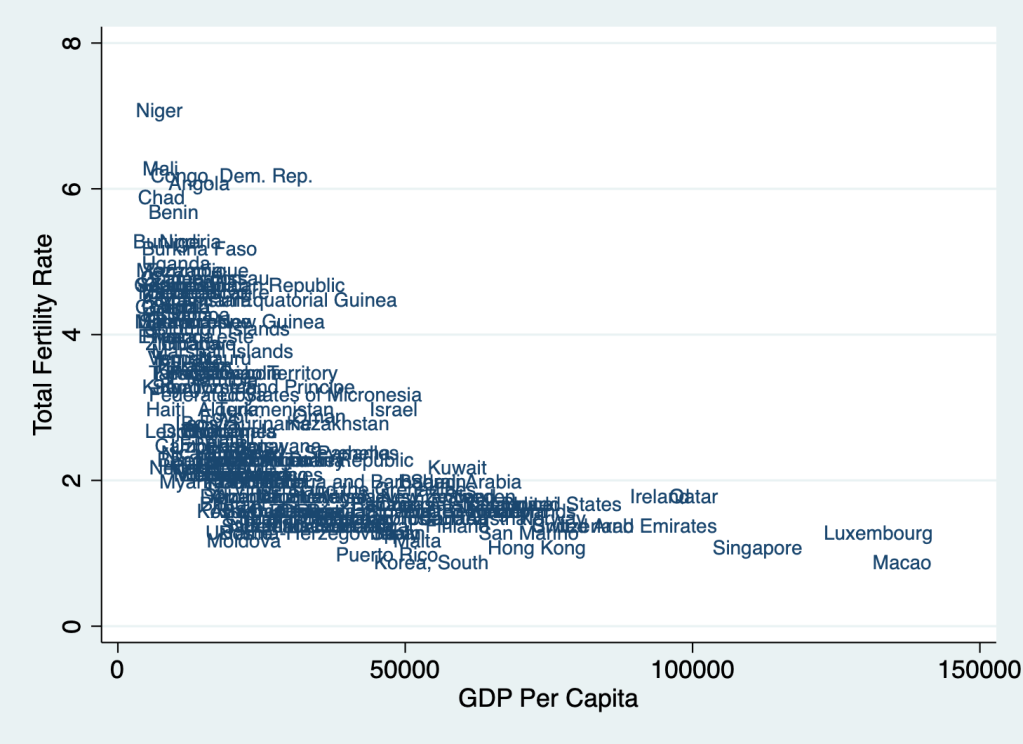
Global population growth has fallen from a peak of 2.1% per year to the current 1%, and is expected to fall to 0 by 2100. The remaining population growth will happen in poor countries, then stop for the same reasons it did in rich countries- the demographic transition from poverty, argicultural work, and high infant mortality to high incomes, high education, and low infant mortality. As the graph below shows, higher income is an incredibly strong predictor of low fertility- and so if economic growth continues, we should expect fertility to continue falling. But where does it stop?

2019 TFR from Population Reference Bureau vs 2019 PPP-adjusted GDP Per Capita fron World Bank

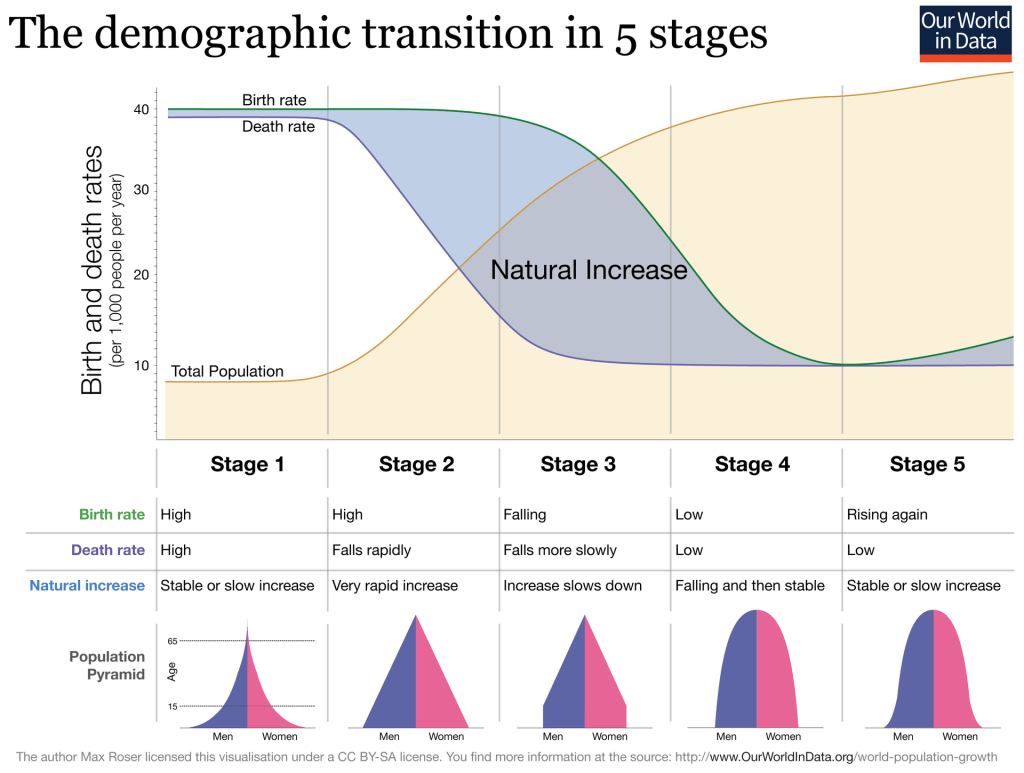
Some have theorized a “J-curve” relationship, where once incomes get high enough, fertility will start rising again. You can see this idea in “Stage 5” of Max Roser’s picture of the demopgraphic transition here:

This makes sense to me in theory. As countries get richer, desired fertility (the number of kids each woman wants to have) has fallen, but realized fertility (the number of kids each woman actually has) has fallen faster. In a typical rich country women would like to have 2-2.5 kids, but actually ends up having about 1.5. There are many reasons for this, but some are clearly economic- the high cost of goods and services that are desired by rich-country parents, like child care, education, and spacious housing near high-paying jobs. Perhaps in a rich enough country all these could be obtained with a single income (maybe even from a part-time job). But it seems we aren’t there yet. Even zooming in on higher-income countries, higher incomes still seem to lead to lower fertility.

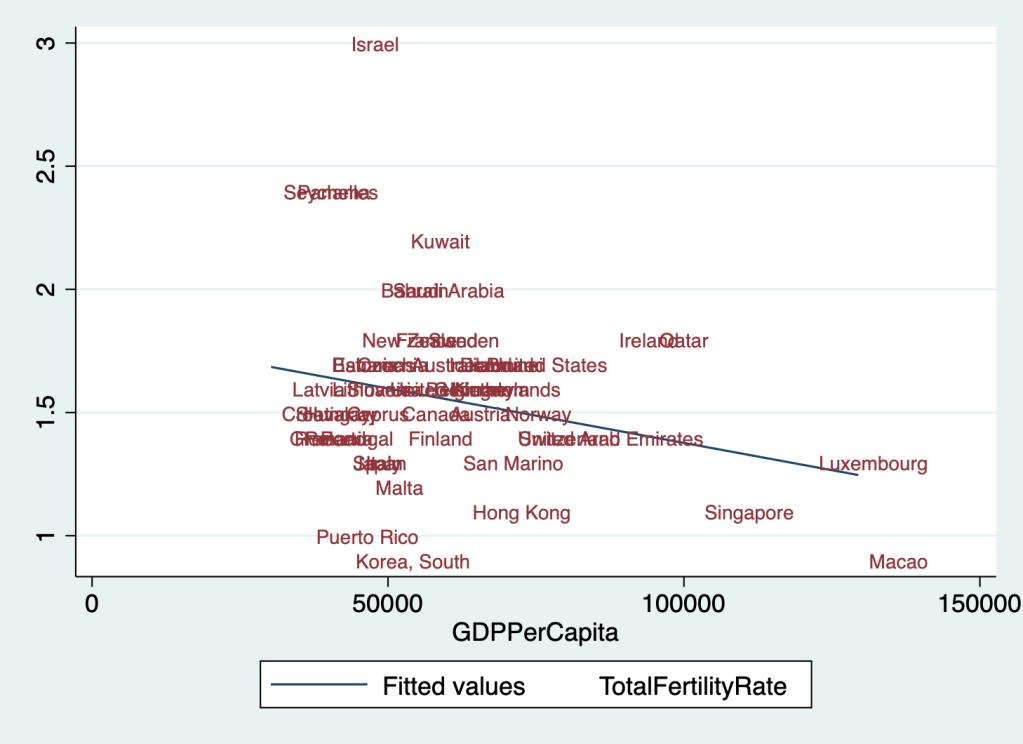
TFR vs GDP Per Capita in countries with GDP Per Capita over 30k/yr

The only rich countries with fertility above replacement are Panama and the Seychelles (barely meeting my 30k/yr definition of rich), Kuwait (right at replacement with 2.2 kids per woman), and Israel- the biggest outlier, with 3 children per woman at a 42k/yr GDP. This hints that pro-fertility religious culture could be one way to stay at or above replacement. But in most countries, rising wealth seems to drive a decline in religiousity along with fertility. Will this trend eventually come to Israel? Or will it reverse in other countries, as more “pro-fertility” beliefs and cultures (religious or otherwise) get selected for?

To do one more crazy extrapolation like the disappearance of South Korea, the number of Mormons is currently growing by over 50% per generation from a base of 6 million while the rest of the US is shrinking. If these trends continue (and setting aside immigration), in at most 10 generations the US will be majority-Mormon. Again, I don’t actually expect this, but I don’t know whether it will be falling Mormon fertility, non-Mormon fertility somehow rising back above replacement, or something else entirely that changes our path.

What would a secular pro-fertility culture look like? For my generation, I see two big things that make people hold back from having kids: a desire to consume experiences like travel and nightlife that are harder with kids, and demanding careers. I see more potential for change on the career front. Remote work means that more quality jobs will be available outside of expensive city centers. Remote work, along with other technological and cultural changes, could make it easier to work part-time or to re-enter the work force after a break. Improving educational productivity so that getting better-education doesn’t have to mean more years of school would be a game-changer; in the short run I think people will spend even more time in school but I see green shoots on the horizon.

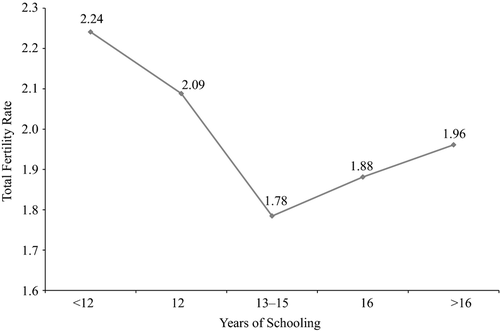
Looking within the US, we are just beginning to see what looks like the “J-curve” happening. Since about the year 2000, women with advanced degrees began to have more children than those with only undergraduate education (though still fewer than those with no college, and still below replacement):

From Hazan and Zoabi 2015, “Do Highly Educated Women Choose Smaller Families?”

We see a similar change with income. In 1980 women from richer households clearly had fewer children, but by 2010 this is no longer true:

Fertility of married white women, from Bar et al. 2018, “Why did rich families increase their fertility? Inequality and marketization of child care”

The authors of the papers that produced the two graphs above argue that this change is due to “marketization”, the increasing ability to spend money to get childcare and other goods and services that make it easier to take care of kids. If this is true, it could bode well for getting back to replacement- markets first figure out how to make more excellent daycare and kid-related gadgets, then figure out how to make them cheap enough for wide adoption.

Endless Frontiers: Old-School Pork or New Cold War Tech Race?

The Endless Frontiers Act passed the Senate Tuesday in a bipartisan 68-32 vote. What was originally a $100 Billion bill to reform and enhance US research in ways lauded by innovation policy experts went through 616 amendments. The bill that emerged has fewer ambitious reforms, more local pork-barrel spending, and some totally unrelated additions like “shark fin sales elimination”. But it does still represent a major increase in US government spending on research and technology- and other than pork, the main theme of this spending is to protect US technological dominance from a rising China. One section of the bill is actually called “Limitation on cooperation with the People’s Republic of China“, and one successful amendment was “To prohibit any Federal funding for the Wuhan Institute of Virology“

Continue reading →

Does Cohabitation Predict Divorce?

My article, coauthored with Sarah Kerrigan and published last week, tries to answer the question. In short, the answer seems to be yes- cohabitation before marriage is associated with a 4.6 percentage point increase in the rate of marital dissolution. This is in line with much of the previous literature, which notes one big exception- choosing right (or getting lucky) the first time: “cohabitation had a significant negative association with marital stability, except when the cohabitation was with the eventual marriage partner”.

But we found some even more interesting facts while digging through the National Survey of Family Growth.

Continue reading →