I’ve never been great at gifts, and don’t have much in the way of specific ideas now. But I’ve been thinking about what the macroeconomic environment means for gift-giving.
First, as you’ve probably heard by now from us or elsewhere, if you want to get any physical gift I’d order it now, since shipping is a mess and prices are only going up. I’d especially recommend this for complex electronics that could become hard to find- its part of why I got my wife an iPad for her birthday this summer. Foreign food and drink that can be stockpiled is always a good idea, but perhaps especially now; think wine, Scotch, or Beirao liqueur (a Portuguese drink that was my favorite discovery this year). Wine and liquor make good stores of value in an time of inflation.
Alternatively, you could avoid the scarcity of physical goods by turning to the digital realm. If your economistic heart yearns to give cash, consider giving some your favorite stock or cryptocurrency instead- its both more personalized and less subject to inflation. Or if you think you can judge the recipient’s taste well enough, subscribe them to one of your favorite Substacks or podcasts. My recommendations:
The Readers Karamazov– Funny podcast on literature and philosophy (now seems entirely free though)
Or if you really have money to burn, go for the Bloomberg subscription. I always run out of free reads on the Tyler Cowen articles and so can’t read Matt Levine, even though he has the magic ability to teach you finance while making you laugh. But the subscription is expensive and Mike Bloomberg doesn’t need the money, while the Substacks are relatively cheap and enable talented writers to spend a lot more time writing instead of needing to focus on a real job.
Yesterday Jeremy pointed out that while the 2021 economics Nobelists have reached various conclusions in their study of labor economics, the prize was really awarded to the methods they developed and used.
Like Jeremy, they think that empirical economic research (that is, research using econometrics) was most quite bad up to the 1980’s; as Ed Leamer put it in his paper “Let’s take the CON out of Econometrics”:
This is a sad and decidedly unscientific state of affairs we find ourselves in. Hardly anyone takes data analyses seriously. Or perhaps more accurately, hardly anyone takes anyone else’s data analyses seriously.
Angrist and Pischke argue that the field is in much better shape today:
empirical researchers in economics have increasingly looked to the ideal of a randomized experiment to justify causal inference. In applied micro fields such as development, education, environmental economics, health, labor, and public finance, researchers seek real experiments where feasible, and useful natural experiments if real experiments seem (at least for a time) infeasible. In either case, a hallmark of contemporary applied microeconometrics is a conceptual framework that highlights specific sources of variation. These studies can be said to be design based in that they give the research design underlying any sort of study the attention it would command in a real experiment.
The econometric methods that feature most prominently in quasi-experimental studies are instrumental variables, regression discontinuity methods, and differences-in-differences-style policy analysis
Our field still has big problems: the replication crisis looms, and the credibility revolution’s focus on the experimental ideal leads economists to avoid important questions that can’t be answered by natural experiments. But I do think that the average empirical economics paper today is much more credible than one from 1980, and that the 3 Nobelists are part of the reason why, so cheers to them.
Living means making decisions with imperfect information. But Covid provides many examples of how people and institutions are often still bad at this. A few common errors:
Imperfect evidence = perfect evidence. “Studies show Asprin prevents Covid”. OK, were the studies any good? Did any other studies find otherwise?
Imperfect evidence = “no evidence” or “evidence against”. In early 2020, major institutions like the WHO said “masks don’t work” when they meant “there are no large randomized controlled trials on the effectiveness of masks”
Imperfect evidence = don’t do it until you’re sure Inaction is a choice, and often a bad one. If the costs of action are low and the potential benefits of action high, you might want to do it anyway. Think masks in 2020 when the evidence for them was mediocre, or perhaps Vitamin D now.
Imperfect evidence = do it, we have to do something Even in a pandemic, it is possible to over-react if the costs are high enough and/or the evidence of benefits bad enough (possibly lockdowns, definitely taking up smoking)
Any intro microeconomics class will explain the importance of weighing both costs and benefits. But how do we know what the costs and benefits are? For many everyday purchases they are usually obvious, but in other situations like medical treatments and public policies they aren’t, particularly the benefits. We have to estimate the benefits using evidence of varying quality. This creates more dimensions of tradeoffs- do you choose something with good evidence for its benefits, but high cost? Or something with worse evidence but lower costs? Graphing this properly should take at least 3 dimensions, but to keep things simple lets assume we know what the costs are, and combine benefits and evidence into a single axis called “good evidence of substantial benefit”. This yields a graph like:
Applied to Covid strategies, this yields a graph something like this:
This is not medical advice- I say this not merely as a legal disclaimer, but because my real point is the idea that we should weigh both evidence quality and costs, NOT that my estimates of the evidence quality or costs of particular strategies are better than yours
Judging the strength of the evidence for various strategies is inherently difficult, and might go beyond simply evaluating the strength of published research. But when evaluating empirical studies on Covid, my general outlook on the evidence is:
Dear reader, perhaps this is all obvious to you, and indeed the idea of adjusting your evidence threshold based on the cost of an intervention goes back at least to the beginnings of modern statistics in deciding how to brew Guinness. But common sense isn’t always so common, and this is my attempt to summarize it in a few pictures.
Tyler has identified talent either earlier than or missed by top undergraduate programs, the best biotech startups, and the best biotech investors, all without any insider knowledge of biotech. In comparison, Forbes 30U30, MIT Tech Review TR35, or Stat Wunderkind, and other industry awards that highlight talent are lagging indicators of success. It’s hard to find an awardee of these programs that was not already widely recognized for their achievements among insiders in their field. The winners of Emergent Ventures are truly emergent.
What explains Tyler’s ability to do this?
1. Distribution: Tyler promotes the opportunity in such a way that the talent level of the application pool is extraordinarily high and the people who apply are uniquely earnest.
2. Application: Emergent Ventures’ application is laser focused on the quality of the applicant’s ideas, and boils out the noise of credentials, references, and test scores.
3. Selection: Tyler has relentlessly trained his taste for decades, the way a world class athlete trains for the olympics.
4. Inspiration: Tyler personally encourages winners to be bolder, creating an ambition flywheel as they in turn inspire future applicants.
This seems right as far as it goes, and there is more depth in the article, but there has to be more to the story than we can see from the outside. Luckily Tyler has said he is writing a book on identifying talent.
We generally do long “effort posts” on specific topics here, but today I’m mixing things up with 5 quick updates.
Covid My daughter got sent home with a cough Tuesday, which meant I cancelled classes Wednesday to hang out with her until we get a Covid-negative PCR. Last Thursday my son’s public school was closed for Yom Kippur, and I got so focused on hanging out with him I forgot to post here.
Cars My wife bought a new used car last week. We’ve covered here how car prices have jumped up while inventories fell this summer, and the latest numbers show that used car prices are now falling slightly from very high levels while new car prices continue to rise. While actually buying a car, the low inventories stood out even more than the high prices. Several times we saw a promising car online, only to call or visit the dealer and find out it had sold the day before. The new Nissan Leaf sounds like an excellent value at its sticker price, but none were available in Rhode Island, and no blue ones anywhere in New England.
China Scott covered the collapsing Chinese real estate market on Tuesday. I’ll just pass along the takes I’ve seen from Western economists and China-watchers Michael Pettis and Christopher Balding, which is that this is a big deal that will slow Chinese growth for years but is unlikely to precipitate a 2007-style financial crisis. I find Balding’s argument that financial contagion will be limited to be convincing partly because of his actual arguments about quasi-bailouts, and partly because he almost always argues that “things in China are worse than you think”, so if he says “Evergrande isn’t Lehman Brothers” I listen.
Crypto Tuesday I met the co-founder of a new crypto-based prediction market, Melange, which sounds promising. The prediction market space is growing rapidly with PolyMarket and Kalshi joining the older PredictIt.
Corruption Last week the World Bank announced it is discontinuing the Doing Business report/ranking due to apparent corruption; top Bank officials in the middle of raising money from countries including China pushed to raise the rankings of those countries beyond what the data justified. I hope another organization steps up do continue the good parts of the Doing Business report in a more trustworthy way.
The United States, by far the richest country in the Americas, had a life expectancy of 78.4 years that was falling even before Covid.
How is it that Costa Rica outperforms not only the much richer United States, but also other somewhat richer countries like Panama, Mexico, Argentina, and the Dominican Republic?
Clearly they don’t do it by outspending us- Costa Rica spends the equivalent of $1600 dollars per person per year on health care, compared to nearly $12000 in the US (7.3% of their GDP goes to health care vs 16.8% for the US).
He argues that the key has been Costa Rica’s investment in primary care and public health. The US might may have many more of the world’s best (and most expensive) hospitals, but the easiest and cheapest health benefits come from keeping people out of hospitals in the first place.
the country has made public health—measures to improve the health of the population as a whole—central to the delivery of medical care. Even in countries with robust universal health care, public health is usually an add-on; the vast majority of spending goes to treat the ailments of individuals. In Costa Rica, though, public health has been a priority for decades.
In the nineteen-seventies, Costa Rica identified maternal and child mortality as its biggest source of lost years of life. The public-health units directed pregnant women to prenatal care and delivery in hospitals, where officials made sure that personnel were prepared to prevent and manage the most frequent dangers, such as maternal hemorrhage, newborn respiratory failure, and sepsis. Nutrition programs helped reduce food shortages and underweight births; sanitation and vaccination campaigns reduced infectious diseases, from cholera to diphtheria; and a network of primary-care clinics delivered better treatment for children who did fall sick. Clinics also provided better access to contraception; by 1990, the average family size had dropped to just over three children.
The strategy demonstrated rapid and dramatic results. In 1970, seven per cent of children died before their first birthday. By 1980, only two per cent did. In the course of the decade, maternal deaths fell by eighty per cent. The nation’s over-all life expectancy became the longest in Latin America, and kept growing. By 1985, Costa Rica’s life expectancy matched that of the United States.
Gawande goes on to describe how every Costa Rican gets a home visit from a health care worker at least once per year. This is quite the contrast to the US, where even getting primary care doctors to let you see them in their office can be a fight. I moved to Rhode Island last year and this week finally tried getting a primary care doctor here. I looked through the list of doctors covered by my insurance that my insurer said were accepting new patients and started making calls (by the way, why calls? do any doctors book appointments online?). 2 said that they actually weren’t taking new patients. 9 never answered the phone. The 12th doctor I tried, one farther away and lower-rated than I’d like, finally agreed to see me- in 3 months.
For anyone with less free time, determination, or insurance coverage, it would be natural to just give up after the 5th or the 10th “no”. Clearly many Americans do, leading manageable conditions like diabetes or high blood pressure to turn into acute health crises and expensive hospital visits.
I do think individual doctors could do better here by thinking through their appointment process from the patient’s perspective. But at its core this is simply a numbers issue- we don’t have enough primary care doctors to go around. We actually have fewer doctors per capita than Costa Rica, and relatively high share of specialists means that we have even fewer primary care doctors to go around. More medical school spots, more primary care residency spots, and fewer restrictions on immigrant doctors could go a long way way toward helping to US catch up to…. Costa Rica.
That, or their secret is just the volcanoes. This is surprisingly plausible- the US state with the longest life expectancy is also the one best known for volcanoes, Hawaii.
Two weeks ago I argued for 4 non-coercive anti-Covid policies I thought were under-rated. I haven’t generally been impressed by the institutional response to the pandemic, and so I wasn’t expecting the policies I mentioned to get traction any time soon. But some did!
I really wasn’t expecting the FDA to move that fast- they have generally learned to be slow because Congress has been much more likely to complain about them approving a bad drug than about them denying or slow-walking a good drug. But Congress itself seems to be changing in response to Covid, with 108 House members pushing the FDA for a timeline on approving vaccines for 5 to 11 year-olds.
I don’t know of a good way to gauge progress on ventilation overall, but I was pleased to see HEPA filters show up in the classrooms at Providence College:
Likewise, I don’t know if Fluvoxamine prescriptions are up in the weeks since a good sized study showed it reduced Covid hospitalizations 31%, but the popular press articles about it keep coming (don’t be deterred by “Vox”, the linked article is by Kelsey Piper and its excellent).
So some institutions seem to be getting smarter, and perhaps coincidentally, we seem to be at the peak of the Delta wave. According to Covidestim.org, Rt is now below 1 in 31 states, and falling in 45 states, including all of the Southern states hit hardest by Delta. Barring a new twist (another worse variant? Winter Delta wave in the North?), things just get better from here.
When there’s only one employer in town who hires for jobs like yours, they have labor-market power, and can pay less and have worse working conditions than a competitive firm would. Economists call this “labor market monopsony” but I like the term “employer power”, which is simpler and makes sense when there are a few employers as well as when its literally just one. This keeps down the wages of machinists at the only factory in town, nurses at the only hospital in town, and professors at the only university in town.
Of course, workers in this situation could always move and get a better job elsewhere, and this does put some limits on employer power, but many workers have strong preferences to stay in their home, which means the balance of power is with the employers- or at least, it has been.
The growth of remote work means that workers can get jobs all over the world (or at least all over nearby time zones) without having to leave their town. Which means that monopsony is over, at least for jobs where remote work is possible.
I’m going up for tenure at my college soon, meaning that by next June they will tell me either that I have a job for life or that I’m fired. This “up or out” system naturally causes a lot of anxiety for professors. Partly this is because many professors’ identities are wrapped up in our jobs to an unnecessary and unhealthy extent, and so we take it as a judgement on our worth as human beings. But partly there was always the very practical problem that failing tenure almost certainly meant you would either need to move, accept a substantially worse job, or both.
The thinness of the academic labor market means that unless you live in a major city, its probably the case that no university nearby is hiring tenure-track academics in your subfield this year; and even if you are in a major city, there are probably only 2-3 searches in your field, and they will be so competitive that you almost certainly won’t get the job. To have a real chance at another good academic job, people need to apply nationwide (when I got my first job I sent out 120 applications all over the country to get 1 offer). Getting another job locally generally means taking a job with much worse pay, worse conditions, or both- like high school teacher, adjunct professor, or entry-level business analyst. Those in relatively practical fields like economics were able to get decent jobs outside of academia (PhD economists in private sector and government jobs typically earn better salaries than academics, at the cost of working more hours with less freedom), but such jobs were plentiful only in a few major cities (DC, SF, NYC, Boston), which usually still meant moving. Even in a mid-sized state capital like Providence, I don’t think I’d have an easy time finding something here- or I didn’t think so, until remote work became ubiquitous last year.
Now I won’t be losing any sleep over the possibility of losing my job next year. Partly I think my odds of getting tenure are good, but even a 1% chance of losing my job would have been worrisome in the pre-remote world. Now instead of worrying I just think about the huge range of opportunities in tech, finance, consulting, business, think tanks, and even government. Remote also addresses one big reason I ignored those jobs in the first place and only applied in academia- flexibility. I didn’t want to be stuck in an office 40+ hours/wk; I wanted to be able to pick my kids up from school. Now flexible hours and the ability to be evaluated on output rather than time spent at the office seem to be increasingly common.
To the extent that remote work puts a dent in employer power we would expect to see higher employment, higher wages, and fewer people feeling trapped in their jobs. We’ve seen all of these in 2021- quits in particular are at an all-time high, a good sign that workers don’t feel trapped- though much this could simply be due to the rapid economic recovery. The real test will come when we see how much this is sustained past the initial recovery, and whether it is mainly in remote-able jobs or is a broad improvement.
Two weeks ago I predicted that Covid cases would continue to spike for at least two weeks due to the Delta variant, but argued against general shutdowns as a way to combat this spike. Two weeks later cases have indeed spiked, and while localities and organizations have been mandating masks and vaccines, we have largely avoided new lockdowns, at least in the US (Australia is reverting to its roots as a prison). In the last post I mostly said what we shouldn’t do to fight Delta, so today I want to show what a better response looks like.
The tendency of authorities to reach first for coercive solutions is a natural product of their incentives, but I’ve been disappointed to see the same tendency among the chattering classes. I think this is due to polarization- people are most interested in debating solutions that are identified with a specific side in politics or the culture war. Masks became blue-coded, so many reds oppose them even though they probably work. Likewise with vaccines, even though they definitely work well and funding them early was the greatest achievement of the Trump presidency. Meanwhile certain medications became red-coded, leading blues to oppose them before the evidence even came in. But many of the best non-coercive and anti-coercive solutions barely get discussed because they have no political valence, or a mixed one.
Fully Approve the Vaccines Already!
The Covid vaccines are still being distributed under an emergency use authorization. This lack of full approval is a source of vaccine hesitancy. More concretely, it also means that pharmaceutical companies aren’t allowed to advertize their vaccines, even though they are much more effective than the typical pharmaceutical you see advertized. The randomized control trials testing the vaccines have been complete for months, we are just waiting on the FDA to do their job.
Authorize Vaccines for Kids
The FDA still bans children under 12 from receiving the vaccine, saying they are waiting for more trial data. Last week, the American Academy of Pedicatrics argued that we have enough data to justify an Emergency Use Authorization for children aged 5-11 given, you know, the emergency. The government is going to make my 5 year old wear a mask to kindergarden won’t allow me (or my physician wife!) to get him a vaccine which would protect him and others much better than a mask.
Repurposing existing drugs to fight Covid is a great idea that has not yet lived up to its promise, aside from the widespread use of Dexamethasone for inpatients with severe cases. The core problem is that it takes large randomized controled trials to really prove that a drug works, and these are expensive. Worse, pharmaceutical companies don’t want to pay for these expensive trials once their drug has gone off patent. This means that many promising treatments have been ignored, while a few have been over-promoted on the basis of observational studies and tiny RCTs (and worse, still promoted once large RCTs showed they probably don’t work). But the British government stepped up to fund the large trials that found Dexamethasone effective last year, and private donors have funded mid-size trials that just found Fluvoxamine reduced Covid hospitalization by 31%. This is excellent news because Fluvoxamine is a cheap and relatively safe anti-depressant that people can take at home. There are other promising treatments that have yet get funding for large RCTs; this is exactly the sort of thing that NIH should be throwing money at. While we’re waiting on compentent government, you can ask a doctor about outpatient treatment if you do get Covid.
Overall, many of our best tools for fighting Covid are being ignored despite, or perhaps because of, the fact that they maintain or increase our freedom.
The idea of “job lock” is well established in the academic literature- employees leave firms that don’t offer health insurance more often than they leave firms that do. But this literature has always measured employer-provided health insurance as a simple binary: either they offer it or they don’t. In fact employers vary widely in the generosity of their plans, both in the quality of the insurance and in how much of the cost is paid by the employer. Some employers pay all of the premiums, some pay none, and most pay part:
Data are from the Current Population Survey, which uses top-coding to protect privacy (values greater than 9997 are reported as 9997)
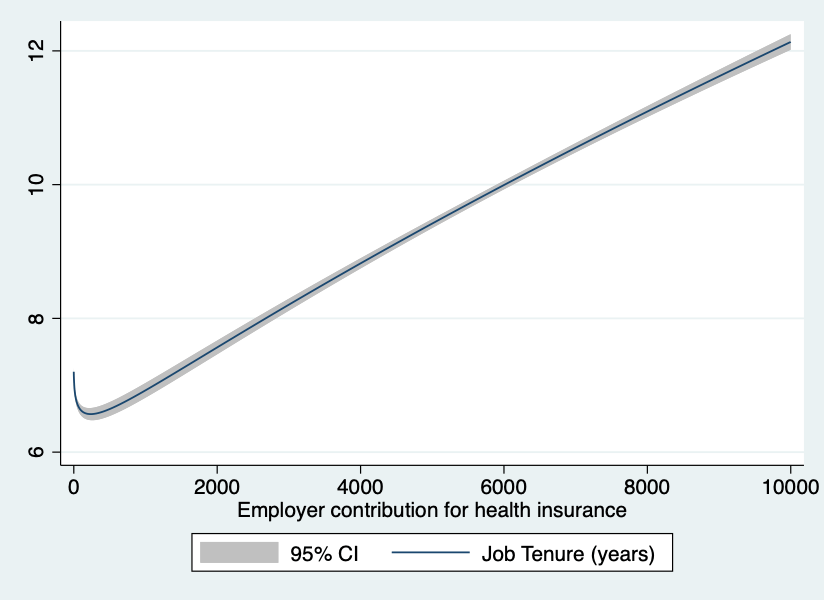
In an article published last week in Applied Economics Letters, my colleague Michael Mathes and I combine two supplements of the Current Population Survey to test whether employers who contribute more towards health insurance see their employees stay longer. Perhaps not surprisingly, we find that they do. We run lots of regressions to establish this, but this simple fit plot tells the story best:
What we found more surprising was the magnitude of this effect: a thousand dollar increase in employer contributions to health insurance is associated with at least 83 additional days of job tenure, compared to less than 10 additional days for a thousand dollar increase in wages. We conclude that:
For employers trying to increase retention, increasing contributions to health insurance appears to lengthen employee tenure far more than increasing wages by a similar amount.
Why the difference? Probably employees rationally valuing $1000 in untaxed contributions to health insurance above $1000 in taxable wages. Why don’t employers shift more compensation away from wages and toward health insurance, given that employees seem to prefer it? Here I’m less sure, and they could simply be making a mistake, but one possibility is that they worry about increasing their costs as couples whose employers both offer insurance choose the more generous one for a family plan. Another is that while generous health insurance plans are better for retention, higher wages could be better for attracting new employees, who tend to be younger and for whom the salary number could be more salient.