Leopold on supply chain independence

Leopold said when he started his new blog that he would be thinking long-term. He has managed to stop staring at footage of the capital raid last week and produced a forward-looking blog. He is not the first person to speculate that the US has a vulnerability in its reliance on the country we buy the most stuff from.  

Free trade is awesome. Something that is going to link together all EWED writers is a common respect for the power of trade to make lives better. Consumers who have access to world market can have much more great stuff. Enjoying your chair, or your phone, or you lightbulbs right now? It’s great to have access to more stuff and be able tot get it cheaper.

However, there are those who worry that if country A abandons domestic production of widget B, then in the unfortunate/unexpected event of a war, country A will be in trouble. For example, it would be concerning for a military power if they are not able to make any steel themselves.

Should country A use tariffs to stimulate domestic production? Tariffs really bother economists. Tariffs bite into the wonderful benefits of free trade. Since I talk to economists, I have heard a lot of arguments against tariffs. Leopold makes a novel argument against using tariffs to advance national security interests.

The problem with tariffs, however, is that they are royally ineffective at reducing the security vulnerability we are concerned about. A general tariff incentivizes onshoring the production that is cheapest and easiest to onshore—but it is likely the imports for which onshoring would be the most expensive and difficult that present the greatest security vulnerability, as I will explain.  In the language of economics, I argue that the imports that present the greatest security vulnerability are those with the most inelastic import demand—while a general tariff most reduces those imports with the most elastic import demand.

I propose an alternative approach: general per-product quotas. These would better target vulnerability than a general tariff.

Instead of having tariffs, require that a certain number of several products be made domestically. That would be expensive, but we already put up with huge losses from tariffs. We already spend hundreds of billions of dollars on defense. The question is not whether we are going to spend money on defense. How can we spend money in the smartest way that recognizes how markets generate information? Think about the government buying 1,000 digital watches made on a friendly supply chain, and also dispensing with some costly tariffs.

Note that Leopold, if I understand him correctly, uses the word quota to mean that the government will buy a block of domestically produced goods at above-world-market prices. This is different from the way “quota” is sometimes used in international trade. See this MRU video narrated by Alex Tabarrok for a discussion of import quotas versus tariffs, a separate topic.

Fitbit got 2 billion and all I got was an email

I made a Fitbit account years ago, even though I don’t wear one. As a user, I got an email on Jan 14, 2021 alerting me that they just sold Fitbit to Google. The email assured me that Google will not try to muscle Fitbit users away from iPhones or iOS. Google has said that it will keep Fitbit data “separate from other Google ad data.” TechCrunch had some more details for me, including how many billions of dollars Fitbit was getting out of this deal.

Is it so bad to see adsbased on your sleep habits? What if you had a bad night and then saw more coffee ads the next day? Seems fine. Is it more “creepy” than seeing an ad for something you just bought?

I don’t actually know much about Google’s data structure. But I can imagine ways that a large tech company could use Fitbit data in a way that users would not like. What if Google knows that you didn’t sleep well this week. Say someone else is using Google search to find a person to recruit for a desirable job in Public Relations. What if predictive models indicate that people who don’t get at least 6.5 hours of sleep per night are low performers? What if you ended up not getting linked up with your dream job, because you weren’t sleeping well one week? This is all speculative. What if Google starts measure how your heart rate responds to viewing various website that you access through Chrome? Have they agreed to not do that as part of the acquisition deal?

In 2018, Tyler sat down with Eric Schmidt, a senior executive of Google. Tyler asked him why Google doesn’t use their massive stores of data to inform investments for a hedge fund. Here was the reply:

SCHMIDT: Well, I’ll give you a more generic answer, which is, from the moment I joined the company, there were many people who said, “Why don’t you take this information and do something that will use it for marketing purposes?”

And the answer is always the same, which is that you need people’s permission to do that, and you can be sure you won’t get that permission, if you follow that reasoning. So we decided that was a pretty bright line. For example, if a tech company that were a consumer company were bundled with a hedge fund, you would have to disclose that it was being used in that context. The people would go crazy.

But the other thing that’s true — and Google was good about this — is we took the position that it was important for us to disclose everything we were doing as well as we could.

I’ll give you a governance argument. In a large company, the employees are independent citizens of humanity, and if they see corruption in your leadership — in other words, if they see you doing things which are inconsistent with the values, you will be criticized.

Schmidt doesn’t deny that Google could take advantage of data in order to become a successful hedge fun. He says that it would look bad, and Google doesn’t want to look bad even to its own employees. Hmmm, right? I don’t bring this up to accuse Google of wrongdoing. It just makes you wonder how things will unfold in the future. One can, at least, see why the acquisition of Fitbit was scrutinized.

I use Google products heavily on my laptop. I don’t have many “smart” devices aside from my smartphone. I wore the Fitbit step tracker for a few days, but I didn’t find the information to be helpful. It’s not like the Fitbit does the dishes for me or drives me to the gym. Get me that smart device and I’ll look at any ads you want.

Female orphan with superpowers stories

It’s been a heavy week. Here’s something for the weekend to take your mind off of Covid deaths and democracy in peril.

Disney made almost $1.5 billion from the theatrical release of Frozen II in 2019. Netflix reported The Queen’s Gambit (TQG) was one of its most popular shows of 2020. TQG attracted tens of millions of viewers around the world. These two stories are strikingly similar to each other.

Continue reading →

Chesterton on Patriotism

America is in the news, and not for reasons I’d like. Here is G.K. Chesterton on “patriotism.” I will always remember this quote from reading his book Orthodoxy (emphasis mine):

Let us suppose we are confronted with a desperate thing – say Pimlico. If we think what is really best for Pimlico we shall find the thread of thought leads to the throne of the mystic and the arbitrary. It is not enough for a man to disapprove of Pimlico; in that case he will merely cut his throat or move to Chelsea. Nor, certainly, is it enough for a man to approve of Pimlico; for then it will remain Pimlico, which would be awful. The only way out of it seems to be for somebody to love Pimlico; to love it with a transcendental tie and without any earthly reason. If there arose a man who loved Pimlico, then Pimlico would rise into ivory towers and golden pinnacles… If men loved Pimlico as mothers love children, arbitrarily, because it is theirs, Pimlico in a year or two might be fairer than Florence. Some readers will say that this is mere fantasy. I answer that this is the actual history of mankind. This, as a fact, is how cities did grow great. Go back to the darkest roots of civilization and you will find them knotted round some sacred stone or encircling some sacred well. People first paid honour to a spot and afterwards gained glory for it. Men did not love Rome because she was great. She was great because they had loved her.

G.K. Chesterton

The Pimlico reference is to some unsavory district of London at the time.

Continue reading →

Voluntary Facebook Friend Purges

Dale Carnegie wrote a famous book called How to Win Friends and Influence People. The title suggests that the more friends you have, the more influence you have.

Something I have seen from many friends since 2016 is messages about how they are cutting off ties with anyone on the political right.

Bad far-right actors mobbed the US Capitol last night. The violence scared me, and it scared people around the world who want to believe in the American Dream. After the traumatic attack, I saw one of my Facebook friends making the statement again last night.

Like most Americans, I am a Facebook user. I learn from keeping many “friends.” I understand that many of them are not actually friends providing emotional support to me, but I get to see lots of heartfelt statements from both sides of the political divide. This helps me understand how statements from media figures are landing with the public.

Continue reading →

Gender and computer attitudes

I’m currently working on understanding the gender gap in tech careers. Here’s a paper published in 2016 about a survey conducted in 2011. They found that male students reported more time on the computer for leisure. However, if they asked about computer use for school activities, there is no gender difference. The question remains as to how much one’s leisure time and subjective attitudes affects one’s ability to take a high-income software engineering job.

Abstract:
This study responds to a call for research on how gender differences emerge in young generations of computer users. A large-scale survey involving 1138 university students in Flanders, Belgium was conducted to examine the relationship between gender, computer access, attitudes, and uses in both learning and everyday activities of university students. The results show that women have a less positive attitude towards computers in general. However, their attitude towards computers for educational purposes does not differ from men’s. In the same way, being female is negatively related to computer use for leisure activities, but no relationship was found between gender and study-related computer use. Based on the results, it could be argued that computer attitudes are context-dependent constructs. When dealing with gender differences, it is essential to take into account the context-specific nature of computer attitudes and uses.

Dan Wang’s 2020 letter on China

Dan Wang is a writer who currently lives in Beijing. He’s released another long letter about what is going on in China. I’ll share the part that caught my attention.

Waiting politely in line is a pretty strong norm in America. I had heard from several sources that Chinese norms for waiting in an orderly line were weak. Here’s an update on that:

And for years, Xi has emphasized following clear rules of written procedure, under the rubric of “law-based governance.”  Since then, the state has improved regulatory systems, for example in setting clear standards for license approvals and in securities and antitrust regulation. The state has removed some of the arbitrary aspects of governance, thus bringing serious enforcement actions following the passage of relatively clear regulations. That has improved facts on the ground. Companies and lawyers tell me that a decade-long effort by the State Council to ease doing business has yielded real results. Obtaining business licenses no longer requires a relentless pace of wining and dining, and has instead become close to a matter of routine. I haven’t been able to verify this fact for myself, but one of my friends told me that the office of the National Development and Reform Commission used to be ringed by some of the fanciest restaurants in Beijing, offering mostly private rooms; many of these restaurants have now closed, following the professionalization of business approvals.

The lived experience of being in Beijing has improved in parallel. I remember what a nightmare it was to buy a high-speed rail ticket for the first time years ago, which involved lots of yelling and multiple people cutting in line. Today, I purchase one on my phone, with no need to obtain a paper ticket, and the lines to board are more or less orderly.

China is changing.

Incidentally, I tried to start a company when I was about 19 in New Jersey. Applying for a tax ID number for my sole proprietorship was quick and easy. All I had to do was fill out a form and pay a small fixed fee to some government office.

Economists Watching Vaccines Every Day

EWVED could be our new name. Americans worked so hard to develop a vaccine (here’s Jeremy’s ode to development) and now we are seeing the distribution become painfully slow.

Continue reading →

Church Attendance and Covid

Today is the last Sunday of 2020. The disruption to employment and rise of remote work might be the bigger story of 2020. However, for a significant fraction of Americans, 2020 is also the year their ability to meet as an in-person church was curtailed. Gathering in a room with many people singing is an efficient means of spreading the virus. For some, church has been an online-only experience since March.

Social scientists are interested in religiosity. Christian devotion has often been measured by asking how many times a person goes to church.

My colleagues who study the economics of religion will have an important issue to study. How does the switch to online church in 2020 affect Christian engagement in the future? How will this affect our ability to track long-term trends on religiosity?

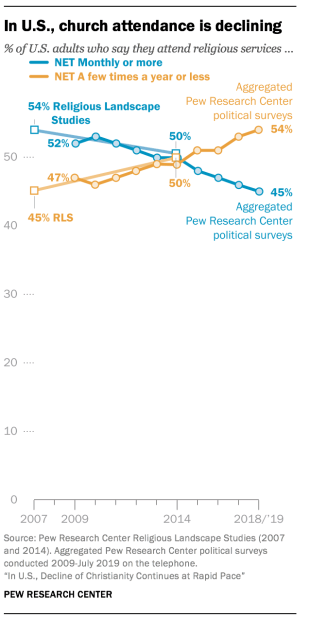
If it is true that large gatherings are safe in a year from now, it will be interesting to compare in-person church attendance in 2022 to 2019. If it turns out that attendance has decreased, then we would need to see a break in the trend to conclude that Covid is the cause. Here’s a graph of church attendance in an article from B.C. (Before Covid).

A book that was published in the 1950s made it sound like, even then, people who attended church weekly were in the minority. Joy Davidman published Smoke on the Mountain in 1953.

The inspiration for this post was reading this line about “remote” church experiences:

Others, instead of stirring their stumps, listen in comfortable living rooms to a sermon on the radio, arguing that it is “just the same.” They have forgotten that one of the first necessities of a Christian life is a congregation…

Overall, Davidman is disappointed in how few of her American countrymen attend church. Early in life, she was a militant atheist. She’s a Christian at the time of writing, but still somewhat militant.

Davidman frowns on radio church, when in-person church was available. However, virtual church today is closer to the traditional visual church experience. Going forward, it will be important to consider whether people who use the internet for church experiences should get counted.

Here are some examples of what churches have been up to, virtually:

Trinity United Methodist Church in Birmingham, AL 

Truro Anglican Church in Fairfax, VA 

Nativity, a Catholic church in Burke, VA 

Larger churches have been podcasting and Youtube-ing for years. One of the top productions is Bethel Church of Redding, CA. They even already had their own Bethel.tv ecosystem, so shutting down in-person services for Covid probably coincided with an increase in viewership for them.

Scheduling The Day

What to do on the Monday before Christmas? My 5-y-o son was beginning a long winter break from school. Thanks to Covid, we were home all day. I wanted my son to do a few chores and some learning.

There were some fun activities I knew we would end up doing that day, such as playing chess and letting him watch some TV. One option would have been for me to order him around all day. If he balked at cleaning up his room, I could threaten to withhold TV. Instead, I made a jar of activities written on slips of paper.

He picked papers out one at a time. The only rule I imposed was that he would do that activity immediately. If he drew tidying his room, then we went straight to his room. Mixing in papers that read “30 minutes of TV” and “pick a snack to share” made the game seem fun. He would have ended up watching TV anyway. I included a paper in the bowl that said, “give Mommy a compliment.” Everyone needs some affirmation!

This tactic was so successful that it got me thinking about how adults, including myself, could benefit from something similar. Adults need structure. I contemplated whether I would want someone to put all my activities for the day in a jar. Something I have done and even paid for is to go to a gym and have a fitness instructor tell me what to do for an hour.

One reason the jar game worked is that my son could not do all the fun activities first before the more unpleasant tasks (i.e. math worksheet). Almost every successful writer says that they write first thing in the morning. They don’t procrastinate.

If you’d like to hear from a real live human who actually does the writing scheduling thing, you can listen to Jennifer Doleac’s recent interview on The Hidden Curriculum podcast. She really does the thing! No wonder she’s so amazing and professionally successful. (She’s also generous with her time and supportive of young scholars.)

I think many of us could think of an excuse for not scheduling every hour of our work days a week ahead of time, as she does. I feel like I have excuses, but I also bet I could get closer. A great book on productivity is Deep Work. Something I took away from that book is that, even if you can’t go full Doleac, every person can do better.

The author, Cal Newport, points out something we all know by now: constantly checking email and social media eats up your day and reduces productivity. After arguing that it’s optimal to block out hours for exclusive intense focus, Newport deals with the objection that some people need to be accessible to others throughout the day. A manager or teacher needs to read and respond to emails promptly. Newport’s response was something like “Ok. However, you can probably check your email LESS frequently than you currently do.”

The New Year is coming. Let’s try again. Let’s try harder. I want to waste LESS time than I currently do. And I’ll so some more of the surprise jar game with my son.