EWVED could be our new name. Americans worked so hard to develop a vaccine (here’s Jeremy’s ode to development) and now we are seeing the distribution become painfully slow.
Author: Joy Buchanan
Church Attendance and Covid
Today is the last Sunday of 2020. The disruption to employment and rise of remote work might be the bigger story of 2020. However, for a significant fraction of Americans, 2020 is also the year their ability to meet as an in-person church was curtailed. Gathering in a room with many people singing is an efficient means of spreading the virus. For some, church has been an online-only experience since March.
Social scientists are interested in religiosity. Christian devotion has often been measured by asking how many times a person goes to church.
My colleagues who study the economics of religion will have an important issue to study. How does the switch to online church in 2020 affect Christian engagement in the future? How will this affect our ability to track long-term trends on religiosity?
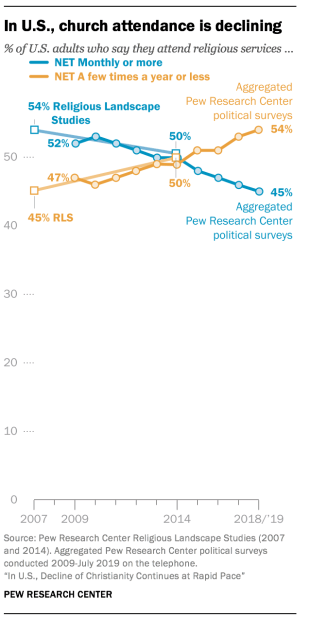
If it is true that large gatherings are safe in a year from now, it will be interesting to compare in-person church attendance in 2022 to 2019. If it turns out that attendance has decreased, then we would need to see a break in the trend to conclude that Covid is the cause. Here’s a graph of church attendance in an article from B.C. (Before Covid).
A book that was published in the 1950s made it sound like, even then, people who attended church weekly were in the minority. Joy Davidman published Smoke on the Mountain in 1953.
The inspiration for this post was reading this line about “remote” church experiences:
Others, instead of stirring their stumps, listen in comfortable living rooms to a sermon on the radio, arguing that it is “just the same.” They have forgotten that one of the first necessities of a Christian life is a congregation…
Overall, Davidman is disappointed in how few of her American countrymen attend church. Early in life, she was a militant atheist. She’s a Christian at the time of writing, but still somewhat militant.
Davidman frowns on radio church, when in-person church was available. However, virtual church today is closer to the traditional visual church experience. Going forward, it will be important to consider whether people who use the internet for church experiences should get counted.
Here are some examples of what churches have been up to, virtually:
Trinity United Methodist Church in Birmingham, AL
Truro Anglican Church in Fairfax, VA
Nativity, a Catholic church in Burke, VA
Larger churches have been podcasting and Youtube-ing for years. One of the top productions is Bethel Church of Redding, CA. They even already had their own Bethel.tv ecosystem, so shutting down in-person services for Covid probably coincided with an increase in viewership for them.
Scheduling The Day
What to do on the Monday before Christmas? My 5-y-o son was beginning a long winter break from school. Thanks to Covid, we were home all day. I wanted my son to do a few chores and some learning.
There were some fun activities I knew we would end up doing that day, such as playing chess and letting him watch some TV. One option would have been for me to order him around all day. If he balked at cleaning up his room, I could threaten to withhold TV. Instead, I made a jar of activities written on slips of paper.
He picked papers out one at a time. The only rule I imposed was that he would do that activity immediately. If he drew tidying his room, then we went straight to his room. Mixing in papers that read “30 minutes of TV” and “pick a snack to share” made the game seem fun. He would have ended up watching TV anyway. I included a paper in the bowl that said, “give Mommy a compliment.” Everyone needs some affirmation!
This tactic was so successful that it got me thinking about how adults, including myself, could benefit from something similar. Adults need structure. I contemplated whether I would want someone to put all my activities for the day in a jar. Something I have done and even paid for is to go to a gym and have a fitness instructor tell me what to do for an hour.
One reason the jar game worked is that my son could not do all the fun activities first before the more unpleasant tasks (i.e. math worksheet). Almost every successful writer says that they write first thing in the morning. They don’t procrastinate.
If you’d like to hear from a real live human who actually does the writing scheduling thing, you can listen to Jennifer Doleac’s recent interview on The Hidden Curriculum podcast. She really does the thing! No wonder she’s so amazing and professionally successful. (She’s also generous with her time and supportive of young scholars.)
I think many of us could think of an excuse for not scheduling every hour of our work days a week ahead of time, as she does. I feel like I have excuses, but I also bet I could get closer. A great book on productivity is Deep Work. Something I took away from that book is that, even if you can’t go full Doleac, every person can do better.
The author, Cal Newport, points out something we all know by now: constantly checking email and social media eats up your day and reduces productivity. After arguing that it’s optimal to block out hours for exclusive intense focus, Newport deals with the objection that some people need to be accessible to others throughout the day. A manager or teacher needs to read and respond to emails promptly. Newport’s response was something like “Ok. However, you can probably check your email LESS frequently than you currently do.”
The New Year is coming. Let’s try again. Let’s try harder. I want to waste LESS time than I currently do. And I’ll so some more of the surprise jar game with my son.
Biden Signs Turn Into Christmas Lights
One of the many things I meant to do and did not have time for this Fall was a photo study of the political signs in my neighborhood. I did snap a few pictures, such as this one of a conservative house:

The next one is not a Biden/Harris sign, but they are supporting the Democrat senator Doug Jones.

The Biden signs far outnumbered the Trump signs. It’s a safe assumption that most Trump voters did not put out signs.
Tonight, you cannot tell which households supported which candidate. I think my election photo journalism failure might actually turn into a different story. Observe this street

Something CUTE that my Alabama neighbors do is put up an outdoor Christmas tree with white lights, like so:

When you drive down a street past dozens of these in a row, the effect is wonderful (and hard to capture adequately with my phone camera). It’s neither a political statement nor an anti-political statement. It’s a community that thrives despite their differences. This is something beautiful they do to enjoy together.
Like many neighborhoods, we also have “that house”:

File under “yes-in-my-front-yard”.
2020 Holiday Viewing
Forget “The Christmas Prince” or “The Prince Christmas” or whatever is on Netflix. Why not spend your holiday refreshing this new vaccine dashboard?
Here’s the announcement:
I personally know a few health care workers who got their shots (do not say “jab” to me) this past week. It’s all very exciting! Here at University of Alabama at Birmingham (UAB), the medical community has freezers, fortunately.
Here’s VP Mike Pence getting his vaccine:
Jeremy and Doug have both talked about allocation this week. Economists get really jazzed about allocating scarce resources. It’s been frustrating to watch first tests and now vaccines not be available on a market. Excellent points are also made every week over at Marginal Revolution on how we are missing an opportunity to get the incentives right. Supply. Curves. Slope. Up. (Thousands. Dying. Every. Week.)
Number of Nice Days
I’m relatively new to Birmingham, Alabama. I was nervous about moving to a place with famously long hot humid summers. My intuition since moving here is that there are many days throughout the year when, at some point in the day, the weather is nice for doing something outside with my kids.
Yesterday, Sunday, was very nice. To have such a nice warm sunny day in mid-December is strange to me. I grew up further north where Decembers are chilly. Here is a picture of a neighbor’s son enjoying the summer-like feel of this technically-winter day. This picture was taken at noon.

Although I am grateful for this particular day, I also think about the hot summer days when noon is a time to hide indoors with air conditioning. Is it nice here? How can that question be answered scientifically?
There is actually a great map of answers, available on several websites, credited to Brian Brettschneider, thanks to data from Iowa State.
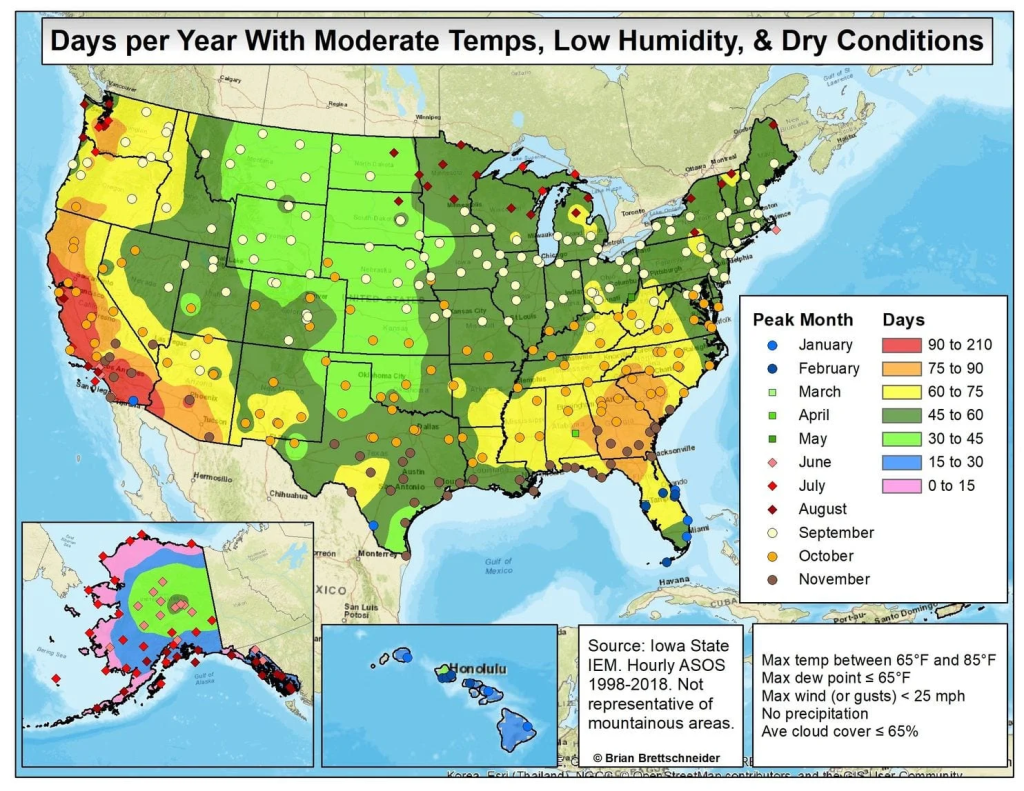
This map confirmed my intuition. My old life in New Jersey was in the dark green zone, and my new life in Alabama is one level better, in terms of how many “nice” days you can expect in a year.
If you don’t have climate control, then you might be more worried about weather extremes. If you are lucky enough to have a regulated indoor environment, then a nice place to live is largely a question of how many days you get when it’s nice to “go out”.
This map accounts for “nice days”. I wonder if New Jersey would seem closer to Alabama if the measure changed to “nice daylight hours”. Yesterday was beautiful, but it was dark by 5pm. When I get time, I’m going to make a map of where in the lower 48 you can enjoy dinner outside after work many times per year (and why is it Southern California?).
Ball and Romer Sticky Prices as Coordination Failure
In the course of research work, I read “Sticky Prices as Coordination Failure” today, published in 1991 by L. Ball and David Romer.
They suggest that “coordination failure is at the root of inefficient non-neutralities of money”. They write an elegant theory of price setting and adjustment that includes a menu cost. A menu cost is imposed on an individual who adjusts prices. The name comes from the fact that some restaurants face a literal cost for switching the paper menus.
If changing prices is costly then there is inertia. People tend to stay where they were before, even if adapting to fluctuating external conditions is more efficient.
According to their model of rational individual agents, people will change if the expected benefit of adjustment is larger than the menu cost. In some cases, the optimal action for an individual depends on what others are doing. Thus
Increases in price flexibility by different firms are strategic complements: greater flexibility of one firm’s price raises the incentives for other firms to make their prices more flexible. Strategic complementarity can lead to multiple equilibria in the degree of nominal rigidity, and welfare may be much higher in the low-rigidity equilibria.
An implication is that if you are surrounded by people who are open to constantly changing, then you yourself will be more likely to adapt. The world is always fluctuating, so welfare is higher for communities that can adapt quickly. Example of changing circumstances include global warming and novel safety procedures suddenly needed during the time of Covid.
In this paper, “multiple equilibria” means that a community might settle at a high-wealth level or a low-wealth level simply because of what everyone else is doing. Ball and Romer don’t try to figure out which equilibrium is more likely to be the outcome in reality.
No one in their model would be out of equilibrium (unnecessarily poor) if it were not for the “sticky” prices. As the title implies, coordinating the optimal levels of production and consumption is difficult because of the inertia of prices.
In their conclusion, they reflect on the role of government when multiple equilibria are possible:
… with multiple equilibria, policy can be less coercive. Instead of prohibiting certain contract provisions, the government could simply convene meetings of business and labor leaders to coordinate adjustment … Second, by moving the economy to a new equilibrium, temporary regulations can permanently change the degree of nominal rigidity.
They assume that after a recession, the price adjustment that needs to happen is “for decentralized agents to reduce nominal wages in tandem.” It’s interesting to see, culturally speaking, how hesitant they seem to strongly recommend government intervention through inflation. I feel like writers in econlit today would not be shy about saying they think governments should intervene through monetary policy, if they believe that to be true.
In my JEBO paper, I found that a little inflation caused workers to not lower production so much in response to a real wage cut after a recession. In our environment, I would say “cooperation” was more important than “coordination”, because there were only two agents and their decisions were sequential.
Visual Decision Trees in SAS Viya
As I said earlier, I used SAS Viya for Learners this semester. I assigned a final project for students. They had to use the data pre-loaded into the free version of SAS Viya, but otherwise had freedom to select their own variables and construct their own research question.
SAS Viya for Learners just recently opened for any users to make an account. This will allow you to learn SAS Viya functions (but not do your own actual work, because you cannot import new data). I’m using SAS Viya 3.4.
I like the way SAS Viya allows users to create a beautiful intuitive interactive decision tree model. This blog is to show you what that looks like. In traditional EconLit, regressions are more popular than decisions trees. Decision trees are a simple and useful machine learning technique. If you are trying to teach a first-timer about decision trees, then the visualization in SAS Viya for Learners can be helpful.
I’ll demonstrate using a decision tree for classification using built-in SAS data. One of the larger datasets available is USCENSUS1990. I’ll use it to demonstrate (and I do love the 90’s!). Consider the variable about the number of children a person has. This could be reasonably predicted by age and education level. [Footnote 1]
Here’s a chart showing the frequency of family sizes for adult women. (I used a Filter to only include people who are not coded zero in iFertil. See Footnote 1.)
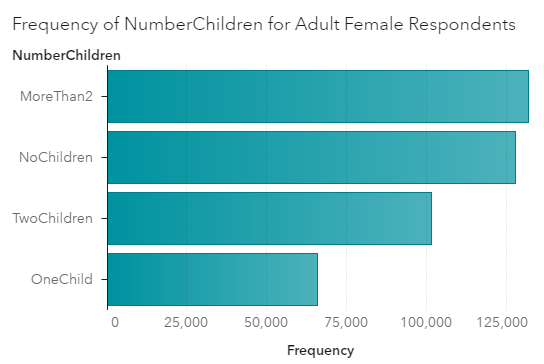
For adult women in 1990, the most frequent category is to have more than 2 children. This would include the parents of Boomers. Think about those big families you know from the Boomer generation.
For input variables to my model, I’ll use age categories and also education levels. I set the new categorical variable I created called NumberChildren as the Response variable for a decision tree model. [Footnote 2] Here’s a zoomed out picture of the visual model output.
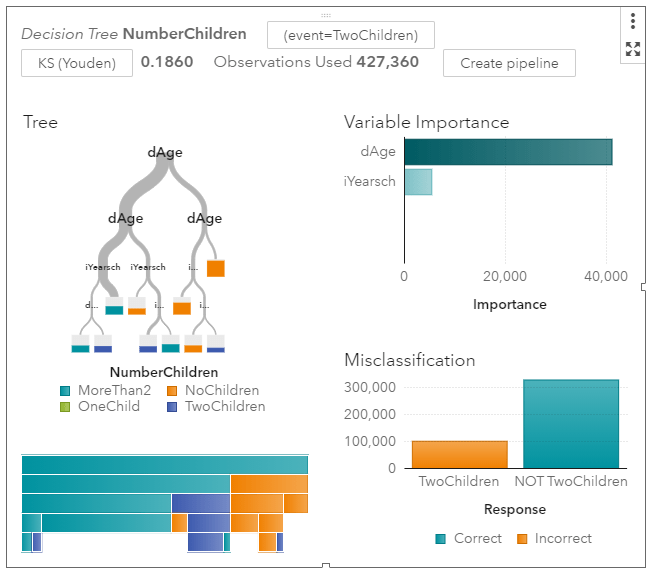
It’s immediately obvious that age is more informative than schooling. Women under the age of 30 are much more likely to have no children. The width of the grey tree branches makes it easy to see where the majority of the observations are.
I’ll zoom in on the left side of the tree where most of the people are.
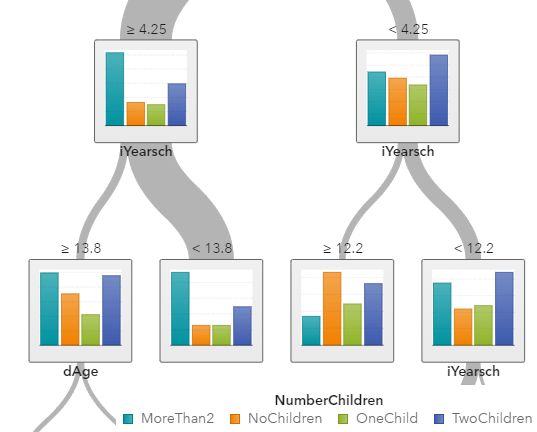
The “>= 4.25” means that women on the far left side are over the age of 40. Among older women, the norm is to have 2 or more children. If you are looking for the older women with exactly two children, you are more likely to find them among those who have an education score of larger than “13”, meaning that they have a Bachelor’s degree or higher.
My point is not to posit causal relationships among education and fertility. My point is how awesome these graphs are. You do have to learn some point-and-click functions within SAS Viya to make them. But I don’t know of any other software that can produce this.
SAS Viya also provides tables and statistics on each node, which is more like what I could get from free open source software a few years ago when I looked into decision tree packages.
[Footnote 1] If you want to replicate what I did, know that the USCENSUS1990 dataset in SAS Viya comes with no explanation. Google brought me to UCI, where I found what I needed in terms of technical documentation.
dAge, iFertil, iSex, iYearsch are the names of the variables you will find in SAS. To create my graphs and models, I converted some of them to categorical variables using the “+New Data Item -> Custom Category” functions. No programming is required.
iSex: 0 indicates Male, 1 indicates Female
dAge is coded as follows: 0 is babies; 1 is under 13, 2 is under 20 (but over 13), 3 is under 30, 4 is under 40, 5 is under 50, 6 is under 65, 7 is for 65 and over
iFertil is coded: 0 is either less than 15 years old or male, 1 is no child, 2 means they have one child (confusing…), 3 means they have two children, all the way up to a 13 which is the code for 12 or more children
iYearsch: 3-10 refers to primary school up to a 10 indicating graduating from high school, 11-13 refer to some college and associate degrees, 14 is a Bachelors degree, 15-17 refers to higher degrees
[Footnote 2] I decided to set Maximum levels to 5 in Options. This keeps the tree smaller which looks better in the blog.
Alabama’s Covid Data Hero
Housekeeping: There was no post yesterday on Economist Writing Every Day. It was my day to write and family responsibilities just took up every minute. This might happen occasionally.
Last week I wrote about American Data Heroes. There are many that I don’t know of , but I wanted to share the work of tireless Frank McPhillips. For months he wrote a succinct post every single day within a private Facebook group for concerned citizens of Alabama. Recently he switched to Substack, meaning I can share it here.
McPhillips summarizes and explains the Covid data for the state of Alabama, where I live. This is data that is publicly available, but most people like myself don’t want to do as much work as he does to understand it. He also understands when the reporting might be wrong or late.
I’m going to quote from his most recent posts.
The Chairman of the Madison County Commission was more blunt. “We’re now talking about alternative space for a morgue”, he said, adding that he has never faced such a decision in 25 years of public service.
According to HHS, 87.7% of Alabama’s ICU beds are occupied… Our State added 3,390 more COVID cases today (incl. 655 probables), raising the 7-day moving average to 3,228 cases per day, which is twice the daily average 3 weeks ago.
With 473 more cases, Birmingham’s home county, Jefferson, has a 14-day positivity rate that tops 30% for the first time.
Now, brace yourself for the updated hospitalization data: 2,079 patients (105 reporting hospitals), a jump of 163 patients in a single day. The Huntsville Hospital system reported 378 COVID patients, an increase of 76 patients in one week. DCH Health system reported 138 patients, double the number just 9 days ago. And finally, Regional Medical Center (Anniston) announced new visitation restrictions due to the pandemic: “For end-of-life care, two visitors will be permitted to remain in the patient’s room, without leaving or re-entering the building and without substitution”.
I appreciate all his work. It’s obvious when he’s getting depressed or exhausted, but he’s decided to keep going (almost) every day. He keeps writing new prose on how this is the most deadly “war” of our time. He wants people to keep fighting back and not get complacent. See his Dec 7 post for more war comparisons.
McPhillips has helped a lot of people in his locality. He inspires me for Writing Every Day.
Teaching with SAS Viya for Learners: Last Report
I used SAS Viya for Learners to teach data analytics to undergraduate business students for one semester.
I’ll start with the benefits of SAS Viya: It’s free; It’s visually appealing and requires no coding; There are some SAS tutorial materials that teachers can use; The way decision tree results are displayed makes intuition easy for students who are new to data mining.
I made a post earlier in which I reported that it actually works. I still think that, but at the end of the semester I did have individual students experience errors and mysterious interruptions to service. It made me wonder if the server gets busy at the end of an academic semester.
SAS is known for making excellent products and charging high fees for them. Since SAS Viya is free, they aren’t going to be giving all the functionality with it. The free version does not let students import any data. There is a sandbox of data to learn with, which is more than enough to fill a semester. I didn’t even open most of the available data sets.
My students did their final projects by choosing one of the pre-loaded datasets and using that for analysis. As far as applying the principles I taught, this was fine. In one sense, it was easier than telling them to fend for themselves and find data on the world wide web.
The downside is that the software-specific skills students learn from free student SAS Viya can’t be used on a project for work or for a different class. Eventually, any useful work involves importing new data.
The decision to use SAS Viya for Learners instead of R should depend on what your students want to do next. Both products will allow them to learn concepts and common functions.
If you are going to use SAS Viya, I highly recommend using the tutorials made by SAS with screenshot-by-screenshot instructions. You can give the instructions to the students, so students aren’t coming to you with questions about every click they need to make.
I paired SAS Viya with a Business Intelligence Textbook. Also note that students had already taken a traditional Business Statistics course previously.

