Joy on Books for 2020 Holiday

I have, I’ll have you know, bought some adult books and read some of them in 2020. Two that I hope to eventually review properly here are One Billion Americans and The Property Species. For now, I’ll just say that I recommend them if your interests overlap with mine.

The books that I read are usually children’s books. I read them out loud, every night.

These are some classics that my 2-year-old is currently asking for on a nightly basis. She is in the repetition stage and also edging into the stage of development where she will flip through a book and “narrate” from the bits that she remembers. “Cow jumpin’ da moon!” is one of the lines she will use when flipping through Goodnight Moon.

Two classic books that are a little more complex for 2 are Make Way for Ducklings and The Little Engine That Could. Sometimes I’ll only read half of the words to keep the pages flipping faster for her.

I’ve got another classic recommendation. I don’t think it’s bad to recommend classics that you have already heard of. At this point, there are so many classics that people still need to choose between them. The Narnia series is really great. The plots are good. Kids are always being told to “be nice”, but children are going to see a portrait of goodness in these books that will serve them well. What does it mean to be good and why do we bother? We just got to the part where King Caspian abolishes the slave trade on an island.

Even though I’m currently reading through the series with my 5-year-old, I would recommend a different strategy to most parents. Wait until age 6. Start off with The Lion, the Witch, and the Wardrobe just one page before Lucy goes into the wardrobe. That way your kid will immediately start meeting magical creatures. Once your child is invested in Narnia, they can probably sit through the entire first chapter on a second read-through.

Two more random kid’s recommendation: (1) We got Germs out of the public library last year. When my son was 4 (well before Covid), he asked for that book every night for months. We checked it out over and over. In the time of Covid, I think this is a great intro to the immune system.

(2) Aunt Flossie’s Hats is a good way to sneak in some history without it feeling like school. The story involves a woman relating memories to her granddaughters. (bonus points for being anti-racist)
If wages fell during a recession

A paper I wrote with Dan Houser is forthcoming in the Journal of Economics Behavior and Organization. “If wages fell during a recession”

https://www.sciencedirect.com/science/article/abs/pii/S0167268120303577

The title comes from Bewley’s famous book “Why Don’t Wages Fall During a Recession?” In that book, Truman Bewley asks managers why they do not cut wages in a recession when equilibrium analysis tells us that the price of labor should fall.

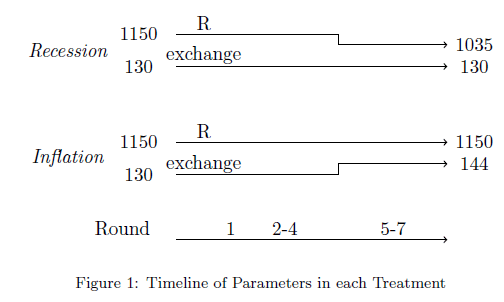
We run an experiment in which employers and workers encounter a recession. The employers could cut wages, or they could keep them rigid as we normally observe during recession. The concept of a “cut” assumes a reference point from which to go down from. We establish that reference point by letting the employer set a wage before the recession and repeating that payment to workers for 3 rounds.

We use a Gift Exchange (GE) Game to model the relationship between employers and workers. Employers offer a wage that is guaranteed to the worker. Employers have to trust that workers will not shirk. We do observe a few subjects shirking, and those people are not very interesting to us. We are interested in the workers who respond with positive reciprocity because that means there is “good morale” in the “workplace”. The employers interviewed by Bewley were afraid that wage cuts would damage the good morale that is necessary for a business to run.

After three rounds, there was a recession. The total surplus available in the GE game shrank by 10%.  In the Inflation treatment, the exchange rate of tokens to dollars increased, such that if firms kept nominal wages rigid there would in fact be a 10% real wage cut.

If workers resent nominal wage cuts, then firms should keep wages rigid in a recession. If worker morale falls and workers decrease effort, then firms will be hurt more by the fall in productivity than by a large real wage cost.

In fact, about half of the firms did cut wages. So, we did not observe wage rigidity and we’d like to do follow-up research on that point. It did mean that we had variation and could observe the counterfactual that we were interested in.

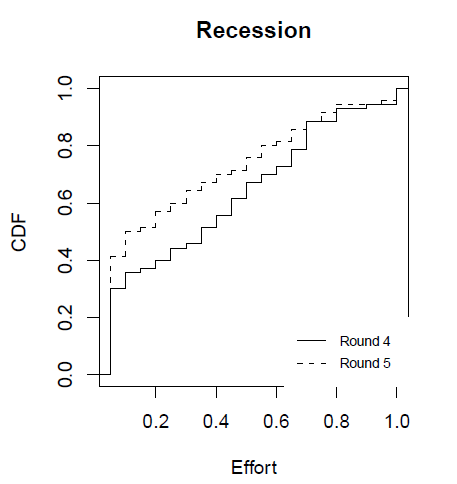
Workers don’t like wage cuts. Workers who had been selecting an effort level near the middle of the feasible range dropped their effort significantly if they experienced a wage cut. The real wage cuts under Inflation did not have as sharp of an effect on effort, which suggests some nominal illusion.

Here’s a cumulative distribution of effort choices among workers (Recession treatment had no inflation). After half of the workers experienced a wage cut, the effort distribution moves toward 0.05, the minimum effort level.

We measured loss aversion at the end. We can’t say that loss averse workers resent wage cuts, because everyone resents wage cuts. There’s maybe some evidence that loss averse employers are less likely to cut wages. Thanks for reading! Please reach out through my Samford email if you’d like to know more.

The relationship between loss aversion and wage rigidity deserves more attention from behavioral economics.

Special thanks to Misha Freer, Cesar Martinelli, and Ryan Oprea for conversations that helped us. Also, we are indebted to everyone that we cited, of course, and to all the people we failed to cite.

2020 Nobel Prize to Milgrom and Wilson

The big news in our world is that the Nobel Prize was announced today for economists. (We call it “the Nobel Prize”.)

Paul Milgrom and Robert Wilson win for 2020. They are known for auction theory and design. Here is a popular introduction from the Nobel Committee.

This prize is special to me because auction design was one of the very first practical problems that presented me with a chance to put economic ideas into practice. As an undergraduate at Chapman University, I had the privilege to spend time talking with people like Vernon Smith and Dave Porter. Some people think of Vernon Smith as being someone who “does things in the lab”. The thing that he actually did was often auctions.

My master’s thesis at Chapman University was a project on auctions. A practical problem to motived our inquiry. Students at Chapman were upset about the way that the most convenient parking spots were allocated. Concerns about parking showed up in quantitative student satisfaction surveys.

We designed an auction to price and allocate the most coveted parking spots. In this scenario, multiple items are being sold because the parking lot has many spots. Hence the “multi-unit” in the title of our paper Information Effects in Uniform Price Multi‐Unit Dutch Auctions.

We had an important question, since we were actually going to run an auction that would affect people’s lives. How to we choose from among the different possible auction formats?

Paul Milgrom (with Robert J. Weber) provided guidance to us in their 1982 paper in Econometrica.

Among other things, in that paper, they compare the revenue properties of English auctions and Dutch auctions. In an English auction, the price starts low and bidders compete to out-bid each other until the price is so high that only one bidder remains. That is the popular conception of an auction. There is another mechanism class (Dutch) in which the price starts higher than anyone wants to pay and drops until a buyer jumps in. Once you start thinking about how many ways one could run an auction, then you need some way to decide between all the mechanisms.

Theory can help you predict who will be better off under different formats. And, in my case, needing to figure out the revenue properties of different auction formats can help you learn economic theory!

American Moments

The presidential debate on September 29, 2020 was an embarrassment. I don’t remember what the candidates said because I just kept panicking thinking about the fact that other people could see what was happening. Didn’t some adult somewhere have a kill switch?

After an hour of listening, I expressed my sincere wish that this had never happened:

Tyler had a more nuanced take:

It’s not just true in America. Much of what passes for “debate” is just people firing off talking points at each other. Usually it’s not quite so obvious and awkward because there are not such clear rules being broken.

If there’s one thing that Americans agree on, it’s that you wait your turn in line. This is the most basic schoolyard etiquette. No matter how rich or famous you are, cutting in line is deeply resented. It felt like President Trump was not taking turns (so then it was strange for me to fact check this and see that Biden spoke only 2 minutes less total than President Trump).

If it were in my power to undo that night I would. However, a new podcast gave me some more to ponder about in terms of what Americans can be proud of. A lot of true news comes out about Americans making mistakes. That can be useful for others. Audrey Tang said of our misdeeds:

COWEN: … the United States, has made … many mistakes … What’s our deeper failing behind all those mistakes?

TANG: I don’t know. Isn’t America this grand experiment to keep making mistakes and correcting them in the open and share it with the world? That’s the American experiment.

Being open about our mistakes might be the next best thing to not making them in the first place.

Tang, a transgender Taiwanese computer policy expert, said something that I think Americans can be happy about.

Speaking of software, here’s a recent conversation with a 5 year old about what exactly is software and what does it mean to buy it. My son imagined that if I bought it in a store I must have picked something up off a shelf. (I could have explained that software is a nonrival good, but I think it’s too soon.)

How Bayesians Read a Think Piece

How likely is it that an opinion critical of [topic] will get expressed by someone on the internet?

My good friend (call her Anne) texted me this week. Anne sent me a link to a blog that declared some of her preferred works of art (i.e. musicals) to be inferior. She loves art, so to be told that her tastes were not exceptionally good was disappointing.

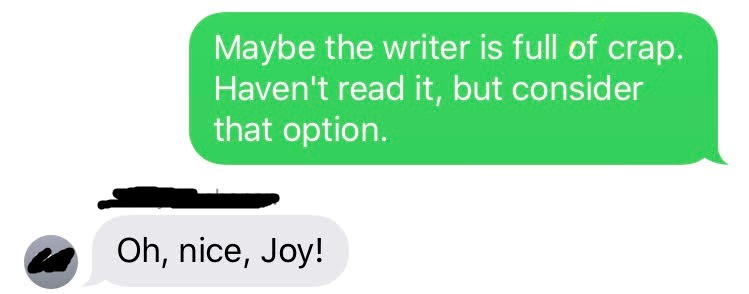
In my reply I wanted to make sure that Anne wasn’t putting too much weight on this new evidence:

How should we incorporate blogs into our beliefs about reality? (I see the irony – I’m writing a blog right now.)

The non-technical summary: you should be skeptical of what you read online.

The technical summary: the fact that some writer said “H” on the internet, should make you only slightly more confident that “H” is true.

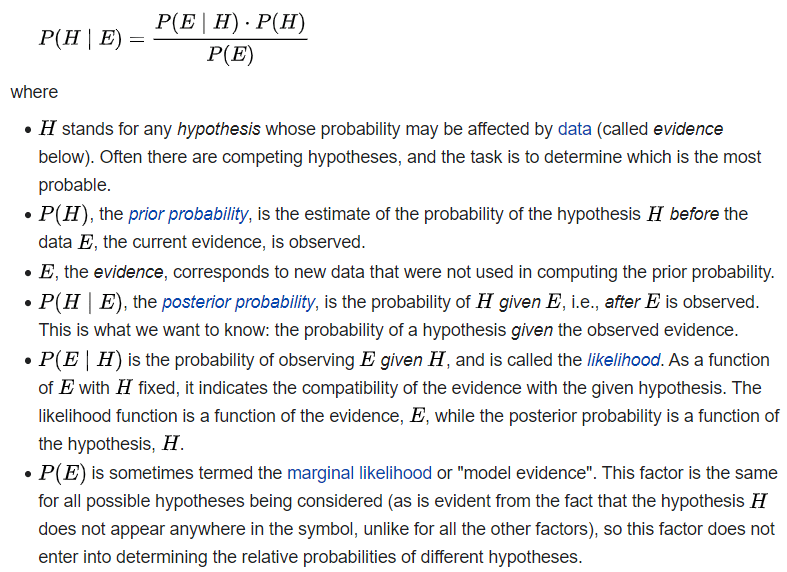
I can’t improve on the Wikipedia presentation of Bayes’ theorem, so I’ll just paste in:

Let’s consider the probability that it is true that Anne’s favorite musical is bad. We’ll call that hypothesis “H”. What’s the probability of H, given that one person wrote an article stating that the musical is bad?  

The evidence, E, is the article.

Instead of just evaluating whether the article is convincing or not, Bayesian inference requires that we consider

  1. Were we confident that H was true BEFORE seeing the article? Was there good data up until this point that convinced us H is true?
  2. If H is true, what’s the probability of this article being written?
  3. What’s the overall probability of this article being written, regardless of whether H is true?

The probability that musical is bad given that someone wrote an article saying so is :

P(H|E) = P(bad|article)

P(bad|article) = ( P(article|bad) x P(bad) )/ P(article)

The right side of the equation asks whether we are likely to see the article if the musical is bad. If the musical is actually bad, then we are likely to see it condemned in print. HOWEVER, if we had a prior belief that the musical is not bad, then the numerator gets smaller.

Finally, we consider the denominator, P(E) or the probability of seeing an article that is derogatory towards the musical. If that probability is high, then the probability of the musical actually being bad goes down.

Here’s how Anne should think:

P(bad|article) = ( likely that article will be written if bad x prior evidence suggests not bad) / snobby think pieces get written regardless

so

P(bad|article) = (big x small)/ big = small probability that Anne’s favorite musical is actually bad

You should be just the right amount of skeptical when it comes to internet content. Be Bayesian.

Only Real Quotes

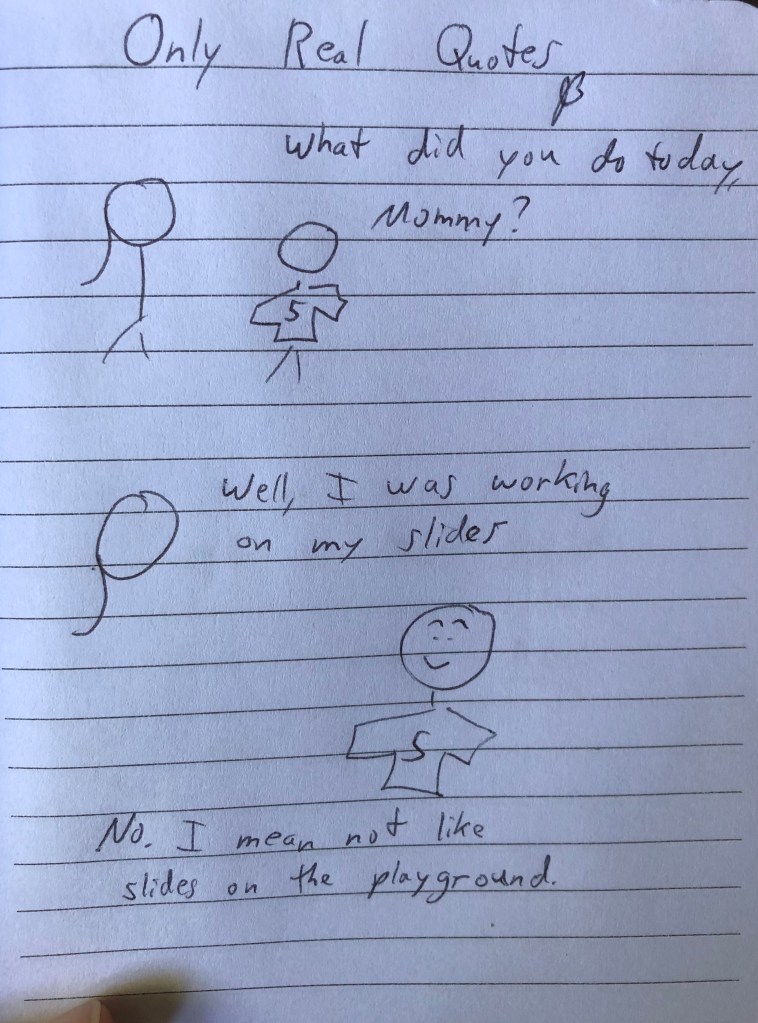
I’m going to occasionally make cartoons of actual things that people have said. The real world can be very entertaining. I was a graduate student at George Mason University, so I got to take a class from Bryan Caplan.

He broke up his 3-hour lectures with Caplan-jokes. I only remember one. Maybe it stuck with me because of the funny voices. He was talking about happiness and consumption in the context of microeconomics. He impersonated a German philosopher debating a British philosopher.

This is an idea Bryan explores in a recent blog.

Do people do what makes them happy? What do we make, as economists, of people who claim that they want to write a novel but never do? If someone claims to prefer sad songs, can we really call them sad songs?

Next, here’s one from me and my son. I put his age on his cartoon shirt. I always ask him about the details of his day while I was away at work. He’s old enough to understand a little bit about how I spend my time, but sometimes I don’t get it right when I attempt two-way communication.  

Affording a second child

I have been reading Matt Yglesias’s book. I’m going to quote his podcast with Tyler here:

I also think that a lot of the way society is structured disincentivizes educated professional people from having a second or third child, even though it’s not that the objective financial cost of doing it is so high.
But you think about Democratic Party micro-targeting of everything. They’ll say, “Well, okay. If this little extra boost will help lift some people over the poverty line, we should do that. But if you’re making $140,000 a year, you don’t ‘need’ help with your childcare costs.” That’s how the people in the think tanks think.

Matt Y

On the margin, people who don’t live in poverty still feel financial pressure. They still worry about whether they can “afford” more children.

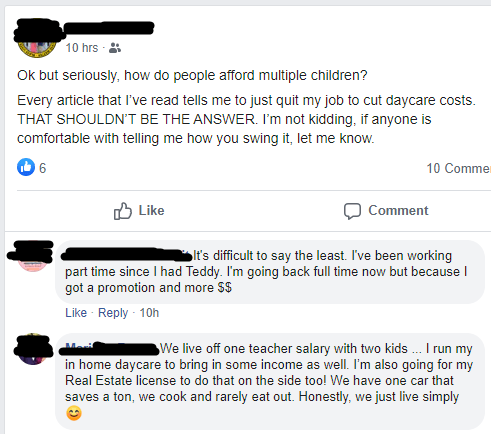
The following Facebook post stood out to me yesterday. I went to high school with this woman (call her Rachel). She teaches at a public elementary school in New Jersey. She is married with one daughter.

It sounds like Rachel wants another child, a sibling for her daughter. As a working mom, I can sympathize with her desire to not quit her job.

More answers from her peers include “I’ve been also looking for this answer. Anyone I know who has had more than one, one usually stays home and the partner works. I don’t know how people do it!” and “I have to say this month has been TERRIBLE! Paying $250 a month for my baby at daycare and then having my oldest there a few days a week bc my in-laws can’t handle zoom 😳 I’m literally working for health benefits.”

This response is probably from someone who is one stage of life ahead of Rachel, “It was hard but we lived off one salary till the kids were 5 years old. We didn’t go out or do much at all. Cost of daycare for twins was insane. Once they were in school most of the day I got my job…”

Matt Yglesias wants Rachel to have another child, and a third if she wants a “big family”. That’s not how we get to one billion Americans, it’s simply how we avoid population shrinkage.

I’ll probably deal with more of Matt’s ideas in future posts. Even if you disagree with all his policy recommendations, it’s a great book to get you thinking.

I did some quick Googling and it seems like Rachel’s job pays over $40,000 per year. It wouldn’t be crazy to assume that Rachel’s household income is “6 figures”. If their daughter is currently in daycare and they have a second child who needs daycare, then they could be looking at a daycare bill over $20,000 per year during the crunch time. That crunch time wouldn’t last very long, BUT that is a daunting bill to pay when you are also paying for rent and diapers and don’t want to eat beans every day. New Jersey has relatively high property taxes, rents, and daycare costs.

Abraham and Kearney on the Decline in Employment

Katherine Abraham and Melissa Kearney just published
“Explaining the Decline in the US Employment-to-Population Ratio: A Review of the Evidence” in the Journal of Economic Literature.

The unemployment rate measures people who are actively looking for work and can’t find a job. The authors are not examining short term fluctuations in unemployment (which shot up in pandemic times). They are looking at at long term decline in employment rates of working-age adults in the US. The trend began in 1999. Employment of adults in the US dipped after the Great Recession and still has not recovered a decade later. Less-educated males have experienced the largest drop in employment.

I’m reviewing the entire paper with my Labor Economics class. Most of what the authors talk about can be found throughout our Labor Econ. textbook, but I like using the paper to organize and motivate the collection of facts and theories.

Here’s a summary of their thorough examination of possible causes of the decline in working.

They estimate, drawing on other empirical work, that two factors have a considerable and measurable impact on the decline in formal employment. Import competition from China (the US changed their position on trade with China in 2000) and automation (industrial robots) both result in lower demand for US workers.

There are three contributing forces that the authors declare them to be minor casual factors. Increased receipt of disability benefits disincentivizes working, higher minimum wages results in less jobs, and the increased incarceration rate in the past few decades takes adults out of the labor force.

The paper is called “A Review of the Evidence”. The following is a list of factors that could in theory be responsible for the decline for working but for which data is scarce:
Lack of child care
Changes in leisure options (i.e. young men play video games)
Changes in social norms (i.e. young people can stay “in the basement”)
Increased use of opioids (could be a result of diminished job opportunities)
Rise in occupational licensing
Frictions or matching issues

All of those indeterminate items represent research opportunities.

The Powerful Allure of R0 < 1

I categorize this as “News”, because I don’t know if we will have enough posts on medicine to justify a whole category for Medicine. Because the coronavirus is affecting life so much, it’s well worth writing about currently.

R0 is the average number of people who will contract a contagious disease from one person with that disease. If you want, you can pronounce it “R naught”.


If R0 is less than 1, and stays that way for a while, the disease will disappear. That means that the virus can still be passed around between a few people (for example, if 1 out of 1,000 people forgets to bring a mask into the grocery store), but over time it will run out of targets and we will be done with this whole thing. If R0 is above 1, that means that a few cases produces more cases and eventually most people will get infected. Once you understand the potential of R0<1 it does become tempting to engineer a lockdown.


We understand the spread of the virus better than we did when lockdowns were first discussed in the US in March 2020. It’s not as simple as every infected person giving the virus to two new people. The way the virus spreads is often through “superspreaders” and superspreader events. That’s why so many large gatherings have been cancelled and continue to be cancelled. With this wrinkle in mind, there is still the overall R0 score of whether the virus is increasing or decreasing.

If you fail to stop the initial spread of the virus (R0 > 1) then a great many people can be infected and eventually the spread will slow simply because the virus is running out of hosts. One of the more controversial topics in Spring 2020 was whether “herd immunity” is or is not something we should want to achieve as a society.

One of the absolute best places to get virus news is MarginalRevolution.com. Today, Tyler has written a new post about herd immunity. I’ll provide some quotes. Much more at the link of course.

… these same herd immunity theorists tended to be less pessimistic than many of the mainstream forecasts…

Now, I don’t recall many of those theorists early on making a prediction about a specific number required for the herd immunity threshold to be reached.  Nonetheless, when deaths and hospitalizations collapsed in Sweden, London, and New York at about 20 percent seroprevalence, obviously it seemed that might be the critical level for herd immunity to kick in.

…

Then things started to go askew in the last few weeks.  First, it seems like a bad second wave came to an already fairly hard hit Madrid.  OK, you could say Madrid was never had 20% seroprevalence to begin with.  And then what appears to be a second wave has started coming to Israel, with rising hospitalizations.  Finally, it is believed that in Britian R equals about 1.7, and that a second wave of cases is on the verge of hitting London and Southeast England.

Tyler Cowen

Even though no one has all the answers, this is the conversation we should be having. In fact, I’m starting to wonder if we should make a Medicine blog post category.

It was just yesterday that the dreaded and long foreseen 200,000 deaths was confirmed.

The Problem of Paying Attention in Online Classes

Currently, I subscribe to Bloomberg Businessweek. Instead of ranking MBA programs, this year they decided to report on a survey of students about switching to online classes. (in the Sept. 21 issue)

Overall, the reaction from students has been negative. They believe an online MBA is not as valuable as the traditional in-person experience.

Something MBA students state, which I have already heard from my own undergraduates, is that it’s difficult to focus during online instruction hours. If your face isn’t being watched through your webcam, then it’s tempting to “multitask” and not pay attention to the professor. I feel the same temptation when I join online research seminars.

What’s the most sympathetic view of this situation? Doing your online classes “isn’t that hard”. I feel like the scold looking over my bifocals at millennials saying, “going to a dry cleaner isn’t that hard”. (We millennials cannot be bothered to go to a dry cleaner.)

Here’s my first and brief thought: College students today have been taught to use screens for recreation by their parents.

Parents put kids in front of screens to get rid of them. I get rid of my own kids by putting them on screens. I ensure that they are not watching something evil.

I hope parents are diligently ensuring that their preteen daughters are not chatting up predators. What responsible parents have been told is to try to limit total screen hours and also to try to keep your child out of the digital equivalent of dark alleys.

That kind of guidance doesn’t teach students how to use screens constructively. They are suddenly being asked by teachers to be constructive on the screen. Some of them can hack it. Some of them can’t. None of them were prepared for this.

Your typical 20-year-old college student today must have done well in traditional classrooms because they did, after all, get admitted to college. But when they were on their screens, they were scrolling and gaming and indulging their impulses. As long as they physically showed up to class on Monday morning and turned in enough homework assignments, no adult was going to make them do chores on screens.

Since screens are here to stay, we need a lot more research on how to raise humans who know how to be responsible on screens.

No answers came to me when posed this question to the hive mind: