This week has been busy with the enjoyable task of hosting a distinguished economist in Alabama. I can only briefly follow up on my campfire post. (Yes, this is apropos of everything.)
I do not usually use LLMs to write even part of my posts but since I am pressed for time, I will just take this as a chance to assess Claude. I pay for Claude and Grok, currently. Both of those subscriptions resulted from a particular moment when I thought I could get a particular task done with them and was in a hurry. If I could do it all over again, I would undo those subs, I think, and go more in on the OpenAI Pro products.
Prompt: Finger wagging is surprisingly ineffective; telling a compelling story is surprisingly effective. Can you expand that out into a paragraph for a blog?
Claude response: The art of persuasion often defies our intuitive assumptions. While many of us default to stern lectures and admonishing fingers when trying to change minds, research consistently shows this approach tends to backfire, causing people to become defensive and dig deeper into their existing beliefs. What proves remarkably more effective is the simple act of storytelling. When we encounter a compelling narrative, our brains react differently than they do to facts and figures alone – we become emotionally invested, our neural patterns sync with the story’s flow, and we naturally lower our defensive barriers. Stories create a shared experience that bridges ideological divides, allowing new ideas to take root not through force, but through the gentle power of narrative empathy. This explains why parables and fables have been humanity’s preferred teaching tools for millennia, while memories of being lectured rarely inspire lasting change.
Claude is always a little too verbose, in my opinion. Still, the logic and grammar are good. The machines can write.
I might write more soon about how AI’s used narrative to influence humans in the novel The Diamond Age.
It’s a niche thing, but Art Carden and I wrote a collection of Taylor Swift/Adam Smith essays. I’m going to use some for teaching this semester, so I wanted to post this in case it’s useful for other teachers.
In introductory economics courses, students often encounter Adam Smith as a one-dimensional figure – the patron saint of self-interest who wrote about the “invisible hand” of the market. But Smith was a far more nuanced thinker, and his insights about human nature remain relevant today. The challenge is making these complex ideas accessible to modern undergraduates.
That’s where this comes in as a teaching aid. Through three recent articles examining Swift’s very public decisions and artistic output, we can introduce students to Smith’s key ideas in a way that feels immediately relevant and engaging. From Swift’s struggles with public perception in “Anti-Hero” to the economic implications of her homemade cinnamon rolls, these pieces provide concrete, contemporary examples that illuminate Smith’s dual role as both moral philosopher and economic thinker. Many undergraduates are already familiar with Swift’s music and public persona, providing an accessible entry point to Smith’s more abstract concepts.
Here’s the recommended order to introduce our articles and a blurb on what you can learn (seriously).
“Anti-Hero as a Smithian Anthem” – This article introduces Smith’s foundational concept of the impartial spectator and his sophisticated view of human nature through a contemporary example. The article demonstrates that Smith wasn’t just an economist but a moral philosopher who understood how deeply humans care about others’ perceptions of them, showing students that economics isn’t just about money.
“Taylor Swift & The World’s Most Expensive Cinnamon Rolls” – This piece provides a bridge between Smith’s moral philosophy and his economic thinking, using opportunity cost analysis while simultaneously showing how rational economic actors might “inefficiently” spend time on activities that build social bonds. The article illustrates how Smith’s ideas about sympathy and social connection exist alongside, not in opposition to, his economic insights about specialization and efficiency.
“Would Adam Smith Tell Taylor Swift to Attend the Super Bowl?” – This article builds on the previous readings to explore the full complexity of Smith’s thought, showing how his ideas from both The Theory of Moral Sentiments and The Wealth of Nations can be applied to analyze real-world decisions.
A recent scout campout got me thinking about who gets an audience. A small group was sitting around a campfire silently. Eventually the person who piped up and sapped our attention was 9 years old, with all the maturity expected thereof. Who is to blame for the low quality of discourse that night? I didn’t expend any energy to make good use of that time. I could have taught those kids something, if I had told an engaging story or introduced a clever joke. It would have taken energy to communicate something important in a way that they would want to listen to it.
We have a limited number of minutes to pay attention to the world and we use few of them productively. There is a metaphorical campfire every night, after the work of subsistence is over. Who speaks up? Who gets an audience? When a journalist is doing their best to cover an important issue or sound an alarm, how many people bother to click or get a paid subscription?
I regularly see people complain that journalists or the media are doing it wrong. “Why didn’t the NYT cover X?” Jeremy regularly points out that the NYT did cover X, but not many people clicked.
Ship hijackings on the other side of the world aren’t very fun to read about. What really got clicks this past week was Melania’s hat.
Most of the handwringing over what the media should do is deflecting blame from what we should be doing, which is paying for good journalism and engaging in the boring/important news.
Even before LLMs, for decades, there has been no shortage of great serious writers and text could be shared at very low cost online. The bottleneck is the audience. Good readers are more scarce than writers.
The Chair on Netflix is entertaining and I’d recommend it to EWED readers.
Plot, via Wikipedia: Professor Ji-Yoon Kim is the newly appointed chair of the English department at Pembroke University. The first woman chosen for the position, she attempts to ensure the tenure of a young black colleague, negotiate her relationship with her crush, friend, and well-known colleague Bill Dobson, and parent her strong-willed adopted daughter.
Something I like about the writing is that there is genuine suspense. Going into the last episode, I didn’t know what would happen with the romance or the threat of job dismissals.
The show is funny, occasionally. If you are looking for something easy to watch in 30-minute episodes at the end of the day that won’t leave you too upset, this will work.
Some of the issues they raise deserve serious treatment, but the serious treatment will not be found in The Chair. It’s for Netflix, with binge watching potential. Without offering any spoilers, I’d say they supply the kind of ending that viewers want. You need not overthink it.
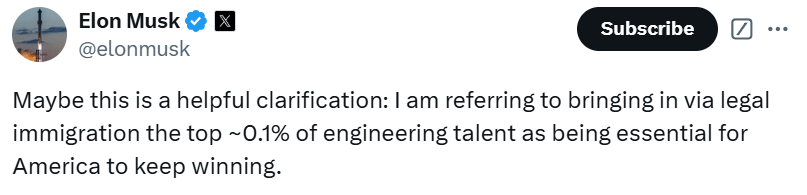
Several recent tweets(xeets) about tech talent re-ignited the conversation about native-born STEM workers and American policy. For the Very Online, Christmas 2024 was about the H-1B Elon tweets.
Elon Musk implies that “elite” engineering talent cannot be found among Americans. Do Americans need to import talent?
What would it take to home grow elite engineering talent? Some people interpreted this Vivek tweet to mean that American kids need to be shut away into cram schools.
The reason top tech companies often hire foreign-born & first-generation engineers over “native” Americans isn’t because of an innate American IQ deficit (a lazy & wrong explanation). A key part of it comes down to the c-word: culture. Tough questions demand tough answers & if we’re really serious about fixing the problem, we have to confront the TRUTH:
Our American culture has venerated mediocrity over excellence for way too long (at least since the 90s and likely longer). That doesn’t start in college, it starts YOUNG. A culture that celebrates the prom queen over the math olympiad champ, or the jock over the valedictorian, will not produce the best engineers.
– Vivek tweet on Dec. 26, 2024
My (Joy’s) opinion is that American culture could change on the margin to grow better talent (and specifically tech talent) resulting in a more competitive adult labor force. This need not come at the expense of all leisure. College students should spend 10 more hours a week studying, which would still leave time for socializing. Elementary school kids could spend 7 more hours a week reading and still have time for TV or sports.
I’ve said in several places that younger kids should read complex books before the age of 9 instead of placing a heavy focus on STEM skills. Narratives like The Hobbit are perfect for this. Short fables are great for younger kids.
Which is it? Is there a glut of engineering talent in America? Are young men who trained for tech frustrated that employers bring in foreign talent to undercut wages? Is there no talent here? Are H-1B’s a national security necessity to make up the deficit of quantity?
Previously, I wrote an experimental paper called “Willingness to be Paid: Who Trains for Tech Jobs?” to explore what might push college students toward computer programming. To the extent I found evidence that preferences matter, culture could indeed have some impact on the seemingly more impersonal forces of supply and demand.
For a more updated perspective, I asked two friends with domain-specific knowledge in American tech hiring for comments. I appreciate their rapid responses. My slowness, not theirs, explains this post coming out weeks after the discourse has moved on. Note that there are differences between the “engineers” whom Elon has in mind in the tweet below versus the broader software engineering world.
One of the hardest questions in copyright policy is: “What would have happened otherwise?” When Disney lobbies for longer copyright terms or academic publishers defend high subscription fees, we struggle to evaluate their claims because we can’t observe the counterfactual. What would happen to creativity and innovation if we shortened copyright terms or lowered prices?
This is what makes Biasi and Moser’s 2021 study in the American Economic Journal: Microeconomics valuable. They examine a rare “natural experiment” from World War II – the Book Republication Program (BRP) – which provides insights into how copyright affects the spread and use of knowledge.
In 1942, the U.S. government allowed American publishers to reprint German scientific books without seeking permission from German copyright holders (though royalties were still paid to the U.S. government). This created a test case: German books suddenly became cheaper, while similar Swiss scientific books (Switzerland being neutral in the war) maintained their original copyright protection and prices.
This setup lets us answer the counterfactual question. What happens when you maintain basic royalty payments but prevent monopoly pricing? The researchers compared the same book before and after the policy change, German books versus Swiss books, areas near libraries with these books versus those without, and usage by English-speaking scientists versus others. Such comprehensive comparison groups are rarely available in copyright research.
The authors report that when book prices fell by 10%, new research citing these books increased by 40%. The benefits spread beyond elite institutions, with new research clusters emerging wherever scientists gained access to these books. This does not appear to just be shifting citations from one source to another – there was genuine new knowledge creation, evidenced by increased patents and PhD production.
Such clean natural experiments in copyright policy are rare (there are a few laboratory experiments). Most changes come from lobbying (like the “Mickey Mouse Protection Act”) or technological disruption (like music streaming), making it hard to isolate the effects of copyright itself. The BRP provides uniquely clear evidence that moderate copyright protection – rather than maximum protection – might better serve innovation.
As we debate copyright terms and academic paywalls today, this historical accident of war gives us something valuable: empirical evidence about what happens when you find a middle ground between total copyright protection and unrestricted access.
Biasi, Barbara and Petra Moser. 2021. “Effects of Copyrights on Science: Evidence from the WWII Book Republication Program.” American Economic Journal: Microeconomics, 13 (4): 218–60.
In our era of increasingly sophisticated artificial intelligence, what can an 18th-century Scottish philosopher teach us about its fundamental limitations? David Hume‘s analysis of how we acquire knowledge through experience, rather than through pure reason, offers an interesting parallel to how modern AI systems learn from data rather than explicit rules.
In his groundbreaking work A Treatise of Human Nature, Hume asserted that “All knowledge degenerates into probability.” …
Furthermore, I explain why this could have implications for the limits of AGI, if LLMs learn from experience and are limited in the number of datapoints they can observe. It is also a follow-up to my summer post: Is the Universe Legible to Intelligence?
In August, I listed the Top EWED Posts of 2024. Here are a few more highlights. This list is roughly based on web traffic, starting with the highest number of views for 2024, since the August list.
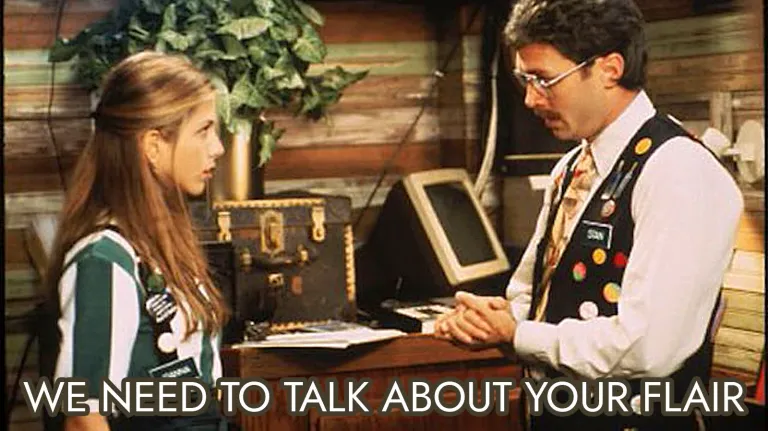
Mike Makowsky has the top post since August with Bad service is a sign of a better world. “What if service in restaurants, hospitality, etc is, in fact, lower in quality than it was one or two decades ago? I would like to suggest that this is a good sign of improving times.” Thoughtful. Recommended. Bosses will not be requiring “15 pieces of flair” anymore. I have noticed that restaurant servers these days seem to wear whatever they want. It was previously noted by Mike that Kitchen staff were canaries in the coal mine.
3. You know it’s good when a post with such a cryptic title goes viral. Mike wrote about the topic people were thinking about, in the moment: At the moment (updated 10/22/24) Sometimes we write about the economics community and what began as a critical mass of people that used to call itself #EconTwitter. Some of those people have moved to Bluesky. You can find Mike there at @mikemakowsky.bsky.social, and most of us have accounts there. Getting social media just right is tricky. If you follow the right people and don’t waste too much time on it, then social media can be part of How to Keep Up With Economics (James).
9. Post-Pandemic Lumber Market Zachary Bartsch writes, “People used to talk about higher gasoline prices all the time, but never discussed with the same enthusiasm when prices fell. The same is true for lumber.” Good for teaching about supply and demand.
10. I Give Up, Standard & Poor’s Wins James lets us learn from his journey- “my stock picks underperformed the incredible 26% return the S&P has posted so far this year.” This is something most people would rather not admit, and yet for most of us it’s true.
12. Why Podcasts Succeeded in Gaining Influence Where MOOCs Failed attracted some attention. If you are being honest, would you have predicted a priori that Joe Rogan talking in a closed room FOR HOURS would outdo Ivy League professor lectures? In retrospect, it might seem obvious, but I probably would have gotten the prediction wrong. MOOCs and podcasts both launched around the same time because the internet lowered the cost of broadcasting. They both had some success. In terms of shaping culture or voting behavior, I think it’s clear that podcasts win. Until a product is launched on the market, we just don’t know what will become popular, which is a topic that came up in the podcast I recorded recently: Joy on The Inductive Economy podcast
Speaking of what I don’t predict, EWED is starting to get web traffic from LLMs like chatgpt.com. Right now, it’s very small compared to Google search. For a while, I wondered if LLMs would simply plagiarize us without giving us any credit. Maybe that’s our raison d’être. Here’s me being dramatic about it in 2022 – “Because of when I was born, I believe that something I have published will make it into the training data for these models. Will that turn out to be more significant than any human readers we can attract?”
However, writers of the world, LLMs might start giving you credit. There is some demand from users for sources and citations. (My paper on made up sources).
While we are settling scores and doing web traffic round-ups, there is one thing I’d like to put on the record. I made one resolution last year, publicly on January 3, 2024. I have made good on this promise. The people who run the AdamSmithWorks website have informed me that I wrote their top post of the year, Would Adam Smith Tell Taylor Swift to Attend the Super Bowl?
Ajeya Cotra writes the following in “Language models surprised us” (recommended, with more details on benchmarks)
In 2021, most people were systematically and severely underestimating progress in language models. After a big leap forward in 2022, it looks like ML experts improved in their predictions of benchmarks like MMLU and MATH — but many still failed to anticipate the qualitative milestones achieved by ChatGPT and then GPT-4, especially in reasoning and programming.
Joy’s thoughts: A possible reason for underestimating the rate of progress is not just a misunderstanding of the technology but a missed estimate on how much money would get poured in. When Americans want to buy progress, they can (see also SpaceX).
I compare this to the Manhattan project. People said it couldn’t be done, not because it was physically impossible but because it would be too expensive.
After a briefing regarding the Manhattan Project, Nobel Laureate Niels Bohr said to physicist Edward Teller, “I told you it couldn’t be done without turning the whole country into a factory.” (https://www.energy.gov/lm/articles/ohio-and-manhattan-project)
We are doing it again. We are turning the country into a factory for AI. Without all that investment, the progress wouldn’t be so fast.
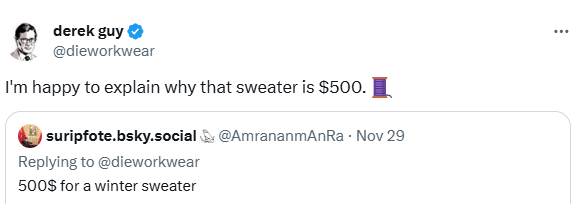
If you spend any time on Twitter/X, you must know the suit guy, Derek. Given my interest in the economics of fast fashion, I read his new thread about expensive craft sweaters.
He explains that some clothes on this earth are still made by hand. Artisan sweaters cost a lot because of the labor. Supporting that art or tradition is fine, if you have $500 on hand.
The comments on the thread are interesting as well. (Caveat, a good number of anonymous accounts are trolls bent on your destruction – read accordingly always.)
One comment, presumably by an amateur knitter in a rich country: “As a knitter, I know how much work would go into hand making sweaters like these. That’s not even taking into account the cost of a good wool yarn. If anything, they are underpriced.”
Not a lot of people want to spend $500 on a sweater. I really loved this reply about thrift stores. We don’t all have to buy the sweater new.
My related posts on fast fashion (a.k.a. factory-made sweaters cost $5):
Cato Globalization book out in paperback – my most optimistic take on this is that AI will facilitate the sharing part of the sharing economy, which will help justify the cost of high-quality new garments.







 Economist Writing Every Day