I first learned computer programming about 1974, using FORTRAN running on an IBM 360 system that, yes, filled a whole room. And yes, my source code existed in the form of a stack of cards with holes punched in them, which got run through a physical card reader. FORTRAN and similar old-school languages were efficient (b/c computer resources were so constrained) and syntactically simple for solving well-specified problems.
C++ started to become popular in the 1980s, and Java in the 1990s. A big part of their appeal was that they were “object-oriented programming” (OOP) languages. I repeatedly asked my computer-programming professional friends back then to help me understand the difference between OOP and conventional Fortran type programs. They would get misty-eyed and rhapsodize about how their program components were modularized. I guess I just failed to ask the right questions, because I never could understand why what they were talking about was so very much better or different than a good clean FORTRAN program, where most of the work was compartmentalized into well-defined functions and sub routines.
So I had a good talk with Claude about all this, and achieved enlightenment.. The differences seem to come down to a couple of key concepts:
(1) Data Compartmentalization
In FORTRAN, you can modularize the data manipulation steps into subroutines, but the data tends to be more in common. Thus, for a very large programs, it is hard to keep some far-distant subroutine from accidentally altering your data. But with OOP, the data and the manipulation methods are “encapsulated” into one airtight thing, so no outside routine can mess with that data.
(2) More Robust Relations Among Chunks of Code
With OOP, there is also a feature called “inheritance”, where some new method can take advantage of an existing method, in a cleaner way than (in the FORTAN world) having a new subroutine call an existing subroutine, which would involve explicitly passing a bunch of parameters back-and-forth (which is very easy to mess up).
For doing fairly straightforward scientific calculations, even big ones, I think FORTRAN is still easier and more efficient. But for modern financial programs, involving millions of lines, written by huge teams of people that cannot all talk to one another, the win goes to OOP. Besides C++ and Java (still popular), in OOP we now have C# (standard for many Windows and gaming applications), and the crowd favorite, Python.
(That’s about it simply as I could put it, without getting long-winded and technical… If you want more details, you can always ask my buddy Claude)
I am not an attentive soccer (football) follower, but it was hard to ignore the 2026 FIFA World Cup being played in my own country (or at least my own continent). I tuned in for more and more games as the play progressed. Spain progressed further and further along, and finally won the gold.
This was not a one-off fluke. Spain won the World Cup in 2010, and has dominated European soccer for the past 3-4 years. Spain also won the most recent women’s World Cup in 2023. My inquiring mind naturally wanted to know what was behind this success. Spain’s population (49 million) is below that of England, France, or of Germany, so it is not simply having a huge demographic to pull from.
When this question was posted on Reddit, a Spanish fan gave this answer:
This is an interesting question with a lot of possible answers.
The most evident one is the Olympic Games of Barcelona 1992. This created a huge shockwave in Spain, which was still a little bit “isolated” from the rest of the world. The preparation of these games and their success made Spain invest a lot of money on sports infrastructure, trainers and programs, which directly impacted on the accomplishments of the big Spanish sportsmen of that generation: Rafa Nadal, Pau Gasol, Fernando Alonso, the whole Spanish football team 2008-2012 and many others. The success of the modern Spanish football team is supported by them.
But it also has a more deep and old reason. Before the 21st century the Spanish football team, even if they didnt win titles, managed to get good positions in international tournaments. Why? Spaniards have been, traditionally, smaller and weaker than the other Europeans (even if that has obviously changed). We couldn’t engage on physical play with the Dutch, Germans, French, English etc. that ran faster and were stronger than us. We don’t even have that many physical players TODAY. So, we had to rely on mentality and skill.
So the team started to become recognized by their fierce attitude, their relentless energy and attacking spirit, gaining the nickname of “La furia Roja” (red fury). And also had to rely on skill, passes, building the game from behind and being more tactical and strategical on the field. This set the foundations for the modern “tiki-taka“, the Barça and Spanish playstyle that basically created modern football. These two things, plus Barcelona ’92 were the perfect mix to create a football tradition for many years.
Poking around the AI and Wikipedia and other sources, I found that this reply did a good job summarizing the sources of Spain’s success. I will just elaborate on a few aspects here.
Certainly, the Spanish technique of rapid, relentless passing (so-called tiki-taka) to maintain possession and to draw the opponent out of position to create scoring opportunities was in full view in this World Cup. It is more efficient and effective to rapidly move the ball than to run your players around. The specifics of this style actually puzzled me when I watched it. In my brief, undistinguished non-career in intramural soccer, I was taught to receive a pass by controlling it with typically two taps, then maybe kick it onward with a third “touch”. But the Spanish players would take an incoming pass and just whack it onward with only one “touch.” That takes exquisite control; get that wrong by just a hair on one of those dozens and dozens of taps back and forth, and there goes your possession.
The internet agrees that Spanish teams historically could not compete head-to-head physically with a team full of hulking northern Europeans, and so they deliberately came up with this alternative playing style that relied on skillful control, not brute strength or size. Another strategic decision by Spanish coaches (trusting in their team’s ball control skills to maintain possession) is to play the defenders up-field, closer to the opponent’s goal, where they can play a role in building attacking pressure.
This playing style depends heavily on teamwork, and is the style promoted through all levels of the Spanish junior/farm teams as well. The whole team operates like a hive-mind organism, with players thinking several moves ahead and trusting the others to do the right thing at the right time. Unlike some other teams, this system is not dependent on one or two superstars to carry the load. I found the Spanish play to be an inspiring facet this year of “the beautiful game.”
When we recently traded in for a newer car, we were handed two fobs. These are push-button start cars, so you absolutely need a fob to drive one. An old-fashioned metal key will not work. Even the hidden metal key in your fob is only good for unlocking the door, not for starting the car. Since life has schooled me that things get lost, I asked how much it would cost to get a spare fob made at time of purchase, hoping I might catch a break. Nope, the dealer cost would be $436. Ouch.
So, I later asked AI what to do. I was advised to have a non-dealer locksmith or hardware store do it instead. With this route, you might save even more money if you buy the blank fob yourself on Amazon for something like $30, and just have the locksmith program it and cut the hidden metal key.
A local ACE hardware store quoted me a price of $330, which is better than $436, but still not great. But I located a mobile locksmith, who drives a big van loaded with spare keys and fobs, and the equipment to cut key copies and to program fobs. He specializes in going and helping folks who are locked out of their cars, and he will drive to your house to make spare fobs and keys. He would come to our house to make a new fob for $270. But it gets even better – – if I had two fobs made in one visit, the price would be only $220 apiece. It was an offer I could not refuse, so now I have spares for both cars.
If you don’t have a working fob for the locksmith to work from: It turns out that for many foreign cars (Subaru, Toyota, and especially most European brands), it can be very difficult for a non-dealer locksmith to create a fob for you. Normally, if you find yourself locked out of your car some dark, snowy night, the mobile locksmith can roll up and create a new fob for you so you can get back in business. For brands like Ford, GM, Honda, and Nissan, he can accomplish this even if you can’t provide him with a working fob to copy. He will charge you twice as much, because it is a much harder job with no working template fob. It gets even harder for, say, Subaru. But for Mercedes-Benz or BMW, it may be impossible for most locksmiths to get a fob made on the spot without a working model to copy. In a big metro area, there may be a few locksmiths who have the specialized equipment for these brands; you’d have to call around and ask the locksmith especially if they can make a new, say, Mercedes fob for an “all-keys-lost” situation. If not, you may have to get towed on a flat-bed ($$$) to a dealer, who can read your vehicle and program the fob ($$$). There may be a middle ground (which will take some days to play out) where you order a blank fob from a dealer along with some essential info for your locksmith to complete the programming, or where you order a programmed fob by mail.
All this argues for having a spare fob made ahead of time; maybe stash it somewhere that a friend or family member could bring it to you, if you were in distress not too far away.
Bonus fob tip: If your fob battery dies, you can still start your car by using the conventional metal key hidden inside your fob to open the car door, and then hold the fob very close to the car ignition button as you push the button, with your foot on the brake as usual.
I have been involved in caregiving for two persons as they were dying. Some years ago, I was the main caregiver for the last few days of a parent, and quite recently I was a support person for another death in my extended family.
On the Internet, there are plenty of compendiums of advice on how to prepare for this eventuality. There are also old-fashioned hardcopy books out there. It’s too big a subject to treat as a whole in a short blog post, so I am going to just focus on one link in the chain of end-of-life care. I am picking out this item because it’s so vital, but it can be one of the hardest steps to execute well.
This step is for the responsible caregivers to obtain, nay, demand, hospice care status, when the appropriate time comes. And then to insist on maximum levels of palliative meds, again, as appropriate.
You might think that this is the obvious, normal course of medical treatment. But (and this is a key point) thisruns contrary to what medical practice is normally geared for. Doctors and hospitals exist largely to “save” lives. When someone gets carted into the emergency room, the normal response is to stick tubes into them and fight to keep them alive. Anything less would be considered irresponsible (and possibly grounds for a lawsuit).
And so, the family caregivers may need to fight with the hospital doctors at this point. I am not overdramatizing here. I know of a case where someone in their 90s, and the family and the nursing home staff had good reasons to believe this person was in the process of dying, and at the emergency room was found to have a secondary condition that was probably treatable by antibiotics. The emergency room doctor naturally wanted to do all the usual stuff with IVs and meds, but in this case the family caregiver (backed up by the nursing home staff) insisted on palliative care only and on immediate hospice qualification. Things got kind of testy with the emergency room staff, but these strong women (caregiver and nursing home nurse) got their way, and so the patient was able to quickly receive palliative care.
Hospice care is amazing. It allows the provision of what a professional caregiver called “comfort juice” – – a cocktail of morphine for physical pain relief, and anti-anxiety meds for psychological calming.
That’s the kind of thing you want when the dying process sets in. Most people wish that they could just pass peacefully in their sleep, or maybe from an instantaneous massive heart attack or brain aneurysm. Sadly, that’s not usually the way it happens. The body is programmed to fight to stay alive, so the death process can be prolonged, uncomfortable, and very undignified. Even with the pain meds, there may be stages in the process that are distressing for the family to witness, but at least they know they are doing all that can be done.
Main Takeaway: If you are the potentially dying person, choose your medical POA (Power of Attorney) very carefully. The POA needs to be strong, competent, and 100% on board with your wishes of no prolonging life. She/he may have to fight like a bulldog to get your pain meds increased if there are signs of distress. We often treat our dogs better than we do our dying seniors. A good pet owner doesn’t let them suffer unnecessarily.
The PAO (and his/her allies) may have to take tough, unpopular stands. Within the broader family, there will likely be a few squeamish members who may want to hold back on the transition to hospice care. Maybe they fell they should “give mom/dad another chance” or they just don’t feel ready to lose the person quite yet. I think doctors may read the room, and withhold hospice if there are some family members that are advocating the normal treatment measures. Again, no doctor wants to be sued. Therefore, instruct your POA and your tougher caregivers to try to keep the weak family members away as much as possible when decision making must be done.
When visiting a large county park the other day, I noticed a sign for “Amateur Radio Field Day, Public Welcome.” I have always had great respect for amateur radio operators, for their technical prowess and for their service in emergencies when other forms of communication go down. So, I wandered over to see what was happening.
There were maybe half a dozen large screened in gazebo type tents. In each gazebo there were one or two men seated before some radio apparatus on a table, with a couple other guys sitting in more of a spectator role, chatting away. Someone had used a potato cannon to shoot a fishing line over the top of a tall tree, which was then used to pull up a rope, which was then used to pull up a long antenna wire. There was also a tall standalone antenna mast, held erect by three guy wires staked to the ground.
What were these guys doing? There were mainly doing what hams mainly do, which is reaching out across the continent and across the globe, to make contact via radio with other amateur radio operators. Some were doing it by voice communication, using single side band (SSB) technology for more efficient transmissions. Some were using a computer interface to turn their transmissions into a digital format, which could be transmitted and received more effectively. The guy on the other end would have matching software to turn the numbers back into words.
And there was one guy doing it the old-fashioned way, listening to “beep, beep, beedily beep” Morse code coming in, and transcribing that to letters and numbers. The Morse code beeps can cut through radio clutter more strongly than voice signals, allowing more distant contacts with relatively low power. Which is kind of a bragging point.
The special thing about so-called short waves used by hams is that they can reflect or refract from the underside of charged layers high up in the atmosphere. Your signal can bounce off those layers and come back to earth hundreds or thousands of miles away. Before the Internet, this was actually a big deal. The only other ways to communicate back then with distant people were snail mail, telegraph, or long-distance telephone, which was super expensive and grid dependent. I put together a short-wave video kit around 1970, and it was pretty amazing to hear a station broadcasting from Ecuador, not to mention Radio Moscow. Voice of America and BBC short wave broadcasts helped to keep the ideal of freedom alive in Soviet occupied Europe for many decades.
The guys in the park (I didn’t see any women operators, although I know they exist) were enthusiastic and friendly. When I mentioned I have a grandson who seems interested in technology, a man pressed on me an envelope filled with electronic components, and a small circuit board, encouraging me to help my grandson solder the parts into the board to make a short-wave receiver for Morse code. I thanked him sincerely, but said I might wait till my grandson was seven or eight before embarking on this project.
I am something of a techie myself, with a professional career in chemical engineering. But I found myself far out-geeked by these gentlemen. They would be certainly eager to help in the amount of emergency, but that’s actually a very rare event. It seems much of the thrill is simply the technology itself. To truly understand antenna theory, and even to design and build your own radio, are marks of distinguishment in that crowd. What I found most interesting from a psychological point of view was that when they do connect with someone 1000 or 10,000 miles away, they usually do not stop to chitchat about things like, how’s the weather where you are, how long have you been doing this, etc. No, nothing of normal human interest, it’s just: dutifully log the other party’s location and call sign, and move on to make the next contact.
My takeaway: as I’ve done maybe once a decade, I peered into my soul to assess whether I wanted to invest the time and money into pursuing this hobby. I could crank up my aging brain to pass the technical exams required to get an amateur radio operator’s license. But to set up a working short-wave radio and antenna, and get proficient at using it, would take a lot of effort. And in the Internet age, reaching out and touching someone on a different continent in real time just is not the rush that it used to be. As a responsible citizen, the emergency preparedness aspect is of interest to me. However, there is a newer, alternative class of radio called GMRS, which I think may be more realistic for most emergency situations. My encounter the other day with the hams did cause me to reengage with GMRS, and I may write a blog post about that in the future.
Imagine my surprise the other day when I noticed that $1000 had been transferred from my bank account to some nonprofit, without any knowledge or approval on my part. It turned out that an acquaintance, with no access to my banking credentials, had done this. They wanted to make a charitable donation, using a direct bank transfer rather than a credit card, to save the charity the 3% fee charged by Visa/Mastercard. I had written them a check some months back, and they accidently entered the routing number and account number from that check of mine, instead of their own account information.
Was this some unique, gross security lapse by the bank? Or can anyone drain money from your bank account from anywhere, simply knowing your routing and account numbers? After all, these numbers appear on every check you write.
In the old days, someone armed with those two numbers could print fake checks for your account and forge your signature. Sadly, the same principle holds true now in the age of electronic transfers.
The ACH network, which powers most bank-to-bank transfers, bill payments, and direct debits, was historically designed on the assumption that initiating a pull was authorization enough. Someone with your numbers can:
Set up a fake “bill pay” or utility payment pulling from your account
Add your account as a payment method on PayPal, Venmo, Amazon, or similar platforms
Set up recurring ACH debits through many merchant processors
Ouch. It seems there is really nothing you can do to prevent this, other than closing your existing account if you are worried, and opening a new account with different numbers.
The main mitigation method is to set your account to notify you every time there is an electronic transfer, and notify the bank immediately (call, and follow up in writing or bank’s message system). Start documenting all aspects of this dispute process, in case of litigation. Or at a minimum, look through every month’s statement soon after it appears, to check for shady transfers. Close or restrict the account if appropriate.
As I understand it, if you notify the bank within 60 days of when they sent the monthly statement, your max liability is $500. Beyond 60 days, you are toast – the money is just gone.
There is a slightly murky provision for limiting liability to $50 if you notify the bank within two days of you learning of the fraud (as long as that is within the 60-day window noted above). The application of this 2-day rule is clear if you are getting real-time notifications of transfers. But, say, if you slit open a printed statement the day after receiving it in the snail mail, perhaps three days after it was sent, notice a fraud and call the bank immediately, it is less clear whether you get dinged $50 or $500. If you are a good customer, I’m guessing the bank would make it $50.
All this is powerful motivation for using credit cards or Venmo/Zelle instead of paper checks. Bad guys can’t withdraw from your Venmo or Zelle unless they have your login information. With a credit card, you generally don’t get charged anything for a fraudulent transaction on your credit card (assuming you report it in reasonable time) – – plus you can usually get 2% or more cash back.
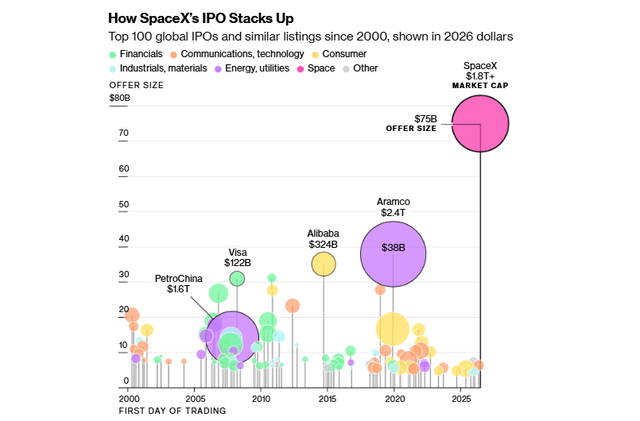
Here is a graphic that compares the size of the initial public offering (vertical axis) and the total company market cap (size of circle) of SpaceX to everything that has come before:
Elon Musk’s space launch/AI conglomerate spin-off SpaceX went public on Friday. Retail investors were all over it like a pack of starving dogs, driving up prices of SPCX from its opening $162 to $192 as of the close Monday. This has been grand theater, with Musk serving up signature visions of gargantuan total addressable markets, while investors are in fact getting crumbs of a money-loser. In the restaurant biz, this is known as selling the sizzle instead of the steak.
Let us pause for a reverent moment to savor the grand vision used to sell SpaceX: making humanity multiplanetary by dramatically lowering the cost of access to space. It extends beyond launch services into global communications (via Starlink), space infrastructure, in-space manufacturing, resource extraction, transportation, and ultimately a potential Mars economy—expanding from billions to trillions of dollars in theoretically addressable markets. Ooh, ahh, who would not want a piece of that?
Well, there are some problems here. It is hard not to splutter when trying to explain it, it is so bad for investors. I will just call out three issues I see:
( 1 ) Governance: You Own It But Can’t Influence It The IPO float represents roughly 4-5% of total shares, so we the people only get a sliver of the company. But it gets worse. Public shareholders receive Class A shares with one vote each, while Musk holds Class B shares carrying ten votes each, giving him approximately 85% voting control. More unusually, the company bylaws explicitly prohibit shareholder proposals — meaning investors cannot even put advisory resolutions to a vote. This is governance subordination beyond what even Zuckerberg imposed on his investors.
( 2 ) Valuation: Priced for Perfection Without Profits There is no price/earnings ratio because there are no earnings. At $2 trillion, SpaceX trades at approximately 20 times REVENUE. That price/sales is not unheard of for a small, fast-growing software company with almost no capital requirements (think: early-stage Amazon, Google, Palantir, etc.). But it makes no sense to apply it to a capital-intensive hardware and infrastructure business with negative GAAP earnings. Starlink is growing rapidly but requires continuous heavy capital expenditure to maintain and expand its satellite constellation. And SpaceX faces meaningful competition for orbital launches from Blue Origin, ULA (for military missions), maybe Rocket Labs, and the Chinese (for non-West payloads). And, if you dig into it, over 90% of their proposed addressable market is not space at all, but enterprise AI (!!). SpaceX pitches a total addressable market of $28.5 trillion, with AI opportunities alone accounting for $26.5 trillion. This is essentially the entire global GDP of the planet for a single year, and I guess they assume their pitiful Grok will claw back lots of market share from Claude, ChatGPT, and Gemini. As we said, priced for perfection.
( 3 ) Unbuilt Revenue Streams SpaceX has announced contracts to provide AI compute services to other companies — potentially a significant revenue source — but the data centers required don’t yet exist. Investors are therefore paying partially for infrastructure that is neither built nor generating revenue, on a timeline that remains speculative.
OK, but we have seen shares of Musk’s other baby, Tesla (TSLA), remain at uniquely high price/sales and price/earnings, seemingly indefinitely. So, investing in SpaceX is much like investing in that shiny yellow metal called gold: there will never be conventional earnings payback, but there might well be some greater fool out there who will pay more for my shares than I did. This really comes down to a psychological head game, not fundamentals. Gold has in fact done very well over the years, and the pros learned the hard way not to short TSLA, not matter how unsupportable its price is.
Final comments on index fund buying to drive up the share price – one of the bull drivers for SpaceX has been the prospect that the huge company market cap (around $2 Trillion) would force index funds like NASDAQ and S&P500 to buy boatloads of SPCX stock, driving up the price. But it turns out this will not be such a big factor. These indices only take into account the publicly traded shares, not locked-up, non-traded founder shares. So, we are looking at around $100 billion in traded SPCX shares, not the full $2 billion, which is mainly shares controlled by Musk and venture capital. $100 billion is only about 0.15% of the total S&P500 market cap of about $70 trillion. This means fund purchases of SPCX should not by itself drive down prices of other companies.
It is true that inclusion in Nasdaq-100 and Russell indexes will force automatic buying of around $25 billion in SPCX shares from funds tracking those indices. That seems like a significant driver, but (a) everyone knows this, so it is already factored into today’s prices, and (b) index fund purchases will be offset by billions in sales from VC’s as they sell shares when their lock-up periods expire in a few months.
Side comment: Historically, the major indices have had a little gravitas about what companies to include. The Nasdaq-100 typically requires at least a 3 month “seasoning” period for an IPO to trade, and then waiting till the next regularly-scheduled reconstitution. Thus, it might take around six months for an IPO to make it into the Nasdaq-100 index. For SpaceX (and presumably for Anthropic and OpenAI IPOs), NASDAQ changed the rules to allow REALLY big IPOs to be included within 15 days. (This means that some other company will get booted from the Nasdaq-100). Russell caved even further than NASDAQ, with almost immediate inclusion in the Russell 3000.
Staid Standard and Poor’s alone has maintained its dignity here, refusing to compromise on its principles. For inclusion in the S&P 500, a company must be publicly listed for at least one full year, must show positive GAAP earnings in the most recent quarter and positive cumulative earnings across the trailing four quarters (this is going to be tough for a cash-burner like SpaceX), and at least 10% (not 5%) of its shares must be publicly traded. So, no S&P listing for SpaceX in the near future.
This is the fifth in a series of occasional blog posts on individual initiatives that made a strategic (not just tactical) difference in the course of the second world war. There were many good generals in WWII, but for the most part they were good just by not being bad. Eisenhower, for instance, did a fine job as the supreme commander in the European theater, but that involved mainly being diplomatic and avoiding dumb mistakes, not strategic brilliance. Also, for the most part, no general was so good or bad that his conduct swayed the ultimate outcome of war.
I see Soviet general Georgy Zhukov as an exception here. The Soviet Union came very close to collapse under the weight of German assault in 1941-42. If the Nazis had won there and consolidated their hold over Russian resources, I doubt whether the Western Allies could have successfully liberated Europe; they barely hung on for the first few weeks of the 1944 Normandy invasion, and that was with most of the German forces off fighting the Russians. Zhukov is seen as the strategic mastermind behind four key Soviet victories in 1939-1942 that allowed the Soviet Union to survive, and then go on the offensive.
The first of these victories was a battle that no one remembers much anymore, but it had enormous strategic ramifications. In 1938-39, the Japanese kept expanding their occupation of territory at the border of China, towards Mongolia (a Soviet satellite). The Japanese had beaten the Russians in 1905, and trounced, massacred and occupied the Chinese all through the 1930s. So, they were pretty cocky. There were several inconclusive battles between Japanese and Soviet forces at the border. Finally, in August 1939, the newly-arrived General Zhukov decided to put an end to it at the Khalgin Gol river, which is otherwise in the middle of nowhere. The usual approach to achieving victory was to mass a huge number of your troops and hurl them at the enemy position. Sure, half your guys would die during the attack, but the rest might break through.
But Zhukov did something very different. Over the course of weeks, he stealthily built up highly mobile forces on the far left and right flanks, hiding the tanks under camouflage. Then he opened the attack with an assault on the middle, aided by enormous artillery and air bombardment, while laying low on the flanks. After the Japanese had pulled their forces in to reinforce the center, he unleashed his armored columns, which raced around behind the Japanese force to cut it off. Since the Japanese declined to surrender, they were annihilated. Such is the power of a well-executed pincers attack, also known as double envelopment.
The magnitude of this defeat led Japan to totally abandon plans to further expand to the north, with two key consequences. First, the cessation of a threat from Japan allowed the Soviets to transfer troops from the Far East just in time to stop the Germans in the west. Also, Japan decided to expand instead to the south, which led to their fateful decision to attack Pearl Harbor in an effort to prevent America from interfering there.
An early objective of the Germans when they invaded the Soviet Union in June, 1941 was Leningrad, the second-largest Soviet city. The city was nearly surrounded by Axis forces by the time Zhukov arrived to take over in September. Zhukov restored discipline (threatening execution for unauthorized withdrawal), fortified defenses, and launched counter-attacks that stabilized the front lines, preventing an immediate German assault. He oversaw the evacuation of 1.5 million civilians, the relocation of critical industry, and opening a critical lifeline for supplies. This allowed Leningrad to hang on by a thread for some 900 days of siege, and kept a significant number of German soldiers tied up there.
The Germans then refocused on taking Moscow, far to the east of Leningrad. They almost succeeded, getting to within 10 miles of the Kremlin. Zhukov was rushed to Moscow in October, 1941 to organize the defense there, which he did with his characteristic energy. He mobilized some 250,000 women and teenagers to dig three rings of defensive fortifications. After months of costly back and forth fighting, in the depth the coldest winter of the twentieth century, Zhukov unleashed a pincers counterattack, which forced the Germans back over 100 miles to avoid encirclement. One result of this victorious counterattack was that Moscow was saved. The other result was also extremely important – – in the wake of this major German defeat, Hitler dismissed the top German general and assumed direct operational command over the German army. This was a complete disaster. The centralization of command negated the German army’s greatest strengths: its flexible command structure and the professional competence of its General Staff. Hitler’s refusal to allow tactical withdrawals led to the encirclement and destruction of entire Axis armies
The Germans in 1942 decided to focus their efforts in southern Russia, to seize control of vital oil fields in the Caucasus region. The city of Stalingrad, with its considerable industrial and armaments industry and its prestigious name lay along the way, so the Germans aimed to occupy it. The Soviets kept up a desperate defense in the city ruins, but the elite German Sixth Army kept advancing until they had taken some 90% of the city. But their almost-victory was turned into a stunning defeat. Zhukov, now in charge of the defense of Stalingrad, stealthily built up enormous forces on the far flanks of the Stalingrad front, where the Axis lines were thinly held by poorly-equipped Romanian and Hungarian troops. In a reprise of his Khalgin Gol maneuver, Zhukov sent his two flanking forces smashing through these lines, and meeting to seal off the 330,000 Axis troops in or near Stalingrad. The Germans tried to relieve this pocket, but the Russian winter and resources were against them. Soviet victory was complete, an entire German army was eliminated (killed/captured), and the initiative on the Eastern Front passed to the Soviets for the rest of the war.
A Few Caveats
What I wrote above was been gleaned from various tertiary sources, including Wikipedia, which reflect the common consensus in the West. In the interest of accuracy, however, I note that some of this brilliant, heroic story is a self-serving myth promulgated by the Soviets as a morale booster, and by Zhukov himself in his not-quite-truthful memoir. There is good reason to believe that he takes credit for what was actually the work of others, especially in the planning of the Stalingrad counter-offensive.
Zhukov was mainly responsible for the planning and execution of the disastrous 1942-43 Rzhev offensive, where he threw division after division into fruitless attacks. This exercise cost the Red Army some 1 million casualties, while accomplishing almost nothing. This campaign was largely written out of Soviet history, and Zhukov carefully downplayed his role in it. That campaign highlighted Zhukov’s famous utter disregard for human lives. Another window into that disregard comes from Dwight Eisenhower’s memoirs. Eisenhower records his surprise during a conversation with Zhukov, when the Soviet general explained matter-of-factly how he sometimes cleared a path through a minefield by making some of his soldiers run through the minefield in a line to get the pesky mines blown up. Soviet soldiers faced a 100% chance of being executed for disobeying orders, versus some small chance of making it through the minefield without getting their legs blown off. As Stalin once quipped, “It does not take much courage to be a hero in the Soviet army.”
Finally, the regime Zhukov defended was arguably as horrible as the regime he fought against. Nevertheless, I suspect the world that would have resulted had Georgy Zhukov failed would have been worse than the actual world of say 1945.
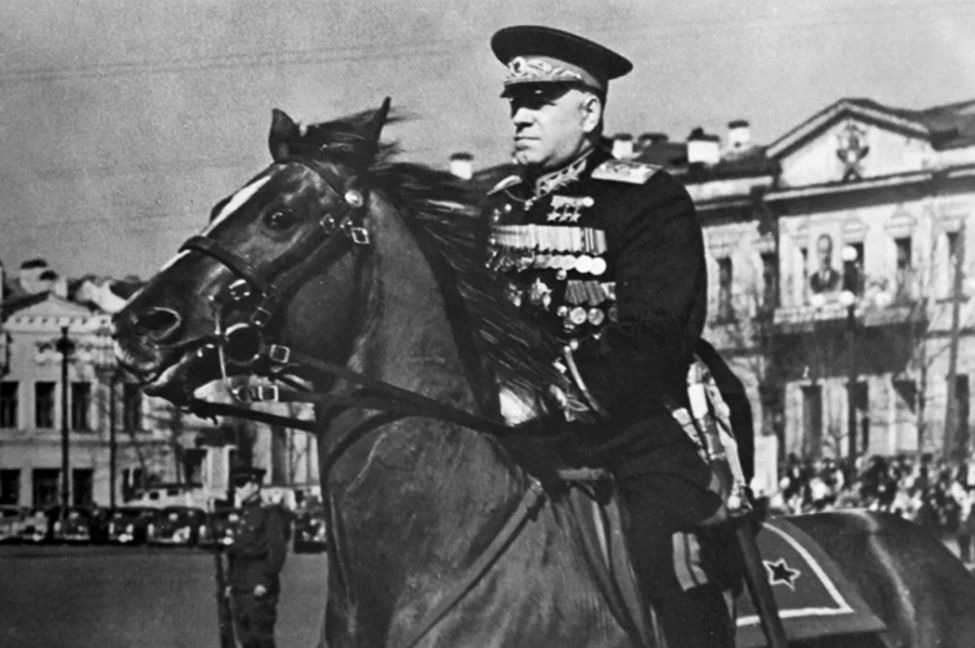
Marshal Georgy Zhukov at a post-war parade in Moscow. (Image source: WikiMedia Commons)
Somewhere in the vast metropolis that stretches from Boston to Washington lives a friend of ours with a long-term dream. To protect her privacy, I will not give her name or town. For over thirty years she has wanted to do some form of homesteading, where you raise most of your own food, plus some extra to sell for cash. She and her husband contemplate moving someday to a rural area in the South, where they could buy cheaper land in a warmer climate to raise goats or pigs or cattle, and grow more extensive crops.
However, that move just never happened (so far), what with the usual limitations on jobs and finances. She decided a few years ago, though, to not just keep putting food production off forever. She is doing what she can, with considerable help from her husband, on an urban/suburban lot of just over a quarter acre. He constructed numerous raised beds in an area that was formerly just grass, and had many trees taken down to admit more sunlight. She sprouts seeds into plants indoors, to get a head start in the spring.
It started about ten years ago, with just two raised beds. Now the garden area looks like this:
….
Those are pictures I took near the beginning of May. By the end of May, the gardens had exploded:
Plantings there include potatoes, onions, squash, peas, peppers, garlic, tomatoes, strawberries, arugula, and lettuce. The brassicas such as cabbage, broccoli, kale, and cauliflower are covered with a tent; otherwise, cabbage moths can decimate these plants. In a rock bed they have horseradish and comfrey. They have four blueberry bushes. The next big project would be an asparagus bed.
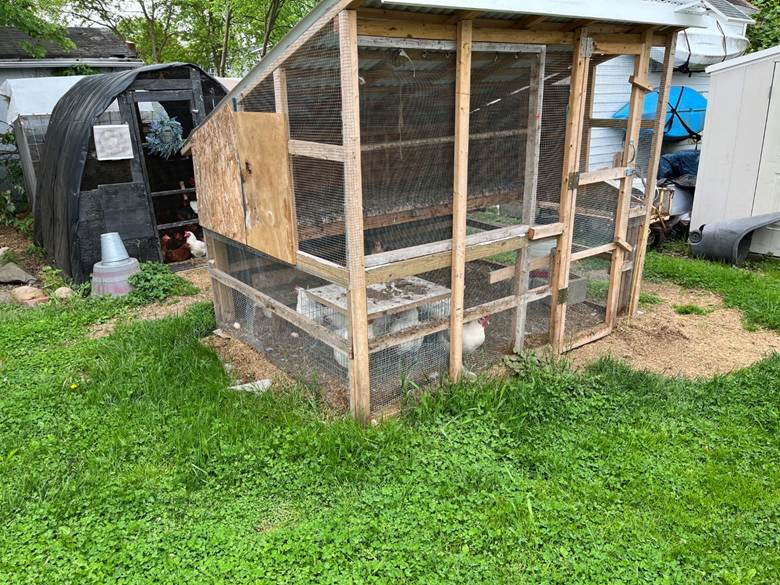
For livestock, they put in chickens about four years ago. In the foreground is a self-contained coop with about 8 birds, and behind it is a second coop with a run behind it, which houses about 18 birds:
They are raising dual-purpose chickens, which are pretty good egg layers, and OK for meat. (There are some breeds that are champs at laying eggs, and others like Cornish Cross whose purpose in life is to grow to eating size in an astonishing 8 weeks). All told, they get some 7-10 dozen eggs a week, spring/summer/fall. This is enough for them to eat and have plenty to sell or give away. In winter, with the cold and shorter daylight, egg production drops to 1-2 dozen/week. To transform a walking, clucking bird with feathers into breasts and drumsticks is a task I will gloss over here, but that is something that homesteaders also must do.
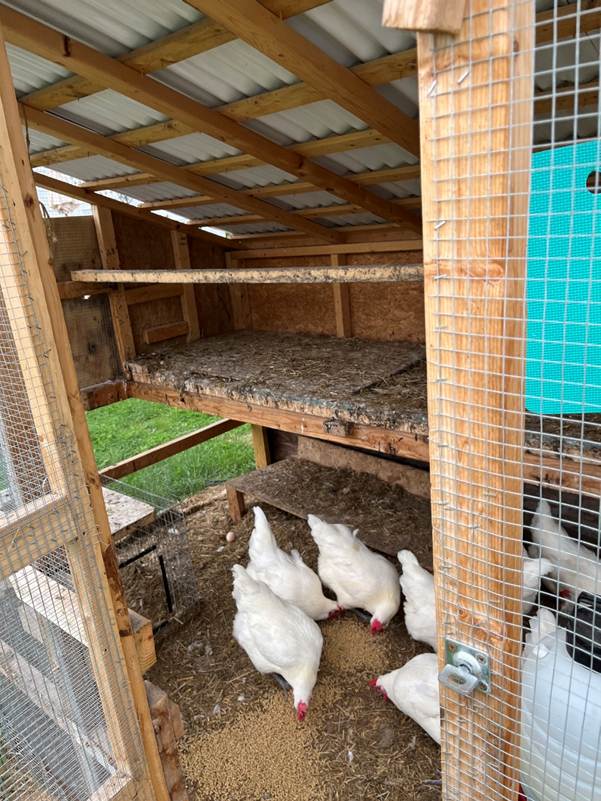
The main ongoing work with their chickens is filling the 7-gallon waterers every couple of days, and throwing a scoop of feed onto the floor of each coop every day. These birds get a “salad” of greens at least once a week, for variety. Here is a shot of the “girls” eagerly pecking away at their dinner; I see at least one egg on the ground in the background:
Chicken poop is pretty nasty, but it is managed by a deep bed system. There are several inches of straw in the bottom of the coops and the run. The birds continually dig around in the straw and mix it. That seems to dilute and dry the poop enough that the “farmers” only need to change out the litter a couple times a year. It just goes on the compost pile, to become fertile planting soil.
Chickens seem to be the most popular animal for budding homesteaders. They are called the “gateway animal”, to get you started/hooked. They tend to require little management, and are versatile eaters, so you don’t need to feed them just purchased grain. Some homesteaders feed them select table scraps, and even raise worms to feed the birds. If you have a large yard or pasture, you can put chickens in a movable “tractor” coop during the day, to forage for insects and greens in the fresh grass under the tractor for that day’s position.
Regulations on selling slaughtered meat are onerous, but it is easy to sell fresh eggs. In their township, chickens are allowed, but no roosters. (No one wants to hear crowing at 3:00 AM). So, our friend’s chicks that hatch out as males end up going to “freezer camp” just before they fully mature. Livestock such as goats and pigs are legal. Our friend wanted to raise a couple of pigs (pigs can also put on weight at an impressive rate, mushrooming from a 50-pound piglet to a harvestable 400-pound hog in 6-7 months). Her husband, however, declined to support that odiferous project.
Growing food is one thing, preserving it for later eating is another. She wrote me:
I can everything. Fruit, jams, veggies, potatoes, meat, fish, and meals. I have chili in jars, along with lamb stew, and onions for Frech onion soup. I make spaghetti sauce too. Yes, I’ve canned our own homegrown chicken.
Since [the storage room] stays cool in the winters (60ish F) I can store hard skin squash and keep fresh potatoes for frying or baking til January or February. I also dehydrate herbs/veggies and meat and fruit. Some veggies don’t can well, they get mushy like zucchini.
“Canning” in this context does not mean sealing into metal cans like you see in stores. It usually means putting the food in special glass “Mason” jars, heating them in a hot water bath (or, better but more work, in a pressure cooker) to sterilize the contents, then sealing them with a lid. Seems like a lot of work, but I am told by friends from the old South that canning your vegetables was a normal household activity there well into the 1960s or so.
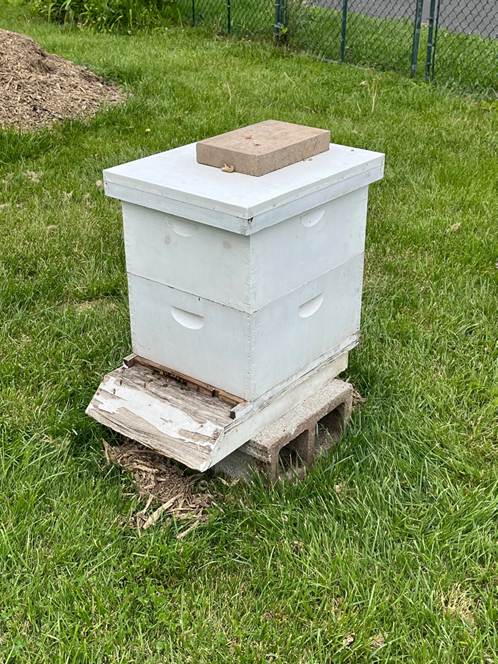
Finally, our friends have a beehive on loan from a neighbor. Zoom in to see the bees going in/out at the bottom:
I found it inspiring to see what this couple was able to accomplish in the way of food sufficiency in a quasi-urban setting, and I wish them well in their quest to relocate to where they can grow their own red meat and hear their rooster crow.
According to Claude: Windows 11 includes a built-in “Windows Scan” app (free in the Microsoft Store) that lets you scan documents directly to PDF — simple and reliable for everyday use. “Adobe Scan” offers a free mobile companion but also works via browser. For more features, “NAPS2” (Not Another PDF Scanner 2) is a popular open-source option with batch scanning, OCR, and direct PDF export. “IrfanView” with its scan plugin is another lightweight choice. For advanced control, “VueScan” offers a free version with core functionality. Most modern all-in-one printers also bundle free scanning software compatible with Windows 11.
Why I Chose “Scan Document to PDF”
My HP scanner software seemed pretty snoopy, not localized to my own PC. Not that I have anything dire to hide, but I’d rather not have my private affairs shooting off to a server who knows where. So I tried the built-in Windows “Scan” function for scanning documents on my trusty ink-jet printer/copier/scanner. It would run pages through the feeder, but then freeze up.
I’ve had mixed experiences with free software, often it gratuitously installs crap-ware on your PC. But surely not Microsoft… so I downloaded the free “Windows Fax and Scan” app mentioned by Claude. It did work, but was a bit clunky and limited. You have to first save a file in some graphic image format like PNG or JPEG, then go to Print, and choose “Microsoft Print to PDF”.
But then, I installed another free Microsoft app, “Scan Document to PDF”. That seems like a sweet spot here. It seamlessly scans to PDF, but has a good deal of extra functions that are intuitively accessible. It can save files as images like jpg if that is what you want. You can activate OCR to make a scanned document searchable. You can scan individual pages, and decide which ones to bundle into a pdf file. You can brighten or rotate pages, etc.
INSTRUCTIONS FOR “SCAN DOCUMENT TO PDF” ON WINDOWS 11 PC
( 1 ) Click Start icon, to left of Search bar at bottom of Windows screen. Click on Show All, for a list of all programs. Scroll down to Scan Document to PDF and click.
( 2 ) Check scan settings showing on left hand side. Can adjust them here, or by clicking Profiles button. Paper Source: Glass for one sheet on scanner, or Feeder for auto feeding pages. Resolution: Suggest 300 dpi. Bit Depth: Color for a color scan, or usually Grayscale for a black & white final document (sometimes gives better resolution than the “Black & White” setting).
( 3 ) Click Scan button (top left) to initiate scan. (Note: on the side of that button is a dropdown for options like setting up Batch Scans.)
( 4 ) Scanned pages will show on screen. To save them all as one PDF, click the Save PDF button. Default pdf file destination is /Downloads/ folder. (To save only selected pages into the final PDF, click on the dropdown on side of that button)
MORE OPTIONS
( 5 ) BEFORE SCANNING: (A) You can set up a different Profile of scan settings (scanner device, feeder, resolution, etc.) by clicking on Profiles button. (B) Click on OCR button to make final pdf searchable (not just a static image).
( 6 ) AFTER SCANNING: (A) Click Import to import pages from existing PDF, that you can then add to newly scanned pages. (B) Click Image button and select a page to crop, brighten, rotate, make black&white, etc.