Organization of the Federal Reserve – OR, Why The President is Impotent against the Fed

In my recent post that included Federal Reserve political independence, I dared to use the word ‘trust’, and commenters let me know that they were not pleased about it. In strict economic terms, there is no such thing as trust. Either that, or it’s the same thing as expectations or maybe low-information expectations. Since it wasn’t the main thrust of my post, I didn’t lay-out the informed reasoning behind my confidence in President Trump’s inability to cause Argentina or Turkey or even 1970’s US levels of political influence on the Fed.

In short, I’m not worried about it because the operational structure of the Fed and the means by which individuals join the Fed are determined by congress and are pretty robust. Below is a diagram that I made. I know that it’s a lot, but I’ll explain below.

Continue reading

I’m Chair! 😬

As of July 1st of this year, I am the Chairman of the Department of Economics at my university. It’s one of those positions that includes more work and not much compensation. Depending on who I tell, I’m given both congratulations and condolences. Generally, at my university there is an expectation that department faculty ‘take turns’ being chair. So, we’re expected to serve whether the pay is good or not. There’s a lot of informal practice around this process.

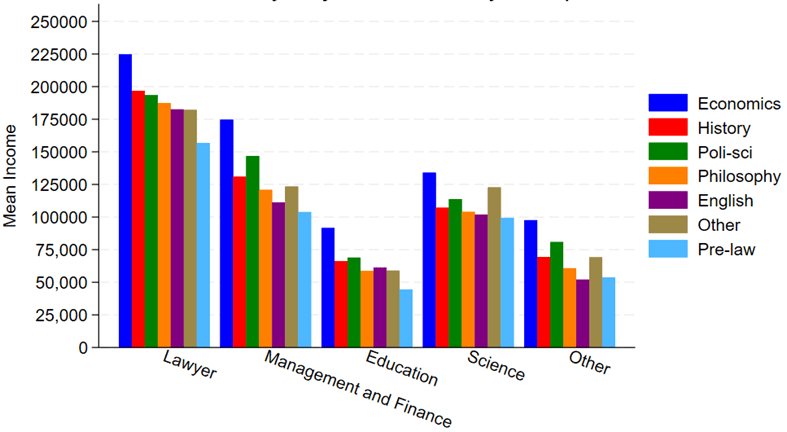
In addition, Economics Majors have been less popular at liberal arts institutions over the past several years. No one knows why and there are probably multiple reasons. At my institution, our department has healthy enrollment among the peripheral majors. So, the Economics BA and BS have lower enrollment, but the Business Economics and the Global Affairs majors are more popular than ever.

All the same, I’d like to increase the number of students who have declared majors in our department and the number of Economics graduates. How do I do that?

Continue reading

Impossible Trinity of Macroeconomic Stability

Trump wants both low taxes and low interest rates. I hope that he doesn’t get it.

For the last ten days of my Principles of Macroeconomics course, I emphasize the aggregate supply and aggregate demand model coupled with monetary offset. What’s monetary offset? It says that, given some target and administrative insulation, the Federal Reserve can ‘offset’ the aggregate demand effects of government fiscal policy. It’s what gives us a relatively stable economy, despite big fiscal policy changes from administration to administration.

For example, if the Fed has a 2% inflation target, then they have an idea of how much total spending in the economy (NGDP) must change. If the federal government changes tax revenues or spends more, then the Fed can increase or decrease the money supply in order to achieve the NGDP growth rate that will realize their target. For example, after the 2017 Tax and Jobs Act lowered taxes, the Federal Funds rate rose in 2018. The effect of the tax cuts on NGDP were *offset* by monetary policy tightening to keep inflation near 2%.

If the Fed doesn’t engage in monetary offset, then fiscal policy has a bigger impact on the business cycle, causing more erratic bouts of unemployment and inflation. The economy would be less stable. Importantly, monetary offset  works in both directions. It prevents tight fiscal policy from driving us into a national depression, and loose fiscal policy from fueling inflation. That’s good since politicians face an incentive/speed/knowledge/political problem.

Personally, I would love lower taxes and lower interest rates. I’d get to enjoy more of my income rather than sending it to uncle Sam and, after refinancing, I’d pay less to service my debts. BUT, the same is true for everyone else too. All of that greater spending would result in higher prices and persistent inflation.

Right now, low taxes and high spending meant that the government is running persistent budget deficits – it’s borrowing money. That’s stimulative. If the Fed lowers interest rates, individuals would refinance and borrow more. That’s also stimulative. If both fiscal and monetary policy are stimulative as part of achieving the Fed’s target, then there is nothing wrong. But deviation from that policy goal brings economic turbulence.

This analysis implies an impossible trinity of macroeconomic stability (not the one from international trade):

Continue reading

The Simple Utility Function Vs. Socialism

I’m a big fan of Friedrich Hayek. I first read his work in an academic setting. But many people first encounter him via The Road to Serfdom, his book that outlines the political and social consequences of state economic controls. I always meant to go back and read it, but it usually took a back seat to other works. Now, I’m slowly making my way through.

A lovely snippet includes Hayek explaining the popular sentiment that “it’s only money” or that money-related concerns are base or superficial. Such an attitude is especially common when people recount their childhood or family life during times of financial difficulty. The story often goes “times were hard, but we had each other”. Similarly, a popularly derisive trope is that economists ‘only care about money’ [, rather than the more important things].

Continue reading

My Perfunctory Intern

A couple years ago, my Co-blogger Mike described his productive, but novice intern. The helper could summarize expert opinion, but they had no real understanding of their own. To boot, they were fast and tireless. Of course, he was talking about ChatGPT. Joy has also written in multiple places about the errors made by ChatGPT, including fake citations.

I use ChatGPT Pro, which has Web access and my experience is that it is not so tireless. Much like Mike, I have used ChatGPT to help me write Python code. I know the basics of python, and how to read a lot of of it. However, the multitude of methods and possible arguments are not nestled firmly in my skull. I’m much faster at reading, rather than writing Python code. Therefore, ChatGPT has been amazing… Mostly.

I have found that ChatGPT is more like an intern than many suppose:

Continue reading

US State Growth Statistics 2005-2024

In macroeconomics we have basic tools to help us talk about economic growth, which is simply the percent change in RGDP per capita. What causes growth? Lot’s of things. All else constant, if more people are employed, then more will be produced. But the productivity of those workers matters too. That’s why we calculate average labor productivity (ALP), which is the GDP per worker. This tells us how much each worker produces. All else constant, more ALP means more GDP.*

What affects ALP? Nearly everything: Technology, demographics, health, culture, and public policy. Most of these have long-term effects. So, it’s better to think in terms of regimes. After all, incurring debt now can result in a lot of investment and production, but there’s no guarantee that it can be sustained year after year. This is why I don’t get terribly excited about individual good or bad policies at any moment. There’s a lot of ruin in a nation. I care more about the long-run policy regime that is fostered over time.

Given the variety of inputs to economic growth, there’s always plenty of room for complaint about policy – even if the economy is doing well. In this post, I’m inspired by a Youtube video that a student shared with me. The OP laments poor policy in Massachusetts. But compared to some other nearby states, MA is doing just fine economically. This is not the same as saying that the OP is wrong about poor policies. Rather, a regime of policy, technology, interests, etc. is built over time and there can be a lot wrong in growing economies.

In the interest of being comprehensive, this post includes basic growth stats for all states from 2005 through 2024 (the years of FRED-state GDP).** First, let’s start with the basic building blocks of population, employment, and RGDP. Institutions matter. Policy affects whether people migrate to/from the state, fertility, how many people are employed, and what they can produce.

People like to talk about migration and the flocking to Texas & Florida. But that fails to catch the people who choose to stay in their state. Utah is  43% more populous than it was 20 years ago. But you don’t hear much clamoring for their state policies. Idaho and Nevada also beat Florida in terms of percent change. Where are the calls to be like Idaho? Employment largely tracks population, though not perfectly. The RGDP numbers can change quickly with commodity prices, reflected in the performance of North Dakota. But remember, these numbers cover a 20 year span. So, any one blockbuster or dower year won’t move the rankings much.

Of course, these figures just set the stage. What about the employment-population ratio, ALP, and RGDP per capita? Read on.

Continue reading

Salty SALT in the OBBB

The Republicans hold a majority in both chambers of congress and they are the party of the president. They want to use that opportunity to pass substantial legislation that addresses their priorities. Hence, the One, Big, Beautiful Bill (OBBB). But, just like the Democratic party, Republican congressmen are a coalition with various and sometimes divergent policy agendas. There are ‘Trump’ Republicans, who want tariffs, executive orders, and deportations. There are more liberal members who want more free markets. You can also find the odd ‘crypto bro’, blue-state representatives, and deficit hawks. Given the slim majority in the House of Representatives, they all have to get something out of the legislation. Put them together, and what have you got?* You get a signature piece of legislation that no one is happy about but everyone touts.

One example of such compromise is the State and Local Tax federal income tax deduction, or SALT deduction. The idea behind it is that income shouldn’t be taxed twice. If you pay a part of your income to your state government in the form of taxes, then the argument goes that you shouldn’t be taxed on that part of your income because you never actually saw it in your bank account. The state took it and effectively lowered your income. The state and local taxes get deducted from the taxable income that you report to the federal government.  The reasoning is that you shouldn’t need to pay taxes on your taxes.

Paying taxes on your taxes sounds bad. And plenty of people don’t like one tax, much less two. The Tax Foundation has done a lot of good work to cut through the chaff and has published many pieces on the SALT deduction over the years.**

Cut and Dry SALT Deduction Facts:

  • It’s a tax cut
  • It reduces federal tax revenue
  • It adds tax code complication
  • It is used by people who itemize rather than take the standard income tax deduction
  • Prior to the 2017 Tax & Jobs Act, there was no limit on the SALT deduction. After, the limit was $10k.
  • The current OBBB increases the SALT deduction.

Those are the basics. Everything else is analysis. The Grover Norquist Republicans never see a tax cut that looks bad, so they’d like to see the SALT limit raised or disappear. Tax think tanks that like simplicity don’t like the SALT deduction because it adds complication. Plenty of others say they don’t like complication, but often change their mind when it comes to the details (much like cutting government waste). Think tanks tend to be a bit lonely on this point.

People mostly care about the SALT deduction due to the distributional effects. Who ends up benefiting from the deduction? The short answer is people who 1) itemize & 2) have heavy state and local tax bills. Who is that? Rich people of course! They have high incomes and lots of wealth and real estate – on which they pay taxes. But not all rich people pay loads of state taxes. So the SALT deduction is a tax cut that primarily benefits rich people who live in high tax districts. Where’s that? See the below.

Continue reading

Retiring for $100 per Month

Everybody follows a different path. Sometimes that path includes a late start on saving for retirement. Say that you have $0 in your retirement account right now. Is it too late? What can you get as a result of contributing $100 per month? Maybe more than you think.

Let’s start with an annuity equation that tells us our balance at retirement with some assumptions baked in. Let’s assume that we have zero dollars saved and contribute $100 per month. What rate of return do we earn? The S&P earns an average of 10% per year, which may not keep happening. We can conservatively assume 7.5%, but there are other concerns. Taxes and inflation will both eat away at that. Let’s subtract 2.5% for inflation with the Fisher approximation, leaving a real rate of return of 5%. We’ll chop off 20% due to taxes*. Below is the annuity equation that tells us the balance at retirement, depending on how many years from now you retire.

Assuming that you retire at 65 years of age, the graph below describes your balance at retirement depending on the age at which you started saving $100 per month. Of course, it’s not the balance that most people are worried about. Rather, we care about the implied monthly retirement check. The graph describes that on the right axis too, assuming that constant real payments will be made forever as perpetuity payments. We can see that getting started early matters a lot. But starting at age 40 still gets you real monthly retirement payments that are just shy of $200. That’s not too shabby.

Of course, nobody receives all of the perpetuity payments.

Continue reading

Per Capita Consumption: 1990 Vs 2024

This is an update to a previous post that I did on per-capita real consumption in 1990 vs 2021. As of 2021, we still weren’t sure after the pandemic what was transitory vs structural, and it was unclear whether incomes would keep up with inflation. We now have three more years of data through 2024. News flash: We’re even richer.

I like to use the BEA real quantity indices. Those track what is actually consumed in volumes rather than by deflating total spending by price indices. Divided by population, we can calculate the real quantities of goods and services that people actually consumed per capita.

Even after the pandemic policies have settled down, we are still SO MUCH RICHER – and even richer than we were with all of the pandemic-related stimulus. The worst consumption category since the pandemic has been food and beverage for off-premise consumption, and that is *up* 4.6% since 2020, increasing 31% since 1990. So, while I understand that people can’t enjoy the the low prices of yesteryear, we are still better off in that category than pre-pandemic. In the other categories, everything is awesome.

Since 1990, our consumption of communication services has risen 332%, our houses are 254% better furnished, and we have 118% greater quality-adjusted clothing consumption. All of this is already adjusted for inflation and is per-capita. Since the pandemic, these numbers are still up by 20.4%, 9.8%, and 31.1% respectively. People didn’t like the post-pandemic inflation. I get that. But these improvements in average consumption are mind boggling.

Continue reading

We’re All Magical

The widespread availability and easy user interface of artificial intelligence (AI) has put great power at everyone’s fingertips. We can do magical things.

Before the internet existed we would use books to help us better interpret the world.  Communication among humans is hard. Expressing logic and even phenomena is complex. This is why social skills matter. Among other things, they help us to communicate. The most obvious example of a communication barrier is language. I remember having a pocket-sized English-Spanish dictionary that I used to help me memorize or query Spanish words. The book helped me communicate with others and to translate ideas from one language to another.

Math books do something similar but the translation is English-Math. We can get broader and say that all textbooks are translation devices. They define field-specific terms and ideas to help a person translate among topic domains, usually with a base-language that reaches a targeted generalizability. We can get extreme and say that all books are translators, communicating the content of one person’s head to another.

But sometimes the field-to-general language translation doesn’t work because readers don’t have an adequate grasp of either language. It isn’t necessarily that readers are generally illiterate. It may be that the level of generality and degree of focus of the translation isn’t right for the reader. Anyone who has ever tried to teach anything with math has encountered this.  Students say that the book doesn’t translate clearly, and the communication fails. The book gets the reader’s numeracy or understood definitions wrong. Therefore, there is diversity among readers about how ‘good’ a textbook is.

Search engines are so useful because you can enter some keywords and find your destination, even if you don’t know the proper nouns or domain-specific terms. People used to memorize URLs and that’s becoming less common. Wikipedia is so great because if you want to learn about an idea, they usually explain it in 5 different ways. They tell the story of who created something and who they interacted with. They describe the motivation, the math, the logic, the developments, and usually include examples. Wikipedia translates domain-specific ideas to multiple general languages of different cognitive aptitudes or interests. It scatters links along the way to help users level-up their domain-specific understanding so that they can contextualize and translate the part that they care about.

Historical translation technology was largely for the audience. More recently, translation technology has empowered the transmitters.

Continue reading