If you read this blog regularly, you’ve seen versions of this chart before. Here is the latest update:

If you read this blog regularly, you’ve seen versions of this chart before. Here is the latest update:

The US Equal Opportunity Commission identifies characteristics by which an employee can’t be harassed, hired, paid, or promoted. A challenge with enforcing the non-discriminatory standards is that the evidence must be a slam dunk. There needs to be a smoking gun of a paper trail, recorded conversation, or multiple witnesses. Mere statistical regularities are insufficient for demonstrating that characteristics like race, age, or sex are being considered inappropriately.
If employees are all identically qualified, then we’d expect the employment at a firm to reflect the characteristics of the applicant pool, within a margin of error due to randomness. One difficulty is that plenty of discrimination can occur within that margin of error. A firm may not have sexist policies, but a single manager can be sexist once or even multiple times and still keep the firm-level proportions within the margin of error. This is especially stark if the company managers or officers are the primary positions for which discrimination occurs.
Another difficulty is that randomness can cause extreme proportions of employee characteristics. Having a workplace that is 95% male when the applicant pool is 60% male isn’t necessarily discriminatory. In fact, given a sample size, we can calculate how likely such an employee distribution would occur by randomness. Even by randomness, extreme proportions will inevitably occur. As a result, lawsuits or complaints that have only statistical evidence of this sort don’t go very far and tend not to win big settlements.
But this doesn’t stop firms from avoiding the legal costs anyway. Firms generally prefer not to have regulatory authorities snooping around and investigating. Most people break some laws even unintentionally or innocuously, and a government official on the premises increases the expected compliance costs. Further, even if untrue accusations are made, legal costs can be substantial. Therefore, firms have an incentive to ensure that they can somehow demonstrate that they are not being discriminatory based on legally protected characteristics.
However, as I said, extreme proportions happen randomly. If those extremes are interpreted as evidence of illegal discrimination, then the firms have an incentive to hire among identical applicants in a non-random manner. They have an incentive to tilt the scales of who gets hired in favor of achieving a specific distribution of race, sex, etc. People have a variety of feelings about this. Some call it ‘reverse discrimination’ or discrimination against a group that has not historically experienced widespread disfavor. Others say that hiring intentionally on protected characteristics can help balance the negative effects of discrimination elsewhere. I’m not getting into that fight.
Continue readingThe average price of a dozen eggs is back up over $4, about the same as it was 2 years ago during the last avian flu outbreak. Egg prices are up 65% in the past year. But does that mean the grocery inflation we experienced in 2021-22 is roaring back?
No really. Spending on eggs is around 0.1% of all consumer spending, and just about 2% of consumer spending on groceries. Symbolically, it may be important, since consumers pick up a dozen eggs on most shopping trips. But to know what’s going on with groceries overall, we have to look at the other 98% of grocery spending.
It’s been a wild 4 years for grocery prices in the US. In the first two years of the Biden administration, grocery prices soared over 19%. But in the second two years, they are up just 3% — pretty close to the decade average before the pandemic (even including a few years with grocery deflation!).

As any consumer will tell you, just because the rate of inflation has fallen doesn’t mean prices on average have fallen. Prices are almost universally higher than 4 years ago, but you can find plenty of grocery items that are cheaper (in nominal terms!) than 1 or 2 years ago: spaghetti, white bread, cookies, pork chops, chicken legs, milk, cheddar cheese, bananas, and strawberries, just to name a few (using BLS average price data).
There is no way to know the future trajectory of grocery prices, and we have certainly seen recent periods with large spikes in prices: in addition to 2021-22, the US had high grocery inflation in 2007-2009, 1988-1990, and almost all of the period from 1972-1982 (two-year grocery inflation was 37% in 1973-74!). Undoubtedly grocery prices will rise again. But the welcome long-run trend is that wages, on average, have increased much faster than grocery prices:

Don’t worry, EWED is in the same place as always, but my personal website is moving.
Temple University has generously hosted my site long after my 2014 graduation. But next week they are moving to a more typical policy where alumni lose access to online university resources like web-hosting, email, and library datasets starting one year after graduation.
My new personal website is at jamesbaileyecon.com. Unless you just trying to learn more about me or my research, I think the big draws are the pages where I share cleaned-up datasets and ideas for research papers.
A few weeks ago I wrote a post comparing housing costs in 1971 to today. I noted that while houses had gotten bigger, the major quality improvement for the median new home was the presence of air conditioning: a semi-luxury in 1971 (about 1/3 of new homes), to a standard feature in 2023. Even accounting for the presence of central air-conditioning and more square footage, I concluded that housing was about 17 percent more expensive in 2023 than 1971 (relative to wages).
However, if we consider the housing quality of the poorest Americans, the improvements go beyond air-conditioning and more square feet. A recent paper in the Journal of Public Economics titled “A Rising Tide Lifts All Homes? Housing Consumption Trends for Low-Income Households Since the 1980s” has important details on these improvements (ungated WP version). In addition to larger homes, there was “a marked improvement in housing quality, such as fewer sagging roofs, broken appliances, rodents, and peeling paint. The housing quality for low-income households improved across all 35 indicators we can measure.”
Overall, the number of poor American households living in “poor quality” housing was roughly cut in half from 1985 to 2021, from 39% to 16% among social safety net recipients, or from 30% to 12% for the bottom quintile. The 12-16% of poor households that still have poor quality housing is much more than we would like, but these are dramatic improvements over a period when many claim there was stagnation in the standard of living for poor Americans.
This figure from the paper shows the improvements for the different features:

For example, the number of households with no hot water was just 20% of what it was in the late 1980s. Some of the other major improvements are also related to plumbing and water, such as the number having no kitchen sink or no private bathtub/shower, but there was also a big decline in the presence of rodents in the house. All of the 35 indicators they looked at showed improvements, on average a 50% reduction in the number of households with these poor-quality components. This paper only uses data back to 1985, but almost certainly there would be even larger improvements if we used 1971 as the starting point.
While the median new home in 1971 had complete indoor plumbing, this was clearly not true for many poor households even through the 1980s. When we talk about the increasing cost of housing for the poorest Americans, much of that improvement does represent essential quality improvements — and not merely more square feet and air conditioning (though they did get these improvements too).
You may have seen on your social media recently that the price of TVs has fallen 98% since 2020. That’s certainly what the data from the BLS says. This would seem to imply that a one-thousand dollar TV in the year 2000 would now be priced at $20. While we have seen amazing things in the market for TVs, we’re not seeing $20 TVs. One take away might be that the data is just wrong. But that data is always wrong. The question is how the data is wrong and whether it’s a problem.
The reason for the disagreement between the data and the price on the shelves is due to something called ‘Hedonic Adjustment’. The idea is that some goods have quality features that change over time, even if the price doesn’t change so much. In the case of TVs, we might see higher resolution, flatter screens, larger screen sizes, smart features, etc. TVs are not a stable set of qualities. They are a bundle of characteristics, and those characteristics have some wiggle room while still satisfying some sensible criteria for being a TV. In theory, every single good is a bundle of services that we value. The reason that the some CPI categories have fallen so much is not only because the price has fallen necessarily. Rather, the amount of services that we get from a TV has increased so that each dollar that we spend can purchase more of those TV features.
Continue reading for the gif.
Continue readingThe tragic act of terrorism in New Orleans early on New Year’s Day might seem like confirmation to many that crime, especially in big cities, is still at elevated levels from before the pandemic. But we have to be very careful with anecdotes, no matter how deadly and visible.
Using data from the New Orleans Police Department dashboard, which has been updated through December 31, 2024, we see that 2024 had the lowest number of homicides going back to 2011, which likely makes it one of the safest years on record in New Orleans:

New Orleans is not alone.
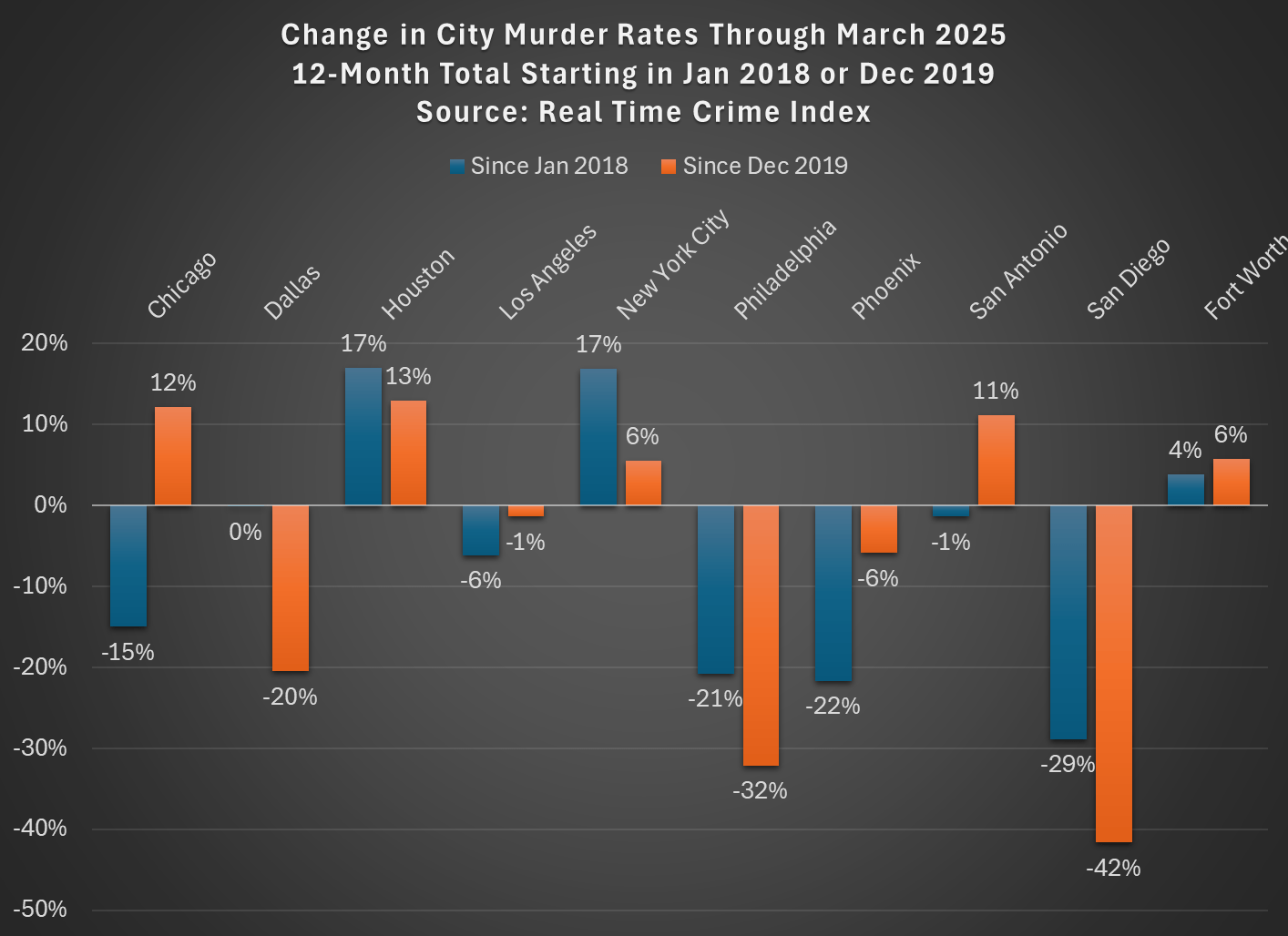
Using data from the Real Time Crime Index, we see that among the 10 largest cities in the US in their index, through the first 10 months of the 2024 (the most recent available for all these cities), homicides are down 16.9% compared to 2023.
Murders in these 10 largest cities are still about 5.6% above the first 10 months of 2019, but three of the 10 cities (Dallas, Philadelphia, and San Diego) are already below the first 10 months of 2019, by fairly significant margins (-13.7%, -26.2%, and -21.6%). Once we have all 12 months of data for these cities, I suspect that a few more will be back to 2019 levels.
Crime is indeed still a major social problem in much of the US, but we are getting back to 2019 levels of social problems — which is still bad, but violent crime is not high and rising, as many seem to believe based on very notable and horrific events.
(The 10 largest cities in the RT Crime Index are Chicago, Dallas, Houston, Las Vegas, Los Angeles, New York, Philadelphia, Phoenix, San Antonio, and San Diego.)
For decades one of the most popular Christmas gifts for kids (and often adults) has been video game systems. And Nintendo has long been a dominant player in this market: the original NES arguably launched the modern gaming market in 1986 (even though it wasn’t the first, it was the first blockbuster) and Nintendo’s latest offering, the Switch, is now the best-selling console ever in the US.
As we often ask on this blog: has it become more or less affordable for an average worker to buy this iconic Christmas gift (or even buy one for yourself)?
When it comes to the consoles themselves, the Switch and NES are, perhaps surprisingly, equally affordable. The original NES cost $90 in 1986, while the Switch costs $300 today. Average wages in late 1986 were $9/hour and they are about $30/hour today. So in both years, it took about 10 hours of work to buy the console (alternatively, it’s about 25% of median weekly earnings in both years).
But as any serious gamer will tell you, the individual game cartridges can cost as much or more than the console if you want to play a lot of games. For example, the games available in the 1986 Sears catalog ranged from $25-$30. To buy just the 10 games in that catalog would cost $275 — over 30 hours of labor at the average wage, or about 3 hours of labor per game.
Today there is a wider range of prices for games, but the most expensive Switch games are around $60, or just 2 hours of labor at the average wage. There are also plenty of games around $30, or just 1 hour of labor.
The challenge with the comparison is that video games today are much higher quality, challenging, and advanced in so many ways. Is there any way to make a more direct comparison?
Yes. Nintendo offers an annual subscription for $20 to Nintendo Switch Online. Included in the subscription is access to nearly every NES game, plus Super Nintendo and Gameboy games. Not only do you get the 10 games from the 1986 Sears catalog, but many dozens more. All for less than $1 hour of labor at the average wage.
In other words, for 30 hours of labor today (the time to purchase those 10 original NES games), you could buy about 46 years worth of subscriptions to Nintendo online. That’s almost a lifetime of video game play, with many more advanced games.
Excel is an attractive tool for those who consider themselves ‘not a math person’. In particular, it visually organizes information and has many built-in functions that can make your life easier. You can use math if you want, but there are functions that can help even the non-math folks
If you are a moderate Excel user, then you likely already know about the AVERAGE and COUNT functions. If you’re a little but statistically inclined, then you might also know about the STDEV.S function (STDEV is deprecated). All of these functions are super easy and only have one argument. You just enter the cells (array) that you want to describe, and you’re done. Below is an example with the ‘code’ for convenience.

=COUNT(A2:A21)
=AVERAGE(A2:A21)
=STDEV.S(A2:A21)
If you do some slightly more sophisticated data analysis, then you may know about the “IF” function. It’s relatively simple; if a proposition is true (such as a cell value condition), then it returns a value. If the proposition is false, then it returns another value. You can even create nested “IF”s in which a condition being satisfied results in another tested proposition. Back when excel had more limited functions, we had to think creatively because there was a limit to the number of nested “IF” functions that were permitted in a single cell. Prior to 2007, a maximum of seven “IF” functions were permitted. Now the maximum is 64 nested “IF”s. If you’re using that many “IF”s, then you might have bigger problems than the “IF” limitations.
Another improvement that Excel introduced in 2019 was easier array arguments. In prior versions of Excel, there was some mild complication in how array functions must be entered (curly brackets: {}). But now, Excel is usually smart enough to handle the arrays without special instructions. Subsequently, Excel has introduced functions that combine the array features with the “IF” functions to save people keystrokes and brainpower.
Looking at the example data we see that there is an identifier that marks the values as “A” or “B”. Say that you want to describe these subgroups. Historically, if you weren’t already a sophisticated user, then you’d need to sort the data and then calculate the functions for each subgroup’s array. That’s no big deal for small sets of data and two possible ID values, but it’s a more time-consuming task for many possible ID values and multiple ID categories.
The early “IF” statements allowed users to analyze certain values of the data, such as those that were greater than, less than, or equal to a particular value. But, what if you want to describe the data according to criteria in another column (such as ID)? That’s where Excel has some more sophisticated functions for convenience. However, as a general matter of user interface, it will be clear why these are somewhat… awkward.
Continue readingYou see a lot of nostalgia for the recent past. People pining for the simpler life of the 1950s, or claims that wages have stagnated since the late 1970s or early 1980s. I’ve tried to take these arguments seriously and respond to them, such as in a paper I wrote with Scott Winship and summarized in a blog post last June. But occasionally, you find really weird economic nostalgia, like for the 1890s. Yes, the 1890s, not the 1990s.
Here’s one example: a cartoon shared on social media of workers being oppressed in the 1890s, with the caption “the problem has only gotten worse.” That post received 2 million views on Twitter, possibly because many people are criticizing it, but it also has a lot of retweets and likes.
If it was just one semi-viral social media post from an anonymous Twitter account, we could easily dismiss it. But 1890s economic nostalgia has been coming from another important place lately: President Elect Trump. Of course he is nostalgic for the policies of the 1890s. But on occasion, Trump will say things like “Go back and look at the 1890’s, 1880’s with McKinley and you take a look at tariffs, that was when we were at our richest” (emphasis added).
Really, our richest in the 1890s? Can this be true? Are the anonymous socialist Twitter accounts correct? Let’s look at the data. But the answer probably won’t surprise you: your intuition is correct, we are much better off today than the 1890s, in almost every way of looking at it economically.
Continue reading