Is Global Capitalism Increasing Poverty?

A few days ago on Twitter, Nathan Robinson made the claim that global capitalism wasn’t reducing poverty. In fact, it appears that poverty, using the threshold of $10/day (rather than the usual lower numbers) has increased from 1981 to 2017:

While there were a lot of critical responses to him on Twitter, he’s not wrong about the data: in 2017, there were 1.3 billion more people living on less than $10 per day (we’re going to assume in this post that the underlying data is basically correct, and correctly adjusted for inflation and purchasing power). It’s also true that at lower thresholds, such as $1.90 and $3.20, the absolute number of poor people has declined. And as a proportion of the world population, fewer people are under $10 per day. But in absolute terms there are more people under $10 per day. And not just a few: over a billion! There are also a lot more people above $10/day in the world than in 1981 (1.7 billion more!), but I agree that we should be concerned if there are more poor people too.

So how should we think about these numbers? Here’s what I think is the fundamental problem with Robinson’s claim: he asserts that the entire world has experienced something called “global capitalism” during this time period. But there has been considerable variation in the extent to which countries have experienced something we would call “capitalism,” and the degree to which it has increased in the past 40 years (I wrote a series of Tweets on this too).

The easiest way to see this is to break down that 1.3 billion people into different countries. Where were the biggest increases? Also, did any countries experience decreases in poverty? (Spoiler alert: YES!)

Continue reading

What Proportion of Journalists Live in NYC?

Michael’s post this week on the dangers of high-status, low wage jobs opened by citing this tweet:

Michael presents a fascinating model that applies well beyond journalism. But when his post went viral, some commenters asked how accurate Josh Barro’s claim about half of young journalists living in Brooklyn was. Clearly Michael’s post doesn’t depend on it being true, and I’m not even sure Barro meant it literally, but it got me wondering- just what proportion of all young journalists do live in NYC?

For a first pass, we can look at the BLS Occupational Employment and Wage Statistics for the category “News Analysts, Reporters, and Journalists“. Their latest data (May 2020) shows 41,580 workers employed in those occupations nationwide. It also shows that the NYC metro has by far the most journalists with 5,940, more than twice as many as the second place metro (DC). This implies that 14.2% of all journalists in America live in the NYC metro. Since only 6% of all Americans live in the NYC metro, journalists are clearly clustering there, though clearly well over half of journalists still live elsewhere.

But, this doesn’t quite get at Barro’s claim, which is about journalists under 40 concentrating in Brooklyn. I don’t know of any data source that would let me really test the Brooklyn part, but I can get at the under-40 claim using Microdata from the American Community Survey, which also zooms us in a bit closer to Brooklyn since it tells us who is in NYC proper (not just the metro area).

The 2019 ACS shows that 10% of all “news analysts, reporters, and journalists” are in NYC proper, rising to 14% if I only consider journalists under 40 years old. This is quite concentrated (only 2.5% of all Americans live in NYC proper), but still a lot less that half of all journalists.

As Michael suggested, the vast majority of young NYC journalists are white (77%) with a college degree (91%), though English was only their second most common major after Communications.

The data confirm the last part of Michael’s post quite well- as journalists get older they are likely to move out of NYC and switch to more lucrative fields like PR. Only 5% of all “public relations specialists” are in NYC.

What’s a Sewer Worth?

Have access to clean water and a functioning sewer system is something that many Americans take for granted. Not all Americans, of course, especially those in rural areas not connected to an urban water system. But most Americans do. But how much is it worth?

It’s a hard question to answer. We know clean water and sewers probably have large effects on disease transmission. For example, Ferrie and Troesken (2008) looked at several major improvements in Chicago’s water system, and found that there were large declines in mortality from diseases like typhoid fever after the improvements (here’s an ungated working paper, with the much better title “Death and the City“). But the limits of earlier studies like this are that they primarily looking at a time series of mortality rate and relating this to some change in public infrastructure. A good attempt, but perhaps not convincing to everyone.

A better method would be to look at not mortality rates but property values. People are, surely, willing to pay more for a home with piped water and a sewer system. But how much more? Knowing this could give us better information on the value of the water systems. And that’s exactly what the authors of a new working paper do, once again visiting Chicago in the nineteenth century to look at how much property values increased after the installation of water and sewer systems. The paper is “The Value of Piped Water and Sewers” by Coury, Kitagewa, Shertzer, and Turner (ungated version).

The effects are huge. There most conservative estimate is that sewer and water systems doubled property values (a 110% increase), but the effect could be much larger (almost 4 times as much, if I am reading it correctly, under other reasonable assumptions).

People are willing to pay a lot for sanitation, it turns out.

Continue reading

Are Special Elections Special?

While the United States does have its problems with democracy, one area where we shine is direct democracy. Rare at the federal level, at the state and local level direct democracy is quite common in the US, much more so than most other democracies (Switzerland also stands out). Almost half the states have some form of citizen initiative or referendum process, and it is used frequently in most of those states. But even more direct democracy takes place at the local level.

And much of that direct democracy at the local level takes place through what are called special elections. I’m not talking about elections to fill unexpected vacancies in office — though of course those do happen. I’m talking about actual voting on issues. Many of these issues revolve around questions of public finance: whether to raise a local sales tax, to approve a property tax millage, or to issue bonds for a capital project.

One very relevant example for me is an upcoming special election in my city of Conway, Arkansas. Citizens are being asked to approve the issuing of bonds to construct a community center, pool, soccer fields, and some other amenities. The bonds would be secured by a tax on restaurants. The tax already exists — city councils can put these in place without a public vote. But to issue bonds, the citizens must be asked. I wrote an op-ed about it in my local paper (if that is gated, try this blog post).

The key is that this is a special election. There are no other issues on the ballot. It takes place on February 8th, not a date that probably stands out in voters minds as an election date. What will this special election mean for voter turnout? A lot of academic research, including a paper that I wrote (currently under review, but summarized here), finds clear evidence that voter turnout will be much lower. Will the result be different? Again, a lot of evidence suggests yes. For example, property tax elections in Louisiana were less likely to pass with higher turnout, and less likely to pass in a general election (my research finds a similar result for sales tax elections in Arkansas).

But why are tax increases less likely to pass in special elections? On this question there are many theories, but they are hard to test. Is it because different kinds of voters show up at special elections, representing a different sample of the population? Possibly, but evidence is hard to find.

A new paper just published in the American Political Science Review sheds some light on these questions.

Continue reading

Is the Labor Market Back?

Last month I asked if travel was back. Air travel has recovered a lot from the depths of the pandemic, but it was still only about 80-85% of pre-pandemic levels.

Labor markets also plummeted during the worst of the pandemic, and have slowly (and sometimes quickly) clawing their way back. But are we back to pre-pandemic levels?

The national unemployment rate is now under 4%, a level which is rarely reached even in the best of times. But there is considerable variation across states.

The latest BLS release of state unemployment data shows that some states are at their historic lows, with one state standing out: Nebraska currently has the lowest unemployment rate a state has ever recorded at 1.7% in December 2021 (the data go back to 1976). Utah is also just below 2% in December — at 1.9% it’s the 2nd lowest in history (after Nebraska, of course).

Of course, all is not well everywhere. California and Nevada have the highest unemployment rates, at around 6.5%. This is well above their pre-pandemic levels of about 4%, and also well above what you would expect during normal times, other than during and immediately following at recession.

So is the labor market back in Nebraska, Utah, and other similar states? Not so fast.

Continue reading

Housing & The Fed’s Reputation

I am not worried about inflation and I’m not worried about the total spending in the economy. As I’ve said previously, total spending is on track with the pre-pandemic trend and, I think, that helped us experience the briefest recession in US history. When output growth declines below trend, we face higher prices or lower incomes. The former causes inflation, the latter causes large-scale defaults. Looking at the historical record, I’m for more concerned about the latter.

I do, however, want to call special attention to the composition of the Fed’s balance sheets. Specifically, its Mortgage Backed Security (MBS) assets. Having learned from the 2008 recession, the Fed was very intent on maintaining a stable and liquid housing market. Purchasing MBS is one way that it maintained that stability. Its total MBS holdings almost doubled from March of 2020 to December of 2021 to $2.6 trillion. Should we be concerned?

At first, a doubling sounds scary. And, anything with the word ‘trillion’ is also scary. Even the graph below looks a little scary. MBS holdings by the Fed jumped and have continued to increase at about a constant rate. Is the housing market just being supported by government financing? What happens when the Fed decides to exit the market?

Luckily for us, there is precedent for Fed MBS tapering. The graph below is in log units and reflects that a similar acceleration in MBS purchases occurred in 2013. Fed net purchases were practically zero by 2015 and total MBS assets owned by the Fed were even falling by 2018. Do you remember the recession that we had in 2013 when the Fed stopped buying more MBS’s? Wasn’t 2018-2019 a rough time for the economy when the Fed started reducing its MBS holdings? No. We experienced a recession in neither 2013 nor 2018. Financial stress was low and RGDP growth was unexceptional.

Although there was no macroeconomic disruption, what about the residential sector performance during those times? Here is a worrisome proposed chain of causation:

  1. Relative to a heavier MBS balance sheet, the Fed reducing its holdings increases supply on the MBS market.
  2. This means that the return on creating new MBS’s falls (the price rises).
  3. A lower return on MBS’s means that there is less demand from the financial sector for new loans from loan originators.
  4. A tighter secondary market for mortgages decreases the eagerness with which banks lend to individuals.
  5. Fewer loans to individuals puts downward pressure on the demand for houses and on the price of the associated construction materials.

The data fits this story, but without major disruption.

Less eager lenders went hand-in-hand with higher mortgage rates and less residential construction spending. The substitution effect pushed more real-estate lending and spending to the commercial side. Whereas residential spending was almost the same in late 2019 as it was in early 2018, commercial real-estate spending rose 13% over the same time period.

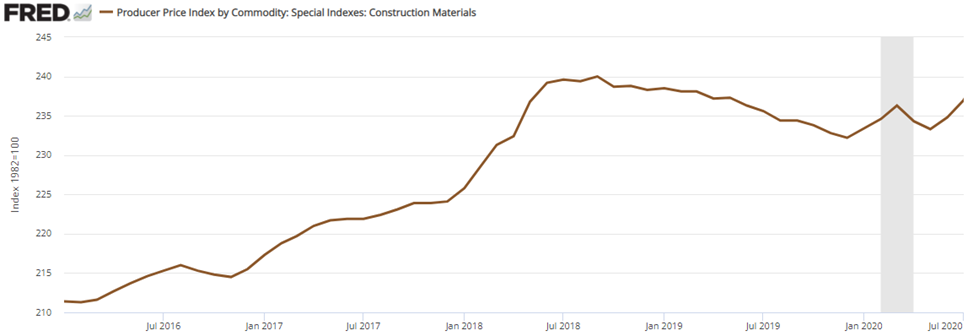
But, importantly in the story, the income effect of a Fed disruption should have been negative, resulting in less total spending and lower construction material prices. And that’s not what happened. Total Construction spending rose and so did construction material prices. Both of these are the opposite of what we would expect if the Fed had caused disruption in the housing construction sector due to its MBS holding changes.   Spending on residential construction fell understandably. But spending on commercial construction and the price of construction materials rose.

My point is that you should not listen to the hysteria.

The Fed has a variety of assets on its balance sheet and it pays special attention to the residential construction sector. Do you think that there is a residential asset bubble? Ok. Now you have to address whether the high prices are due to demand or supply. Do you suspect that the Fed unloading its MBS’s will result a popped bubble and maybe even contagion? It’s ok – you’re allowed to think that. But the most recent example of the Fed doing that didn’t result in either a macroeconomic crisis or substantial disruption in the construction markets.

The Fed has a track record and it has a reputation that serves as valuable information concerning its current and prospective activities. The next time that someone gets hysterical about Fed involvement in the housing sector, ask them what happened last time? Odds are that they don’t know. Maybe that information doesn’t matter for their opinion. You should value their opinion accordingly.

Are Car Accidents Getting Labeled as “COVID Deaths”?

Of all the increases in mortality in 2020, one that is notable is motor vehicle accidents. There were 43,045 deaths from motor vehicle accidents, according to the final CDC data. This means motor vehicle accident was listed on the death certificate, even if it was not determined to be the “underlying cause,” though for 98% of these deaths the accident was listed as the underlying cause.

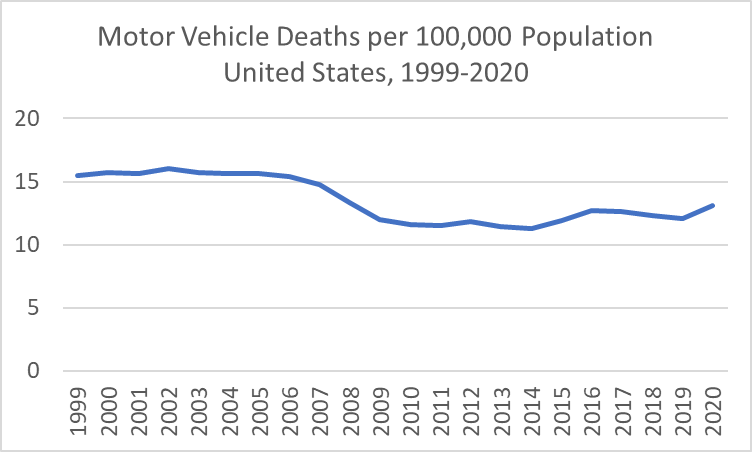
The increase from past years was large. Compared with 2019, there were over 3,000 more motor vehicle deaths, though such as increase is not unheard of: 2015 and 2016 each saw increases of around 2,500. Even so, the crude death rate from motor vehicle accidents in 2020 was the highest it has been since 2008.

If that weren’t bad enough, another theory emerged in 2020 and continues to be suggested today: that car crashes are being labeled as “COVID deaths,” artificially inflating the COVID death count. While one can find this claim made almost daily by anonymous Twitter users, one of the most prominent statements was on Fox News in December 2020. Host Raymond Arroyo said that car accidents were being counted as COVID deaths, and that due to errors like this COVID deaths could be inflated by as much as 40 percent. Senator Marco Rubio made a similar claim on Twitter in December 2021, though he was talking about hospitalizations, not deaths.

Back in 2020, many doctors and medical professionals tried to debunk the “car accidents being labeled as COVID deaths” claim, but the problem was we didn’t have complete data. Anonymous anecdotes were cited, but medical professionals tried to reassure the public this wasn’t the case or at least wasn’t widespread.

But now, we have the data! That is, the complete CDC mortality data for 2020 available through the CDC WONDER database.

What does this data show us? Short answer: there aren’t that many car accidents being labeled as COVID deaths. At most, it’s about 0.03% of COVID deaths.

Continue reading

The Return of Independent Research

Universities have been around for about a thousand years, but for much of that time it was typical for cutting-edge research to happen outside of them. Copernicus wasn’t a professor, Darwin wasn’t a professor. Others like Isaac Newton, Robert Hooke, and Albert Einstein became professors only after completing some of their best work. Scientists didn’t need the resources of a university, they simply needed a means of support that gave them enough time to think. Many were independently wealthy (Robert Boyle, Antoine Lavoisier) or supported by the church (Gregor Mendel). Some worked “real jobs”, David Ricardo as a banker, Einstein famously as a patent clerk.

Over time academia grew and an increasing share of research was done by professors, with most of the rest happening inside the few non-academic institutions that paid people to do full time research: national labs, government agencies, and a few companies like Xerox Parc, Bell Labs and 3M. In many fields research came to require expensive equipment that was only available in the best-funded labs. “Researcher” became a job, and research conducted by those without that job became viewed with suspicion over the 20th century.

But the Internet Age is leading to the growth in opportunities outside academia, opportunities not just economic but intellectual. Anyone with a laptop and internet can access most of the key tools that professors use, often for free- scientific articles, seminars, supercomputers, data, data analysis. Particularly outside of the lab sciences, the only remaining barrier to independent research is again what it was before the 20th century- finding a means of support that gives you time to think. This will never be easy, but becoming a professor isn’t either, and a growing number of people are either becoming independently wealthy, able to support themselves with fewer work hours (even vs academics), or finding jobs that encourage part time research. If you work for the right company you might even get better data than the academics have.

Particularly in artificial intelligence and machine learning, the frontier seems to be outside academia, with many of the best professors getting offers from industry they can’t refuse.

Even in the lab sciences, money is increasingly pouring in for those who want to leave academia to run a start-up instead:

I think it’s great for science that these new opportunities are opening up. A natural advantage of independent research is that it allows people to work on topics or use methods they couldn’t in academia because they are seen as too high risk, too out there, make too many enemies, or otherwise fall into an academic “blind spot“.

I’m still happy to be in academia, and independent research clearly has its challenges too. But over my lifetime it seems like we have shifted from academia being the obvious best place to do research, to academia being one of several good options. Even as research has begun to move elsewhere though, universities still seem to be doing well at their original purpose of teaching students. Almost all of the people I’ve highlighted as great independent researchers were still trained at universities; most of the modern ones I linked to even have PhDs. There are always exceptions and the internet could still change this, but for now universities retain a near-monopoly on training good researchers even as the employment of good researchers becomes competitive.

As an academic I may not be the right person to write about all this, so I’ll leave you with the suggestion to listen to this podcast where Spencer Greenberg and Andy Matuschak discuss their world of “para-academic research”. Spencer is a great example of everything I’ve said- an Applied Math PhD who makes money in private sector finance/tech but has the time to publish great research, partly in math/CS where a university lab is unnecessary, but more interestingly in psychology where being a professor would actually slow him down- independent researchers don’t need to wait weeks for permission from an institutional review board every time they want to run a survey.

Latest Inflation Data: Hot Dogs and Cheese On Sale!

The latest CPI inflation data was released this morning. Mostly the new data just confirms what we’ve seen the past few months: consumer price inflation is at the highest levels in decades, and it is now very broad based.

To see how broad based the inflation is, we can look at any of the “special aggregates” that the BLS produces. CPI less food. CPI less shelter. CPI less food, shelter, energy, used cars and trucks (what a mouthful!). All of these are up substantially over the past year. The lowest number you can get is that last aggregate I listed, which excludes almost 60% of consumer spending, and even it is up 4.7% over the past year — the largest increase since 1991 for that particular special index.

Or, you can just look at food. We all have probably observed that meat prices are way up recently — about 15% over the past year. But it’s not just meat. It’s fruit, vegetables, grains, dairy… the whole darn food pyramid. In fact, there are only two food categories (hot dogs and cheese) and two drinks (tea and wine) that are actually down since December 2020.

I’ve covered the symbolic importance of hot dog prices before, but the fact that only four food or drink categories had price decreases are indications that food-price inflation is extremely broad-based.

So what’s causing the inflation?

Continue reading

Really Stable Prices

Breaking news in America this week: Little Caesars will be raising the price of their Hot-N-Ready Pizzas from $5 to $5.55. Some see this as a sign of the times, just another bit of bad news among all the inflation data lately. But what really surprised me is that this price has been stable they introduced it in 1997. This means that compared to median wages, these pizzas were about 50% cheaper than 1997 (before this price increase). That’s a doubling of America’s Pizza Standard of Living in just 24 years.

Keeping a fixed price is a somewhat rare, but fascinating pricing strategy. It can even become part of the identity of the product. The most famous example was Coca-Cola, which sold a 6.5 ounce bottle for 5 cents from 1886 to 1959. It’s so famous that it has its own Wikipedia page! “Always 5 cents” became a marketing slogan for them. And while we may regard that time period as one of generally low inflation, consumer prices on average more than tripled from 1886 to 1959.

Probably the most famous recent example is Costco’s $1.50 hot dog and soda combo, which has been stable in price since 1985. Rumor has it that the founder of Costco once told the current CEO that he’d kill him if he raised the price of the hot dog. Since 1985, nominal median wages in the US have tripled, meaning that your Costco Hot Dog Standard of Living has also tripled.

The concept of nickel and dime stores and later dollar stores are similar concepts, but they aren’t necessarily selling the exact same products over time. Coca-Cola, Hot-N-Ready pizzas, and Costco hot dogs really are the same product from year-to-year, so these products stand out as amazing examples of price stability during periods of time when most prices were rising in nominal terms (other than new technologies).

What are some other examples of consistently stable prices?