Flying the Friendly Skies (Today and in the Past)

It’s almost summer. About half the US population has at least one dose of a COVID vaccine. For many Americans that haven’t had their employment impacted by the pandemic, their bank accounts are flush with cash and they are ready to do one thing with that cash: travel. See family and friends. See something other than the inside of your own home.

And for many Americans traveling this summer, they will fly. The airlines, no doubt, will appreciate your business. At this time last year, the world had so radically shifted that Zoom’s market cap was bigger than the 7 largest airlines in the world. In May 2020, air passenger traffic in the US was less than 10% of traffic in 2019. Today, we’ve recovered a lot, but we are still only back to about two-thirds of normal levels. And since airplanes are just a marginal cost with wings, flying all their planes at close to full capacity is crucial for airlines to return to profitability. They really need you to fly the friendly skies this summer.

One of the reasons that so many Americans are able to fly in today is because flying is, compared to historical prices, very cheap.

How cheap is flying to today compared to the past? Let’s look at some historical price data for flights.

Continue reading

When will housing prices fall?

US housing prices shot up during the pandemic. People spending all day at home wanted bigger houses, and the Fed fueled their demand with low interest rates. But home owners didn’t want to sell- the total number of homes on the market is less than half what it was a year ago. This combination of rising demand & falling supply has sent prices way up & cut the time homes spend on the market.

Contrary to popular belief, its actually rare for economists to make market forecasts and most of us aren’t especially well-equipped to do so- but I’m going to try anyway! I think home prices will almost certainly stop growing so quickly, and may actually fall, within two years.

Why? The end of the pandemic, the rise of new construction, and the end of low interest rates.

Continue reading

Let’s Talk About Inflation

You’ve probably seen the headlines. Corn prices are double what they were a year ago. Lumber prices are triple. You can find all kinds of other scary examples. Is runaway inflation just around the corner? Is it already here?

And yet, measures of prices that consumers pay are much more stable. The most widely tracked measure, the CPI-U, is up 4.2% over the past year. That’s through April — and keep in mind that it’s starting from a low base since March-May 2020 saw falling prices). The Personal Consumption Expenditures index, often preferred by economists, is up just 2.3% (though that’s only through March).

So what gives? Do these consumer measures understate inflation in some way? Or is the increase in commodity prices telling us that consumer prices will increase soon?

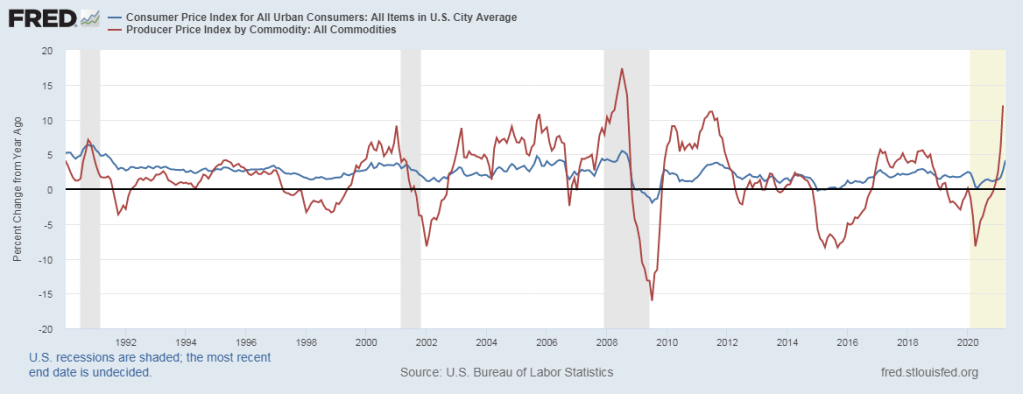
Let’s take that second question first. Do higher commodity prices necessarily lead to higher consumer prices? The answer is a clear no. First, we can see that in the data. The producer price index for all commodities (such as corn and lumber) is up 12% over the year (through March, with April data coming out tomorrow). That’s a big increase. But as the chart below suggests, that probably will not lead to 12% increases in consumer prices. It probably won’t even lead to a 5% increase in consumer prices.

Notice two things about this chart. First, commodity prices (the red line) are much more volatile than consumer prices, both on the upside and downside. Second, there really isn’t much of a lag, if any. The direction of change is similar in both indexes, almost to the month. When producer commodity prices go up, consumer prices also go up, that very same month, but not by the same amount. So all of that 12% increase in producer prices is probably already reflected in consumer prices.

Why might this be? Simple supply and demand analysis (hello Econ 101 critics!) can tell us why.

Continue reading

Are Poor Americans Really as Rich as Average Canadians?

Have you seen this chart? I certainly have. It floats around on social media a lot. The chart seems to indicate that poor Americans are better off than the average person in most other rich countries. Roughly equal to Canada and France, and better off than Denmark or New Zealand.

When I’ve asked for sources in the past, people usually aren’t sure. They remember downloading it from somewhere, but they can’t recall where.

But I think I found the source: it’s this article from JustFacts. After seeing how they calculated it, I’m skeptical that it provides a good comparison of poor Americans to other countries.

Here’s what the chart does. For most countries, it uses a World Bank measure of consumption per capita. They then convert that to US dollars using PPP adjustments. For the poor in the US, they use a consumption estimate for the bottom 20% of households (Table 6), and then divide by the average number of people per household. For the poor in the US, the average consumption for 2010 was an amazing $57,049, more than double the poverty line! That’s about $21,000 per poor person.

How is this possible?

Continue reading

Old Lives Matter

Bryan Caplan has kindly responded to my latest blog post, which was in turn a response to his blog post on the relative value of human lives by age. Caplan has always been kind in his responses, even when responding to pesky graduate students — kind in both his approach and the time he dedicates to responding thoughtfully. So I appreciate his taking the time to respond to me, and I will offer a few more thoughts on the matter.

To briefly summarize: Caplan believes that young lives (10 year olds) are worth 100-1,000 as much as old lives (80 year olds). I contend that they are closer to roughly equally valued. My disagreement with Caplan can be broken down into two categories:

  • A. Caplan’s three reasons why young lives are worth more (a lot more!) than old lives. I didn’t respond to that directly, but I will do so here. I think Caplan is narrowing the goalposts.
  • B. A disagreement over the shape of the VSL curve over the lifetime, specifically whether an inverted-U-shaped curve makes sense. I’ll say more about this too, but Caplan doesn’t just have a beef with me, but with almost everyone in the VSL literature!

Let’s start with Caplan’s three reasons, which he calls “iron-clad”: young people have more years to live, those years are generally healthier, and young people will be missed more when they are gone. The first in undeniably true on average, the second is probably true almost all the time, and I’m not sure on the third, but I’m willing to admit it’s not a slam dunk either way.

So how can I disagree? These are only three things. There are many other considerations, and we can imagine other reasons that old lives are valued as much or more than younger lives! I’ll call mine 4-6 to go with Caplan’s 1-3:

  1. Old age spending is the largest component of public budgets in developed countries (and this is unlikely mostly due to rent seeking or the self interest of younger generations).
  2. The elderly possess wisdom which is highly valuable and that the young benefit from.
  3. The last years of your life are, on average, worth a lot more — you are usually very wealthy, have no employment obligations, you have grandchildren you love (without the responsibilities of parenting), and are (until the very end) generally healthy too.

Taken as a whole, I think these three reasons present a strong counterargument to Caplan’s three reasons. And I think we could certainly come up with more! My point being that Caplan has picked three areas where clearly young lives have the advantage, but ignored all the good reasons why old lives are more valuable. These is what I mean by we shouldn’t rely on our intuitions. Neither of our lists are exhaustive, but let me elaborate on a few of these.

Continue reading

Facebook Disrupts a Phishing Spy Campaign

Written by Braden Murray, a Samford business school student:

Facebook is a social media platform, with more than one billion users (GCFGlobal.org). Facebook is also a data warehouse, and an analytics powerhouse. The company uses its technology to track user activity and obtain information on preferences. Information is used to update its newsfeed algorithm or sell advertising. Because Facebook monitors users, analysts know how many accounts are inactive or have suspicious activity. The WSJ reports a phishing attempt recently caught by Facebook.

Facebook has reported a security issue affecting the Uyghurs population. The social media company has just taken down multiple accounts connected to China being used online to “spy on journalists and dissidents in the overseas Uyghur Muslim community” (Horwitz). Facebook did not blame the Chinese government. It pinned the hacking on a network that used infected apps created by Chinese companies. Facebook also said the hacking activity happened outside of its social media platform, although the hackers did use Facebook accounts pretending to be members of the Uyghur community. They would send their victims links to the infected apps over Facebook, which is known as social media phishing. However, the only way the malware would download and corrupt the device is if it met the criteria of using Uyghur-language settings. 

Phishing is a crime committed on the internet that causes malware to corrupt a computer system and personal information to be stolen. It is usually conducted through email, text, or over the phone in some cases. A link is sent to the victim from a random source that seems like it could be reliable. If the link is clicked, the hack occurs and corrupts their technological device. The results of phishing include identity theft, financial fraud, and malware. The FBI said phishing was the most popular cybercrime of 2020 and doubled in cases from 114,702 to 241,324 (Tessian). Phishing is a very common occurrence that people need to be aware of in order to avoid consequences. 

Mike Dvilyanski is a Facebook employee who handles cyber threat intelligence. He said he “saw attackers injecting malicious code into the website pages” and how it would “then infect them with specific malware if they met criteria that attackers set up.” After noticing the hacking efforts, Dvilyanski and other coworkers would shut down the accounts. The hacker group was identified by a joint effort of several companies working along with Facebook. The Chinese hacker group called Earth Empuse or Evil Eye posed as journalists in the Uyghur community and other nearby places.

The effort was to shut down as many fraudulent accounts as possible to disrupt the network and decrease the number of successful phishing attacks. This is just one example of the security issues that Facebook encounters and combats using data analytics.

Note by Joy Buchanan: I encounter fraud and phishing attempts regularly on the internet, and usually it doesn’t faze me. Twice in the past year, I have gotten an email to my work address from someone pretending to be the dean of my school. I wasn’t tricked successfully either time, but I found those attacks to be particularly creepy.

Growing a Financial Advisory Practice Using Data

Lance Rybka is a current finance major at Samford University. He hopes to start a business that uses data analytics to help fee-based financial advisers grow firms.

According to data from the most recent Tiburon Summit, small fee-based financial advisers are increasingly facing pricing pressures that place their businesses at risk. Since 2009 the average fees charged by these advisors have decreased from 1.2% of AUM to .96%,, and 86% of Tiburon CEOs believe that these fees will continue to decrease over the next five years. While robo-advisers and data analytics are partially responsible for this restrictive pricing trend, many traditionalists do not realize the potential they have to grow their practice by embracing this technology instead of resisting it.

Continue reading

Tesla and Data Privacy

Samford business school student A.K. Vance writes:

As technology and data have become more prevalent in our daily lives, concern about privacy grows. Governments and countries now worry about “commercial espionage” on citizens. In a recent Wall Street Journal article, Trefor Moss discusses the implications of the ability for companies like Tesla to collect data on its consumers. China is currently attempting to restrict its citizens’ access to Tesla cars which have the capability to track and collect data on its owner. The Chinese government cites the fear that data including images which can be taken by the cars will be sold or given to the American government. Beijing has gone so far as to restrict the use of Tesla cars “by military personnel or employees of some state-owned companies”. Elon Musk has publicly stated that no data will be released to the United States or any other nation. The results of selling or giving such data or information to other governments could lead to many negative effects for Tesla and could cause a huge loss of Tesla’s business. In the last year, China made up a quarter of Tesla car sales. If Tesla did use their data capabilities to collect and give information to the United States government, they would risk losing a huge market for their product. Musk goes on to claim that such a violation of privacy could lead to a “shut down everywhere which is a very strong incentive for us [Tesla] to be very confidential”.

Related concerns over the Chinese application, TikTok, led to an attempt to ban the application in the United States due to its potential of collecting data on American citizens which could be used by the Chinese government to spy. As products become more integrated into the internet, privacy concerns may affect international trade. Companies might have a private incentive to protect customers, but that might not be sufficient. Legislation is still catching up to the changes in technology and new capacity to track individuals via “commercial espionage”.

Moneyball for March Madness

Sinclaire Green, a Samford business school student, writes:

Since Billy Beane transformed the 2002 Oakland Athletics baseball team by utilizing data analytics, propelling the team to a 20 consecutive game win streak, sports fans, coaches, and players have all become more attuned to the role data can play in baseball. As a result, professional basketball teams also began to use data analytics to improve their game plans, skills, and recruiting. In the past few years, Colton Houston and Matt Dover have begun to use data analytics to help college basketball teams similarly to how Billy Beane helped transform the Oakland A’s in the early 2000s.

Houston and Dover’s company, HD Intelligence, provides a service to college basketball that was previously only feasible for professional teams. HD Intelligence eliminates the need for internal data analysts. Analysists at HD Intelligence compile data and present it to college basketball coaches to improve decision making. HD Intelligence prides themselves on making meaningful insights that coaches can understand. Instead of coaches having to rely on watching video and looking at statistics from box scores, HD Intelligence provides reports for teams. Coaches can know their team better, know their opponent better, evaluate recruits effectively, and optimize their schedules.

In the 2019-2020 basketball season, HD Intelligence had two primary college basketball clients, The University of Dayton Flyers and the University of Alabama Crimson Tide. Similar to the Oakland A’s, Dayton does not have quite as robust of a budget as many of the nation’s other top programs. Also similar to the Oakland A’s, the Flyers had a 20-game win streak last year and many basketball aficionados think that Dayton would have won the NCAA tournament had the COVID-19 pandemic not halted the tournament. Similarly, Alabama basketball has had an excellent 2020-2021 season. The program has risen within the SEC to win the 2021 conference tournament. More importantly, the Tide made themselves a legitimate contender for the national title by making it to the Sweet 16 in the NCAA tournament. Even though Alabama did not make it to the Elite Eight, they had a great season with many wins. HD Intelligence helped both Dayton and Alabama optimize their talent and resources by providing data analysis of each game and by assisting with pre-season non-conference scheduling for the two programs. Looking to next basketball season, Houston and Dover have over 10 schools who they will assist with data analytics.

The Future of the World’s Tiniest Billboards

Ben Lange, a business student at Samford, writes:

In January of this year, Apple made a big announcement. It wasn’t about a new iPhone. Apple announced that it will soon release an update to their software that allows users to choose whether they give permissions to apps such as Facebook to track their browsing history on other companies’ apps and websites.(WSJ) This has implications for data usage and availability in advertising. As technology has advanced, regulations surrounding exactly what a company is allowed to do with your data has  stayed relatively stagnant, especially for smartphones. Companies such as Facebook and Twitter are allowed to monitor your searches not only on their apps, but also on your phone browser and other apps.

Continue reading