In the course of research work, I read “Sticky Prices as Coordination Failure” today, published in 1991 by L. Ball and David Romer.
They suggest that “coordination failure is at the root of inefficient non-neutralities of money”. They write an elegant theory of price setting and adjustment that includes a menu cost. A menu cost is imposed on an individual who adjusts prices. The name comes from the fact that some restaurants face a literal cost for switching the paper menus.
If changing prices is costly then there is inertia. People tend to stay where they were before, even if adapting to fluctuating external conditions is more efficient.
According to their model of rational individual agents, people will change if the expected benefit of adjustment is larger than the menu cost. In some cases, the optimal action for an individual depends on what others are doing. Thus
Increases in price flexibility by different firms are strategic complements: greater flexibility of one firm’s price raises the incentives for other firms to make their prices more flexible. Strategic complementarity can lead to multiple equilibria in the degree of nominal rigidity, and welfare may be much higher in the low-rigidity equilibria.
An implication is that if you are surrounded by people who are open to constantly changing, then you yourself will be more likely to adapt. The world is always fluctuating, so welfare is higher for communities that can adapt quickly. Example of changing circumstances include global warming and novel safety procedures suddenly needed during the time of Covid.
In this paper, “multiple equilibria” means that a community might settle at a high-wealth level or a low-wealth level simply because of what everyone else is doing. Ball and Romer don’t try to figure out which equilibrium is more likely to be the outcome in reality.
No one in their model would be out of equilibrium (unnecessarily poor) if it were not for the “sticky” prices. As the title implies, coordinating the optimal levels of production and consumption is difficult because of the inertia of prices.
In their conclusion, they reflect on the role of government when multiple equilibria are possible:
… with multiple equilibria, policy can be less coercive. Instead of prohibiting certain contract provisions, the government could simply convene meetings of business and labor leaders to coordinate adjustment … Second, by moving the economy to a new equilibrium, temporary regulations can permanently change the degree of nominal rigidity.
They assume that after a recession, the price adjustment that needs to happen is “for decentralized agents to reduce nominal wages in tandem.” It’s interesting to see, culturally speaking, how hesitant they seem to strongly recommend government intervention through inflation. I feel like writers in econlit today would not be shy about saying they think governments should intervene through monetary policy, if they believe that to be true.
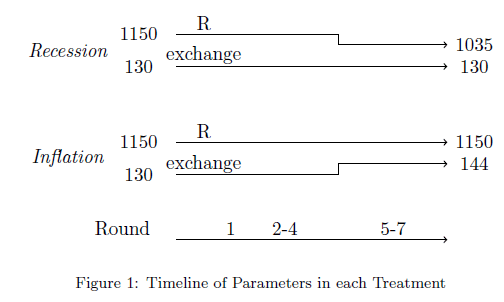
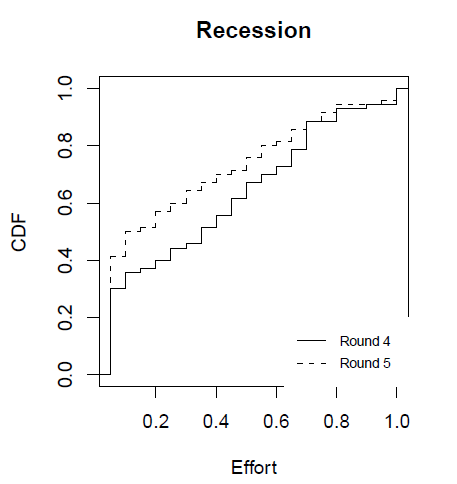
In my JEBO paper, I found that a little inflation caused workers to not lower production so much in response to a real wage cut after a recession. In our environment, I would say “cooperation” was more important than “coordination”, because there were only two agents and their decisions were sequential.