Tough Year for Investing (with one little-known, totally safe exception)

There’s still a few more days left in the year, but at this point it is safe to say, unfortunately, that it was a very bad year for investing. This Google chart shows most of the bad news. Note: nothing in this post is investment advice about the future, just a summary of the past.

The S&P 500, the typical benchmark for US equities, was down 20%. Bonds, usually a safe haven, were down over 14% as measured by the Vanguard Total Bond fund (more on bonds later).

Gold, the traditional hedge against bad times, was flat. I guess that’s not so bad. But gold is also traditionally considered a hedge against inflation, and inflation will probably end up being somewhere in the range of 5-7% this year (depending on your preferred index). So in real terms, even gold was down. And the supposed new hedge against fiat currency? Bitcoin is down 65% (crypto has other potential redeeming features, but inflation hedging was supposed to be one of them).

Did anything do well? Oil was basically flat too, starting and ending the year in the $75-80 range. Of course, oil companies did very well this year — Exxon is up over 70%, since prices were elevated for much of the year. But picking individual stocks is always fraught with danger. For example, you might think electric car companies would have done well in the past year, given the high gas prices for much of the year, yet Tesla was down over 70% (I won’t speculate here about why, but it may have other idiosyncratic explanations).

There is one boring, sleeper investment that would have earned you a decent return. Not a massive return, but one that will likely be slightly higher than the rate of price inflation (once we have complete inflation data). And the investment is totally safe, and by April you would have known exactly your rate of return for the full year: 8.5%.

That investment? Series I Savings Bonds, issued by the US Treasury. Series I Bonds pay a fixed rate of return for 6 months, which you know at the time you buy it. The interest rate rests every 6 months based on the rate of CPI inflation. If you invested in these bonds in January 2022, you would have earned 3.56% for 6 months, and then you would have earned 4.81% for the second half of 2022. And this was all known as early as April 2022 (though not officially confirmed by the Treasury until May).

While a lot of people were talking about the possibility of high inflation at the beginning of 2022, I don’t recall many people advising anyone to buy these bonds. It’s not a super well known investment, and not super exciting. Plus each investor is capped at $10,000 per year in most cases, so you couldn’t have moved all your money into I Bonds. Another restriction is that you lose some of the interest if you pull the money out before 5 years.

Still, this was one bright spot in an otherwise terrible year for most broad investment types.
“Let whoever needs to die, die”:  China’s Abrupt COVID Reopening To Achieve Rapid Herd Immunity and Resumption of Industrial Production, at the Cost of a Million Deaths

I noted a month ago that President Xi and the CCP have taken credit for relatively low (reported) deaths from COVID, due to strict lockdown protocols. By “strict” we mean locking down whole cities and blockading residents in their apartment buildings for months at a stretch. However, public protests rose to an unprecedented level, and so the Chinese government has done a surprising full 180 policy change, towards almost no restrictions.

According to Dr. Ezekiel Emanuel in the Wall Street Journal, the way this policy is being carried out has the makings of a mass human tragedy:

Zero Covid was always untenable and had to be ended. But it could have been done responsibly.

Among other things, that would involve buying Pfizer and Moderna bivalent vaccines and administering them to the elderly and other high-risk people, and purchasing Paxlovid and molnupiravir to treat those who test positive. Supplies of these products are ample. Authorities could continue mask mandates to reduce transmission. And China could institute a rigorous wastewater testing program to identify potential SARS-CoV-2 variants as soon as possible – and commit to sharing the data with the world.

Due to nationalistic pride, China has spurned the purchase of effective mRNA vaccines from Pfizer and Moderna, pushing instead the less-effective in-house vaccine.

Readers may recall in the early days of COVID spread in the West, masking and social distancing were promoted, not because they would prevent everyone from ultimately becoming infected, but because these measures would “flatten the curve” (i.e. reduce the peak load on hospitals at any one time, but instead spread it out over time). China is headed into a very un-flattened infection curve; some 800 million people (10% of the world’s population) may get COVID in the next 3 months, overwhelming hospitals and leading to over a million deaths. Besides the near-term human costs, this concentration of active COVID cases is likely to lead to a slew of new, even more virulent variants which will affect the rest of the world, along with China. What should help mitigate the situation is that the newer, most virulent variants of COVID may be somewhat less fatal than the original strain.

Why is the Chinese government doing it this way? Well, the sooner the country gets through mass exposure to the virus, the sooner everyone can get back to their factories and start producing stuff again. If in the process a bunch of (mainly older) people die, well, that’s just the price of progress. Let ‘er rip…

From MSN:

[U.S.] Epidemiologist and health economist Dr Eric Feigl-Ding estimate that 60 per cent of China’s population is likely to be infected over the next 90 days. “Deaths likely in the millions—plural,” he added.

According to Eric, bodies were seen piled up in hospitals in Northeast China. “Let whoever needs to be infected infected, let whoever needs to die die. Early infections, early deaths, early peak, early resumption of production,” the epidemiologist said terming it to be summary of Chinese Communist Party’s (CCP) current goal.

But don’t expect any acknowledgement of mass death from the official Chinese media. Just as the initial COVID outbreak was denied and censored by the Chinese propaganda machine, so the current surge is being minimized. From Barrons:

On Friday, a party-run newspaper cited an official estimate of half a million daily new cases in the eastern city of Qingdao. By Saturday, the story had been amended to remove the figure, an AFP review of the article showed….

Several posts on the popular Weibo platform purporting to describe Covid-related deaths appeared to have been censored by Friday afternoon, according to a review by AFP journalists.

They included several blanked-out photos ostensibly taken at crematoriums, and a post from an account claiming to belong to the mother of a two-year-old girl who died after contracting the virus.

Posts about medicine shortages and instances of price gouging were also taken down, according to censorship monitor GreatFire.org.

And social media users have posted angry or sardonic comments in response to the perceived taboo around Covid deaths.

Many rounded on a state-linked local news outlet after it reported Wu Guanying — designer of the mascots for the 2008 Beijing Olympics — had died of a “severe cold” at the age of 67.

Perhaps we should not be surprised that the Chinese Center for Disease Control and Prevention just reported zero COVID deaths for December 25 and 26.

Average US Consumption: 1990 Vs 2021

On Twitter, folks have been supporting and piling on to a guy whose bottom line was that we are able to afford much less now than we could in 1990 (I won’t link to it because he’s not a public figure). The piling on has been by economist-like people and the support has been from… others?

Regardless, the claim can be analyzed in a variety of ways. I’m more intimate with the macro statistics, so here’s one of many valid stabs at addressing the claim. I’ll be using aggregates and averages from the BEA consumer spending accounts.

Continue reading

College Major, Marriage, and Children Update

In a May post I described a paper my student my student had written on how college majors predict the likelihood of being married and having children later in life.

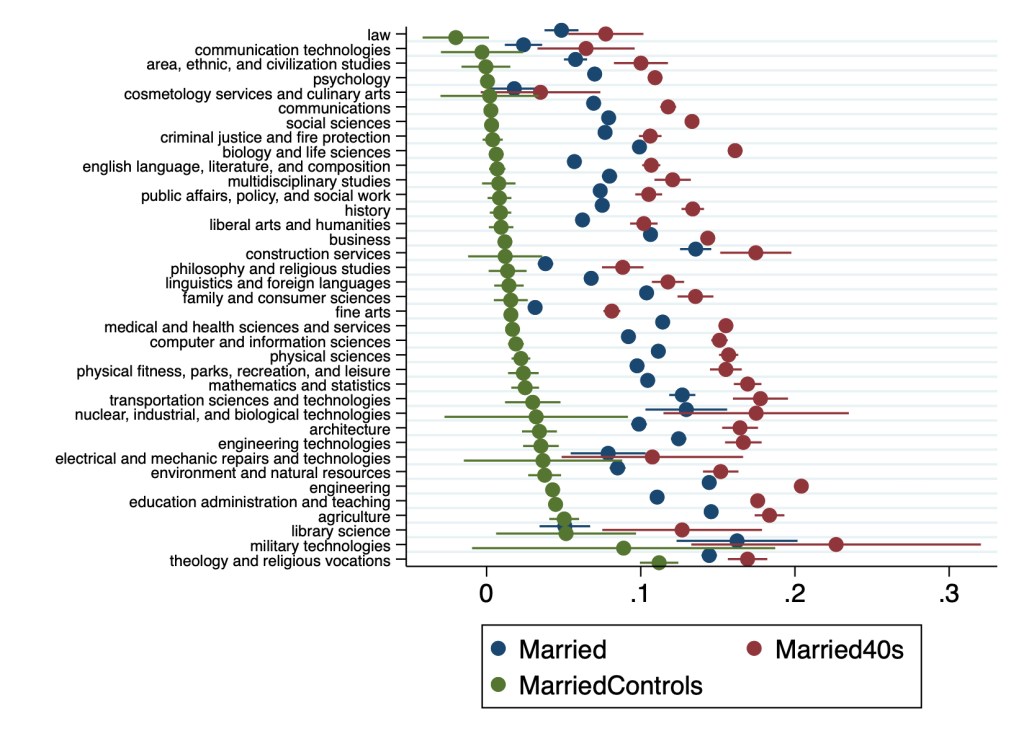
Since then I joined the paper as a coauthor and rewrote it to send to academic journals. I’m now revising it to resubmit to a journal after referee comments. The best referee suggestion was to move our huge tables to an appendix and replace them with figures. I just figured out how to do this in Stata using coefplot, and wanted to share some of the results:

Points represent marginal effects of coefficient estimates from Logit regressions estimating the effect of college major on marriage rates relative to non-college-graduates. All regressions control for sex, race, ethnicity, age, and state of residence. MarriedControls additionally controls for personal income, family income, employment status, and number of children. Married (blue points) includes all adults, others include only 40-49 year-olds. Lines through points represent 95% confidence intervals.
Points represent coefficient estimates from Poisson regressions estimating the effect of college major on the number of children in the household relative to non-college-graduates. All regressions control for sex, race, ethnicity, age, and state of residence. ChildrenControls additionally controls for personal income, family income, employment status, and number of children. Children (blue points) includes all adults, others include only 40-49 year-olds. Lines through points represent 95% confidence intervals.

Many details have changed since Hannah’s original version, and a lot depends on the exact specification used. But 3 big points from the original paper still stand:

  1. Almost all majors are more likely to be married than non-college-graduates
  2. The association of college education with childbearing is more mixed than its almost-uniformly-positive association with marriage
  3. College education is far from uniform; differences between some majors are larger than the average difference between college graduates and non-graduates

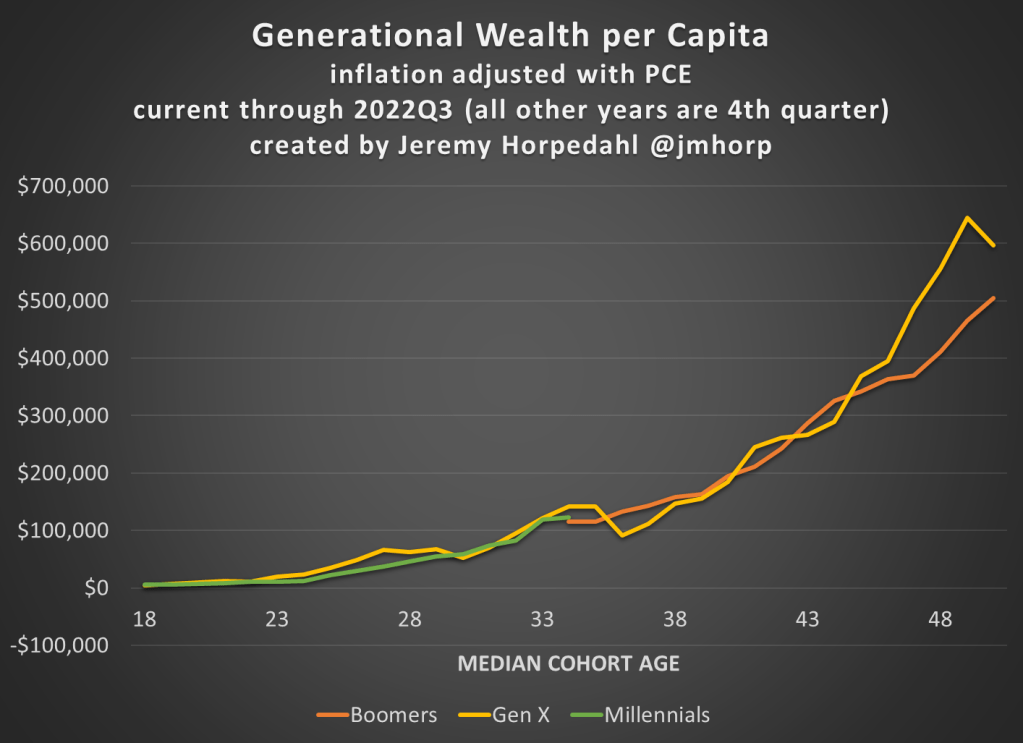
The Wealth of Generations: Latest Update

I’ve covered the topic of generational wealth before, and here’s the latest data on how each generation was doing at roughly the same age. The data is updated through the 3rd quarter of 2022.

The main takeaways:

  • Millennials are roughly equal in wealth per capita to Baby Boomers and Gen X at the same age.
  • Gen X is currently much wealthier than Boomers were at the same age: about $100,000 per capita or 18% greater
  • Wealth has declined significantly in 2022, but the hasn’t affected Millennials very much since they have very little wealth in the stock market (real estate is by far their largest wealth category)

Food Price Increases Won’t Be Solved by Raising Interest Rates

I make a hobby of reading, and sometimes acting on, investment advice, particularly regarding high-yielding securities (many of my holdings are now yielding over 10%/year). One of the best authors on the Seeking Alpha investing site writes under the name of Colorado Wealth Management. He mainly writes on REIT (real estate investment trust) stocks, but recently opined on the wisdom of raising interest rates to combat inflation regarding some of the major components of CPI.

His article, Why High Yields Will Be Popular Again, may be behind a paywall for some readers, so I will summarize some key points. He kind of sidesteps the influence of massive federal deficit spending that injected trillions and trillions of new dollars into the economy for COVID, which I think has been the major driver for this inflation; and the reignited deficit spending which is already on the books for November and likely even huger for December of this year. However, he does make some interesting (and new to me) points regarding food prices in particular.

He sees the price 2021-2022 price increases in some major food items as being driven by supply constraints, rather then by excessive demand. Specifically eggs, coffee, and vegetable oils have been hit by exogenous factors which have constrained supply; raising interest rates will not help here, and may even hurt if higher rates make it harder for farmers to recover and re-start high production. I’ll transition to his charts and mainly his excerpted words, in italics below:

Avian Flu, Culled Hens, and the Price of Eggs

The background here is that tens of millions of chickens, including egg-laying hens, have been deliberately killed (“culled”) this year in an attempt to slow the spread of avian flu. This, of course, cuts into the egg supply and raises egg prices. We went through a similar cycle in 2015 with avian flu, where culling led to a rise in egg prices, but then prices fell naturally as a new crop of chicks grew into egg-laying hens. Similarly, the current shortage in eggs should correct itself:

Raising interest rates has never produced additional eggs. Raising interest rates and driving a recession (with larger credit spreads) only makes it more difficult for farmers to get the funding necessary to replace tens of millions of hens that were culled to slow the spread of the avian flu….If interest rates don’t work, what will? The cure for high prices is high prices. We can see how it played out with the Avian flu in 2015:

  • Is Jerome Powell going to lay even one egg? Probably not.
  • Are farmers going to focus on turning their chicks into egg-laying hens? Absolutely.

Since eggs go into several other products, it drives inflation throughout the grocery store. Even if a product doesn’t use eggs, the drop in egg production means more people eating other foods.

Drought in Brazil and the Price of Coffee

Coffee prices have been rising rapidly. Well, domestic prices have been rising rapidly. Global prices actually declined since peaking in February 2022:

So, what drove the price up? Brazil normally produces over 35% of the world’s coffee and bad weather in Brazil (not to mention the pandemic impacts) drove dramatically lower production in 2021. As the shortfall in production became evident, global prices began rising rapidly. That’s why the global [wholesale] prices were ripping higher in 2021, not 2022. However, [retail] consumers are seeing most of the impact over the last several months.

War in Ukraine and the Price of Sunflower Oil

Margarine requires vegetable oil. Soybean, palm, sunflower, and canola oil are the key ingredients. What country produces the most sunflower oil? Ukraine. This is one of several inflationary impacts of the war. You can see the impact of reduced supply in the following chart:

Government Bungling in Indonesia and the Price of Palm Oil

What happened to palm oil? How could it soar so much and then fall so hard?

The first issue is that dramatic increases in the price of fertilizer made production more expensive. … That contributed to a reduction in supply. However, Indonesia is the world’s largest exporter of palm oil. Yet exports of palm levy were subject to a huge levy. That made exporting far more expensive. Despite the levy, it was still worth producing and exporting palm oil. Then the Indonesian government decided to simply ban exports over concern about higher domestic prices. Banning exports for a country that produces 59% of the world’s total palm oil exports had a predictable impact.

If you guessed that the supply of palm oil couldn’t be sold domestically, you’d be right. The ban was lifted. However, it was only after:

High palm oil stocks have forced mills to limit purchases of palm fruits. Farmers have complained their unsold fruits have been left to rot. There were 7.23 million tonnes of crude palm oil in storage tanks at the end of May, data from the Indonesian Palm Oil Association (GAPKI) showed on Friday.

With palm oil prices at all time-record highs, nearly triple the level from two years prior, the supply was left to rot. Each business tried to make the best decision they could, given the ban on exports. Rather than record profits for mills and record profits for farmers, the produce was wasted. That’s supply constraints for the global market, and it destroys the local economy.

Global prices are plunging now as mills seek to unload their storage. As bad as the higher prices were for the rest of the world, no one suffered worse than the farmers whose product became worthless as a result of government failure.

Contrary to today’s popular opinion, higher interest rates won’t do anything to improve production of vegetable oil.

Farewell to the First Normal Semester in 3 Years

Today as I gave my last final and took my kids to a huge school party, it struck me that things are finally back to something like 2019 levels of normality.

2020 was a lost cause, of course. I had high hopes for 2021 that vaccines would immediately get us back to normal. They did get my school back to fully in-person by Fall 2021, but not really back to normal, partly thanks to the variants. My students were out sick more than normal, and I was out watching my sick kids more than normal, as every cold meant they would be home until the school was sure it wasn’t Covid. Toward the end of the Spring 2022 semester worries were subsiding, and my state was pretty much fully re-opened, but things still weren’t really back to normal. Student attendance and effort were still way below normal, partly from the lingering effects of Covid, and partly from celebrating its end- partying to make up for lost time (and cheering on a great basketball team).

Fall 2022 finally felt like a basically normal semester. I still see the occasional mask, still hear from the occasional student out with Covid, and still have one kid missing 2 school days with every cough (policies stricter than 2019, but much relaxed from the days when both kids were at schools that could have them miss 5+ days with every non-Covid cough). Overall though student attendance and effort are back to what seem like normal levels. Up to Spring 22 I’d have students just disappear for a few weeks, not in class, not answering e-mails about why they weren’t showing up or completing work, needing lots of help to get on track once they finally reappeared. This Fall that didn’t happen; in my Senior Capstone everyone turned in a quality paper basically on-time and without me having to chase anyone down for it. Also, everyone just seemed happier now that their stress levels are back down to the baseline for college students.

This semester was nothing special- and that was beautiful.

Inflation-Adjusted Wages Have Been Rising Since June 2022

Back in May 2022, I wrote about the very bad picture for inflation-adjusted wages in the US. While they were still slightly above pre-pandemic levels, wages had been falling consistently since the beginning of 2021.

But since then, we’ve got some better news. The chart below shows the data (note: I’m using wages for private production and non-supervisory workers here, rather than for all private workers in the May post).

While the overall inflation picture still looks bad, with 7.1% annual inflation in the latest report, we also see that in the past 5 months wage growth has exceeded CPI growth. It’s also been true compared with the PCE price index for the past 4 available months (November PCE data won’t be available until next Friday). Inflation has cooled slightly in the past few months, while wages have continued to grow.

This all means that real (inflation-adjusted) average wages in the US have been rising consistently since June 2022. Finally, some good news!

Reckless Management Led to BlockFi Crypto Bankruptcy

Since my nontrivial deposits at the cryptocurrency lending firm BlockFi have been blocked (maybe forever) from withdrawal, I keep an eye on news from that front. My main source of information has been missives from BlockFi itself, in which management portrays itself as being very careful with customer funds; it was only the shocking, unforeseeable collapse of the FTX exchange that forced the otherwise sober and responsible BlockFi into its recent bankruptcy. I have believed that view of things, since that is all I knew.

However, Emily Mason at Forbes has poked around behind the scenes, including finding insiders willing to talk (off the record) about less-savory doings within BlockFi. The title of her recent article, BlockFi Employees Warned Of Credit Risks, But Say Executives Dismissed Them, pretty much says it all. The article starts out:

In its bankruptcy filing last week, New Jersey-based BlockFi attempted to paint itself as a responsible lender hit by plummeting crypto prices and the collapse of crypto brokerage FTX and its affiliated trading firm, Alameda.

That is the view I have held up till now. However, Mason then goes on to note:

 But a closer look at the company’s history reveals that its vulnerabilities likely began much earlier with missteps in risk management, including loosened lending standards, a highly concentrated pool of borrowers and unsustainable trading activity.

To keep this blog post short, I will just paste in a few excerpts where she fleshes out her case:

While the company regularly touted a sophisticated risk management team, current and former employees indicate in interviews that risk professionals were dismissed by executives preoccupied with delivering growth to investors. As early as 2020, employees were discouraged from describing risks in written internal communications to avoid liability, a former employee states.

Ouch. Not a good sign.

Until August 2021, BlockFi advertised that loans were typically over-collateralized. But large potential borrowers were often unwilling to meet those requirements, a cease and desist order brought by the Securities and Exchange Commission against BlockFi in February states. The availability of uncollateralized capital from competing companies like Voyager created stiff competition in the lending field.

Under pressure to continue growing and delivering yields, BlockFi began lending to these parties with less collateral than publicly stated without informing customers on the amount of risk involved with interest accounts, according to the SEC order which resulted in a $100 million fine for the company. As a result, BlockFi paused access to its interest accounts in the U.S.

Wait, that is MY money they were messing with. Now I am really annoyed.

In addition to lowering its collateral requirements, BlockFi’s due diligence process had flaws, former borrowers say. Available credit for borrowers was decided based on their assets, but BlockFi and other lenders failed to investigate both the size and quality of potential borrowers’ holdings. Like Voyager and other crypto lenders, BlockFi accepted unaudited balance sheets from hedge funds and proprietary trading firms former borrowers say, leaving room for manipulation on the borrower side.

In the due diligence process, lenders like BlockFi and Voyager did not examine whether borrowers’ balance sheet assets were denominated in dollars or less liquid tokens like FTX-issued FTT.

The revelation that Alameda’s balance sheet was mostly FTT tokens was the news that set off the unraveling of both Alameda and FTX and triggered contagion effects across the industry. In early November, Alameda defaulted on $680 million in loan obligations to BlockFi, according to the bankruptcy filing.

Some BlockFi employees reportedly warned of the shakiness of the parties to whom clients’ finds were being loaned. Management dismissed these concerns because the loans were “collateralized”,  but as noted above, the extent of that collateral was *not* what we clients were told:

An internal team at BlockFi also raised concerns that the borrower pool was too concentrated among a pool of crypto whales, including mega hedge funds Three Arrows Capital and Alameda, another former employee states. Management responded that the loans were collateralized, according to the employee.

This is a very common scenario in finance: In search of profits, management  cuts corners and takes more risks with client funds than they were telling the clients. Maybe Sam Bankman-Fried will up with cell-mates from BlockFi.

Because BlockFi survived the Luna/Terra collapse some months ago and because I believed the steady stream of reassuring pronouncements from BlockFi management, I only withdrew a third of my funds back in the summer. But as it turns out, that withdrawal was apparently bankrolled by a big loan to BlockFi from Bankman-Fried’s FTX; but FTX is now caput.  So the odds of my ever seeing the rest of my funds are slim indeed:

In BlockFi’s bankruptcy filing and in public statements made by its CEO, Zac Prince, the company points to its survival through the collapse of the Terra/Luna ecosystem and subsequent shuttering of Three Arrows Capital as evidence of strong management. But that endurance four months ago was made possible through a $400 million credit line from now-defunct FTX, which allowed the firm to meet panicked withdrawal requests from depositors. When FTX folded in early November, BlockFi lost its lending back stop and could no longer meet fresh waves of withdrawal requests.

One lesson learned: If there is a reasonable chance of a panic, it can pay to be the first to panic, not the last.

Slow Adjustment in Tech Labor for CGO Research

The CGO published a policy paper I wrote with Henry Kronk.

The Slow Adjustment in Tech Labor: Why Do High-Paying Tech Jobs Go Unfilled?

Executive Summary

The United States technology industry continues to struggle to recruit new talent. According to the US Bureau of Labor Statistics, the number of people employed in technology is not increasing quickly. 

Tech jobs pay well and don’t have the drawbacks of some other in-demand jobs, such as the travel schedule of a truck driver or the physically taxing labor required in oil fields.

Tech jobs are sometimes touted as a guarantee of having a comfortable and rewarding career, but the reality is not that simple.

Economics suggests that high wages would eliminate labor shortages, but that’s not the case in tech work. Why?

In this paper, authors Joy Buchanan and Henry Kronk propose a set of factors that have been overlooked and apply broadly to the tech sector. 

Individuals with high-status tech jobs report burnout, anxiety, depression, and other mental health issues at higher rates than the general population. They also have to deal with the constant threat of becoming obsolete. Because technology changes so quickly, they must constantly work to update their skills in order to remain competitive.  

The authors offer several recommendations for tech companies, educators, and policymakers:

  • Political and community leaders can provide more accurate messaging such as communicating clearer expectations about the difficulties of entering the tech workforce. 
  • The tech industry could benefit from improvements in computer education. The authors cite a need for more pre-college exposure to computer occupations as well as a need to add communication skills to computer science curriculums.
  • Teachers, parents, and tech companies can all find ways to inform young people at an age-appropriate level about opportunities. Computer science is abstract and hard to understand. Young people who have some exposure to computer science through a class or camp are more likely to become CS majors in college. 
  • Company leaders can improve their recruitment and development strategies to reflect the labor market realities including paying enough to compensate employees for the mental challenges of demanding technical work and alleviating their own talent shortages by investing in training and education. 
  • Tech companies may be able to attract more women and minorities by improving their scheduling and management practices.

Henry and I examined public data and the existing literature to get a better understanding of the current state of knowledge on this issue. I hope our paper can be helpful, however we partly just highlight how many questions still exist about tech and talent.

My recent paper in Labour Economics, Willingness to be Paid: Who Trains for Tech Jobs?, was designed to add new data to address these questions.