Credit Card Limits for Men and Women

Yesterday Federal Reserve researcher Nathan Blascak presented a paper at my Economics Seminar Series that was a surprise hit, with the audience staying over 40 minutes past the end to keep asking questions. So today I’ll share some highlights from the paper, “Decomposing Gender Differences in Bankcard Credit Limits”

The challenge here is that its hard to get data that includes both gender and credit card limits (its illegal to use gender as a basis for allocating credit, so credit card companies don’t keep data on it, as they don’t want to be suspected of using it). The paper is original for managing to do so, by merging three different datasets. But even this merged data only lets them do this for a fairly specific subgroup- Americans who hold a mortgage solely in their name (not jointly with a spouse). Even this limited data, though, is quite illuminating.

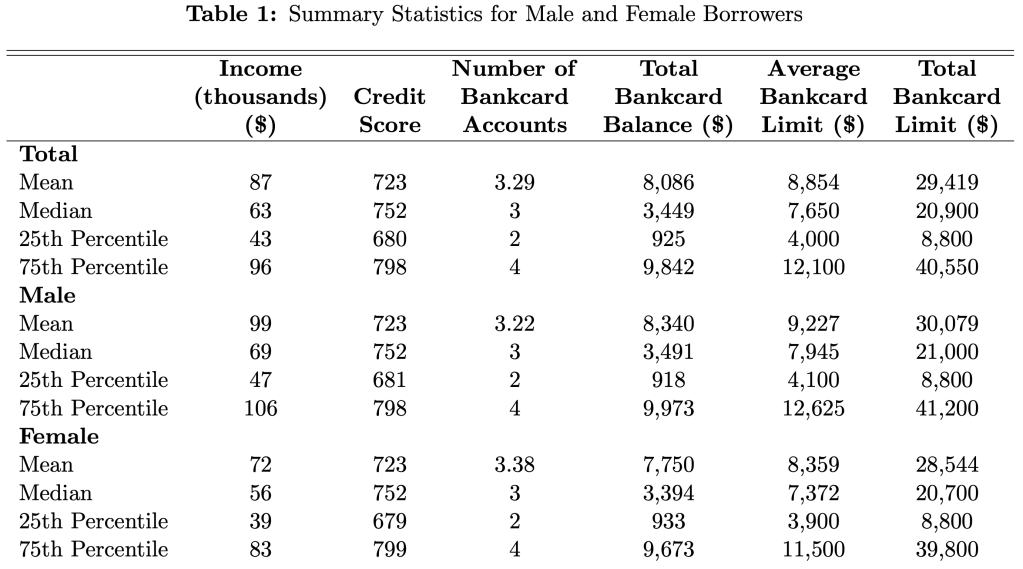
Their headline result is that men have 4.5% higher credit limits than women. Women actually have slightly more credit cards (3.38 vs 3.22), but have lower limits on each card; summing up their total credit limit across all cards yields an average of $28,544 for women vs $30,079 for men.

Source: Table 1 of this paper

Two of the big factors that determine limits, and so could cause this difference, are credit scores and income. The table above shows that men and women have remarkably similar credit scores, while men have higher incomes. Still, when the paper tries to predict credit limits, controlling for credit scores, incomes, and other observables explains only about 13% of the gender gap.

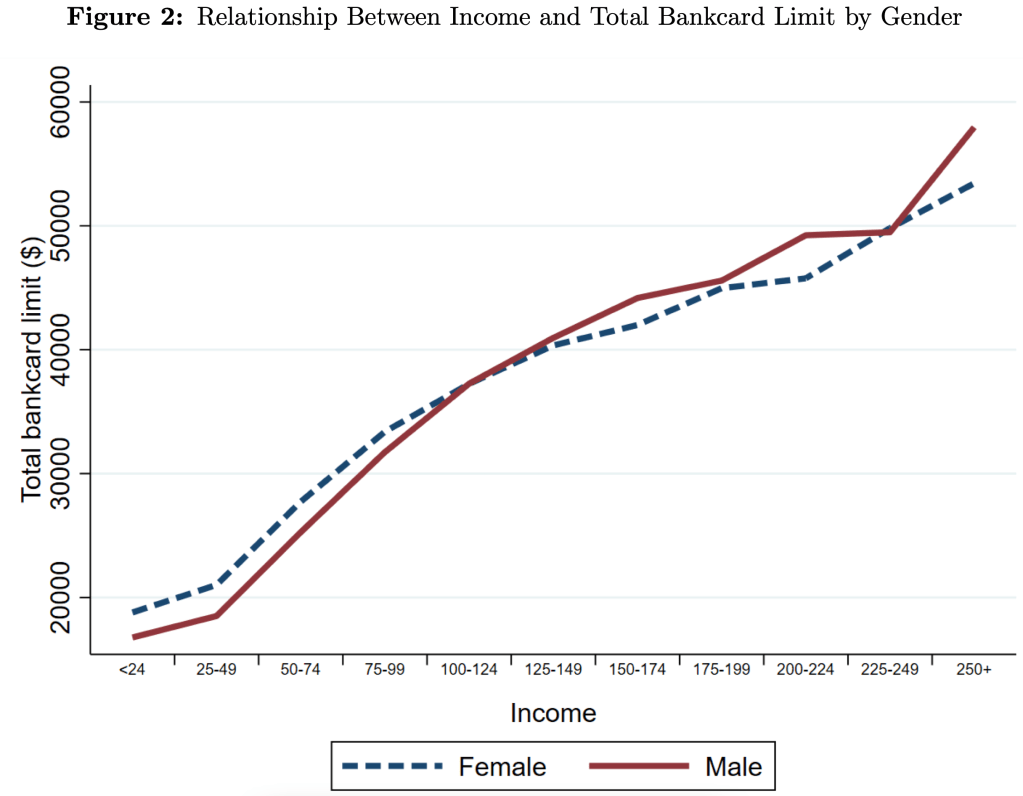
Men have 4.5% higher credit limits on average, but this difference varies a lot across the distribution. For credit scores, the gap is narrow in the middle but bigger at the extremes. For income, we see that men get higher limits at higher incomes, but women actually get higher limits at lower incomes- and not just “low incomes”, women do better all the way up to $100,000/yr:

The papers data covers 2006-2018, so they also show all sorts of interesting trends. The average number of credit cards held by men and women plunged after the 2008 recession and remains well below the peak. Total credit limits plunged too, though they were almost totally recovered by 2018.

There’s lots more in the paper, which is a great example of the value of descriptive work with new data. If anything I’d like to see the authors push even harder on the distribution angle. Its nice to see how limits vary across all incomes and credit scores, but why not show the full distribution of credit card limits by gender? My guess is that the 1st and 99th percentiles are very interesting places, because there’s all sorts of crazy behavior at the extremes. Finally, I wonder if higher limits are actually a good thing once you get beyond a relatively low amount- do you know of anyone who ever had a good reason to get their personal credit card balances over $20,000?

Wealth Growth During the Pandemic

In the US wealth distribution, which group has seen the largest increase in wealth during the pandemic? A recent working paper by Blanchet, Saez, and Zucman attempts to answer that question with very up-to-date data, which they also regularly update at RealTimeInequality.org. As they say on TV, the answer may shock you: it’s the bottom 50%. At least if we are looking at the change in percentage terms, the bottom 50% are clearly the winners of the wealth race during the pandemic.

chart created at https://realtimeinequality.org/

Average wealth of the bottom 50% increased by over 200 percent since January 2020, while for the entire distribution it was only 20 percent, with all the other groups somewhere between 15% and 20%. That result is jaw-dropping on its own. Of course, it needs some context.

Part of what’s going on here is that average wealth at the bottom was only about $4,000 pre-pandemic (inflation adjusted), while today it’s somewhere around $12,000. In percentage terms, that’s a huge increase. In dollar terms? Not so much. Contrast this with the Top 0.01%. In percentage terms, their growth was the lowest among these slices of the distribution: only 15.8%. But that amounts to an additional $64 million of wealth per adult in the Top 0.01%. Keeping percentage changes and level changes separate in your mind is always useful.

Still, I think it’s useful to drill down into the wealth gains of the bottom 50% to see where all this new wealth is coming from. In total, there was about $2 trillion of nominal wealth gains for the bottom 50% from the first quarter of 2020 to the first quarter of 2022. Where did it come from?

Continue reading

The Shrinking Allied Social Science Association

For many decades the Allied Social Science Association (ASSA) meetings, anchored by the American Economic Association, have been by far the world’s largest gathering of economists each year, typically attracting well over ten thousand. But the meetings went virtual-only for the past two years, and when they finally return in-person in 2023 they will likely be substantially diminished.

Some of this is due to potentially one-off factors; some people don’t want to travel to Louisiana because of its state laws, some still want to avoid large conferences because of Covid, others want to avoid the ASSA’s response to Covid:

All registrants will be required to be vaccinated against COVID-19 and to have received at least one booster to attend the meeting…. High-quality masks (i.e., KN-95 or better) will be required in all indoor conference spaces.

But the AEA made one big, apparently permanent change that means it could be a long time before we see a meeting as big as January 2020’s in San Diego- they gave up the job market. Prior to Covid the vast majority of first-round interviews to be a full-time US economics professor took place at ASSA. Naturally interviews moved online during Covid, but surprisingly the AEA has asked that they stay online, and in fact has specifically asked schools NOT to schedule interviews during ASSAs. This removes a huge source of demand for the meetings- the ~1200 new PhDs looking for their first jobs, the thousands of people there to recruit them (each hiring school typically sends 2-4 interviewers), and everyone trying to switch jobs. This was THE big thing that made AEAs special, that other conferences didn’t really have.

I’ll let everyone else debate whether this makes the job market better or worse; I’m agnostic there, but I’m sure it will shrink the conference. One silver lining to a smaller conference is that it is much easier to find a hotel room. Like usual I was waiting on the AEA website this Tuesday to book a hotel room on the first minute the AEA’s deeply discounted hotel blocks opened, because the good hotels tend to fill up near-instantly. But it appears this was unnecessary this year- two days later and even the headquarters hotel is still wide open:

I got the room I wanted at the Hotel Monteleone; I’ll be looking to grab a spot on the Carousel Bar, maybe see some of you there. I’ll present a poster at AEA, but mostly I’m just looking forward to spending real time in New Orleans for the first time since I moved away in 2017.

Yes, it rotates while you sit and drink

So I’m still looking forward even to a diminished AEA, but it does make me wonder- which other conferences will benefit most from AEA’s decline? I don’t know that anyone has put together the numbers for all the conferences enough to know what the 2nd-largest is, but my bet both for the 2nd-largest and most likely to benefit is the Southern Economic Association; I’ll be there too, in Ft. Lauderdale this November.

Grocery Prices and Wages, in the Short Run and the Long Run

From the recent CPI inflation report, one of the biggest challenges for most households is the continuing increase in the price of food, especially “food at home” or what we usually call groceries. Prices of Groceries are up 13.5% in the past 12 months, an eye-popping number that we haven’t seen since briefly in 1979 was only clearly worse in 1973-74. Grocery prices are now over 20% greater than at the beginning of the pandemic in 2020. Any relief consumers feel at the pump from lower gas prices is being offset in other areas, notably grocery inflation.

The very steep recent increase in grocery prices is especially challenging for consumers because, not only are they basic necessities, if we look over the past 10 years we clearly see that consumer had gotten used to stable grocery prices.

The chart above shows the CPI component for groceries. Notice that from January 2015 to January 2020, there was no increase in grocery prices on average. Even going back to January 2012, the increase over the following 8 years was minimal. Keep in mind these nominal prices. I haven’t made any adjustment for wages or income! (If you know me, you know that’s coming next.) Almost a decade of flat grocery prices, and then boom!, double digit inflation.

But what if we compare grocery prices to wages? That trend becomes even more stark. I use the average wage for non-supervisory workers, as well as an annual grocery cost from the Consumer Expenditure Survey (for the middle quintile of income), to estimate how many hours a typical worker would need to work to purchase a family’s annual groceries. (I’ve truncated the y-axis to show more detail, not to trick you: it doesn’t start at zero.)

Continue reading

McDouble vs Big Mac: Why Inflation Hits the Bottom Harder

Since they were first introduced as part of the Dollar Menu in 1997, the McDouble and the McChicken have been my go-to choices when I visit Mcdonald’s. It was always hard to justify getting one of the fancier sandwiches like a Big Mac or Quarter Pounder, since they were 4-5x the cost of a McDouble but only about twice the size. This is part of why the McDouble has been called “the greatest food in human history“. But as we’ve seen with the plagues and wars of the 2020s, history doesn’t always progress in the direction you’d hope.

I hadn’t been to a McDonald’s for a while until last weekend, when I was shocked to see the McDouble and McChicken listed at $2.99. This wasn’t at an airport restaurant either, or even in an expensive big city; I stopped in Keene, New Hampshire on a drive home from Vermont. The price is up 200% from the days of the Dollar Menu! Meanwhile, the Big Mac has also got more expensive, but much less dramatically; it was $5.89, compared to the ~$5 I expect. So, 200% price increases at the bottom, vs 18% at the top.

This location may be a bit of an anomaly, but the big picture is clear; a typical McDouble now costs well over $2 in most of the US, while a typical Big Mac is still well under $6. You used to be able to get 4-5 McDoubles for the price of a Big Mac; now you typically get less than 3 and sometimes, as in Keene, less than 2.

What’s going on here? First, the McDouble was always absurdly cheap. Second, prices rise most quickly where demand is inelastic, and demand is less elastic for goods that are cheaper and goods that are more like “necessities” than “luxuries”.

This is why I think the McDouble is worth highlighting- its part of a more general trend of where inflation hits. I’ve noticed this in the grocery store as well; the price of standard ground beef is up much more than grass-fed organic beef, likewise with standard eggs vs free-range organic. How different would the Economist’s Big Mac Index look if it used the McDouble instead?

With falling inflation we may see the end of this necessity vs luxury price compression. But I doubt we’ll ever see the glory of the standard $1 McDouble again.

The New Hampshire McDonalds was disappointing, but Vermont was nice

The Cost of Raising a Child

Raising kids is expensive. As an economist, we’re used to thinking about cost very broadly, including the opportunity cost of your time. Indeed, a post I wrote a few weeks ago focused on the fact that parents are spending more time with their kids than in decades past. But I want to focus on one aspect of the cost, which is what most “normal” people mean by “cost”: the financial cost.

Conveniently, the USDA has periodically put out reports that estimate the cost of raising a child. Their headline measure is for a middle-income, married couple with two children. Unfortunately the last report was issued in 2017, for a child born in 2015. And in the past 2 years, we know that the inflation picture has changed dramatically, so those old estimates may not necessarily reflect reality anymore. In fact, researchers at the Brookings Institution recently tried to update that 2015 data with the higher inflation we’ve experienced since 2020. In short, they assumed that from 2021 forward inflation will average 4% per year for the next decade (USDA assumed just over 2%).

Doing so, of course, will raise the nominal cost of raising a child. And that’s what their report shows: in nominal terms, the cost of raising a child born in 2015 will now be $310,605 through age 17, rather than $284,594 as the original report estimated. The original report also has a lower figure: $233,610. That’s the cost of raising that child in 2015 inflation-adjusted dollars.

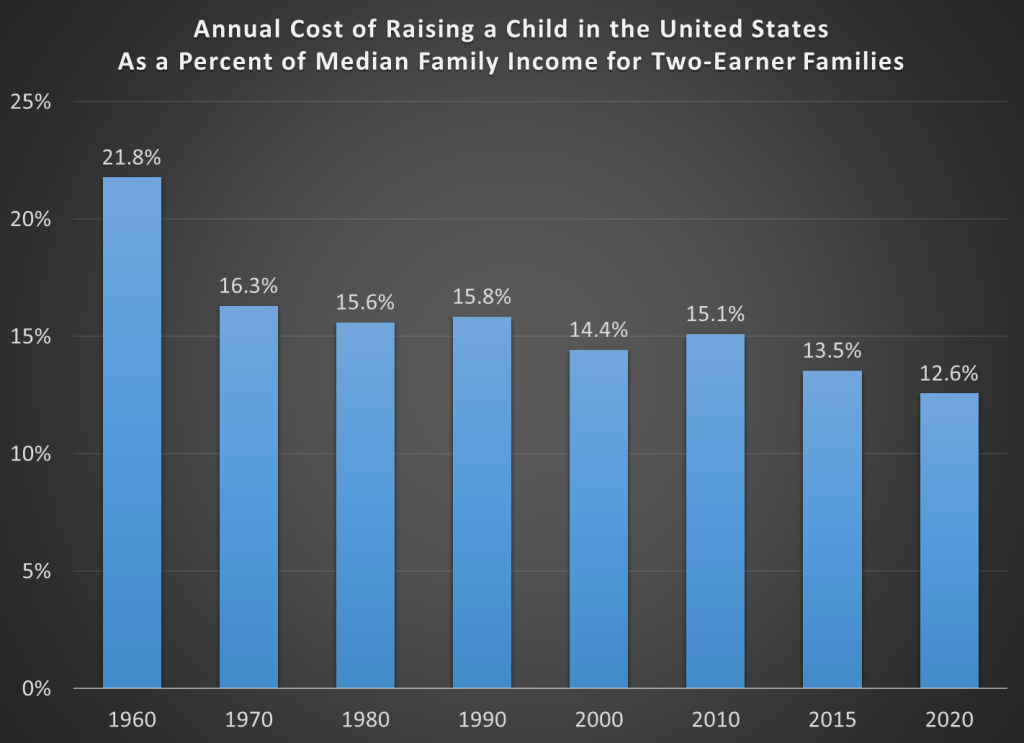
As I’ve written several times before on this blog, adjusting for inflation can be tricky. In fact, sometimes we don’t actually need to do it! To see if it is more or less expensive to raise a child than in the past, what we can do instead is compare to the cost to some measure of income. I will look at several measures of income and wages in this post, but let me start with the one I think is the best: median family income for a family with two earners. Why do I think this is best? Because the USDA and Brookings cost estimates are for married couples who are also paying for childcare. To me, this suggests a two-earner family is ideal (you may disagree, but please read on).

Here’s the data. Income figures come from Census. Child costs are from USDA reports in 1960-2015, and the Brookings update in 2020.

Continue reading

Series 65 for Economists

Financial discussions often give the disclaimer “this is not investment advice” for legal reasons. I would always see this and wonder, is anyone ever willing to say “this *is* investment advice”?

The answer is, yes, licensed investment advisers do when speaking to their clients. How do people become licensed investment advisers? They start by taking the Series 65 exam.

I decided to take the Series 65 because I thought it would be a good learning opportunity, that it could be fun to tell people “this is investment advice”, and because it also provides the fast track to becoming an accredited investor. I’d like to have the option to invest in startups or hedge funds, but the SEC doesn’t let people do that unless they are rich (consistently over $300k/yr HH income, or $1mil in assets) or a licensed financial professional. I didn’t want to wait years to pass the income or asset tests, and so decided to pass the literal test instead.

I hoped that as a PhD economist who sometimes reads about finance for fun, I could pass the Series 65 without studying. This turned out not to be true, but it also wasn’t wildly wrong. You need to get at least 72% of questions correct to pass; taking a practice test cold I got 62%. I decided to first take the slightly easier Security Industry Essentials exam as a warmup. For both exams, I passed after spending ~ 2 weeks reading through the ~500 page study guides from the Securities Institute of America in my spare time.

For someone with an economics background, the exams will feature a few true econ questions you’ll know cold, a lot of “common sense” finance questions you probably know, some more specific finance questions you probably don’t know, and some specific questions about laws and regulations for investment advisers you almost certainly don’t know. This means you can speed through some parts of the study guide, but will need to slow way down in others. I found myself learning a roughly equal mix of things I’m happy to know for their own sake, things that would only be helpful to the extent I actually work as an investment adviser, and things that seem completely pointless.

Overall this seems like a decent way to spend a bit of time and money. Economists love to complain about people asking us for financial advice, and we tend to either reply “I don’t know, that’s not what economics is about” or give uninformed answers. But it doesn’t take that much time to educate yourself enough to be able to give people good, informed answers, so I think we should do so, especially when the alternatives people turn to tend to either be uninformed (friends or internet randos) or biased (advisers who get paid for steering them to high-fee investments).

That said, if your goal is actually to make money as an adviser or as an accredited investor, the Series 65 exam is only the first hoop to jump through. You still need to get licensed, which means either starting an investment advisory firm or joining one. I haven’t tried to do this yet despite passing the Series 65 in June, as I’ve been busy with my main job. I’d be interested to hear from anyone who has done this, especially anyone who got a part-time or consulting role just to get licensed to make accredited investments. How hard was it, how long did it take, what did you think of the actual work?

High Yield Investing, 2: Types of Funds; Loan Funds; Preferred Stocks

Types of Funds: Exchange-Traded, Open End, and Closed End

Some investors like to pick individual stocks, while others would rather own funds that own many stocks.  For bonds, investors usually own funds of bonds rather than taking possession of individual bonds.

A straightforward type of fund is the exchange-traded fund (ETF). This holds a basket of securities such as stocks or bonds, and its price is constantly updated to reflect the price of the underlying securities. You can trade an ETF throughout trading hours, just like a stock. If you simply hold it, there will be no taxable capital gains events. Many ETFs passively track some index (e.g. the S&P 500 index of large company stocks) and have low management fees.

An open end mutual fund also trades close to the value of the baskets of securities it holds, but not as tightly as with an ETF. You can place an order to buy or sell an open end fund throughout the day, but it will only actually trade at the end of the day, when the share price of the fund is updated to the most recent value of the net asset value. A quirk of open end funds is that buying and selling by other customers can generate capital gains for the fund, which get distributed to all shareholders. Thus, even if you are simply holding fund shares without selling any, you may still get credited with, and taxed on, capital gains. Also, if a lot of shareholders sell their shares at the bottom of a big dip in prices, the fund must sell the underlying securities at a low price to redeem those shares. This hurts the overall value of the fund, even for customers who held on to their shares through the panic.

Some open end mutual funds offer skilled active management which may meet your needs better than an index fund. For instance, the actively-managed Vanguard VWEHX fund seems to give a better risk/reward balance than the indexed junk bond funds.

Closed-end funds (CEFs) are more complicated. A closed-end fund has typically has a fixed number of shares outstanding. When you sell your shares, the fund does not sell securities to redeem the shares. Rather, you sell to someone else in the market who is willing to buy them from you. Thus, the fund is protected from having to sell stocks or bonds at low prices. The fund’s share price is determined by what other people are currently willing to pay for it, not by the value of its holdings. Shares typically trade at some discount or premium to the net asset value (NAV). The astute investor can take advantage of temporary fluctuations in share prices, in order to buy the underlying assets at a discount and then sell them at a premium. CEFs are typically actively managed, and employ a wider range of investment strategies than open-end funds or ETFs do. CEFs can raise extra money for buying interest-yielding securities by borrowing money. This leverage enhances returns when market conditions are favorable, but can also enhance losses.

Bank Loan Funds

One type of debt security is a loan. Banks can make loans to businesses, with various conditions (“covenants”) associated with the loans. Banks can then sell these loans out into the general investment market.

Most commercial loans are floating-rate, so the interest received by the loan holder will increase if the general short-term commercial interest rate increases. Thus, the loan holder is largely protected against inflation. Loans typically rank higher than bonds in order of payment in case the company goes bankrupt, and some loans are secured by liens on particular company-owned assets like vehicles or oil wells. For these reasons, in the event of bankruptcy, the recovery on loans is higher (around 70%) than for bonds (average around 40%).

Various funds are available which hold baskets of these bank loans, also called senior loans or leveraged loans. One of the largest loan funds is the PowerShares Senior Loan ETF (BKLN), which currently yields about 4.5%. Most of its loans are rated BB and B, i.e. just below investment grade.   There are also closed end funds which hold bank loans, which yield nearly twice as much as the plain vanilla BKLN ETF, by virtue of employing leverage, selling at a discount to the actual asset value of the fund, and expertly selecting higher yielding loans.  For instance,  the Invesco Senior Income Trust (VVR), which I hold,  currently yields 8% , which is enough to keep up with inflation.      

High-Dividend Common Stocks

Most “stocks” you read about are so-called  common stocks. Most company common stocks are valued for their potential to grow in share price or to steadily keep increasing the size of their dividend. The average dividend yield for the S&P 500 stocks is about 1.6%, which is lower than the current yield of the (risk-free) 2-year Treasury bond.

There are some regular (C-corporation) stocks which are not expected to grow much, but which pay relatively high, stable dividends. These include some telecommunication companies like AT&T (T; 6.5%) and Verizon (VZ; 5.9%), electric utilities like Southern (SO; 3.5%) and Duke (DUK; 3.7%), and petroleum companies like ExxonMobil (XOM; 3.6%). Investors might want to buy and hold some of these individual stocks, since these are among the highest yielding, high quality stocks. Broader funds which focus on large high-quality, high-yielding stocks tend to have lower average yields than the stocks mentioned above. For instance the Vanguard High Dividend Yield Index Fund (VHYAX) currently yields only about 3.2 % .  

Preferred Stocks

Companies, including many banks, issue preferred stocks, which behave more like bonds. They  often yield more than either bonds or common stock. Like bonds, most preferreds have a fixed yield; some convert from fixed to floating rate after a certain number of years. Unlike bonds, most preferreds have no fixed redemption date. Fixed-rate preferreds are vulnerable to a large loss in value if interest rates rise, since the shareholder is stuck essentially forever with the original, low rate. On the other hand, if interest rates drop, a company typically can, after a few years, redeem (“call”) the preferred for its face value (typically $25) and then issue a new, lower-yielding preferred stock.

Preferred shares sit above common stock but below bonds in the capital structure. Companies have the option of suspending payment of the dividends on preferred stock if financial trouble strikes. However, a company is typically not permitted to pay dividends on the common stock if it does not pay all the dividends on the preferred stock.

The largest preferred ETF is iShares US Preferred Stock (PFF). It yields about 5.8%, but holds mainly fixed-rate shares. The PowerShares Variable Rate Preferred ETF (VRP; 5.9%  yield) holds variable or floating rate shares, which helps insulate investors from the effects of interest rate raises. The First Trust Intermediate Duration Preferred & Income Fund (FPF) is a closed end fund with more than half its holdings as floating rate. Due to use of leverage and selling at a discount, the fund yield is a juicy 7.9%.

My favorite class of high yield investments is business development companies, discussed here.

Happy investing…
Economics in Wedding Season

You watch a romantic comedy to feel good. I was tired at the end of last week, so “Wedding Season” Netflix looked like it might be funny. I was not expecting that the protagonist would be an economist.

First, how was the movie? The first half was somewhat entertaining. The second half is too sappy and long for me.

This movie is one of the few movies I know that is just unironically set in New Jersey. There were no jokes about Jersey or Shore folk. New Jersey is where immigrant families from India are making dreams come true. The dialogue about immigrant Indian culture, including arranged marriages, was interesting.

You know the trope about a character becoming rich because they inherited money from an estranged uncle? In Wedding Season, the guy becomes unexpectedly rich from Facebook stock.

Second, how was economics portrayed?

Here is the plot summarized by Wikipedia

Asha is an economist working in microfinance who has recently broken off her engagement and left a Wall Street banking career behind to work for a microfinance startup in New Jersey. Asha’s mother Suneeta, concerned for her future and against the advice of her husband Vijay, sets up a dating profile through which Asha meets Ravi.

In the beginning of the movie, Asha pitches microfinance to investors from Singapore. Asha tries to convince them using graphs and statistics. The investors turn her project down.

Microfinance was hyped in the 2000’s. I believed, so I became a Campus Kiva Representative as an undergraduate. I convinced teens in my dorm to pool our dollars to sponsor a loan for a woman in a poor country. Since then, economists have done empirical work to show that microfinance is not as effective as we hoped (see work by 2019 Nobel Prize Winners Esther Duflo and Abhijit Banerjee). The filmmakers either do not know the latest research or they don’t care. The pitch is still as emotionally appealing as it was when I heard it for the first time 15 years ago, so it makes for good movie scenes.

The irony in Wedding Season is not only that Asha succeeds in getting bankers from Singapore to invest in microfinance but also how she goes about it.

Continue reading

The Future of Student Debt

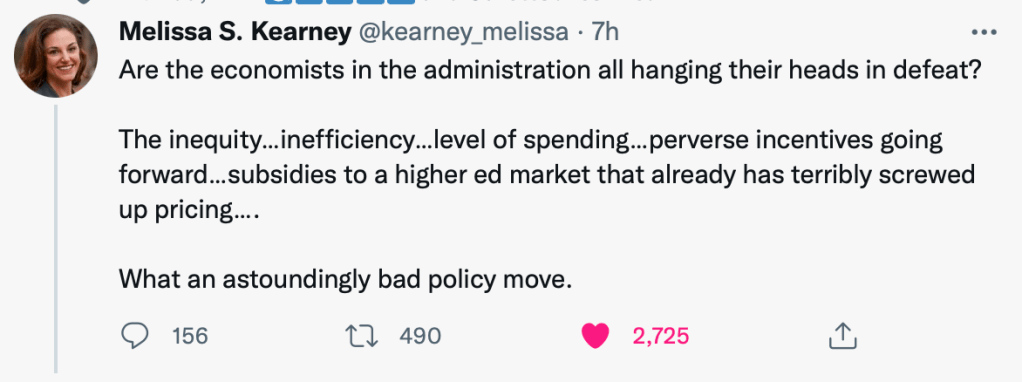
Yesterday the Biden administration announced that is forgiving up to $20k per person in student debt. So far we’ve seen lots of debate over whether this was a good/fair idea; as an economist who paid back his own debt early, you can probably guess what I have to say about that, so I’ll move on to the more interesting question of what happens now.

…after sharing one tweet
OK one more, but I promise its relevant

The above is a quote from Thomas Sowell as a political commentator, but he was also a great economist. His book Applied Economics says that the essence of the economic approach to policy analysis is to not just consider the immediate effect, but instead to keep asking “and then what?” So let’s try that here.

We’ll start with the immediate effects. Those whose debt just fell will be happy, and will have more money to spend or save in other ways. The federal government is on the other side of this, they’ll receive less in debt payments and so will have to fund themselves in other ways like borrowing money or raising taxes. People are still trying to estimate how big this transfer from the government to student debtors is, but let’s take the Penn Wharton Budget Model estimate of $330 billion (the actual cost is likely higher, since that estimate is for $10k of loan forgiveness, but the actual program forgives up to $20k for those who had Pell grants). Dividing by US population tells you the cost is roughly $1000 per American; dividing by $10,000 tells you that roughly 33 million debtors benefit.

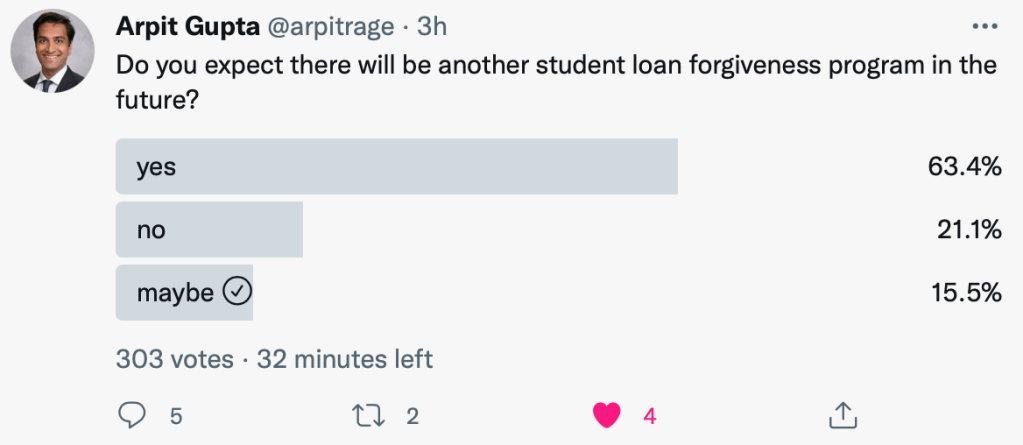
OK, what happens next? The big question is: is this a one-time thing, or does it make future loan forgiveness more or less likely? Later I’ll make the argument for why the answer could be “less”. But right now most people seem to think the answer is “more”, and that belief is what will be driving decisions.

If current and future students think loan forgiveness is likely, they have an incentive to take out more loans than they otherwise would, and to pay them off more slowly (particularly since income-based repayment was just cut from 10% to 5% of income). This higher willingness to pay from students gives colleges an incentive to raise tuition; historically about 60% of subsidized loans to students end up captured by colleges in the form of higher prices:

We find a pass-through effect on tuition of changes in subsidized loan maximums of about 60 cents on the dollar, and smaller but positive effects for unsubsidized federal loans. The subsidized loan effect is most pronounced for more expensive degrees, those offered by private institutions, and for two-year or vocational programs.

Source: https://www.newyorkfed.org/research/staff_reports/sr733.html

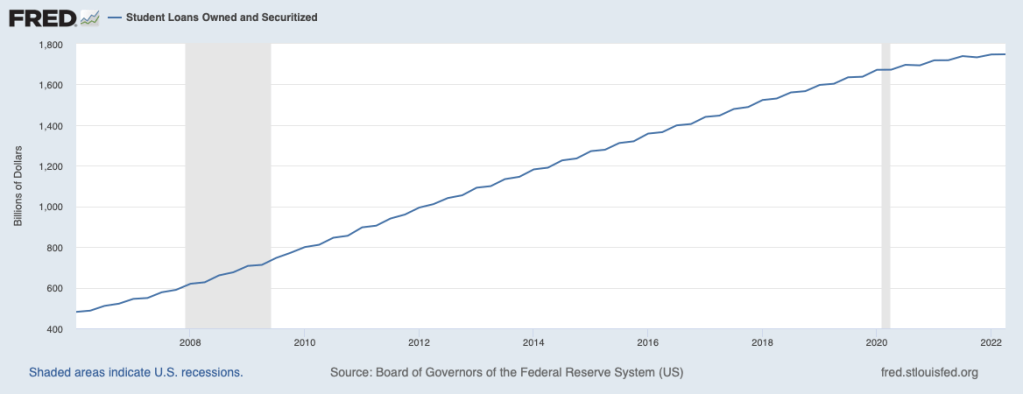
To the extent that you think student debt is a national problem, this action didn’t solve the problem so much as push it back 6 years; wiping out roughly 20% of all student debt brings us back to 2016 levels. So we could end up right back here in 2028, possibly faster to the extent that students borrow more as a result.

Source: https://fred.stlouisfed.org/series/SLOAS#

That, together with the “normalization” of student loan forgiveness, is why people think a similar action in the future is likely. But I’ll give two reasons it might not happen.

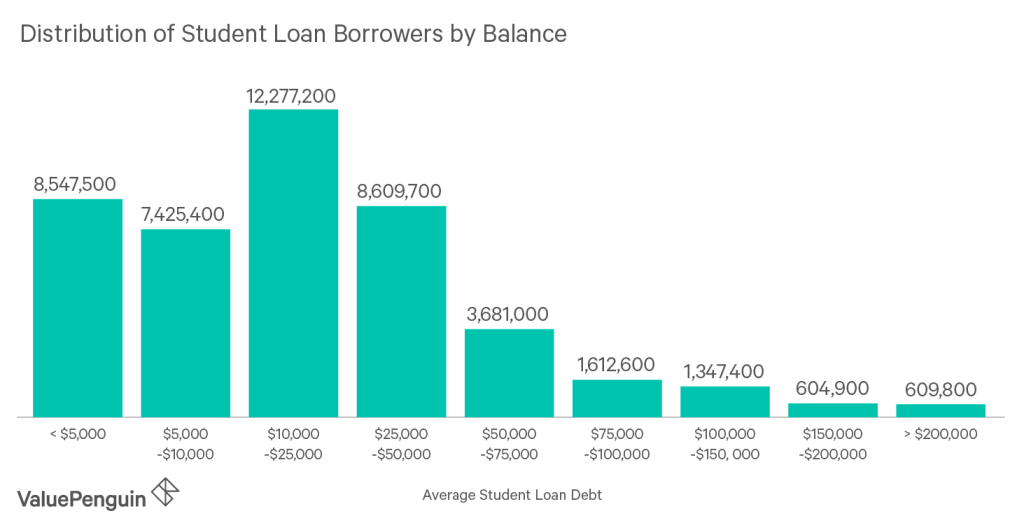
First, this action may have only reduced student debt by about 20%, but it reduced the number of student debtors much more (at least 36%), because most debtors owed relatively small amounts. It will take more than 6 years for the number of voters who’d benefit from loan forgiveness to get back to what it was in 2022, reducing support for forgiveness in the mean time.

Source: https://www.valuepenguin.com/average-student-loan-debt

That also gives Congress plenty of time to do something, even by their lethargic standards. Part of what bothers many people about this loan forgiveness is that it not only doesn’t solve the underlying issue of the Department of Education signing kids up for decades of debt, it will likely worsen the underlying issue through the moral hazard effect I describe above. Forgiveness would be much more popular if it were paired with reforms to solve the underlying issue. While we aren’t getting real reform now, I do think forgiveness makes it more likely that we’ll see reform in the next few years. What could that look like?

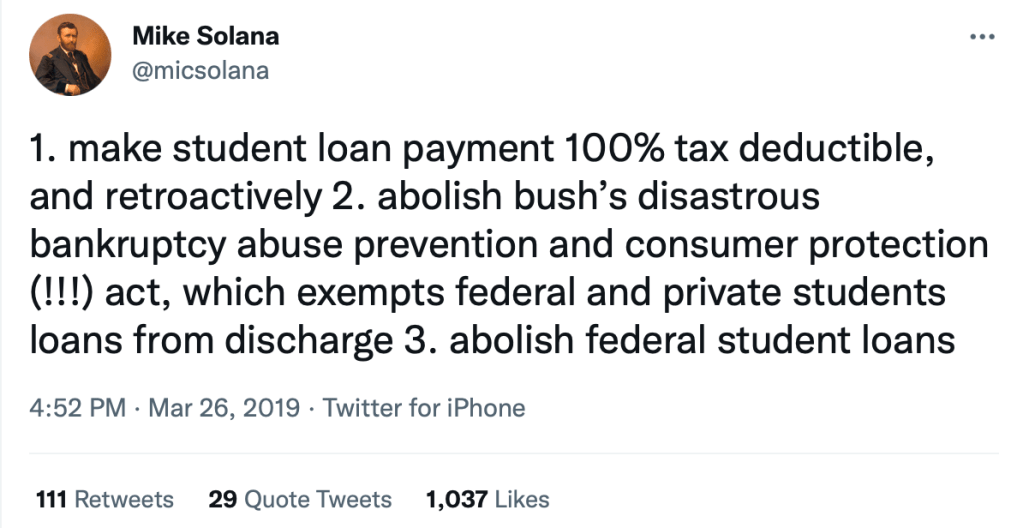
Let’s start with the libertarian solution, which of course won’t happen:

More realistic will be limits on where Federal loan money can be spent, and shared responsibility for colleges. Colleges and the government have spent decades pushing 18 year olds to sign up for huge amounts of debt. While I’d certainly like to see 18-year-olds act more responsibly and “just say no” to the pushers, the institutions bear most of the blame here. The Department of Education should raise its standards and stop offering loans to programs with high default rates or bad student outcomes. This should include not just fly-by-night colleges, but sketchy masters degree programs at prestigious schools.

Colleges should also share responsibility when they consistently saddle students with debt but don’t actually improve students’ prospects enough to be able to pay it back. Economists have put a lot of thought into how to do this in a manner that doesn’t penalize colleges simply for trying to teach less-prepared students.

I’d bet that some reform along these lines happens in the 2020’s, just like the bank bailouts of 2008 led to the Dodd-Frank reform of 2010 to try to prevent future bailouts. The big question is, will this be a pragmatic bipartisan reform to curb the worst offenders, or a Republican effort to substantially reduce the amount of money flowing to a higher ed sector they increasingly dislike?