Irish Superman: 4 Weeks of Potatoes

Back in May I mentioned that a study was recruiting participants to try a 4-week all-potato diet. What I didn’t say was that I was joining the study, and I finished this week.

I’m glad I did it; I lost 8 pounds and 2 inches of waistline, going from slightly overweight (BMI 26) to just barely not-overweight (BMI 24.9). Here are some of my notes:

Day 5: Energy boost kicked in today. Feel half my age

Day 6: Potato energy going strong. Feel like Irish Superman

Day 15: Almost too much energy, hard to sit down at a computer and work, took a break to play basketball

So like many people who previously tried this, I can add more anecdotal evidence of weight loss (despite eating all the potatoes you want) and energy. I’ll also echo people who said that “hunger feels different” and not as demanding, and that it “resets your tastebuds” so that previously bland foods taste good (I just had a turnip with zero seasoning and it was almost too intense). Now to answer your likely questions:

Q: Did you actually eat nothing but potatoes for 4 weeks?

A: No, but I got reasonably close. I cooked potatoes in avocado oil and added seasonings, I drank coffee and beer, I ate other vegetables, I had some snacks. Overall I estimate I got 75-80% of my calories from potatoes.

Q: Was it hard to stick to? didn’t you get bored?

A: Being hungry or even bored weren’t really issues, all 5 times I slipped up and ate a meal that wasn’t potatoes I’d say it was for social reasons (I was at a party with great food, at a restaurant with someone, et c)

Q: What kinds of meals did you cook?

A: Lots of home fries and roast potatoes using lots of varieties of potato (russet, gold, red, purple, sweet). Mashed potatoes a few times. McCain’s craft beer fries for my birthday.

Q: Aren’t potatoes bad for you? Why didn’t this make you fat?

A: Anything can be bad for you if you deep-fry it, or otherwise smother it with fats or process it to death. This is probably how most potatoes get consumed in America, but they start as nutritious root vegetables.

Q: What about protein? Doesn’t this kill your gains?

A: This was my biggest concern going into the study. Potatoes do have more protein than I thought, enough to live on but probably not enough to make you strong. My lifts did come down a bit, though it’s unclear if that was due to the lack of protein or just the lower calories and weight loss taking some muscle along with the fat. I was eating high-protein yogurt many days to try to mitigate this.

Q: If this is so great, are you going to keep doing it?

A: No, it was great for the first 14-16 days then just ok. Most of the weight loss and energy boost happened in the first half. If I ever do this again I’m going to plan on two weeks, which I think is also what Penn Jillette suggests. I do think I’ll do potatoes for lunch a lot more often than I used to, and pivot this to a “whole foods / not-ultra-processed” diet.

Q: Is there something special about potatoes? Would any single-food diet work as well?

I’m not sure. Some of the benefit likely comes from cutting out variety, so not eating a lot just because “I need to try everything”. Some likely comes from cutting out specific categories of food, like high fat / high sugar / hyper-palatable. I don’t think that just any food would work, probably most whole foods would, but potatoes are cheap and nutritious. The potato diet leading to weight loss is consistent with many, though not all theories of obesity.

Q: Can I still sign up for the study?

A: No:

Signups are now closed, but we plan to do more potato diet studies in the future. If you’re interested in participating in a future potato diet study, you can give us your email at this link and we’ll let you know when we run the next study.

But you can always just do it yourself.

Cost Plus Drugs

A new online pharmacy funded by Mark Cuban promises to sell prescription drugs at a fixed markup, 15% over cost plus a $3 flat fee. What’s the catch?

As far as I can tell, there are two- they only sell generics, and they don’t take insurance. But I think this will still save many people a lot of money.

The most expensive drugs get that way because they are sold by monopolies, almost always because they were invented less than 20 years ago and are still on-patent. But it’s still possible for older drugs to be sold at huge markups, as Martin Shkreli could tell you now that he’s out of prison (Shkreli’s case is supposedly what inspired Dr. Alex Oshmyansky to start this pharmacy). Sometimes you can still blame these markups on monopolies, just induced by the FDA instead of patents. But even for generic drugs with competitive manufacturing, you still sometimes see large and variable markups at the pharmacy level. So I think there’s still huge value in a pharmacy offering a low and stable markup on generics.

What about not taking insurance? First of all, lower cash prices obviously still benefit the 28 million Americans who don’t have health insurance. But even for those with insurance, it’s surprisingly common throughout health care to find cash prices lower than their copay. I have relatively good insurance but when I checked Cost Plus Drugs for the last two prescriptions my family got, I found that one was 80% cheaper than our copay (the other was about the same as our copay, so we’d only come out even, though we’d presumably save our insurer a lot).

Cost Plus Drugs originally wanted to also work through insurance as a Pharmacy Benefit Manager, but seems to have pivoted to being an “unPBM” that just offers generics to employers to supplement their existing plans. They also want to manufacture some of their own drugs, which seems on track to happen. They were started as a Public Benefit Corporation, so while they are for-profit this lends credibility to the idea that they really do want to keep prices down, not just start with low prices to make a name for themselves. Anyway, this seems like a worthy experiment and I encourage anyone with an expensive prescription to see if you can get it cheaper here.

Sick of high drug prices? Try some low-price anti-nausea mediation

Why Many Substance Use Treatment Facilities Don’t Take Insurance

According to the latest data, about one in four facilities doesn’t accept private insurance or Medicaid, and more than half don’t accept Medicare. This makes substance use treatment something of an outlier, since 91% of all US health spending is paid for through insurance. Still, there are many reasons to prefer being paid in cash: insurance might reimburse at low rates, impose administrative hassles, and generally try to tell you how to run things.

Providers generally put up with the hassles of insurance because they see the alternative as not getting paid. But if demand for their services gets high enough that they can stay busy with patients paying cash, they will often try going cash-only. Some try to generate high demand by providing excellent service. Sometimes high demand comes from a growing health crisis, as with opioids.

Demand can also be high relative to supply because supply is restricted. US health care is full of supply restrictions, but in this case I wondered if Certificate of Need laws were playing a role. As we’ve written about previously, CON laws require health care providers in 34 states to get the permission of a government board to certify their “economic necessity” before they can open or expand. But there’s a lot of variation from state to state in what types of services are covered by this requirement; acute hospital beds and long-term care beds are most common. 23 states require substance use treatment facilities to obtain a CON before opening or expanding.

States with Substance Use–Treatment CON Laws in 2020. Created using data from Mitchell, Philpot, and McBirney

How do these laws affect substance use treatment? We didn’t really know- only one academic article had studied substance use CON, finding it led to fewer facilities in CON states. But I’ve studied other types of CON, so I joined forces with Cornell substance use researcher Thanh Lu and my student Patrick Vogt to investigate. The resulting article, “Certificate-of-need laws and substance use treatment“, was just published at Substance Abuse Treatment, Prevention, and Policy. Here’s the quick summary:

We find that CON laws have no statistically significant effect on the number of facilities, beds, or clients and no significant effect on the acceptance of Medicare. However, they reduce the acceptance of private insurance by a statistically significant 6.0%.

Overall I was surprised that CON didn’t significantly affect most of the outcomes we looked at, and appears to be far from the main reason that treatment facilities don’t take insurance. Still, repealing substance use CON would be a simple way to improve access to substance use treatment, particularly since CON doesn’t appear to bring much in the way of offsetting benefits.

Going forward I aim to investigate how these laws affect health outcomes like overdose rates, and to dig more into the text of state laws and regulations to determine exactly what is covered by substance use CON in different states. As the article explains, we identified several errors in the official data sources we were using. This makes me worry there are more errors we didn’t catch, and there are certainly things the sources just don’t specify, like in which states the laws apply to outpatient facilities. So I hope we (or someone else) will have even better work to share in the future, but for now this article is as good as it gets, and we share our data here.

COVID Deaths, Excess Deaths, and the Non-Elderly (Revisited)

While we know that COVID primarily affects the elderly, the mortality and other effects on the non-elderly aren’t trivial. I have explored this in several past posts, such as this November 2021 post on Americans in their 30s and 40s. But now we have more complete (though not fully complete) mortality data for 2021, so it’s worth revisiting the question of COVID and the non-elderly again.

For this post, I will primarily focus on the 12-month period from November 2020 through October 2021. While data is available past October 2021 on mortality for most causes, data classified by “intent” (suicides, homicides, traffic accidents, and importantly drug overdoses) is only fully current in the CDC WONDER data through October 2021. This timeframe also conveniently encompasses both the Winter 2020/21 wave and the Delta wave of COVID (though not yet the Omicron wave, which was quite deadly).

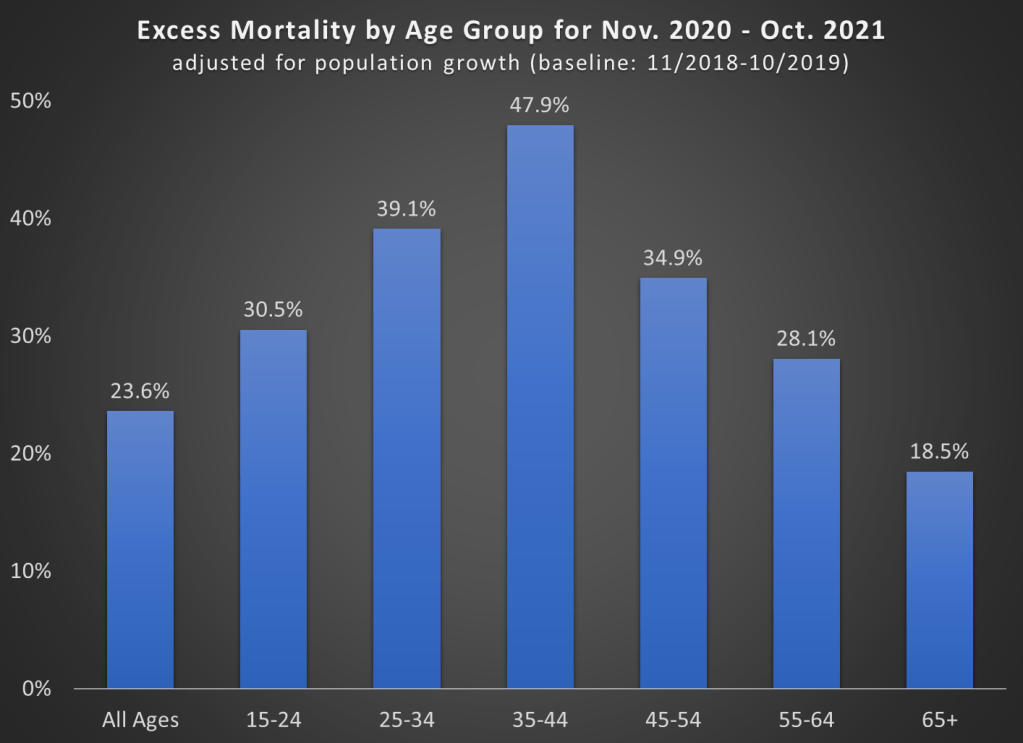
First, let’s look at excess mortality using standard age groups. For this calculation, I use the period November 2018 through October 2019 as the baseline. The chart shows the increase in all-cause deaths in percentage terms. It is also adjusted for population growth, though for most age groups this was +/- 1% (the 65+ group was 3% larger than 2 years prior).

A few things jump out here. First notice the massive increase in mortality for the 35-44 age group (much more on this later). Almost 50% more deaths! To put that in raw numbers, deaths increased from about 82,000 to 122,000 for the 35-44 age group, and population growth was only about 1%. And while that is the largest increase, there were huge increases for every age group that includes adults.

Also notice that the 65+ age group certainly saw an increase, but it is the smallest increase among adults! Of course, in raw numbers the 65+ age group had the most excess deaths: about 450,000 of the 680,000 excess deaths during this time period. But since the elderly die at such high rates in every year, the increase was as large in percentage terms.

One related fact that doesn’t show up in the chart: while there were about 680,000 excess deaths during this time frame in the US in total, there were only about 480,000 deaths where COVID-19 was listed as the underlying cause of death. That means we have about 200,000 additional deaths in this 12-month time period to account for, or a 24% increase (population growth overall was only 0.4%).

That’s a lot of other, non-COVID deaths! What were those deaths? Let’s dig into the data.

Continue reading

Eat 20 Potatoes a Day…. For Science

Several people have tried eating an all-potato diet for a few weeks and reported losing lots of weight with little hunger or effort. Could this be the best diet out there? Or are we only hearing from the rare success stories, while all the people who tried it and failed stay quiet?

Right now we don’t really know, but the people behind the Slime Mold Time Mold blog are trying to find out:

Tl;dr, we’re looking for people to volunteer to eat nothing but potatoes (and a small amount of oil & seasoning) for at least four weeks, and to share their data so we can do an analysis. You can sign up below.

I was surprised to see that they are the ones running this, since they are best known for the “Chemical Hunger” series arguing that the obesity epidemic is largely driven by environmental contaminants like Lithium. The conclusion of that series noted:

Bestselling nutrition books usually have this part where they tell you what you should do differently to lose weight and stay lean. Many of you are probably looking forward to us making a recommendation like this. We hate to buck the trend, but we don’t think there’s much you can do to keep from becoming obese, and not much you can do to drop pounds if you’re already overweight. 

We gotta emphasize just how pervasive the obesity epidemic really is. Some people do lose lots of weight on occasion, it’s true, but in pretty much every group of people everywhere in the world, obesity rates just go up, up, up. We’ll return to our favorite quote from The Lancet

“Unlike other major causes of preventable death and disability, such as tobacco use, injuries, and infectious diseases, there are no exemplar populations in which the obesity epidemic has been reversed by public health measures.”

That said, they did still offer some advice based on the contaminant theory that is consistent with the potato diet:

1. — The first thing you should consider is eating more whole foods and/or avoiding highly processed foods. This is pretty standard health advice — we think it’s relevant because it seems pretty clear that food products tend to pick up more contaminants with every step of transportation, packaging, and processing, so eating local, unpackaged, and unprocessed foods should reduce your exposure to most contaminants. 

2. — The second thing you can do is try to eat fewer animal products. Vegetarians and vegans do seem to be slightly leaner than average, but the real reason we recommend this is that we expect many contaminants will bioaccumulate, and so it’s likely that whatever the contaminant, animal products will generally contain more than plants will. So this may not help, but it’s a good bet. 

Overall though I think the idea here is to ignore grand theories and take an empirical approach. The potato diet works surprisingly well anecdotally, so lets just see if it can work on a larger scale. Seems worth a try; I’m sure plenty of my ancestors in Ireland and Northern Maine did 4-week mostly-potato diets and lived to tell about it. You can read more and/or sign up here. Let us know how it goes if you actually try it!

Are the COVID Vaccines Effective at Preventing Death?

A recent analysis by the Kaiser Family Foundation of CDC data suggests that about 234,000 COVID deaths in the US could have been prevented if everyone was vaccinated. That’s about 25% of all COVID deaths throughout the pandemic, and about 60% of COVID deaths since June 2021 (roughly the time when most older adults in most states had had a chance to be vaccinated).

The first way to think of that death rate is tragic, given that so many lives could have been saved. Rather than being the high-income nation with the highest COVID death rate, the US could have been more in line with countries like Italy, the UK, and France. The US actually had a lower COVID death rate than Italy and the UK when the vaccine roll-out began, and today we could be at about France’s level with better vaccination rates.

But there’s a flipside to the KFF numbers. If 60% of COVID deaths since June 2021 were preventable, that means 40% weren’t preventable. Furthermore, the same data show that about 40% of COVID deaths in January and February 2022 were fully vaccinated or had boosters. That sounds like the vaccines might not work very well! So what does this all mean? Let’s dig into the data from the CDC a little bit.

The first, and most important thing, to recognize is that most American adults are vaccinated (about 78%), so unless vaccines are 100% effective (and they aren’t, despite some public officials overenthusiastic pronouncements early in the vaccine rollout), there are still going to be a lot of COVID deaths among the vaccinated. If 100% of the population was vaccinated, 100% of the deaths would be among the vaccinated. The key question is whether vaccines lower the chance of death.

And they do. Let’s see why.

Continue reading

How to Get People Vaccinated for 93 Cents

We’ve talked a lot about vaccines on this blog, including both the benefits of vaccines and how to get people vaccinated. For example, last month I posted about Robert Barro’s estimate on the number of additional vaccines needed to save 1 life. Barro put it at about 250 vaccines. Using some reasonable assumptions, I further suggested that each person vaccinated has a social value of about $20,000. That’s a lot!

But how do we convince people to get vaccinated? Lotteries? Pay them? In addition to just paying them (the economist’s preferred method), another good old capitalist method is advertising (the marketer’s preferred method). And a new working paper tries just that, running pro-vaccine ads on YouTube with a very specific spokesman: Donald Trump.

Running ads on YouTube is pretty cheap. For $100,000, the researchers were able to reach 6 million unique users. And because they randomized who saw the ads across counties, they are able to make a strong claim that any increase in vaccinations was caused by the ads. They argue that this ad campaign led to about 104,000 more people getting vaccinated, or less than $1 per person (the actual budget was $96,000, which is how they get 93 cents per vaccine — other specifications suggest 99 cents or $1.01, but all of their estimates are around a buck).

Considering, again, my rough estimate that each additional vaccinated person is worth $20,000 to society (in terms of lives saved), this is a massive return on investment. Of course, we know that everything runs into diminishing returns at some point (they also targeted areas that lagged in vaccine uptake). Would spending $1,000,000 on YouTube ads featuring Trump lead to 1 million additional people getting vaccinated? Probably not quite. But it might lead to a half million. And a half million more vaccinated people could potentially save 2,000 lives (using Barro’s estimate).

I dare you to find a cheaper way to save 2,000 lives.

Highlights from EAGx Boston

Last weekend I was at Effective Altruism Global X Boston, a great conference that worked very differently from the academic ones I usually attend. The attendees were younger and the topics were different, but the big innovation was the use of Swapcard to encourage 1-on-1 meetings. At academic conferences I spend most of my time listening to formal presentations or talking to people I already know, but here I talked to 13 new people for a half hour each, and many others more briefly.

That said, the talks I did attend were excellent. Alvea is a 3-month-old company that already has a novel DNA-based Omicron-targeted Covid vaccine in Phase 1 trials. My notes on co-founder Ethan Alley’s talk:

Learning by doing is the way to go. I learned more in 3 months as a founder than 12+ months as an MIT grad student. Like that you have to pay a company $125k to randomize your clinical trial, and they take 8 weeks to do it

Richard Cash talked about the Oral Rehydration Therapy he helped develop that has saved tens of millions of lives. In short, many people who died of diarrheal diseases like Cholera were simply dying from dehydration, and he realized that this can be prevented cheaply and easily in most cases by having them drink a solution of water, glucose, and certain salts (basically Gatorade). He noted that much of the basic research behind this had been done in the US well before it was applied in the developing countries where it has helped most, so it was crucial to simply notice how important and broadly applicable the findings were. On the other hand, some things really did work differently in developing countries; here the medical conventional wisdom was that people shouldn’t eat while they had diarrhea, but if kids are already malnourished it turns out they are better off eating anyway.

Wave is a mobile payment company that is hugely successful in Senegal but has been slow to expand elsewhere. I asked their Chief Technical Officer Ben Kuhn why this was, and his answer made perfect economic sense:

Fixed costs plus local network effects. Fixed costs: need to get approval of a country’s central bank to operate, need to hire local staff, et c. Network effects: our system gets more valuable as more of the people you send money to/from use it, and these are usually within-country. Makes more sense to keep expanding within a country until its nearly totally saturated, and only then move to the next country. There’s also a limit of how much $ we have to expand, especially since we don’t want VCs to control the company.

(My notes, not a verbatim quote)

As I talked to people I was trying to narrow down my post-tenure plans. This didn’t really work, because people gave me good new ideas without convincing me to abandon any of my old ideas. Although I talked to several senior researchers at NGOs, the ideas that stuck with me most came from talking to undergrads, and were all things that sound obvious in hindsight but that I hadn’t actually been planning to do. The one I’ll mention here as a commitment device is to post my research ideas on my website. I have many more paper ideas than I have time to write about them, and I no longer care much about whether I get credit/publications for them or someone else does. This summer I’ll post a list of ideas there, and perhaps a series of posts fleshing them out here.

P.S. If you identify at all with Effective Altruism, I recommend trying to attend a conference. I’m planning to go next to the one in DC in September.

$5,000 Worth of Vaccines Saves One Life

I’ve written about the social benefits (in terms of the value of lives saved) of COVID mitigation measures, such as wearing face masks, before. But at this juncture in the pandemic (and really for the past 12 months), the key mitigation measure has been vaccines. How much does it cost to save one life through increased vaccination?

Robert Barro has a new rough estimate: about $5,000. In other words, he finds that it takes about 250 additionally vaccinated people in a state to save one life, and the vaccines cost about $20 to produce (marginal cost). So, about $5,000.

Barro gets this number (specifically, that 250 new vaccinated people saves one life) by using cross-state regressions on COVID vaccination rates and COVID death rates. Of course, there are plenty of potential issues with cross-state regressions. It’s not a randomized control trial! But Barro does a reasonable job of trying to control for most of these problems.

Another way to restate these numbers: if we assume that the VSL of an elderly life is somewhere around $5 million, then the social benefit from each person getting vaccinated is around $20,000. In other words from a public policy perspective, it would have made sense to pay each person up to $20,000 to get vaccinated!

Or thought of one more way: each $20 vaccine is worth about $20,000 to society. That’s an astonishing rate of return. And we’re not even including the value of opening up the economy earlier (from both a political and behavioral perspective) than an alternative world without the vaccines.

Lessons from a Failed Merger

The two largest hospital systems in Rhode Island, Lifespan and Care New England, wanted to merge. I wrote previously that:

Basic economics tells us that if a company with 50% market share buys a company with 25% market share in the same industry, they have strong market power and are likely to use this monopoly position to raise prices…. I think the Federal Trade Commission will almost certainly challenge the merger, and that they will likely succeed in doing so

It turns out I was right about the FTC challenge, but wrong that it would be necessary. The same day that the FTC challenged the merger, Rhode Island Attorney General Neronha blocked it. The law in Rhode Island is such that he doesn’t need to convince a judge like the FTC would; the merger was done unless the parties tried to appeal. But today they gave up and officially terminated the merger.

I was surprised by the AG’s move because the merging parties have so much political clout in the state, and many politicians like Senator (and former RI AG) Whitehouse had expressed support for the merger. I expected that even if state leaders didn’t like the merger, they would approve it with the expectation that the FTC would step in and be the bad guy for them. So AG Neronha blocking the merger was a pleasant surprise.

I also said previously that the FTC might challenge the merger for creating a monopsony (predominant employer of health care workers) as well as a monopoly (predominant provider of hospital services). This turned out to be one vote short of true. The FTC voted 4-0 to challenge the merger, but released two concurring statements explaining why. The two Democratic commissioners wanted to challenge the merger on both monopoly and monopsony grounds, while the two Republican commissioners thought it would only be a monopoly. This didn’t matter for this case, since they all thought it would be a monopoly, and since the AG blocked it. It was also odd that the Democratic FTC commissioners were more worried about labor than the actual unions involved. But it may be a sign of more monopsony challenges to come, particularly once the vacant spot gets filled and a 3rd Democrat is breaking the ties.

This was the first big political / economic issue I’ve got involved in since moving to Rhode Island, and I have to admit I was worried about making enemies. But despite speaking against the merger at the same forum as its most powerful proponents, speaking to several journalists, and at the AG’s public forum, I didn’t hear a single angry response; if anything I made friends.

One final surprise in all this is that the two hospitals systems are reported to have spent $28 million pursuing the merger. Apparently money can’t buy everything. But what a lot to spend on something that so many of us thought was clearly destined to fail.