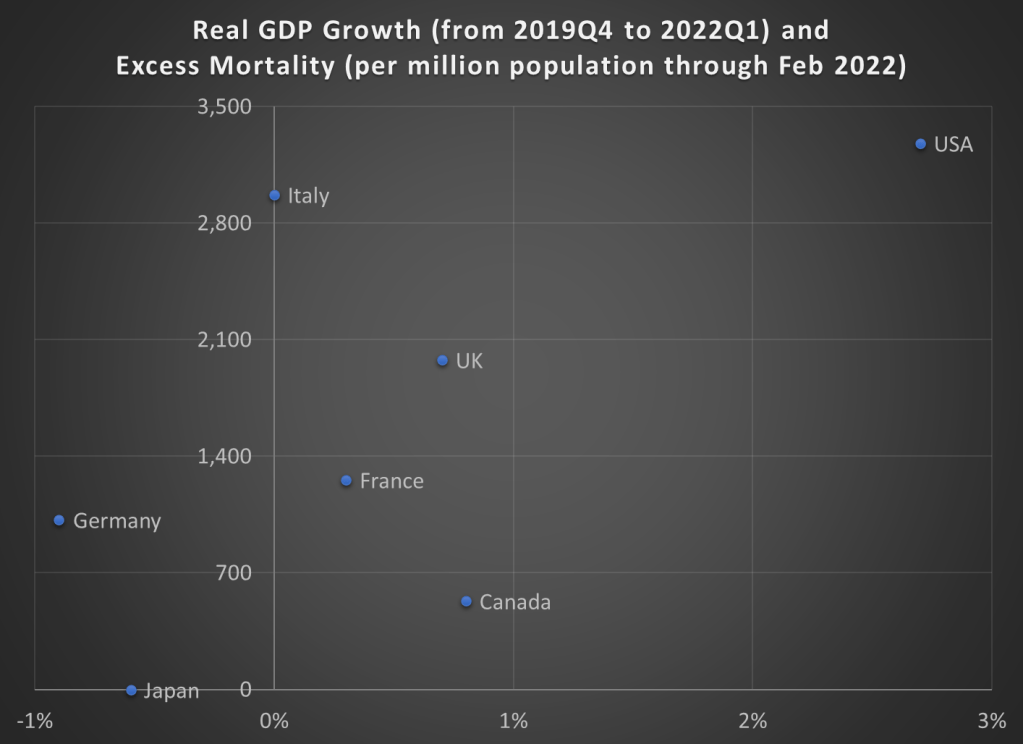
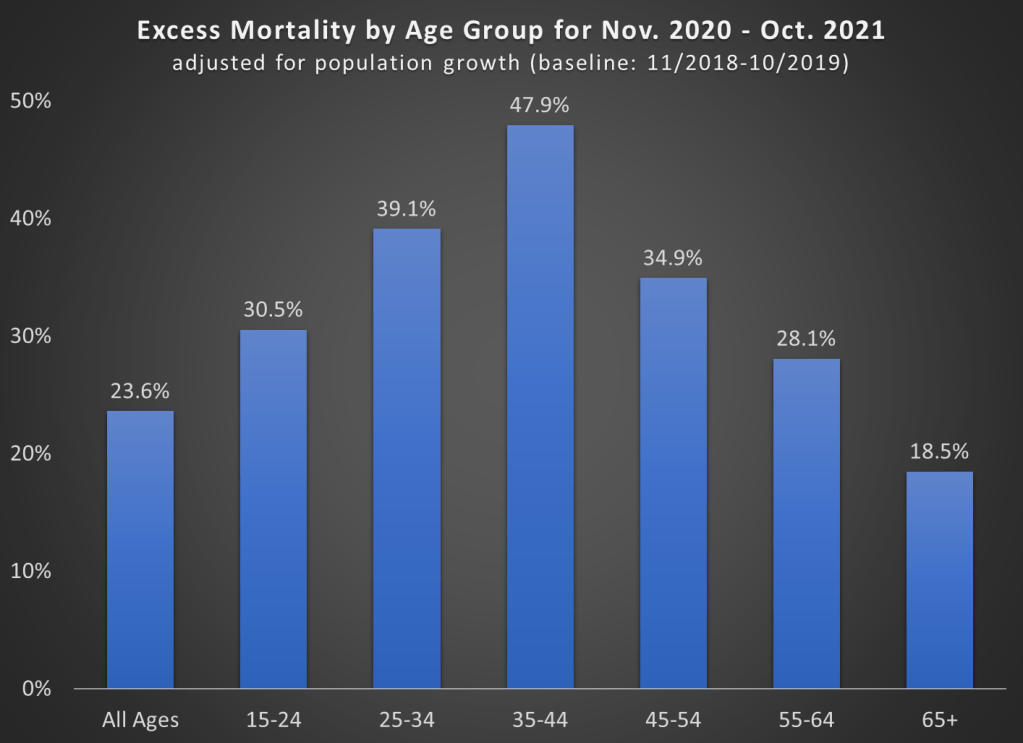
I’ve written about the social benefits (in terms of the value of lives saved) of COVID mitigation measures, such as wearing face masks, before. But at this juncture in the pandemic (and really for the past 12 months), the key mitigation measure has been vaccines. How much does it cost to save one life through increased vaccination?
Robert Barro has a new rough estimate: about $5,000. In other words, he finds that it takes about 250 additionally vaccinated people in a state to save one life, and the vaccines cost about $20 to produce (marginal cost). So, about $5,000.
Barro gets this number (specifically, that 250 new vaccinated people saves one life) by using cross-state regressions on COVID vaccination rates and COVID death rates. Of course, there are plenty of potential issues with cross-state regressions. It’s not a randomized control trial! But Barro does a reasonable job of trying to control for most of these problems.
Another way to restate these numbers: if we assume that the VSL of an elderly life is somewhere around $5 million, then the social benefit from each person getting vaccinated is around $20,000. In other words from a public policy perspective, it would have made sense to pay each person up to $20,000 to get vaccinated!
Or thought of one more way: each $20 vaccine is worth about $20,000 to society. That’s an astonishing rate of return. And we’re not even including the value of opening up the economy earlier (from both a political and behavioral perspective) than an alternative world without the vaccines.
The two largest hospital systems in Rhode Island, Lifespan and Care New England, wanted to merge. I wrote previously that:
Basic economics tells us that if a company with 50% market share buys a company with 25% market share in the same industry, they have strong market power and are likely to use this monopoly position to raise prices…. I think the Federal Trade Commission will almost certainly challenge the merger, and that they will likely succeed in doing so
It turns out I was right about the FTC challenge, but wrong that it would be necessary. The same day that the FTC challenged the merger, Rhode Island Attorney General Neronha blocked it. The law in Rhode Island is such that he doesn’t need to convince a judge like the FTC would; the merger was done unless the parties tried to appeal. But today they gave up and officially terminated the merger.
I was surprised by the AG’s move because the merging parties have so much political clout in the state, and many politicians like Senator (and former RI AG) Whitehouse had expressed support for the merger. I expected that even if state leaders didn’t like the merger, they would approve it with the expectation that the FTC would step in and be the bad guy for them. So AG Neronha blocking the merger was a pleasant surprise.
I also said previously that the FTC might challenge the merger for creating a monopsony (predominant employer of health care workers) as well as a monopoly (predominant provider of hospital services). This turned out to be one vote short of true. The FTC voted 4-0 to challenge the merger, but released two concurring statements explaining why. The two Democratic commissioners wanted to challenge the merger on both monopoly and monopsony grounds, while the two Republican commissioners thought it would only be a monopoly. This didn’t matter for this case, since they all thought it would be a monopoly, and since the AG blocked it. It was also odd that the Democratic FTC commissioners were more worried about labor than the actual unions involved. But it may be a sign of more monopsony challenges to come, particularly once the vacant spot gets filled and a 3rd Democrat is breaking the ties.
This was the first big political / economic issue I’ve got involved in since moving to Rhode Island, and I have to admit I was worried about making enemies. But despite speaking against the merger at the same forum as its most powerful proponents, speaking to severaljournalists, and at the AG’s public forum, I didn’t hear a single angry response; if anything I made friends.
One final surprise in all this is that the two hospitals systems are reported to have spent $28 million pursuing the merger. Apparently money can’t buy everything. But what a lot to spend on something that so many of us thought was clearly destined to fail.
My article on benefit mandates was published today at the Journal of Risk and Financial Management. It begins:
Every US state requires private health insurers to cover certain conditions, treatments, and providers. These benefit mandates were rare as recently as the 1960s, but the average state now has more than forty. These mandates are intended to promote the affordability of necessary health care. This study aims to determine the extent to which benefit mandates succeed at this goal
I began my research career by writing about these mandates, and my goal with this article was to tie up that whole chapter. I realized that all my articles on benefit mandates, as well as most of what other economists write about them, simply try to measure their costs- how much they raise health insurance premiums, raise employee contributions to premiums, lower wages, lower employment, or harm smaller businesses. Its good to know their costs, but to really evaluate a policy we should learn about its benefits too so that we can compare costs and benefits.
One key benefit that had yet to be measured was how much a typical mandate lowers out-of-pocket health care costs. In this article, I estimate that the average benefit mandate lowers costs by 0.8%-1%. I argue that combining this with a measure of how mandates affect total health spending by households could provide a sufficient statistic for the net benefits of mandates for households. I’m not totally confident this works in theory though, and it has a big challenge in practice- one of my empirical strategies finds that mandates reduce total spending, but the other finds they don’t. So I think the main contribution of the article ends up being the first estimate of how the average state health insurance benefit mandate affects out-of-pocket costs.
I’m currently planning to move on from writing about mandates- other topics are catching my eye, state policymakers don’t seem to particularly care what the research says about mandates, and changes in how economists use difference-in-difference methods are making it harder to publish articles like this that study continuous treatments. But I think there are still big opportunities here for anyone who wants to take up the torch. First, the ACA Essential Health Benefits provision changed the game for state mandates in a way that I have yet to see the empirical literature grapple with. Second, there are more than a hundred separate types of state benefit mandates; in most of my articles I aggregate them but they should really be studied separately. A handful have been, such as mandates for autism treatments, infertility treatments, and telemedicine. But the vast majority appear to be completely unstudied.
P.S. Writing this article gave me two wildly varying opinions of our federal bureaucracy. I tried to get both data and funding from the Agency for Healthcare Research and Quality for this article. The data side worked well- they were surprisingly fast, efficient and reasonable about the process of accessing restricted data. On the other hand, I applied for funding from AHRQ in March 2019 and still have yet to officially hear back about it (it is “pending council review” in NIH Commons). This sort of thing is why nimble organizations like Fast Grants can do so much good despite having much smaller budgets.
P.P.S. This article is part of a special issue on Health Economics and Insurance that is still accepting submissions. I’m the guest editor and would handle your submission, though my own got handled by other editors and put though multiple rounds of revisions.
A British study by Ben Killingley and 31 co-authors recently appeared in pre-print form, where 36 (heroic) healthy young adult volunteers were deliberately exposed to the Covid virus by nasal drops. These volunteers then went into quarantine for 14 days, and logged their symptoms and were subjected to various tests for a total of 28 days.
Of the 36 subjects, only 18 (53%) became infected with the virus, as determined by PCR testing (the gold standard for Covid tests) and by direct counting of viral loads in mucus cells by FFA.
The study found that viral shedding (as estimated by mucus viral loads) begins within two days of exposure and rapidly reaches high levels, then declines. Viable virus is still detectible up to 12 days post-inoculation. This result supports the practice of people quarantining for at least 10 days after they first exhibit symptoms of infection. There were significant higher viral loads in the nose than in the throat, which supports the practice of wearing masks that cover the nose as well as the mouth.
The cheap, fast, LFA rapid antigen test method (used in home tests) performed fairly well. Because it is less sensitive, it did not it did not yield positive results for infected individuals until an average of four days after infection, or about two days after viral shedding may have begun. But from four days onward, the LFA method was sensitive and reasonably accurate which supports the ongoing use of these quick, cheap tests.
These direct inclusions from the paper are helpful, but not earthshaking. The elephant in the room, which the paper did not seem to directly address, is why nearly half of the people who were exposed did NOT become infected. This raises all kinds of issues about what mechanisms the human body may have to naturally fight off COVID or similar viral infections. Gaining insight on this could lead to breakthroughs in preventing or mitigating this pernicious virus.
An article by Eileen O’Reilly at Axios probes these questions. There is nothing conclusive out there, but four ideas that are under investigation are:
1. Cross-immunity from the four endemic human coronaviruses is one hypothesis. Those other coronaviruses cause many of the colds people catch and could prime B-cell and T-cell response to this new coronavirus in some people.
2. Multiple genetic variations may make someone’s immune system more or less susceptible to the virus. Some 20 different genes have been identified which affect the likelihood of severe infection, and a genetic predisposition to not getting infected is seen in other diseases where people have one or multiple factors that interfere with the virus binding to cells or being transported within.
3. Mucosal immunity may play an underrecognized role in mounting a defense.
This suggests nasal vaccines might have a chance at stopping a virus before it invades the whole body.
4. Where the virus settled on the human body, how large the particle was, the amount and length of exposure, how good the ventilation was and other environmental circumstances may also play a role.
These considerations support continuing with the usual recommendations of social distancing, wearing facemasks, and ventilating buildings, especially when caseloads are peaking. Also, the doses administered to the volunteers in the study were considered quite small by clinical standards. It was surprising that such a low dose was effective as it was in causing full-blown infections; and the particular strain used in the experiment was not necessarily one of the more recent highly virulent variants. After reading these results, it is more understandable to me why so many reasonably careful friends and family members of mine (nearly all vaccinated, fortunately) have come down with (presumably) omicron COVID in the past two months. Just a little dab will do ya.
Around January of 2021, hospital staff and other select personnel received the first vaccines meant for the public. As a classroom teacher, I was designated important enough in the state of Alabama to get a Pfizer vaccine as early as February 2021.
Imagine what could have happened next
Americans grew antsy in May of 2021, because less than half of the population had been able to get a vaccine. It was frustrating to see the vaccine winners carrying on with life without fear of the virus while supply constraints made it impossible for everyone to join them at once.
An unintended consequence of the gradual vaccine rollout was that Americans who were initially concerned about vaccine safety had months to observe their family members and neighbors who got in line first. By July of 2021, most Americans personally knew of someone who died from Covid, and almost no one had witnessed a bad vaccine outcome.
By the end of the summer of 2021, over 90% of the American public was fully vaccinated. The economy roared back to life and working parents did not have to worry about school closures anymore.
Americans felt proud to have invented and implemented the world’s best Covid vaccine. Considering that Trump has started the research and Biden had overseen the distribution, it was one thing that red and blue Americans could unite over.
The internet as a concept was vindicated because anyone who wanted to understand vaccines could do their own research. Scientific knowledge is no longer the domain of a select elite. Anyone can see the Covid death rates for vaccinated versus unvaccinated people. Amateurs can create data visualizations to share. Information on mRNA technology is free to all.
Speech remained free with regard to vaccine dialogue, but those who tried to discourage Americans from getting Covid vaccines were shouted down in all forums or accused of being foreign trolls.
The first Covid wave in April of 2020 was terrible and the second big event around Christmas of 2020 resulted in thousands of deaths per day lasting for months. No one wanted to repeat that.
The number of Americans who died from Covid in January 2022 is available from the CDC website.
Number of Covid deaths in January 2022, CDC
59367
Number of Covid deaths in January 2021, CDC
97866
We came fairly close (60%) to repeating the tragedy after the Christmas of 2020. The exponential rise and fall of a new Covid variant and the ensuing pattern of deaths is something we have been through several times. We knew this would happen.
Would every one of those deaths have been prevented by higher vaccine take-up? No. But the death rates among vaccinated people are much lower. Charles Gaba, a data analyst, estimates that about 143,000 Americans have died since the summer of 2021 who would have lived if we had a higher vaccine uptake rate.
My best explanation for this is that people want to feel like they are in control of their own lives. Due to a variety of factors, a large number of adults have a different concept of being in control than I do.* Something that shaped my personal attitude toward the vaccine was reading about the research and development process in real time, which I largely did by keeping up with Marginal Revolution.
Unrelatedly, Jeffrey Clemens has given our blog a label this week that I’m happy with: “speculative but engaging”
Enjoyed this speculative but engaging piece on the economics of the labor market for journalists. https://t.co/vKwPhhzM5C
The South Carolina Senate just voted 35-6 to repeal its Certificate of Need laws, which required hospitals and many other health care providers to get the permission of a state board before opening or expanding. The bill still needs to make it through the house, and these sorts of legislative fights often turn into a years-long slog, but the vote count in the senate makes me wonder if it might simply pass this year. That would make South Carolina the first state in the Southeast to fully repeal their CON laws, although Florida dramatically shrunk their CON requirements in 2019.
This seems like good news; here at EWED we’re previouslywritten about some of the costs of CON. I’ve written several academic papers measuring the effects of CON, finding for instance that it leads to higher health care spending. I aimed to summarize the academic literature on CON in an accessible way in this article focused on CON in North Carolina.
CON makes for strange bedfellows. Generally the main supporter of CON is the state hospital association, while the laws are opposed by economists, libertarians, Federal antitrust regulators, doctors trying to grow their practices, and most normal people who actually know they exist. CON has persisted in most states because the hospitals are especially powerful in state politics and because CON is a bigger issue for them than for most groups that oppose it. But whenever the issue becomes salient, the widespread desire for change has a real chance to overcome one special interest group fighting for the status quo. Covid may have provided that spark, as people saw full hospitals and wondered why state governments were making it harder to add hospital beds.
Of all the increases in mortality in 2020, one that is notable is motor vehicle accidents. There were 43,045 deaths from motor vehicle accidents, according to the final CDC data. This means motor vehicle accident was listed on the death certificate, even if it was not determined to be the “underlying cause,” though for 98% of these deaths the accident was listed as the underlying cause.
The increase from past years was large. Compared with 2019, there were over 3,000 more motor vehicle deaths, though such as increase is not unheard of: 2015 and 2016 each saw increases of around 2,500. Even so, the crude death rate from motor vehicle accidents in 2020 was the highest it has been since 2008.
If that weren’t bad enough, another theory emerged in 2020 and continues to be suggested today: that car crashes are being labeled as “COVID deaths,” artificially inflating the COVID death count. While one can find this claim made almost daily by anonymous Twitter users, one of the most prominent statements was on Fox News in December 2020. Host Raymond Arroyo said that car accidents were being counted as COVID deaths, and that due to errors like this COVID deaths could be inflated by as much as 40 percent. Senator Marco Rubio made a similar claim on Twitter in December 2021, though he was talking about hospitalizations, not deaths.
Back in 2020, many doctors and medical professionals tried to debunk the “car accidents being labeled as COVID deaths” claim, but the problem was we didn’t have complete data. Anonymous anecdotes were cited, but medical professionals tried to reassure the public this wasn’t the case or at least wasn’t widespread.
But now, we have the data! That is, the complete CDC mortality data for 2020 available through the CDC WONDER database.
What does this data show us? Short answer: there aren’t that many car accidents being labeled as COVID deaths. At most, it’s about 0.03% of COVID deaths.
Most US states require hospitals and other healthcare providers to obtain a “Certificate of Need” (CON) from a state board before they are allowed to open or expand. These laws seem to be one reason why healthcare is often so expensive and hard to find. I’ve written a lot about them, partly because I think they are bad policies that could get repealed if more people knew about them, and partly because so many aspects of them are unstudied.
States vary widely in the specific services or equipment their CON laws target- nursing homes, dialysis clinics, MRIs, et c. One of the most important types of CON law that remained unstudied was CON for psychiatric services. I set out to change this and, with Eleanor Lewin, wrote an article on them just published in the Journal of Mental Health Policy and Economics.
We compare the state of psychiatric care in states with and without CON, and find that psychiatric CON is associated with fewer psychiatric hospitals and beds, and a lower likelihood of those hospitals accepting Medicare.
Together with the existing evidence on CON (which I tried to sum up recently here), this suggests that more states should consider repealing their CON laws and letting doctors and patients, rather than state boards, decide what facilities are “economically necessary”.
EDIT at 7pm, same day as posting: You know you have good friends when someone quietly emails you and tells you that the news about Omicron just got much worse and you should probably edit your post. I’ve been trying to rationalized why this January will be better than last January. Of course if it were not for Omicron, I would expect very little from holiday gatherings among mostly-vaccinated Americans. However, having known Omicron was looming, I probably shouldn’t have even tried to speculate. Get your booster and be prepared to hunker down in January if the 2-3 week data indicates that infections are turning extra-lethal. </edit>
In keeping with the “dismal science” brand, let’s dwell on the horrible death toll of the January 2021 Covid wave in the US that followed the Christmas holiday. Here comes Christmas (and other winter holidays) again, a major public health event.
This graph I borrowed from CNBC shows how fast deaths spiked up after the winter holidays of 2020. See also https://data.cdc.gov/.
According to Google search auto-complete, the public is more interested in whether there will be another Christmas Prince movie than whether there will be another Christmas Covid death wave.
I think it’s unlikely that we will see a repeat of exactly what happened last year. I’ve been looking online for predictions and mostly I have found articles warning that Omicron will cause a some kind of wave. No one wants to commit to predicting how many people will die, because anyone who tries is sure to be wrong. The consensus is that breakthrough infections are likely but that vaccines protect against extreme illness.
Nearly a million Americans have died from Covid already (Jeremy argues for a million). Some of those deaths, in retrospect, can almost certainly be tied to family travel during the holidays in 2020. The January Covid wave has only happened once, so it’s impossible to predict what will happen this time. Unfortunately we may get an interaction from increased holiday travel plus a novel highly infectious variant.
The Omicron variant is spreading fast, but no one knows if it will be worse than we we are currently dealing with from Delta. It seems like triple-vaxxed people are not at high risk, from preliminary data. That is reassuring to me personally. Thank you South Africa for being fast and sharing data with the world. For communities with low vaccination rates, it seems certain that more deaths will result from fast-traveling Omicron. Yet, from my reading this week, it is hard to know if it’s really much worse than what they are currently experiencing from Delta.
I’m keeping a Twitter thread going of what other people are saying. Caleb Watney points out that we have two things going for us. Widely available vaccines keep people safer from infection and reduces the chance of needing medical treatment. Secondly, we have gotten better at treating the disease. Together, that should mean less deaths in January 2022, as long as people seek treatment quickly and hospital capacity does not become a limiting factor. Omicron could multiply cases so quickly that we can’t apply all our best treatments to everyone. That is the biggest reason to worry.
Even though people will be less cautious about winter holiday travel this year than they were last year, the country has been open for many months now, including the recent Thanksgiving holiday. The vulnerable population this time should be smaller, in terms of the people likely to die from Omicron.
To say that we won’t blindly exactly repeat the biggest mortality event of my lifetime is not “optimism”. It seems like this January will not be as bad as last January for the reason Watney states: better medical tech on hand, most importantly vaccines for prevention.
According to the Johns Hopkins COVID tracker, the US has now surpassed 800,000 COVID deaths during the pandemic. The CDC COVID tracker is almost to 800,000 too. But is this number right? Confusion about COVID deaths and total deaths has been rampant throughout the pandemic, especially when comparing across countries.
One method that many have suggested is excess deaths, which is generally defined as the number of deaths in a country above-and-beyond what we would expect given pre-pandemic mortality levels. It’s a very rough attempt at creating a counterfactual of what mortality would have looked like without the pandemic. Of course, you can never know for sure what the counterfactual would look like. Would overdoses in the US have increased anyway? Hard to say, though they had been on the rise for years even before the pandemic.
So don’t treat excess deaths as a true counterfactual, but just a very rough estimate. I wrote about excess deaths in the US way back in January 2021 (feels like a lifetime ago!), and at the time for 2020 it looked like the US had about 3 million total deaths (in the first 48 weeks of 2020), which was about 357,000 deaths more than expected (again, based on historical levels of the past few years), or about 13.6% above normal.
But once we had complete data for 2020, deaths were even higher: about 19% above expected, or somewhere around 500,000 excess deaths. This compares with the official COVID death count of about 385,000 in 2020 for the US.
What happens if we update those numbers with the most recent available mortality data for 2021? Keep in mind that data reporting is always delayed, so I’ll just use data through October 2021. The following chart shows both confirmed COVID deaths and total excess mortality, cumulative since the beginning of 2020.
As we can see in the chart, there are a lot more excess deaths than confirmed COVID deaths. There were already over 1 million excess deaths through the end of October 2021 in the US, cumulative since January 2020. This compares with about 766,000 confirmed COVID deaths. That’s a big gap!
We could spend a lot of time trying to understand this gap of 250,000 deaths. Is this under-reporting of COVID deaths? Is it deaths caused by government restrictions? Is it caused by the overwhelming of the health system?
I won’t be able to answer any of those questions today. Instead, let’s ask a different question: is the potential US undercount of COVID deaths unusual?