Did we repeat the Christmas Covid Wave?

The year is 2021

Around January of 2021, hospital staff and other select personnel received the first vaccines meant for the public. As a classroom teacher, I was designated important enough in the state of Alabama to get a Pfizer vaccine as early as February 2021.

Imagine what could have happened next

Americans grew antsy in May of 2021, because less than half of the population had been able to get a vaccine. It was frustrating to see the vaccine winners carrying on with life without fear of the virus while supply constraints made it impossible for everyone to join them at once.

An unintended consequence of the gradual vaccine rollout was that Americans who were initially concerned about vaccine safety had months to observe their family members and neighbors who got in line first. By July of 2021, most Americans personally knew of someone who died from Covid, and almost no one had witnessed a bad vaccine outcome.

By the end of the summer of 2021, over 90% of the American public was fully vaccinated. The economy roared back to life and working parents did not have to worry about school closures anymore.  

Americans felt proud to have invented and implemented the world’s best Covid vaccine. Considering that Trump has started the research and Biden had overseen the distribution, it was one thing that red and blue Americans could unite over.

The internet as a concept was vindicated because anyone who wanted to understand vaccines could do their own research. Scientific knowledge is no longer the domain of a select elite. Anyone can see the Covid death rates for vaccinated versus unvaccinated people. Amateurs can create data visualizations to share. Information on mRNA technology is free to all.

Speech remained free with regard to vaccine dialogue, but those who tried to discourage Americans from getting Covid vaccines were shouted down in all forums or accused of being foreign trolls.

The first Covid wave in April of 2020 was terrible and the second big event around Christmas of 2020 resulted in thousands of deaths per day lasting for months. No one wanted to repeat that.

Of course, that is not what happened.

Now I have the answer to the question I asked two months ago when I wrote https://economistwritingeveryday.com/2021/12/18/will-we-repeat-the-christmas-covid-wave/

The number of Americans who died from Covid in January 2022 is available from the CDC website.

Number of Covid deaths in January 2022, CDC 59367
Number of Covid deaths in January 2021, CDC 97866

We came fairly close (60%) to repeating the tragedy after the Christmas of 2020. The exponential rise and fall of a new Covid variant and the ensuing pattern of deaths is something we have been through several times. We knew this would happen.

Would every one of those deaths have been prevented by higher vaccine take-up? No. But the death rates among vaccinated people are much lower. Charles Gaba, a data analyst, estimates that about 143,000 Americans have died since the summer of 2021 who would have lived if we had a higher vaccine uptake rate.

Ezra Klein also engaged in some wishful thinking this week, so I’m not the only one.

My best explanation for this is that people want to feel like they are in control of their own lives. Due to a variety of factors, a large number of adults have a different concept of being in control than I do.* Something that shaped my personal attitude toward the vaccine was reading about the research and development process in real time, which I largely did by keeping up with Marginal Revolution.

Unrelatedly, Jeffrey Clemens has given our blog a label this week that I’m happy with: “speculative but engaging”

* According to Andrew Sullivan, “There’s something about masking … and vaccines themselves, that some men seem to find feminizing.”

South Carolina Certificate of Need Repeal

The South Carolina Senate just voted 35-6 to repeal its Certificate of Need laws, which required hospitals and many other health care providers to get the permission of a state board before opening or expanding. The bill still needs to make it through the house, and these sorts of legislative fights often turn into a years-long slog, but the vote count in the senate makes me wonder if it might simply pass this year. That would make South Carolina the first state in the Southeast to fully repeal their CON laws, although Florida dramatically shrunk their CON requirements in 2019.

Source: Mercatus Center at George Mason University

This seems like good news; here at EWED we’re previously written about some of the costs of CON. I’ve written several academic papers measuring the effects of CON, finding for instance that it leads to higher health care spending. I aimed to summarize the academic literature on CON in an accessible way in this article focused on CON in North Carolina.

CON makes for strange bedfellows. Generally the main supporter of CON is the state hospital association, while the laws are opposed by economists, libertarians, Federal antitrust regulators, doctors trying to grow their practices, and most normal people who actually know they exist. CON has persisted in most states because the hospitals are especially powerful in state politics and because CON is a bigger issue for them than for most groups that oppose it. But whenever the issue becomes salient, the widespread desire for change has a real chance to overcome one special interest group fighting for the status quo. Covid may have provided that spark, as people saw full hospitals and wondered why state governments were making it harder to add hospital beds.

Are Car Accidents Getting Labeled as “COVID Deaths”?

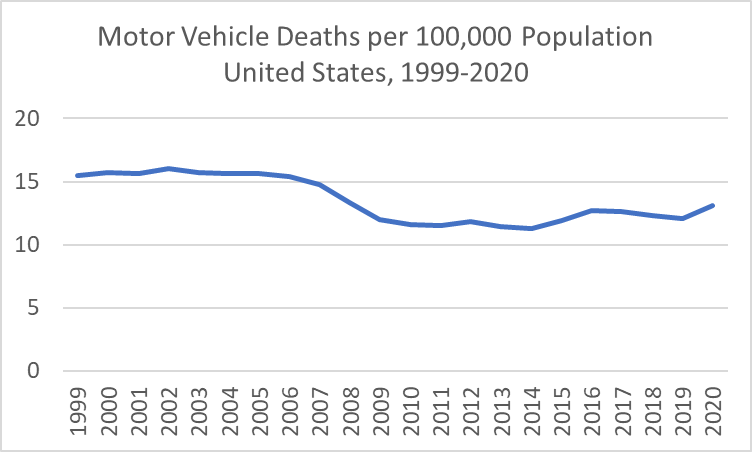
Of all the increases in mortality in 2020, one that is notable is motor vehicle accidents. There were 43,045 deaths from motor vehicle accidents, according to the final CDC data. This means motor vehicle accident was listed on the death certificate, even if it was not determined to be the “underlying cause,” though for 98% of these deaths the accident was listed as the underlying cause.

The increase from past years was large. Compared with 2019, there were over 3,000 more motor vehicle deaths, though such as increase is not unheard of: 2015 and 2016 each saw increases of around 2,500. Even so, the crude death rate from motor vehicle accidents in 2020 was the highest it has been since 2008.

If that weren’t bad enough, another theory emerged in 2020 and continues to be suggested today: that car crashes are being labeled as “COVID deaths,” artificially inflating the COVID death count. While one can find this claim made almost daily by anonymous Twitter users, one of the most prominent statements was on Fox News in December 2020. Host Raymond Arroyo said that car accidents were being counted as COVID deaths, and that due to errors like this COVID deaths could be inflated by as much as 40 percent. Senator Marco Rubio made a similar claim on Twitter in December 2021, though he was talking about hospitalizations, not deaths.

Back in 2020, many doctors and medical professionals tried to debunk the “car accidents being labeled as COVID deaths” claim, but the problem was we didn’t have complete data. Anonymous anecdotes were cited, but medical professionals tried to reassure the public this wasn’t the case or at least wasn’t widespread.

But now, we have the data! That is, the complete CDC mortality data for 2020 available through the CDC WONDER database.

What does this data show us? Short answer: there aren’t that many car accidents being labeled as COVID deaths. At most, it’s about 0.03% of COVID deaths.

Continue reading

Certificate of Need and Mental Health

Most US states require hospitals and other healthcare providers to obtain a “Certificate of Need” (CON) from a state board before they are allowed to open or expand. These laws seem to be one reason why healthcare is often so expensive and hard to find. I’ve written a lot about them, partly because I think they are bad policies that could get repealed if more people knew about them, and partly because so many aspects of them are unstudied.

States vary widely in the specific services or equipment their CON laws target- nursing homes, dialysis clinics, MRIs, et c. One of the most important types of CON law that remained unstudied was CON for psychiatric services. I set out to change this and, with Eleanor Lewin, wrote an article on them just published in the Journal of Mental Health Policy and Economics.

We compare the state of psychiatric care in states with and without CON, and find that psychiatric CON is associated with fewer psychiatric hospitals and beds, and a lower likelihood of those hospitals accepting Medicare.

Together with the existing evidence on CON (which I tried to sum up recently here), this suggests that more states should consider repealing their CON laws and letting doctors and patients, rather than state boards, decide what facilities are “economically necessary”.

Will we repeat the Christmas Covid wave?

EDIT at 7pm, same day as posting: You know you have good friends when someone quietly emails you and tells you that the news about Omicron just got much worse and you should probably edit your post. I’ve been trying to rationalized why this January will be better than last January. Of course if it were not for Omicron, I would expect very little from holiday gatherings among mostly-vaccinated Americans. However, having known Omicron was looming, I probably shouldn’t have even tried to speculate. Get your booster and be prepared to hunker down in January if the 2-3 week data indicates that infections are turning extra-lethal. </edit>

In keeping with the “dismal science” brand, let’s dwell on the horrible death toll of the January 2021 Covid wave in the US that followed the Christmas holiday. Here comes Christmas (and other winter holidays) again, a major public health event.

https://www.cnbc.com/2021/01/27/us-reports-record-number-of-covid-deaths-in-january.html

This graph I borrowed from CNBC shows how fast deaths spiked up after the winter holidays of 2020. See also https://data.cdc.gov/.

According to Google search auto-complete, the public is more interested in whether there will be another Christmas Prince movie than whether there will be another Christmas Covid death wave.

I think it’s unlikely that we will see a repeat of exactly what happened last year. I’ve been looking online for predictions and mostly I have found articles warning that Omicron will cause a some kind of wave. No one wants to commit to predicting how many people will die, because anyone who tries is sure to be wrong. The consensus is that breakthrough infections are likely but that vaccines protect against extreme illness.

Nearly a million Americans have died from Covid already (Jeremy argues for a million). Some of those deaths, in retrospect, can almost certainly be tied to family travel during the holidays in 2020. The January Covid wave has only happened once, so it’s impossible to predict what will happen this time. Unfortunately we may get an interaction from increased holiday travel plus a novel highly infectious variant.

The Omicron variant is spreading fast, but no one knows if it will be worse than we we are currently dealing with from Delta. It seems like triple-vaxxed people are not at high risk, from preliminary data. That is reassuring to me personally. Thank you South Africa for being fast and sharing data with the world. For communities with low vaccination rates, it seems certain that more deaths will result from fast-traveling Omicron. Yet, from my reading this week, it is hard to know if it’s really much worse than what they are currently experiencing from Delta.

I’m keeping a Twitter thread going of what other people are saying. Caleb Watney points out that we have two things going for us. Widely available vaccines keep people safer from infection and reduces the chance of needing medical treatment. Secondly, we have gotten better at treating the disease. Together, that should mean less deaths in January 2022, as long as people seek treatment quickly and hospital capacity does not become a limiting factor. Omicron could multiply cases so quickly that we can’t apply all our best treatments to everyone. That is the biggest reason to worry.

Even though people will be less cautious about winter holiday travel this year than they were last year, the country has been open for many months now, including the recent Thanksgiving holiday. The vulnerable population this time should be smaller, in terms of the people likely to die from Omicron.

To say that we won’t blindly exactly repeat the biggest mortality event of my lifetime is not “optimism”. It seems like this January will not be as bad as last January for the reason Watney states: better medical tech on hand, most importantly vaccines for prevention.

Continue reading

800,000 Deaths? Or 1 Million Deaths?

According to the Johns Hopkins COVID tracker, the US has now surpassed 800,000 COVID deaths during the pandemic. The CDC COVID tracker is almost to 800,000 too. But is this number right? Confusion about COVID deaths and total deaths has been rampant throughout the pandemic, especially when comparing across countries.

One method that many have suggested is excess deaths, which is generally defined as the number of deaths in a country above-and-beyond what we would expect given pre-pandemic mortality levels. It’s a very rough attempt at creating a counterfactual of what mortality would have looked like without the pandemic. Of course, you can never know for sure what the counterfactual would look like. Would overdoses in the US have increased anyway? Hard to say, though they had been on the rise for years even before the pandemic.

So don’t treat excess deaths as a true counterfactual, but just a very rough estimate. I wrote about excess deaths in the US way back in January 2021 (feels like a lifetime ago!), and at the time for 2020 it looked like the US had about 3 million total deaths (in the first 48 weeks of 2020), which was about 357,000 deaths more than expected (again, based on historical levels of the past few years), or about 13.6% above normal.

But once we had complete data for 2020, deaths were even higher: about 19% above expected, or somewhere around 500,000 excess deaths. This compares with the official COVID death count of about 385,000 in 2020 for the US.

What happens if we update those numbers with the most recent available mortality data for 2021? Keep in mind that data reporting is always delayed, so I’ll just use data through October 2021. The following chart shows both confirmed COVID deaths and total excess mortality, cumulative since the beginning of 2020.

As we can see in the chart, there are a lot more excess deaths than confirmed COVID deaths. There were already over 1 million excess deaths through the end of October 2021 in the US, cumulative since January 2020. This compares with about 766,000 confirmed COVID deaths. That’s a big gap!

We could spend a lot of time trying to understand this gap of 250,000 deaths. Is this under-reporting of COVID deaths? Is it deaths caused by government restrictions? Is it caused by the overwhelming of the health system?

I won’t be able to answer any of those questions today. Instead, let’s ask a different question: is the potential US undercount of COVID deaths unusual?

Continue reading

If Tyler is talking about a new variant…

For some Americans, this Thanksgiving was the first holiday that felt normal in a long time. Being re-united, without Covid restrictions, is something to celebrate.

On the other hand, a new coronavirus variant was just discovered in South Africa. It’s scary enough that travel bans might be imposed. We have all (just about) learned to live with the original strain from Wuhan, but scientists want time to figure out how dangerous and infectious this new strain is. Maybe at this point people are tired of being lectured about risks. No matter how much or little a person sacrificed for Covid-19, they might feel like that storyline has become too boring to deserve any more of our attention. We cannot stop looking out for new variants that might force us to put cherished traditions on hold again. Coronaviruses kill. My advice is to keep following news from Tyler Cowen, Alex Tabarrok, and Emily Oster.

Oster has been consistently reasonable about family and health risks. She argued to open schools and essentially said that you can see grandparents if the risk is small enough (even though the risks are never zero). As I said before, another trustworthy source of information throughout the pandemic has been Tyler and Alex, who put up almost all of their material in real time at Marginal Revolution.

I’ll share something a friend wrote to me today:

Although [his wife’s name]’s chemo treatment continues to show good long-term signs, this morning we discovered that [she] tested positive for COVID. That’s bad news, the good news is that [she] is already getting the antibody treatment and some extra fluids at the hospital as I write this.

“The antibody treatment” did not exist when the first Covid-19 waves swept through New York with such devastating consequences.

If the newest strain turns out to be a serious development, then in many ways we are better prepared to deal with it than we were before. We probably will blow through the red tape on at-home rapid tests faster the next time around (I’m such an optimist!). We already have contact tracing apps that protect privacy. Vaccine scheduling software is already in place. Everyone has masks at home.

The biggest difficulty I foresee is not coming up with scientific solutions but agreeing as a society about which tools to use. Some people might (will) not even believe the new strain is real.

EWED was started right at the moment when Marginal Revolution commentary on Covid seemed the most crucial. So, sometimes I will do little more here than keep up the echo. Do tweets, phone calls, letters, blogs, or talk about Covid around the Thanksgiving table. Don’t give up.

It’s now clear, whether or not the news out of South Africa turns out to be serious, that we are living with a new problem that will last a long time. It’s a marathon, not a sprint.

If you ever read much of the New Testament, you’ll see a theme in the letters of Paul to cities he has visited. The brand-new churches were doing well, while he was with them in person. Then time goes by and the community or doctrine starts to fray.

Paul wrote these words to the church in Galatia, more than a year after he had visited them:

Let us not become weary in doing good, for at the proper time we will reap a harvest if we do not give up. 

Galatians 6:9
Continue reading

Alex Madrigal’s Atlantic Article on Testing Positive for COVID, and Pushbacks

A friend just texted me a link to an article by Alex Madrigal that came out yesterday in The Atlantic. Madrigal described how he made a last-minute decision to attend a wedding and associated gatherings in New Orleans. He knew there would be non-zero risk of infection, of course, but he had been fully vaccinated and he had reason to believe that essentially everyone else at the festivities was likewise vaccinated.  Madrigal had helped to assemble and lead a consortium of journalists who gathered and published COVID data in the early months of the pandemic, before officialdom got its act together on reporting good numbers, so he is well-acquainted with the math of this disease.

He had been seeing maskless people laughing and chatting  in restaurants, and he really liked New Orleans, and he wanted to support his friend who was getting married, and he wanted to enjoy some return to good old normal good times. So, he went and he mingled. Liquor flowed and happy chatter filled the air. And then he flew home.

He has a wife and two children, so to be on the safe side, upon his return he took no less than three PCR antigen tests, a day or so apart. All came back negative, even the one four days after the wedding. He did develop some cold symptoms, and upon his wife’s request, did one more swab at home on the fifth day. That was unmistakably positive, as was a follow-up test.

What followed was a nontrivial amount of inconvenience – – he went and  lived in a rental apart from his family for at least ten days, his kids got pulled out of school, and he worried that if he had passed it to them, they in turn would need to quarantine. He is 39 and in top physical condition, and was vaccinated, so his course of illness was just that of a nasty cold, but that was still not fun. For him the most poignant aspect was the reaction of his two children:

My nonbinary 8-year-old was so mad and maybe so scared that they could barely look at me. My 5-year-old daughter proved her status as the ultimate ride-or-die kid. She brought a chair down the street so she could sit 20 feet away from me outside in her mask, as I sat on the porch in an N95. I’m not sure which reaction was more heartbreaking. It was as if one never wanted to see me again and the other didn’t want to let me out of her sight.

He wrote all this up in “ Getting Back to Normal Is Only Possible Until You Test Positive “. The concluding lines echo the title, “Right now most policies appear designed to make life seem normal. Masks are coming off. Restaurants are dining in. Planes are full. Offices are calling. But don’t be fooled: The world’s normal only until you test positive.”

My reaction, which I’d like to think would be a common reaction to this piece, is sympathy for the hassle that he and his family have been through, and appreciation for this reality check: the newer variants of COVID multiply so fast that you can get sick and spread the disease, even if you have been vaccinated. You probably won’t die, but getting infected could be very uncomfortable and inconvenient. At the macro level, some activities may never get fully back to pre-2020 levels, and on the personal level we should keep all this in mind before entering a room with lots of talking (or singing) unmasked people. In the U.S. there are still a thousand people dying every day from this communicable disease, and Europe is getting hit hard. I guess we all have pandemic fatigue, but a thousand deaths at a pop used to be considered a lot.

That would be a fine observation with which to end this blog post. But I will throw in one other observation: the internet is a pretty harsh place, and Madrigal’s article spawned at least two fairly ascerbic pushback articles.  Claire Carusillo at gawker.com (which I know nothing about), in Alexis Madrigal: I Can’t Believe I, a Really Good Person, Got Covid , takes multiple jabs:

Alexis C. Madrigal, a columnist for The Atlantic and a cofounder of the COVID tracking project, got a mild breakthrough COVID case at a destination wedding in New Orleans. Instead of just going to bed for two weeks like a normal person, he wrote an essay about it wherein the only thing he makes clearer than his dedication to his workout routine is how he believes his story is a horrifying parable for our time.

It isn’t. It’s an unremarkable story from a public health perspective, though Madrigal’s inclusion of specific details make this piece a fascinating study of what it’s like to be an American man with a certain level of privilege who also just so happens to have a huge platform and a deadline to meet. Social distancing, it seems, has inflamed his out-of-touchness with what most people have endured over the course of the last 20 months.

… You may be thinking, spending a few childcare-light days at an Airbnb on your own block with a mild throat “tickle” that does not prevent you from either doing Peloton workouts or writing an essay for The Atlantic does not sound that bad. In fact, you may think it sounds a lot better than the trips I have taken to the Bay Area, particularly the family vacation we took to Alcatraz when I was nine. Either way, how dare you?

Ouch.

Tiana Lowe at the Washington Examiner blames Madrigal’s fear-mongering for his kids’ reactions to his plight, in her article If your nonbinary 8-year-old gets mad at you for getting COVID, tell them to grow up :

Over at the Atlantic, Alexis Madrigal engages in some light sadism, dedicating thousands of words to flagellating himself for the great sin of contracting the coronavirus….. He got a mild breakthrough case of coronavirus. But because the vaccines work well, he made a full recovery shortly thereafter.

….Children these days have dramatically calmed down from the bad behavior of the ’80s. This has brought with it the blessing of far fewer pregnancies and underaged smokers. But helicopter parenting, even before the pandemic, produced a significant cohort of children far, far too cautious and not nearly socialized well enough for adulthood. The share of teenagers who have ever had a job, gotten their driver’s license, or gone on a date, all previously the major milestones of young adulthood, has plummeted, and now we’re adding COVIDiocy to that trend?

An 8-year-old capable of making a parent abide by their preferred gender identity is probably also capable of bullying said parent out of having a normal social life. But the real fault belongs to the parent who would let a child live in such fear and fall so deeply into coronavirus delusions.

A virus for which we now have three vaccines and several new, inexpensive treatments does not provide any reason to stop living life to the fullest. To fail to explain this to children is the kindness of cowardice — or even cruelty masquerading as kindness.

Again, ouch. I think the two pushback articles make some valid points, particularly Lowe’s observations on helicopter parenting in general, and it does seem like the Madrigals’ kids had been given overly inflated fears about their dad’s prospects. That said, we need more in the way of civil discourse. The abrasive tone of these reactionary articles says more about their authors’ attempts to garner clicks than about Madrigal’s original earnest cautionary tale. It is a jungle out there.

COVID and The Young

The CDC just approved vaccines from Americans aged 5-11. That’s great news! But today, I want to talk about another age group: mine.

A few months ago I wrote a post summarizing data for COVID-19 deaths among people in their 30s and 40s. While we have primarily thought of COVID as a disease impacting the elderly (and indeed in the aggregate, it is), there have been major health consequences for those under 65 too. Including major health consequences for the age group 30-49 (which I believe is the age range of all our bloggers here at EWED).

I wanted to update that data because a few new things have come to light. First, I highly recommend reading a recent paper by my friend Julian Reif and co-authors. They estimate the number of Years of Life Lost and Quality-Adjusted Years of Life Lost for different age groups from COVID-19. Their data runs through mid-March 2021, so before vaccines probably had much of a chance to impact the aggregate death numbers (though vaccines were being rolled out at the time).

Here’s their main result: while most of the deaths from COVID were among those aged 65 and older (80% through March 2021), most of the life lost in terms of years was for Americans under 65 (54% of QALYs). And even for very young adults, the risk in terms of years of life lost was not minimal. A comparison from the paper: “Adults aged 85 years or older faced 70 times more excess risk for death than those aged 25 to 34 years but only 3.9 times more individualized loss of QALYs per capita.” Compared to the 35-44 age group, the relevant factor is 2.8 times more individualized loss for the 85+ group.

It’s a great paper, but it only goes through March. What has happened since March 2021? While 80% of the COVID deaths up through March 2021 were among the elderly (65 and older), since April 2021 only 60% of the COVID deaths have been among the elderly. Part of this is because deaths are down among the elderly, but it’s also because deaths are up for the non-elderly. The table is my attempt to show this effect, looking at the period from March-September in both 2020 and 2021 (data is current as of October 27, so the September 2021 data is still not complete, but instructive).

For the oldest Americans, COVID deaths fell by 50%. That’s great! But for younger Americans, COVID deaths roughly doubled. Not good!

Continue reading

Joy Recommends Running Products

Late October is a nice time to get outside in Alabama. I have answered the primal call to suburban moms and signed up for a 5K running race at the end of the month. To make running practice safe and fun, I dropped a few hundred dollars this month on products.

Now that I’m old, my first concern is not injuring myself. Having good new shoes that absorbs some of the impact from running is important. I went to a local running store and ended up getting Asics Gel Nimbus.

I really like them. Amazon link. It seems like the price ($150) in the boutique store and the Asics website and Amazon is all the same.

Assuming you are not considering getting these shoes for yourself, do not buy a woman running shoes for Christmas, obviously, unless you’ve discussed it with her. You could buy a family member the other big purchase I made for running: AirPods.

Many people already have AirPods but I’ll review them anyway. I bet there are at least 10 people out there just like me who view them as newfangled and unnecessary.

My primary reason for getting them was so that I can listen to music while I run and not have the annoying headphones cord in my face. They are great for running. By the way, I got the cheapest version since I only use them occasionally.

AirPods are more than wireless headphones.  They are smart. They allow you to take hands free phone calls when your phone is two rooms away (which can be a reason to keep them in even when you are not listening to music). They respond to voice commands and prompt you on what to say. Maybe I shouldn’t be, but I was surprised by how easy it was to start using them.

I use a free application called RunKeeper. Without any fiddling from me, the AirPods give me useful feedback on my run from RunKeeper. I don’t have to stop the music or pull out my phone to get this feedback. It just knows, and the AI is correct about what I want to hear when.

While I was at the Apple store getting AirPods, I considered getting an Apple Watch. It turns out that the Apple Watch does not have a long range from the phone. So, I cannot run a mile away from my phone and still get all services on the Watch. Since I’m not a serious runner, I did not want to spend hundreds of dollars on a new watch plus pay for a separate cellular plan for the device. I run while holding my small-ish iPhone.

Apple Watch records your heart beat. I can be a privacy grump, even though I use a lot of tech. Apple Corp. can C it’s way right out of my vital signs. I don’t even want data on my heart rate and sleep patterns, for myself. I’m already mentally overloaded, so I don’t want more data to think about.

Here’s a song I like to put at the beginning of my running song playlist: https://www.youtube.com/watch?v=FxmkYugYu7Q

Lastly, for your holiday shopping list, I will make one plug for the shirts in our Blog Store. These make a fun gift for math majors or Econ Ph.D. folk.