What to Read: Claudia Goldin’s Career and Family

A better battery is an excellent gift, but for the gift that never needs recharging, a book is always a great idea. So this week Joy asked us to recommend a book. Again, this would be great as a gift or for yourself!

My recommendation is a very new book: Claudia Goldin’s Career and Family, which just came out this month. Confession: the book is so new, that I’ve only read about half of it so far! But this book is, as they say, self-recommending.

Goldin has spent almost her entire academic career studying the history of women’s participation in the US labor force. I think it’s fair to say that there is no person living today that knows more about the subject, possibly no one ever. This book is her attempt to sum up much of her research into a cohesive narrative about the changes in women’s labor force participation throughout the 20th century.

Her 2006 AEA Ely Lecture, “The Quiet Revolution,” was an earlier attempt to explain these long changes, and it is highly readable still today. Her 2014 AEA Presidential Address, “A Grand Gender Convergence,” is also excellent (watch the video of it too!). But this book brings all the ideas together into a complete narrative, tracking five cohorts of women and their experience in the labor force from 1900 to 2000. The last of these five cohorts matches the title of her book, the generation of women that entered the labor force since 1980 and now have a reasonable chance of achieving both an career and a family, rather than having to chose between the two.

This does not mean, and certainly Goldin would not say, that the journey is over and all is well for women today. Goldin focuses primarily on college graduates in this story, since they are the group most well-positioned to achieve the goal of having a career and a family. Obviously there are still challenges, and Goldin spends some time discussing one that the COVID pandemic revealed but was always there: the challenge of finding affordable childcare.

If you want a taste of the book, you can read or watch her 2020 Feldstein Lecture, “Journey Across a Century of Women.” But really the story is so complex that it does take a book to explain it all.

Continue reading

Book Recommendation: “How the Irish Saved Civilization”

It is hard to wrap our minds around how rapid and thorough was the loss of literate culture throughout Europe after the collapse of the Roman political and economic order. As of 400 A.D, the Pax Romana held throughout the whole Mediterranean world, and up through what is now France (“Gaul”) and England. The immense depth and breadth of classical knowledge comes through, for instance, in the works of Augustine. Writing just as the barbarian wave was starting to overrun the empire, Augustine casually alludes to a wide range of Greek and Roman philosophers, historical events, skilled medical procedures and a long list of metals and precious stones, knowing that his contemporary readers would be familiar with all these things.

All this changed after 406. On the last day of that year, the Rhine River, which formed the border between the Roman empire and the Germanic tribes to the north and east, froze solid.  A vast horde of barbarians began to surge across the border, overwhelming the thin force of Roman frontier guards. Every German man was a warrior, and their armed women followed closely behind. The invaders quickly spread south through Gaul and into Italy, Spain, and North Africa, looting and doing the generally disruptive sorts of things that invading barbarians do. Rome itself was sacked in 410.

In an orderly, diverse pre-industrial economy, there are enough slaves and peasants toiling away at the bottom of the pyramid to support a reasonable number of merchants, priests and aristocrats who can carry on higher culture. But with societal collapse in the fifth century, and new class of overlords who knew and cared little about literacy, centuries of Greek and Roman learning were nearly lost to most of Europe. In this bare survival situation, nobody had the leisure or drive to learn to read and appreciate literature, and to do the physical copy of manually copying  manuscripts which was necessary before the printing press.

The big, bright, exception, which is the subject of Thomas Cahill’s book, was the newly minted set of monasteries in Ireland. The Irish had been thoroughly pagan (think human sacrifice) and thoroughly illiterate until Patrick brought Christianity to them in the middle of the fifth century. Cahill describes the Irish mindset in detail, and how Patrick appealed to its best elements.

(Patrick’s story is very dramatic and monumental in its impact, but I won’t try to summarize it here in the interests of space.  Just one quote:  “The greatness of Patrick is beyond dispute: the first human being in the history of the world to speak out unequivocally against slavery. Nor will any voice as strong as his be heard again until the 17th century”).

The few monasteries on the European continent saw little value in the ancient non-Christian Greek and Roman writers, so those works were not reproduced. The Irish had a more eclectic attitude, and happily copied whatever texts came their way, including “pagan” authors like Plato.

The final step in this cultural saga is that starting around 600 many of these Irish monks, along with their precious manuscripts, made their way back to Gaul and northern Italy. They established their monasteries, which served as outposts of literacy, and they started to educate the local kings and  warlords and their children. And that is how “the Irish saved civilization”.

Anyone with an inquiring mind should enjoy this book. It manages to be deeply erudite and deeply engaging, giving depth portraits of representative personages in the late Roman empire, the Irish before and after Patrick, and key leaders in the succeeding centuries. One thing the author points out is that life in the later Roman empire was not typically much fun unless you were in the oppressive, narcissistic upper upper crust. Although we may rightfully mourn the loss of classical learning, for the vast majority of its inhabitants, the demise of the empire and its tax collectors was maybe not such a tragedy.

Cahill further makes the case that the fusion of Patrick’s Christianity with Irish sensibilities gave rise to a richer, healthier spirituality than could be found in Roman-type Catholicism:

Patrick could put himself – imaginatively –  in the position of the Irish. To him, no less than to them, the world is full of magic. One can invoke the elements – the lights of Heaven, the waves of the sea, the birds and the animals – and these will come to one’s aid, as in the incantation of [Patrick’s famous prayer] the “Breastplate”. The difference between Patrick’s magic and the magic of the druids is that in Patrick’s world all beings and events come from the hand of a good God, who loves human beings and wishes them success. And though that success is of an ultimate kind – and, therefore does not preclude suffering – all nature, indeed the whole of the created universe, conspires to mankind‘s good, teaching, succoring, and saving.

Patrick… could assure you that all suffering, however dull and desperate, would come to its conclusion and would show itself to have been worthwhile.

… Christ has trodden all pathways before us, and at every crossroads and by every tree the Word of God speaks out. We have only to be quiet and listen.

…This sense of the world as holy, as a Book of God – as a healing mystery, fraught with divine messages – could never have risen out of Greco- Roman civilization, threaded with the profound pessimism of the ancients and their Platonic suspicion of the body as unholy and the world as devoid of meaning.

Reading Slavery and American Economic Development

Slavery is a bad and we should rid ourselves of it. One of the arguments made by abolitionists before the Civil War in the United States is that slaves make poor workers and therefore it’s not that costly to get rid of slavery. Of course, it doesn’t matter if slaves worked hard or not. Slavery was a moral abomination, regardless. However, it does make it easier to argue that we should direct government resources to fight enslavers when we can make a case that slavery makes the entire country poorer.

On the one hand, there were many non-slave workers and farmers in North America, demonstrating that products including cotton could be produced by free labor. On the other hand, slavery as an institution expanded into the South and the West, presumably because of the economic advantage it gave to slave-owners.

In Slavery and American Economic Development, economist Gavin Wright states that whether or not slaves were as productive as free/wage labor is hard to measure and also is not hugely important. Slavery might have provided wealth to slave owners in the South, but that is only because of the institutional setting that was created explicitly to maintain the slave society.

The American South had some of the best land in the world for growing cotton and cotton became a lucrative export crop thanks to British demand before the Civil War. Before the Civil War, there were some extremely profitable plantations on which slaves worked. It is true that some enslavers became rich and that drives up what appears to be the GDP per capita in the South at the time.

Wright explains that a slave owner living closer to the East Coast was better able to go on an entrepreneurial venture into Alabama to clear a large plantation for cotton farming than a typical free family farmer. The slave owner could obtain large loans and had a future guarantee of workers (thanks to the local laws and police state). So, something like a modern corporation employing free labor could also have accomplished the venture. But, at the time, it was an opportunity that was easier for enslavers to take advantage of. Free farmers also expanded West into the United States, but they tended to move more slowly and focus on subsistence (e.g. wheat for consumption). That is, partly, what Wright means when he speaks of slavery as a “system of property” as opposed to just a “system of production”. That helps explain why slavery was on the rise in the American South.

Wright also examines slavery as a political regime. In a place with many slaves, resources had to be allocated to policing and preventing revolts. It might have been individually rational for a landowner to offer freedom to slaves as a form of compensation for work, but this was disallowed by that broader political environment. So, everyone was somewhat trapped. Most importantly, the slaves were abused and trapped. But the free residents of the South had to live in a stagnant society. Governments did not invest in schooling, even for white children.

Municipalities in the North were booming and attracting free migrants with public investments. These investments set the North on a path to overtake the South economically and demonstrate which system is superior for creating wealth. Wright blames property owners in the South for continuing to fail to vote for good institutions that foster economic growth after the Civil War.

Polarized Americans in 1840

I’m reading a new book Liberty Power by historian Corey Brooks. It is about how abolition was accomplished through American politics. Something that stood out to me in the introduction is that abolitionists claimed that they had been “cancelled” by proslavery dominant powers in Congress. Americans did not like to see someone getting cancelled, and it created sympathy for abolitionists.

Weigh costs, benefits, and evidence quality

Living means making decisions with imperfect information. But Covid provides many examples of how people and institutions are often still bad at this. A few common errors:

  1. Imperfect evidence = perfect evidence. “Studies show Asprin prevents Covid”. OK, were the studies any good? Did any other studies find otherwise?
  2. Imperfect evidence = “no evidence” or “evidence against”. In early 2020, major institutions like the WHO said “masks don’t work” when they meant “there are no large randomized controlled trials on the effectiveness of masks”
  3. Imperfect evidence = don’t do it until you’re sure Inaction is a choice, and often a bad one. If the costs of action are low and the potential benefits of action high, you might want to do it anyway. Think masks in 2020 when the evidence for them was mediocre, or perhaps Vitamin D now.
  4. Imperfect evidence = do it, we have to do something Even in a pandemic, it is possible to over-react if the costs are high enough and/or the evidence of benefits bad enough (possibly lockdowns, definitely taking up smoking)

Any intro microeconomics class will explain the importance of weighing both costs and benefits. But how do we know what the costs and benefits are? For many everyday purchases they are usually obvious, but in other situations like medical treatments and public policies they aren’t, particularly the benefits. We have to estimate the benefits using evidence of varying quality. This creates more dimensions of tradeoffs- do you choose something with good evidence for its benefits, but high cost? Or something with worse evidence but lower costs? Graphing this properly should take at least 3 dimensions, but to keep things simple lets assume we know what the costs are, and combine benefits and evidence into a single axis called “good evidence of substantial benefit”. This yields a graph like:

Applied to Covid strategies, this yields a graph something like this:

This is not medical advice- I say this not merely as a legal disclaimer, but because my real point is the idea that we should weigh both evidence quality and costs, NOT that my estimates of the evidence quality or costs of particular strategies are better than yours

Judging the strength of the evidence for various strategies is inherently difficult, and might go beyond simply evaluating the strength of published research. But when evaluating empirical studies on Covid, my general outlook on the evidence is:

Of course, details matter, theory matters, the number of studies and how mixed their results are matters, potential fraud and bias matters, and there’s a lot it makes sense to do without seeing an academic study on it.

Dear reader, perhaps this is all obvious to you, and indeed the idea of adjusting your evidence threshold based on the cost of an intervention goes back at least to the beginnings of modern statistics in deciding how to brew Guinness. But common sense isn’t always so common, and this is my attempt to summarize it in a few pictures.

20 Years To The Day

It’s a blog. I’ll write about 9/11, since it’s 20 years today. 9/11 was an attack on my family and I will always be sad on this day remembering the horror. 9/11 was more than the number of murders we can count.

The Twin Towers episode was more than an attack on American citizens. New York City is the place people from all over the country and all over the world dream of reaching. It is the great melting pot. It is the symbol of American ideals, even as it is paradoxically at odds sometimes with the conservative heartland. Anything is possible for anyone, in New York.

I was not a New Yorker as a kid. I grew up nearby, but my parents avoided the city. I think the fact that you had to pay for parking and fight traffic was their primary reason. We were transcendentalists, preferring to park for free by some hiking trail on weekends. Anyway, I want to be a New Yorker now, if they’ll have me. I will always share that dream of moving to New York and experiencing the version of freedom that was uniquely created there.

I follow a lot of smart people who want to fix all problems. By all means, fix problems. This day just hurts. No one is expected, for example, to cure cancer on the day their deceased husband’s birthday comes around. This day can be for remembering what was lost and listening to a favorite song and talking to a favorite person. I try to convert the survivor’s guilt into gratitude.

9/11 will haunt me all my life.  I know this is becoming a topic for history textbooks. People will interpret this event as coldly as I do when I read about massacres in history books. My professor peers are getting the first wave of kids born after 9/11. “I can’t believe these kids were born after 9/11. Is that… Do I have a gray hair?” It is in fact true that everyone born after 9/11 was born after 9/11. Maybe we should be happy that it’s been so long. I don’t wish this memory on my children.

The kids-these-days lost their innocence to Covid (and watching adults fight about it). I can only imagine how the 9th graders felt who were sent home from school to watch from the windows while a parent-killing plague swept through their community. They will want to share their lockdown stories in the way that I want to share my “where were you on…” story.

I lived close enough to New York to feel the outer ripple of grieving families. A schoolmate’s uncle died. I had a flamboyant Sunday School teacher who told us that God told him to stay home that morning and make muffins, else he would have been in lower Manhattan at his job in the fashion industry.

Tomorrow, I will begin a series of post about “behavioral economics” and the rumor that it died.

Here’s a song I have been listening to this week. https://youtu.be/zyVZ4uVHYRw

Who is the Wealthiest Generation?

Have you seen this chart?

I have seen it many times. It comes from this Washington Post article, but it seems to go viral on Twitter about every 6 months or so.

The implication of the chart seems to confirm what many young people feel in their bones: Boomers had it much easier, and it’s getting harder and harder for later generations to catch up and build wealth. For many the graph… explains a lot, as one recent viral Tweet put it (in the weird world of social media, 5 short words and a recycled chart are all it takes for 20,000 retweets).

But wait. A few questions probably come to mind. For example, when Boomers were young they comprised a much larger share of the population. The original article makes an attempt to adjust for this, by calculating a few ratios towards the end of the article. However, there’s a much more straightforward way to adjust for this, which also nicely fits into a chart: put wealth in per capita terms!

If we do that, here’s the chart we get (also, of course, adjusted for inflation).

Data is for 1989-2021 from the Federal Reserve’s Distributional Financial Accounts, but only the first quarter is available right now for 2021. For 1989, it is the average of the third and fourth quarters. Population data comes from Census single-year of age estimates for various years. 2020 and 2021 population estimated using growth rate from 2010-2019.
Continue reading

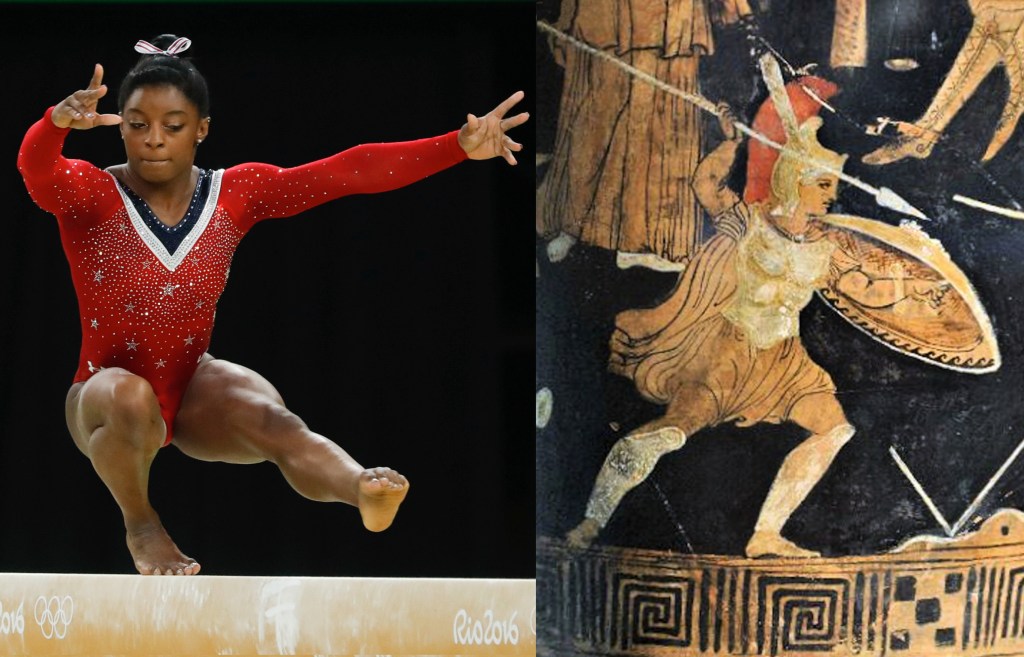
Simone Biles and the Trojan War

When star gymnast Simone Biles decided to sit out the Olympics this week to ‘focus on herself’, both those praising her and those criticizing her seemed to treat this like a unique story that wouldn’t have happened in earlier generations. But it reminds me of one of the oldest recorded stories in the world, one that predates even the first ancient Greek Olympics of 776 BC- Achilles’ decision to sit out the Trojan War.

Here is Biles this week:

We also have to focus on ourselves, because at the end of the day we’re human, too… We have to protect our mind and our body, rather than just go out there and do what the world wants us to do.

Here is Achilles, greatest of the Greek warriors, thousands of years ago:

Him do I hate even as the gates of hell who says one thing while he hides another in his heart; therefore I will say what I mean. I will be appeased neither by Agamemnon son of Atreus nor by any other of the Danaans, for I see that I have no thanks for all my fighting. He that fights fares no better than he that does not; coward and hero are held in equal honour, and death deals like measure to him who works and him who is idle. I have taken nothing by all my hardships- with my life ever in my hand; as a bird when she has found a morsel takes it to her nestlings, and herself fares hardly, even so man a long night have I been wakeful, and many a bloody battle have I waged by day against those who were fighting for their women. With my ships I have taken twelve cities, and eleven round about Troy have I stormed with my men by land; I took great store of wealth from every one of them, but I gave all up to Agamemnon son of Atreus. He stayed where he was by his ships, yet of what came to him he gave little, and kept much himself….

Agamemnon has taken her from me; he has played me false; I know him; let him tempt me no further, for he shall not move me. Let him look to you, Ulysses, and to the other princes to save his ships from burning…. I will draw my ships into the water and then victual them duly; to-morrow morning, if you care to look, you will see my ships on the Hellespont, and my men rowing out to sea with might and main. If great Neptune vouchsafes me a fair passage, in three days I shall be in Phthia. I have much there that I left behind me when I came here to my sorrow, and I shall bring back still further store of gold, of red copper, of fair women, and of iron, my share of the spoils that we have taken; but one prize, he who gave has insolently taken away. Tell him all as I now bid you, and tell him in public that the Achaeans may hate him and beware of him should he think that he can yet dupe others for his effrontery never fails him.

As for me, hound that he is, he dares not look me in the face. I will take no counsel with him, and will undertake nothing in common with him. He has wronged me and deceived me enough, he shall not cozen me further; let him go his own way, for Jove has robbed him of his reason. I loathe his presents, and for himself care not one straw. He may offer me ten or even twenty times what he has now done, nay- not though it be all that he has in the world, both now or ever shall have; he may promise me the wealth of Orchomenus or of Egyptian Thebes, which is the richest city in the whole world, for it has a hundred gates through each of which two hundred men may drive at once with their chariots and horses; he may offer me gifts as the sands of the sea or the dust of the plain in multitude, but even so he shall not move me till I have been revenged in full for the bitter wrong he has done me. I will not marry his daughter; she may be fair as Venus, and skilful as Minerva, but I will have none of her: let another take her, who may be a good match for her and who rules a larger kingdom. If the gods spare me to return home, Peleus will find me a wife; there are Achaean women in Hellas and Phthia, daughters of kings that have cities under them; of these I can take whom I will and marry her. Many a time was I minded when at home in Phthia to woo and wed a woman who would make me a suitable wife, and to enjoy the riches of my old father Peleus. My life is more to me than all the wealth of Ilius while it was yet at peace before the Achaeans went there, or than all the treasure that lies on the stone floor of Apollo’s temple beneath the cliffs of Pytho. Cattle and sheep are to be had for harrying, and a man buy both tripods and horses if he wants them, but when his life has once left him it can neither be bought nor harried back again. 

My mother Thetis tells me that there are two ways in which I may meet my end. If I stay here and fight, I shall not return alive but my name will live for ever: whereas if I go home my name will die, but it will be long ere death shall take me. To the rest of you, then, I say, ‘Go home, for you will not take Ilius.’ Jove has held his hand over her to protect her, and her people have taken heart. Go, therefore, as in duty bound, and tell the princes of the Achaeans the message that I have sent them; tell them to find some other plan for the saving of their ships and people, for so long as my displeasure lasts the one that they have now hit upon may not be

In either case, economists aren’t surprised to see people stop showing up to work when they think the costs to them exceed the benefits, even when that work is itself unusual and could benefit their country.

The Recession Is Over! (15 months ago)

Lately there has been lots of both good and bad news about the pandemic and its impact on the economy. But here’s once piece of good news you might have missed: the recession which began in February 2020 ended in April. And not April 2021… it ended in April 2020. At least, that’s according to the NBER Business Cycle Dating Committee, which made the announcement last week.

The 2020 recession of just 2 months is by far the shortest on record. NBER maintains a list of recessions with monthly dates going back to 1854 (there are annual business cycles dates before that, including important modern revisions of the original estimates, but the monthly series starts in 1854). In that timeframe, there have been 7 recessions in the 6-8 month range, but nothing this short. Still, it was mostly definitely a recession, as unemployment briefly spiked to levels not seen since the Great Depression. But only for 2 months. Keep in mind that the first part of the Great Depression last 43 months.

Unemployment Rate, 1948-present

But how can this be? Is the recession really over? There are still about 6-7 million fewer people working than before the pandemic began. Lots of businesses are still hurting. The unemployment rate is still 2 full percentage points above pre-pandemic levels. How in the world can we say the recession ended 15 months ago?

To answer that question, it helps to know what NBER and most macroeconomists mean by a “recession” — essentially, it is used interchangeably with “contraction.” It means the economy, by a broad array of measures (NBER uses about 10 measures), is shrinking — or we might say, going in the wrong direction. The only other option, at least in the NBER chronology, is an expansion — when the economy is going in the right direction.

Does an economic expansion mean that everything is fine the economy?

Continue reading

CEA on Inflation Today and WWII

This week the Biden Council of Economic Advisers blogged about “Historical Parallels to Today’s Inflationary Episode”.

Consumer demand in 2021 is roaring back after pandemic shutdowns. Demand for airline travel is exceeding expectations. Car dealer lots are empty.

The authors argue that, of all the periods of rapid inflation in American history, the boom after WWII has the most parallels to today.

During WWII, Americans were obviously in war mode. Price controls and supply shortages led to deprivation on the Homefront. Families had trouble buying cars, just like today.

Instead of focusing on consumer or industrial durable goods, manufacturing capabilities were concentrated on military production. Today’s shortage of durable goods is similar—a national crisis necessitated disrupting normal production processes. Instead of redirecting resources to support a war effort, however, manufacturing capabilities were temporarily shut down or reduced to avoid COVID contagion.

Remember when oil had a negative price in 2020? While people in the US were staying home, many were building up personal savings. As soon as the “war” ends, consumers compete as buyers and drive up the prices of the limited available goods.

They present the post-war inflationary episode as dramatic but temporary, because it only lasted for two years. It’s short compared to inflation of the late ‘70’s. They are standing behind the Powell “transitory” story, in their conclusion.

On the other hand, they say that the most comparable moment in history to today involved the price level spiking 20% and taking two years to come down. I’m pondering a very expensive repair on our car, just make sure I don’t have to buy a new one soon.