The Growth of Black Wealth and Income in the United States

African Americans have seen much adversity throughout US history, but also significant economic progress. One way to measure economic progress is by looking at wealth. There is a fantastic paper by Derenoncourt and co-authors recently published titled “Wealth of Two Nations: The U.S. Racial Wealth Gap, 1860–2020” which puts together the best historical data on Black and White wealth in the US.

The paper primarily focuses on wealth inequality, and here it paints a pessimistic picture since 1950: while the racial wealth gap was closing up until 1950, it stalled after that, and possibly got worse after the 1980s. But using that same data, we can focus on the growth of Black wealth, and here the results are quite optimistic: inflation-adjusted Black wealth per capita was about 7 times larger in 2019 than it was in 1950. Black wealth per capita has roughly doubled since from about 1992 to 2019 (inflation adjusted).

Here’s the long-run data in a chart, which shows that in 2019 Black wealth per capita was 86 times greater than in 1870 (inflation adjusted). That’s some real economic progress!

For income data, there is no long-run historical series similar to the wealth series that I am aware of, but there are estimates for particular years. For example, Robert Margo estimates that Black income per capita was about $1,500 in 1870 (inflation adjusted to 2022 dollars) and $2,400 in 1900 (once again, inflation adjusted to 2022). Margo says that these data should be comparable to the Census CPS Historical Income tables, and the 2022 estimate from this series is $31,180 for Blacks. This data suggests that Black per capita income is 21 times was it was in 1870, and about 3 times what it was in 1967 (first year in the Census CPS series).

Using the same census data for families, rather than individuals, we can also look at the growth of Black family income since 1967. This data suggests that both median and mean family income for Blacks roughly doubled in inflation-adjusted terms from 1967 to 2022, which isn’t as impressive as the tripling of per capita income, but keep in mind that families are smaller today than in 1967. When we look at the distribution of those incomes, the progress becomes very clear:

In 1967, half of Black families had incomes under $35,000 (in 2022 inflation-adjusted dollars), which is close to the official definition of poverty (depending on family size). By 2022, this had been cut in half: just 25 percent of Black families were under $35,000.

The number of “rich” Black families (incomes of at least $100,000) in 1967 was miniscule: only about 200,000 families, just 5 percent of the total. In 2022, there were an additional 3 million rich Black families, now comprising almost one-third of the total, and outnumbering poor Black families. The number of rich Black families has grown by about 1 million in just the past decade — no stagnation there! The Black “middle class” (incomes between $35,000 and $100,000) now has 4.5 million families — the same number as the total count of Black families in 1967.

Of course, there is still much work to be done on economic progress in the US. But the astonishing economic progress of Blacks since emancipation and since the Civil Rights era is worth celebrating, even if racial gaps haven’t closed much recently.

How an All-U-Can-Eat Special Driven by a Controlling Investor Pushed Red Lobster Over the Edge

The Red lobster restaurant chain has historically positioned itself in what was hopefully a sweet spot between slow, expensive, full-service restaurants, and cheaper fast-food establishments. With its economies of scale, the Red Lobster franchise could engage in national advertising and improved supply contracts, giving it an advantage over small family-owned local restaurants.

The firm has been struggling for a number of years, caught between the quasi-upscaling of many fast-food chains, and the rise of fast-casual competitors like Chipotle. Also, seafood is more expensive to procure compared to chicken and beef, and the pandemic made a long-lasting dent in their revenues. That said, Red Lobster has been viable business for decades.

However, the firm has been adversely affected by financial engineering by outside companies. General Mills spun off Red Lobster to a company called Darden Restaurants in 1995. In 2014 Darden sold Red Lobster to a private equity firm called Golden Gate Capital for $2.5 billion. Golden Gate promptly plundered Red Lobster by selling its real estate out from under it. Instead of owning their own land and buildings, now the restaurants had to pay rent to landlords.  This put a permanent hurt on the restaurant chain’s profits. After this bit of financial engineering, the private equity firm in 2019 sold a 49% stake to a company called Thai Union. Thai Union bought out the rest of Red Lobster ownership from Golden Gate in 2020.

The Iron Fist from Outside

Thai Union is a huge seafood producer, which operates massive shrimp farms in Southeast Asia and sells a lot of shrimp to Red Lobster.
Although Thai Union initially said they would not interfere in the operations of Red Lobster, that’s not how it panned out.

An article by CNN author Nathaniel Meyersohn details how Thai Union took effective control of red lobster management decisions by 2022. Given the restaurant chain’s poor financial performance, it’s understandable that Thai Union would want to shake things up, but unfortunately the hatchet men they brought in appeared to have done more harm than good. Numerous off the record conversations agreed that the outside CEO was unnecessarily rude as well as incompetent. Knowledgeable Red Lobster veterans were driven out, and morale plummeted. Per Meyersohn:


Thai Union’s damaging decisions drove the pioneering chain’s fall, according to 13 former Red Lobster executives and senior leaders in various areas of the business as well as analysts. All but two of the former Red Lobster employees spoke to CNN under the condition of anonymity because of either non-disclosure agreements with Thai Union; fear that speaking out would harm their careers; or because they don’t want to jeopardize deferred compensation from Red Lobster…

Former Red Lobster employees say that while the pandemic, inflation and rent costs impacted Red Lobster, Thai Union’s ineptitude was the pivotal factor in Red Lobster’s decline.

“It was miserable working there for the last year and a half I was there,” said Les Foreman, a West Coast division vice president who worked at Red Lobster for 20 years and was fired in 2022. “They didn’t have any idea about running a restaurant company in the United States.”

At Red Lobster headquarters, employees prided themselves on a fiercely loyal culture and low turnover. Some employees had been with the chain for 30 and 40 years.  But as Thai Union installed executives at the chain, dozens of veteran Red Lobster leaders with deep knowledge of the brand and restaurant industry were fired or resigned in rapid succession. Red Lobster ended up having five CEOs in five years…

Former Red Lobster employees describe a toxic and demoralizing environment as Thai Union-appointed executives descended on headquarters and interim CEO Paul Kenny eventually took over the chain in 2022. Kenny, an Australian-born former CEO of Minor Food, one of Asia’s largest casual dining and quick-service restaurants, was part of the Thai Union-led investor group that acquired Red Lobster.

Kenny criticized Red Lobster employees at meetings and made derogatory comments about them, according to former Red Lobster leaders who worked closely with Kenny…

At the direction of Thai Union, Kenny became interim CEO, according to Red Lobster’s bankruptcy filing.

In the months after Kenny took over, Valade’s leadership team and other veteran leaders left. In July of 2022, the chief operations officer and six vice presidents of operations overseeing restaurants were abruptly fired shortly before Red Lobster’s annual general manager conference.

Kenny appointed a Thai Union frozen seafood manager, Trin Tapanya, as Red Lobster’s chief operations officer overseeing restaurants. Tapanya had no experience running restaurants. He did not respond to CNN’s requests for comment.

Other Thai Union representatives also became more closely involved across Red Lobster’s supply chain, finance, operations and strategy teams…Thai Union took a larger role in Red Lobster’s supply chain decisions, despite pledges in 2020 that it would not interfere.

Red Lobster had spent decades developing a wide array of suppliers to buy at competitive prices and mitigate the risks of becoming too reliant on any single supplier.

Thai Union blew that up.

Red Lobster employees say they were pressured by Thai Union representatives to buy more seafood from Thai Union. Thai Union representatives also began sitting in on meetings between Red Lobster and seafood suppliers, said one of the former Red Lobster employees who witnessed these conversations. Thai Union was the direct competitor of these other seafood suppliers, and suddenly had intimate access to their products, prices and strategy. “Our suppliers were really upset that [Thai Union representatives] were in those meetings with them,” this person said.

Red Lobster now claims that Thai Union pushed out other shrimp suppliers, “leaving Thai Union with an exclusive deal that led to higher costs to Red Lobster”.

The “Endless Shrimp” Disaster
The final blow to Red Lobster was offering an every-day special of all the shrimp you can eat. The firm had historically offered occasional all you can eat specials, to draw in first-time customers. But they had learned from a disastrous extended all you can eat crab special back in 2003, that if you are not very careful, you can lose a ton of money letting people eat all they want of an expensive food item.

Apparently, Thai Union pressured Red Lobster into offering an every-day “Endless Shrimp” special starting in June, 2023. Old guard Red Lobster management tried to push back, but were overruled. For Thai Union, this was of course a chance to sell more shrimp. But it led to huge losses on the part of Red Lobster. Internet personalities boosted their viewings by wolfing down plate after plate after plate of expensive shrimp:

The deal quickly went viral on social media. People started posting videos on Tik Tok showing how many shrimp they could eat. It became something of a challenge where people would try to eat as many shrimp as possible to gain social media clout. For example, a YouTuber called The Notorious Bob ate 31 plates of shrimp. Each plate has six shrimp so he ate 186 shrimp in total … another YouTuber called Sir Yacht stayed at Red Lobster for 10 hours and ate 200 shrimps throughout the day.

Red Lobster has now filed for Chapter 11 bankruptcy protection from its creditors, while it further downsizes to try to stay afloat. Thai Union has written down its investment in Red Lobster to the tune of $540 million, and its creditors now own the company.

The various actors in our current financial system played their usual roles here: General Mills spun off a non-core business; a private equity firm plundered its acquisition and then dumped it, presumably making gobs of money in the process for its partners; a supplier acquired a downstream company to develop a more integrated business line; a venerable American brand simply lost ground (think: Sears) in the competitive market place as tastes and competition changed over time, with vicious cost-cutting unable to save it.

This story is somewhat tragic, but I’m not sure there are any real villains, apart from the obnoxious outside CEO. Thai Union is a powerhouse seafood supplier, but they simply did not understand the American restaurant business and could not come up with a viable plan to fix Red Lobster. The now-unemployed restaurant workers may be victims, but the cooks and wait staff and store managers who worked extra hard, short-handed to keep serving their customers well despite horrible upper management – – to me, those are the heroes here.

Grocery Price Nostalgia: 1980 Edition

Many people have nostalgia for nominal prices of the past. I’ve written about this topic in various contexts before, but the primary error in doing this is that you must also look at nominal wages from the past. Prices in isolation give us little context of how affordable they were.

One area with a lot of nostalgia is food prices of the past, specifically grocery prices (I’ve also written about fast food prices). While I have addressed grocery price inflation since 2021 in another post (it’s bad, but probably not as bad as social media leads you to believe), there is another version of grocery price nostalgia that goes back even further. For example, this image shows up on social media frequently with nostalgia for 1980 prices:

(Note that the image also mentions housing prices, but the clear focus of the image is on groceries. I won’t dig into housing in this post, but it’s something I have written a lot about before, and I would recommend you start with this post on housing prices from February 2024. But she sure looks happy! As models often do in promotional photos.)

Could you buy all those groceries for $20 in 1980? And how should we think about comparing that to grocery prices today?

One approach to grocery affordability is to look at how much a family spends as a share of their budget on food and other items. In the past I’ve used this approach to show that food spending has fallen dramatically over time as a share of a household’s budget, including since the early 1980s. But perhaps that approach is flawed. Maybe housing has got more expensive, so families are cutting back on food spending to accommodate for that fact, but they are getting less or lower quality food.

For another approach, I will use Average Price Data for grocery items from the BLS CPI series. Note that I am using actual average retail price data, not prices series data, which means there are not adjustments for quality changes or substitutions. No funny stuff, just the raw price data (the only adjustment is if product sizes changes, which of course we want them to do, so we aren’t fooled by shrinkflation — so BLS uses a constant package size, such as 1 pound for many items or a dozen eggs, etc.).

The items I have chosen out of the 150-plus price series are the 24 items which are available in both 1980 and 2024. There may be some biases by doing this, but in general BLS is continuing to collect data on things that people continue buying. So it’s the best apples-to-apples comparison we can do (note that there are no apples in this list! Apples are tracked in the CPI, but there is no continuous price series from 1980 to 2024 for one apple variety).

How best to compare prices over time? Rather than “adjusting for inflation,” as is common in the popular press and by some economists, a better approach that I and other economists use is called “time prices.” Time prices show the number of hours or minutes it would take to purchase the good in two different years, using some measure of wages or income (I will use both average and median wages in this post). By looking at prices compared with wages for individual items, we can see whether each items as well as the entire basket has become more or less affordable.

Here is what time prices for these 24 items look like if we use average wages (I use a series that covers about 80% of the workforce, but excludes supervisors and managers). For this chart, I use prices in April 1980 and April 2024, since there is some seasonality to some prices (and April 2024 is the most recent price and wage data available, so it’s as current as I can get).

The chart shows that for 23 out of the 24 items, it takes fewer minutes of work to buy the items in April 2024 than it did in April 1980. For many items, it is a huge decrease: 13 items decrease by 30 percent or more (30 percent is also the average decrease). And while we once again might be concerned by selection bias of the goods, we have a nice variety here of proteins, grains, baking items, vegetables, fruits, snacks, and drinks. Unfortunately for the bacon lovers out there it is the one product going in the other direction, but there are still a variety of other proteins that have become much more affordable (pork chops are much cheaper!).

Here’s one way in which the image of the lady shopping wasn’t wrong: you could get a basket of groceries for about $20 in 1980. The basket I’ve put together (which is obviously different from the woman’s basket, but you work with the data you have) would cost $27 if you bought the package sizes BLS tracks (e.g., one pound for most of the meats and produce). In 2024, that same basket would cost $84. That’s 3 times as much! But since wages are over 4 times higher, the family is better off and groceries are, in a real sense, more affordable.

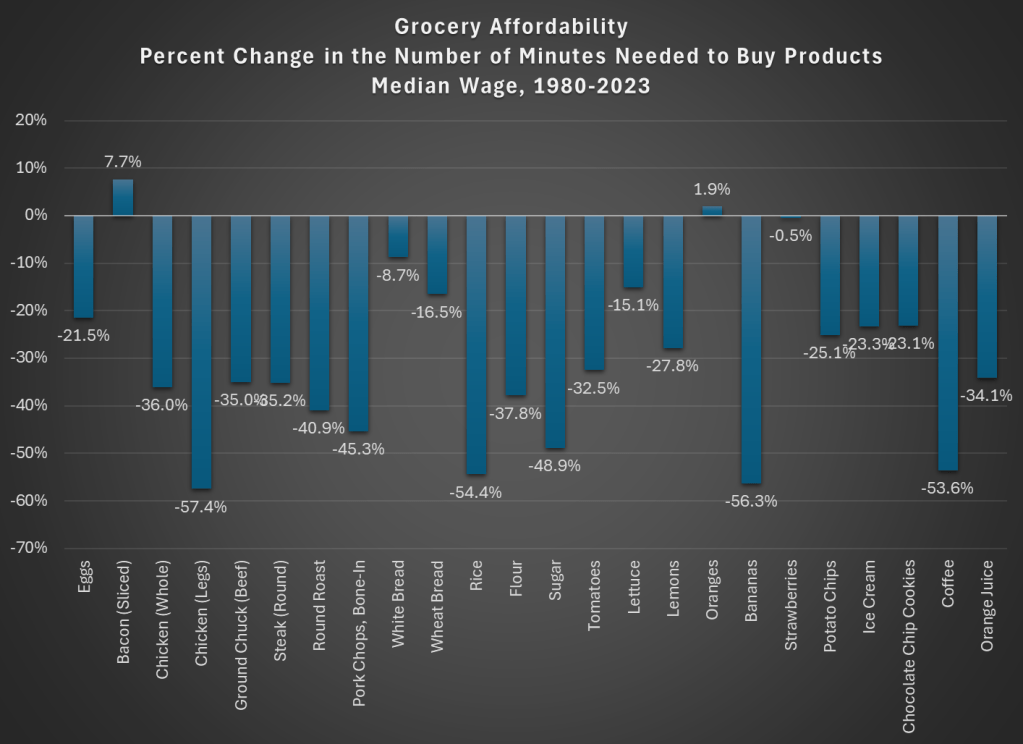
Speaking of wages though, is my chart perhaps biased because I’m using the average wage? What if we used another measure, such as the median wage? For that, I can use the EPI’s median wage series (which comes from the CPS), and I also converted it to a nominal wage for 2023. This wage data is only available annually, with the most recent being 2023, so I will also use 2023 price data for this chart (note: for oranges and strawberries, I use the second quarter average price, since they weren’t available year round in 1980 — another subtle example of growing abundance and prosperity today).

The immediate thing you will notice is that there isn’t much difference between the average wage chart. Bacon is still less affordable. We know have oranges being slightly less affordable and strawberries being basically the same, though keep in mind as I mentioned above the chart that these weren’t available year-round in 1980.

But other than bacon and those seasonal fruits, everything is more affordable in 2023 than 1980. The average decrease is the same as the prior chart: 30 percent fewer minutes of work at the median wage to purchase this basket of goods, with 13 of the 24 items decreasing by more than that 30 percent average. The reason for this similarity is that both the average and median wages as measured by these series are more than 4 times higher than 1980.

But are these 24 items representative of other grocery items that we don’t have complete price data in the public BLS series? They are probably pretty close. The unweighted percent change in the items from April 1980 to April 2024 was 201%. If we use the CPI Food at Home component, which includes many more items but also changes in composition as buying habits change, we see a slightly larger 255% increase. But that is still less than wages have increased since 1980 (by over 300% for both average and median wages). As our incomes rise, we will naturally switch to better and more expensive foods, which can explain the 255% vs 201% difference in price increases, but it also shows the BLS isn’t engaging in any funny business with the indexes: if they kept the basket of goods constant, price increases would be smaller.

While the rise in prices since 2021 might rightly make us nostalgic for the pre-pandemic era of prices, let’s not be nostalgic for 1980 grocery prices.

Humanity’s Childhood and Chiefs

I’m going to explore a passage from The Dawn of Everything about whether humans reject Western civilization.

The introductory chapter of The Dawn of Everything is called “Farewell to Humanity’s Childhood.” The authors are idealists wrestling with big questions.

We can take [Steven] Pinker as our quintessential Hobbesian. (page 13)

For instance, if Pinker is correct, then any sane person who had to choose between (a) the violent chaos and abject poverty of the ‘tribal’ stage in human development and (b) the relative security and prosperity of Western civilization would not hesitate to leap for safety. (page 18)

Over the last several centuries, there have been numerous occasions when individuals found themselves in a position to make precisely this choice – and they almost never go the way Pinker would have predicted.

Continue reading

Almost Observable Human Capital

I’ve written about IPUMS before. It’s great. Among individual details are their occupations and industry of their occupation. That’s convenient because we can observe how technology spread across America by observing employment in those industries. We can also identify whether demographic subgroups differed or not by occupation. There’s plenty of ways to slice the data: sex, race, age, nativity, etc.

But what do we know about historical occupations and what they entailed? At first blush, we just have our intuition. But it turns out that we have more. There is a super boring 1949 report published by the Department of Labor called the “Dictionary of Occupational Titles”. The title says it all. But, the DOL published another report in 1956 that’s conceptually more interesting called “Estimates of Worker Trait Requirements for 4,000 Jobs as Defined in the Dictionary of Occupational Titles: An Alphabetical Index”.  The report lists thousands of occupations and identifies typical worker aptitudes, worker temperaments, worker interests, worker physical capacities, and working conditions. Below is a sample of the how the table is organized:

Continue reading

Accounting Appears Before Literature

For a current research project on institutions, I skimmed The Dawn of Everything (2021).

I liked this passage about an archaeological site in Syria. The following items were found in a destroyed village where people are estimated to have lived 8,000 years ago:

These devices included economic archives, which were miniature precursors to the temple archives at Uruk and other later Mesopotamian cities.

These were not written archives: writing, as such, would not appear for another 3,000 years. What did exist were geometric tokens made of clay, of a sort that appear to have been used in many similar Neolithic villages, most likely to keep track of the allocation of particular resources.

In chunks, the book has fascinating stuff like the quote above. However, D-o-E is the second book I have read this year that tries to do too much. A book on “everything” sounds incredibly fun to write, and I’m the type who would try, so I take these as a warning.

What is more intriguing than history? Emily Wilson said it well, concerning some of the oldest records we have of human words:

I think we should stop selling classics as, “These are the societies that formed modern America, or that formed the Western canon” — which is a really bogus kind of argument — and instead start saying, “We should learn about ancient societies because they’re different from modern societies.” That means that we can learn things by learning about alterity. We can learn about what would it be to be just as human as we are, and yet be living in a very, very different society.

Coffee’s Supply & Demand Dance during Prohibition

I’ve written about coffee consumption during US alcohol prohibition in the past. I’ve also written about visualizing supply and demand. Many. Times. Today, I want to illustrate how to use supply and demand to reveal clues about the cause of a market’s volume and price changes. I’ll illustrate with an example of coffee consumption during prohibition.

The hypothesis is that alcohol prohibition would have caused consumers to substitute toward more easily accessible goods that were somewhat similar, such as coffee. To help analyze the problem, we have the competitive market model in our theoretical toolkit, which is often used for commodities. Together, the hypothesis and theory tell a story.

Substitution toward coffee would be modeled as greater demand, placing upward pressure on both US coffee imports and coffee prices. However, we know that the price in the long-run competitive market is driven back down to the minimum average cost by firm entry and exit. So, we should observe any changes in demand to be followed by a return to the baseline price. In the current case, increased demand and subsequent expansions of supply should also result in increasing trade volumes rather than decreasing.

Now that we have our hypothesis, theory, and model predictions sorted, we can look at the graph below which compares the price and volume data to the 1918 values. While prohibition’s enforcement by the Volstead act didn’t begin until 1920, “wartime prohibition” and eager congressmen effectively banned most alcohol in 1919. Consequently, the increase in both price and quantity reflects the increased demand for coffee. Suppliers responded by expanding production and bringing more supplies to market such that there were greater volumes by 1921 and the price was almost back down to its 1918 level. Demand again leaps in 1924-1926, increasing the price, until additional supplies put downward pressure on the price and further expanded the quantity transacted.

We see exactly what the hypothesis and theory predicted. There are punctuated jumps in demand, followed by supply-side adjustments that lower the price. Any volume declines are minor, and the overall trend is toward greater output. The supply & demand framework allows us to image the superimposed supply and demand curves that intersect and move along the observed price & quantity data. Increases toward the upper-right reflect demand increases. Changes plotted to the lower-right reflect supply increases. Of course, inflation and deflation account for some of the observed changes, but similar demand patterns aren’t present in the other commodity markets, such as for sugar or wheat. Therefore, we have good reason to believe that the coffee market dynamics were unique in the time period illustrated above.


*BTW, if you’re thinking that the interpretation is thrown off by WWI, then think again. Unlike most industries, US regulation of coffee transport and consumption was relatively light during the war, and US-Brazilian trade routes remained largely intact.

Historians Admit To Inventing Ancient Greeks

This just in:

Scholars apologize for attributing Western democracy to a make-believe civilization.

WASHINGTON—A group of leading historians held a press conference Monday at the National Geographic Society to announce they had “entirely fabricated” ancient Greece, a culture long thought to be the intellectual basis of Western civilization.

The group acknowledged that the idea of a sophisticated, flourishing society existing in Greece more than two millennia ago was a complete fiction created by a team of some two dozen historians, anthropologists, and classicists who worked nonstop between 1971 and 1974 to forge “Greek” documents and artifacts.

“Honestly, we never meant for things to go this far,” said Professor Gene Haddlebury, who has offered to resign his position as chair of Hellenic Studies at Georgetown University. “We were young and trying to advance our careers, so we just started making things up: Homer, Aristotle, Socrates, Hippocrates, the lever and fulcrum, rhetoric, ethics, all the different kinds of columns—everything.”

“Way more stuff than any one civilization could have come up with, obviously,” he added.

According to Haddlebury, the idea of inventing a wholly fraudulent ancient culture came about when he and other scholars realized they had no idea what had actually happened in Europe during the 800-year period before the Christian era.

Frustrated by the gap in the record, and finding archaeologists to be “not much help at all,” they took the problem to colleagues who were then scrambling to find a way to explain where things such as astronomy, cartography, and democracy had come from.

Within hours the greatest and most influential civilization of all time was born.

“One night someone made a joke about just taking all these ideas, lumping them together, and saying the Greeks had done it all 2,000 years ago,” Haddlebury said. “One thing led to another, and before you know it, we’re coming up with everything from the golden ratio to the Iliad.”…

Around the same time, a curator at the Smithsonian reportedly asked for Haddlebury’s help: The museum had received a sizeable donation to create an exhibit on the ancient world but “really didn’t have a whole lot to put in there.” The historians immediately set to work, hastily falsifying evidence of a civilization that— complete with its own poets and philosophers, gods and heroes—would eventually become the centerpiece of schoolbooks, college educations, and the entire field of the humanities.

Emily Nguyen-Whiteman, one of the young academics who “pulled a month’s worth of all-nighters” working on the project, explained that the whole of ancient Greek architecture was based on buildings in Washington, D.C., including a bank across the street from the coffee shop where they met to “bat around ideas about mythology or whatever.”

“We picked Greece because we figured nobody would ever go there to check it out,” Nguyen-Whiteman said. “Have you ever seen the place? It’s a dump. It’s like an abandoned gravel pit infested with cats.”

She added, “Inevitably, though, people started looking around for some of this ‘ancient’ stuff, and next thing I know I’m stuck in Athens all summer building a…Parthenon just to cover our tracks.”

Nguyen-Whiteman acknowledged she was also tasked with altering documents ranging from early Bibles to the writings of Thomas Jefferson to reflect a “Classical Greek” influence—a task that also included the creation, from scratch, of a language based on modern Greek that could pass as its ancient precursor.

Historians told reporters that some of the so-called Greek ideas were in fact borrowed from the Romans, stripped to their fundamentals, and then attributed to fictional Greek predecessors. But others they claimed as their own.

“Geometry? That was all Kevin,” said Haddlebury, referring to former graduate student Kevin Davenport. “Man, that kid was on fire in those days. They teach Davenportian geometry in high schools now, though of course they call it Euclidean.”

~ ~ ~ ~ ~ ~ ~ ~ ~ ~ ~ ~ ~ ~ ~ ~ ~ ~ ~ ~ ~ ~ ~ ~ ~

Happy April Fools…the above excerpt was pasted verbatim from a classic article published in the news-satire site The Onion. I thought it was a clever piece, which did a worthy service highlighting the wide-ranging achievements of a relatively small people group (compared to the teeming masses of ancient Mesopotamia and Egypt) in a relatively short period of time.

Apologies to any Greeks reading this post – -my wife has been to Greece and tells me it is in fact a very beautiful country.

Median MSA Incomes: 1949 vs 2022

Lately on Twitter this chart has been going around:

The chart comes from Bloomberg journalist Justin Fox, who always puts together interesting economic data. You can read his interpretation of the data at Bloomberg, but the folks posting it on Twitter all seem to have the same shock and awe: Detroit was the richest big city in 1949. And of course we all know that today it isn’t. Still, the Detroit MSA has done OK since 1949, even though it is no longer anywhere near the top.

How well has Detroit done? Despite industrial decline and many other major problems, median household income of the Detroit MSA was around $71,000 in 2022 according to the Census Bureau. How does this compare to the $3,627 median income in 1949? It’s about double in real terms: you can multiply it by about 10 using the Census’ preferred inflation adjustment for household incomes since 1949 (the C-CPI-U since 2000, and the R-CPI-U-RS before that).

Is a doubling in 73 years a good outcome?

Continue reading

How Long Does It Take Prices to Double?

Let me start by saying high rates of inflation, especially unexpected inflation, is bad. Still, it is useful to have some historical context. We’ve experienced the highest inflation rates in a generation lately, especially in 2022, but past generations experienced inflation too. How to compare?

Here’s one approach. Using the latest CPI-U data, we can see that prices on average approximately doubled between March 1996 and February 2024. That’s 335 months to double, or just shy of 28 years. How long did it take prices to double if we keep moving backward in time from March 1996?

It only took 194 months for prices to double from January 1980 until March 1996, just a little over 16 years. Prior to January 1980, prices doubled even quicker, this time taking less than 10 years! Prior to that, it took 24 years for prices to double between WW2 and 1970, and before that you have to go back 31 years to 1915 for another doubling. Judged by this, our recent history doesn’t look so bad.

That doesn’t mean everything is OK. As I said above, unexpected inflation is the worst kind, since individuals and businesses aren’t planning for it. And we’ve had 20% inflation in the past 4 years — something not seen since 1991 over a 4-year time period. A 20%+ inflation rate is unusual to us today, but it certainly wasn’t in the past: basically all of the 1970s and 1980s had 20%+ inflation every 4 years, sometimes more than 40% or even 50%.

Finally, while unexpected inflation is bad, we also care about the relationship between wage increases and price increases. We can rightfully bemoan rapid, unexpected price inflation, but if wages are increasing faster than inflation, we are still better off (on average). The BLS average hourly wage series for production and non-supervisory workers only goes back to 1964, so we can’t do a full comparison with the CPI-U, but we can compare the three most recent doublings of prices.

Keep in mind with the chart above that prices (as measured by the CPI-U) increased by 100% for each of these time periods. So, for the 1970s and 1980-1996 periods, wages actually rose by less than rate of inflation — wage stagnation! If we used the PCE price index instead, those time periods still don’t look good: PCE prices increased by 88% for 1970-1980, 85% from 1980-1996, and 78% since 1996. With either price index, the 1996-2024 period is clearly the best of these three, and it’s not even really close.

Let me finish where I started: the recent inflation is bad. I don’t want to downplay that. But some historical perspective is also useful.

See also a similar post and calculation on inflation doubling that I wrote in June 2022, which includes some discussion of 19th century inflation too.